

The total cost of attendance (COA) is the official estimate of what you will spend to attend college for one full academic year, covering every major expense category beyond tuition. Federal law requires every college to publish this figure, and it forms the foundation of every financial aid calculation you will encounter. Public four-year in-state universities average $28,000–$32,000 annually, while private nonprofit colleges run $45,000–$60,000 or more before any aid is applied. Knowing what goes into that number, and what it actually means for your family’s budget, is the first step toward making a confident college decision.
What is included in the total cost of attendance?
The COA is defined by six federal components: tuition and mandatory fees, room and board, books and supplies, transportation, personal expenses, and miscellaneous costs. Each one affects your budget differently, and several are far more variable than the published number suggests.
Tuition and mandatory fees
Tuition is the charge for instruction. Mandatory fees cover campus services like student health centers, recreation facilities, and technology infrastructure. These costs vary by institution, and some programs, such as engineering or nursing, carry additional program-specific fees on top of standard tuition.

Room and board
Room and board covers housing and meals. On-campus housing typically includes a meal plan, which simplifies budgeting but often costs more than cooking for yourself off campus. Students living at home with family can reduce this line item significantly, sometimes by $10,000 or more per year.
Books, supplies, and transportation
Books and course materials vary widely by major. A science student buying lab manuals and specialized texts will spend more than a humanities student who relies on library reserves. Renting textbooks or buying used copies cuts this cost considerably.
Transportation is frequently the most inaccurate line item for individual budgets. A student commuting from home by car faces gas, parking, and maintenance costs. A student flying home from across the country faces airfare. The published figure is a regional average that rarely matches anyone’s actual situation.
Personal expenses
Personal expenses cover clothing, entertainment, toiletries, and health insurance if you are not on a parent’s plan. Typical estimates run $1,800–$2,500 per year, but actual spending varies widely based on lifestyle and location. A student in a high-cost city like San Francisco or New York will spend more than a student at a rural campus.
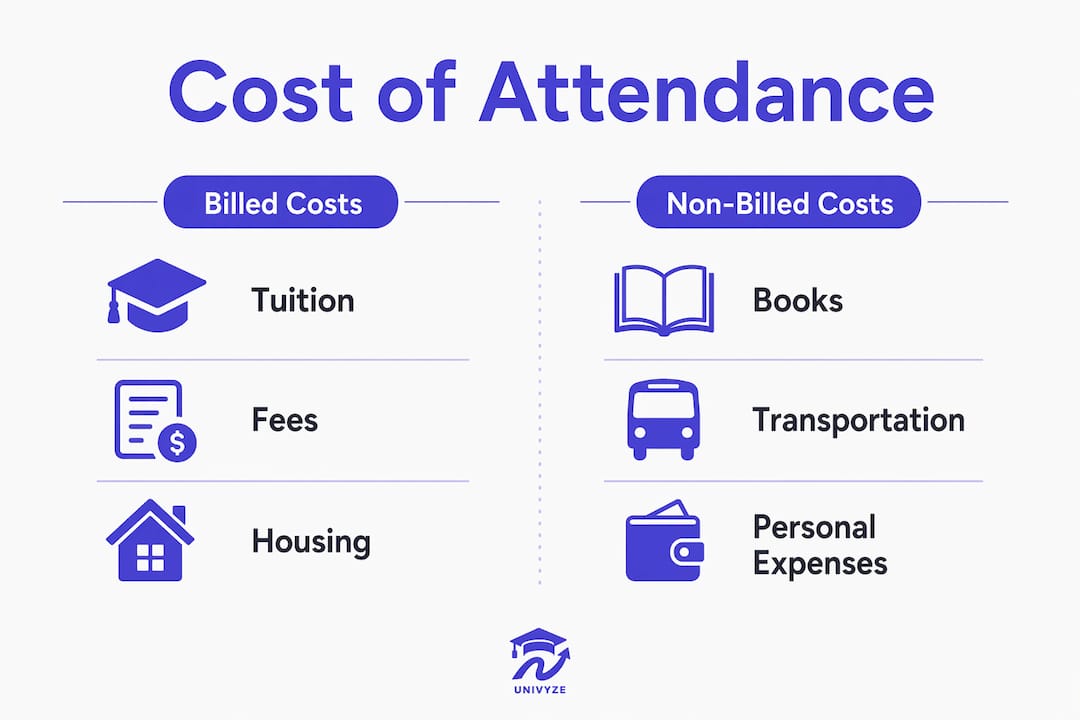
Pro Tip: Separate your expenses into billed costs (tuition, on-campus housing, meal plans) and non-billed costs (books, off-campus rent, travel, personal items). Families who focus only on the tuition bill routinely underestimate total spending by thousands of dollars.
How do published COA figures compare to your actual costs?
The published COA is a maximum estimate, not a final bill. This distinction matters more than most families realize. COA minus your Student Aid Index (SAI) determines how much financial aid you are eligible to receive. The SAI is a number calculated from your family’s financial information submitted through the FAFSA, and it represents what the federal government estimates your family can contribute.
Sticker price vs. net price
The sticker price is the published COA. The net price is what you actually pay after grants and scholarships are subtracted. These two numbers can differ by tens of thousands of dollars. Average net tuition for first-time full-time in-state public students drops to roughly $2,300 after grants. At private nonprofits, average net tuition falls to about $16,910 after aid. Those figures look very different from the sticker prices listed in college brochures.
Federal aid also has firm ceilings. The maximum Pell Grant is $7,395 and the Federal Supplemental Educational Opportunity Grant (FSEOG) caps at $4,000, with actual awards based on need and COA. These grants reduce your out-of-pocket cost but do not eliminate it entirely for most families.
The Net Price Calculator
Every college’s financial aid website hosts a Net Price Calculator. Running this tool is the only reliable way to estimate your true annual cost after gift aid. The calculator asks for income, assets, and household size, then returns a personalized estimate. Run it at every school on your list before making any decisions.
Pro Tip: Do not compare schools using sticker prices. Compare them using net price estimates from each school’s calculator. A private college with a $58,000 sticker price may cost less out of pocket than a public university with a $30,000 sticker price, depending on your aid package.
| Cost type | What it includes | Who it affects most |
|---|---|---|
| Sticker price (COA) | All six federal components, averaged | Every applicant sees this figure |
| Net price | COA minus grants and scholarships | Varies by income, merit, and school |
| Out-of-pocket cost | Net price minus work-study and loans | What families actually pay each year |
| Student Aid Index (SAI) | Family contribution estimate from FAFSA | Determines aid eligibility directly |
What do typical COA ranges look like by college type?
Cost ranges differ sharply by institution type and living arrangement. Understanding these ranges helps you set realistic expectations before you receive a single financial aid letter.
Public four-year universities charge in-state students $28,000–$32,000 per year in total COA. Out-of-state students at the same schools often pay $44,000–$58,000 because tuition nearly doubles. Private nonprofit colleges range from $45,000 to well over $60,000 annually before aid, though their generous merit and need-based aid packages frequently bring net prices below those of out-of-state public schools.
Living arrangements shift the numbers considerably. A student living on campus at a public university might pay $12,000–$14,000 for room and board alone. A student living off campus with roommates in a lower-cost area might pay $8,000–$10,000 for rent and groceries. A student living at home with family might pay nothing for housing, reducing total COA by a third or more.
Here is a simplified line-item comparison for two representative student scenarios:
| Expense category | On-campus public (in-state) | Off-campus private (with aid) |
|---|---|---|
| Tuition and fees | $11,000 | $38,000 (sticker) / $16,910 (net) |
| Room and board | $13,500 | $10,000 (off-campus estimate) |
| Books and supplies | $1,200 | $1,000 |
| Transportation | $1,500 | $800 |
| Personal expenses | $2,200 | $2,200 |
| Estimated total | $29,400 | $30,910 (net) |
The comparison shows why net price matters more than sticker price. A private school with heavy aid can land in the same range as a public school for many families.
How can you plan for and manage college costs effectively?
Planning starts with building a personal budget that goes beyond the published COA. The published figure uses regional averages. Your actual costs depend on your spending habits, your location, and your living choices.
- Run Net Price Calculators at every school on your list. Do this before application deadlines, not after. The results will reshape your list in ways that save real money.
- Separate billed from non-billed expenses. Non-billed costs like books, off-campus rent, and travel add thousands that never appear on a tuition bill. Budget for them separately.
- Compare living arrangements with real numbers. Price out on-campus housing versus local apartments versus commuting from home. Run the actual math for your specific school and city.
- Reduce book costs with rentals and used copies. Campus bookstores are rarely the cheapest option. Platforms that offer rentals or used copies can cut book costs by 50% or more.
- Contact the financial aid office directly. If your family’s financial situation changed after you filed the FAFSA, ask about a professional judgment review. Aid offices have discretion to adjust packages based on documented circumstances.
Pro Tip: Smarter course planning directly affects your total college cost. Every extra semester you spend in school adds another full year of COA. Students who plan their degree path carefully avoid the expensive mistake of taking courses that do not count toward graduation.
Key Takeaways
The total cost of attendance is a maximum estimate covering six expense categories, and your real out-of-pocket cost depends on aid, living choices, and personal spending habits.
| Point | Details |
|---|---|
| COA covers six components | Tuition, fees, room and board, books, transportation, and personal expenses all count. |
| Net price beats sticker price | Subtract grants and scholarships from COA to find what your family actually pays. |
| Non-billed costs add up fast | Books, travel, and personal items can add thousands beyond your tuition bill. |
| Net Price Calculators are essential | Run each school’s calculator to get a personalized cost estimate before deciding. |
| Course planning reduces total cost | Graduating on time or early eliminates one or more full years of COA expenses. |
What families consistently get wrong about COA
Most families I work with treat the published COA as a final invoice. They see $52,000 at a private college and immediately cross it off the list. That reaction is understandable, but it costs families real opportunities.
The COA is a ceiling, not a floor. The actual spending for a careful student living off campus, buying used books, and managing personal expenses well can come in meaningfully below the published figure. At the same time, a student who lives on campus, flies home for every break, and spends freely on entertainment can blow past the published number without realizing it.
The piece that surprises families most is how much regional averages diverge from individual reality. The transportation and personal expense lines in particular are placeholders. They are not predictions. A student commuting 45 minutes each way by car will spend far more on transportation than a student who walks to class. A student in a city with high rent will spend more on off-campus housing than the published estimate assumes.
My honest advice: build your own line-item budget using real local data. Look up apartment rents near campus. Price out a realistic grocery budget. Check parking permit costs. Then compare that number to the net price from the school’s calculator. That exercise takes two hours and gives you a far more accurate picture than any published COA ever will.
Degree planning connects directly to this. Every semester you stay enrolled beyond your expected graduation date adds another full COA to your total bill. Tools like Univyze exist precisely to help students see their academic path clearly and avoid the costly drift that adds semesters without adding progress.
— Ryan
How Univyze helps you plan beyond the COA
Understanding the cost of attendance is only half the equation. The other half is making sure every semester you pay for actually moves you toward graduation.

Univyze gives students and parents a clear, term-by-term view of degree requirements mapped against real course offerings. When you can see exactly which courses you need and when they are available, you avoid the schedule conflicts and missed prerequisites that push graduation back by a semester or more. Each extra semester carries the full weight of another year’s COA. Univyze helps you build a multi-year degree plan that keeps you on track from day one. Join the Univyze waitlist and start planning with the clarity your investment deserves.
FAQ
What is the total cost of attendance?
The total cost of attendance is the official annual estimate of all expenses a student incurs at a college, including tuition, fees, room and board, books, transportation, and personal expenses. Federal law requires every college to publish this figure.
Is the COA the same as what I will actually pay?
No. The COA is a maximum estimate. Your actual cost depends on your financial aid package, living arrangements, and personal spending. Use each school’s Net Price Calculator to get a personalized figure.
How does the COA affect financial aid eligibility?
COA minus your Student Aid Index equals your financial aid eligibility. A higher COA at a given school can mean more aid eligibility, even if the sticker price looks intimidating.
What is the difference between billed and non-billed costs?
Billed costs appear directly on your student account: tuition, mandatory fees, and on-campus housing. Non-billed costs include books, off-campus rent, travel, and personal items. Families often overlook non-billed costs when budgeting.
How can I reduce my total college expenses?
Living off campus or at home, renting textbooks, minimizing discretionary spending, and planning your degree path carefully to graduate on time are the most effective ways to reduce total college expenses over four years.