

Semesters give you more time per class and closer faculty relationships; quarters move faster and let you sample more courses. Most U.S. colleges run on semesters, so if you’re transferring or comparing schools, the real work is credit conversion: 1 semester credit equals 1.5 quarter credits. Neither system is objectively better. It depends on how you learn and what you’re optimizing for.
TL;DR:
- Quarter system’s faster pace allows students to complete more courses annually, but can increase workload pressure and reduce depth of learning.
- Credit conversion from quarter to semester is simple: divide quarter credits by 1.5, which may cause credit losses during transfer between systems.
- Longer summer breaks in semester schools support internships and study abroad more naturally, while quarter schools may require summer classes or shorter breaks.
- GPA impacts and academic outcomes tend to favor semester calendars, which allow more time per course for deeper projects and faculty mentorship.
- Planning tools like Univyze help students visualize credit requirements, transfer credit applications, and scheduling risks before making transfer decisions.
Table of Contents
- What Is the Semester System?
- What Is the Quarter System?
- Quarter to Semester Conversion: The Numbers That Matter
- Semester vs Quarter: Weighing the Trade-Offs
- How Your Academic Calendar Affects GPA, Internships, and Graduation
- How to Choose Between Quarter and Semester Systems
- How Degree-Planning Tools Reduce Calendar Risk
- Where the Quarter and Semester Systems Came From
- How Your Calendar Affects Financial Aid and Tuition Billing
- How Each Calendar Affects Workload and Stress
- Comparing Breaks: Winter, Spring, and Summer
- Research Projects and Thesis Timelines Under Each System
- A Note on Advising Students Through This Decision
- Join the Univyze Waitlist and Plan Your Terms With Confidence
- Sources
- FAQ
What Is the Semester System?
The semester system splits the academic year into two main terms, fall and spring, each running roughly around 15 weeks. Many schools add a shorter summer session, but the two core terms carry most of the credit load. A full course load typically runs 12 to 18 semester credits, which usually breaks down to four or five classes at a time.
Semesters line up well with standard hiring calendars, since:
- Fall runs roughly from September through December
- Spring runs roughly from January through May
- Summer break stretches long enough for a full internship, often about 10 to 12 weeks
- Study-abroad programs are frequently built around a single semester, matching the term length exactly
That extended summer window is one reason semester schools rarely see students scrambling to shift internship start dates.
What Is the Quarter System?
Quarters divide the year into three primary terms, fall, winter, and spring, each lasting approximately 10 weeks, often followed by an optional summer quarter. Because each term is shorter, you’ll typically carry three to four classes per quarter rather than the four or five common in a semester schedule.
Run the math across a full year and quarter students often end up taking more total courses than semester students, since:
- Three 10 week terms plus a possible summer term means more scheduling cycles a year compared to two in semesters
- Faster terms mean faster turnaround on grades, feedback, and course changes
- The academic year can run later into June, which sometimes bumps against early June internship start dates
- More frequent registration cycles mean more chances to adjust your schedule if something isn’t working
That later end date matters more than it sounds. If your target internship starts the first week of June, a quarter calendar can force an awkward conversation with a recruiter.
Quarter to Semester Conversion: The Numbers That Matter
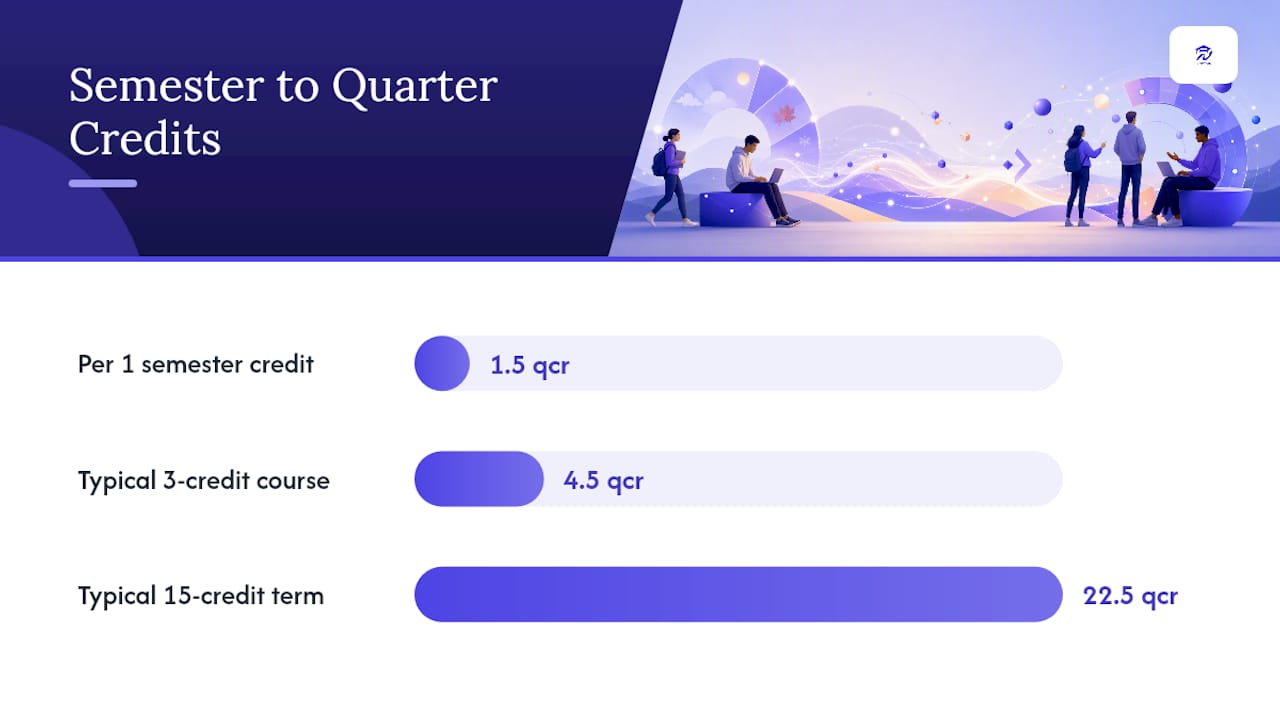
The conversion rule is simple and worth memorizing before you transfer: 1 semester credit equals 1.5 quarter credits, according to Drexel’s credit conversion guidance. To convert quarter credits back into semester credits, divide by 1.5 according to official registrar guidance.
So a standard 3-credit semester course converts to 4.5 quarter credits. A 15-credit semester load (five classes) converts to roughly 22.5 quarter credits, which usually spreads across four or five quarter courses depending on how each is weighted. Registrar tools like Cal Poly’s unit converter can run these calculations automatically, which is worth doing before you assume a transcript will transfer cleanly.
| Factor | Semester system | Quarter system |
|---|---|---|
| Term length | About 15 weeks | About 10 weeks |
| Typical course load per term | Generally 12–18 credits (about 4–5 classes) | Usually 3–4 classes per term |
| Credit conversion | 1 semester credit equals about 1.5 quarter credits | 1 quarter credit converts to about two-thirds semester credit |
| Pace/depth of learning | Slower pace, more depth per course | Faster pace, more breadth |
| Internship/study abroad timing | Long summer break aligns well | Later end date can conflict with early June starts |
Over four years, the pacing difference can result in quarter students completing more distinct courses than semester students, though total credit hours after conversion are similar.
Semester vs Quarter: Weighing the Trade-Offs
Neither system wins outright. Each comes with real advantages and real costs depending on what you value.
Semester advantages:
- More time per course supports deeper projects, research, and faculty mentorship
- Fewer transitions per year means less time spent on syllabus week and finals prep
- Long summer breaks align naturally with internships and study abroad
Semester disadvantages:
- Fewer course slots per year limits how many electives or minors you can explore
- One bad exam or project carries more weight in your final grade, since there are fewer assessments spread across the term
Quarter advantages:
- More courses per year means more elective variety and easier double-majoring
- Faster terms mean a rough class or a mismatched professor doesn’t haunt you for four months
- More frequent contact with different faculty across a degree
Quarter disadvantages:
- The accelerated pace leaves less room to recover from a slow start
- Midterms and finals arrive constantly, which can spike stress if you don’t plan ahead
- Later spring end dates can complicate internship scheduling, a pattern several higher-ed guides flag as a recurring friction point for quarter students.
How Your Academic Calendar Affects GPA, Internships, and Graduation
The math behind GPA impact is straightforward but easy to overlook. In a semester system, each course typically represents a larger share of your term’s grade point average because you’re taking fewer classes at once. In a quarter system, a rough class has less weight individually, but you have less time to recover within that single term before finals hit.
Research on calendar switches backs this up with real numbers. A study from the American Economic Association found that when institutions switched from quarters to semesters, students experienced lower first-year grades, a reduced probability of carrying a full course load, and delayed major declaration. That’s a strong signal that calendar structure itself shapes academic outcomes, not just scheduling convenience.
Transfers add another layer of friction. Moving between systems means recalculating your credits, checking which courses satisfy which requirements, and sometimes losing credit hours in the conversion. UCLA’s transfer guidance urges incoming students to meet with an advisor early specifically because quarter pacing catches new transfers off guard. The earlier you start that conversation, the fewer surprises you’ll hit at registration.
How to Choose Between Quarter and Semester Systems
Picking the right calendar (or making the most of the one you’re stuck with) comes down to a few concrete checks:
- Match the system to your learning style. If you need time to sit with material and build relationships with professors, semesters usually serve you better. If you want to sample widely before committing to a major, quarters give you more shots per year.
- Check internship and study-abroad windows against the calendar. Quarter schools often need summer-term strategies to avoid missing early-June internship starts.
- Talk to your registrar about conversion before you transfer, not after. Credits don’t always map one-to-one.
- Estimate your total course count over four years. Quarters can let you fit in more distinct classes, which matters for double majors or minors.
Pro Tip: Before you commit to a transfer, ask your target school’s registrar for a sample conversion of your actual transcript, not a generic ratio. Real course-by-course mapping catches gaps a simple math formula misses.
How Degree-Planning Tools Reduce Calendar Risk
Switching between quarters and semesters, or just managing either one well, gets messy fast once AP credit, dual enrollment, and transfer credits enter the picture. That’s where a planning dashboard earns its keep.
Univyze maps your degree requirements against real course offerings term by term, so you can see:
- How AP credit, dual enrollment, and transfer credits actually apply to your specific requirements
- What a “what if” scenario looks like if you switch majors or add a minor under your school’s calendar
- Where schedule conflicts are likely to show up before registration opens, not after
None of that replaces your official degree audit, university catalog, registrar, or advisor. Univyze helps you plan smarter and spot risk earlier. It doesn’t certify requirements for you.
Where the Quarter and Semester Systems Came From
The semester system traces back to European university traditions and became the dominant American model through the 19th and 20th centuries, largely because it matched the rhythm of agricultural and industrial calendars that shaped early public education.
Quarters emerged later, championed by research universities that wanted more frequent assessment cycles and faster curriculum turnover. The University of Chicago adopted a quarter calendar in the 1890s partly to keep facilities running through summer, and that model spread to a cluster of major research institutions, many of them in the University of California system and other West Coast schools.
Globally, most countries outside the U.S. use calendars closer to the semester model, often with two terms per year, though the exact structure varies by country and by level of education. Within the U.S., semesters remain the dominant structure by a wide margin, while quarters persist mainly at a specific set of research universities and community college systems, particularly on the West Coast.
That history explains a real friction point for students. When you transfer between a quarter school and a semester school, you’re not just converting credits. You’re crossing two institutional traditions that built their entire academic culture around different rhythms of instruction and assessment.
How Your Calendar Affects Financial Aid and Tuition Billing
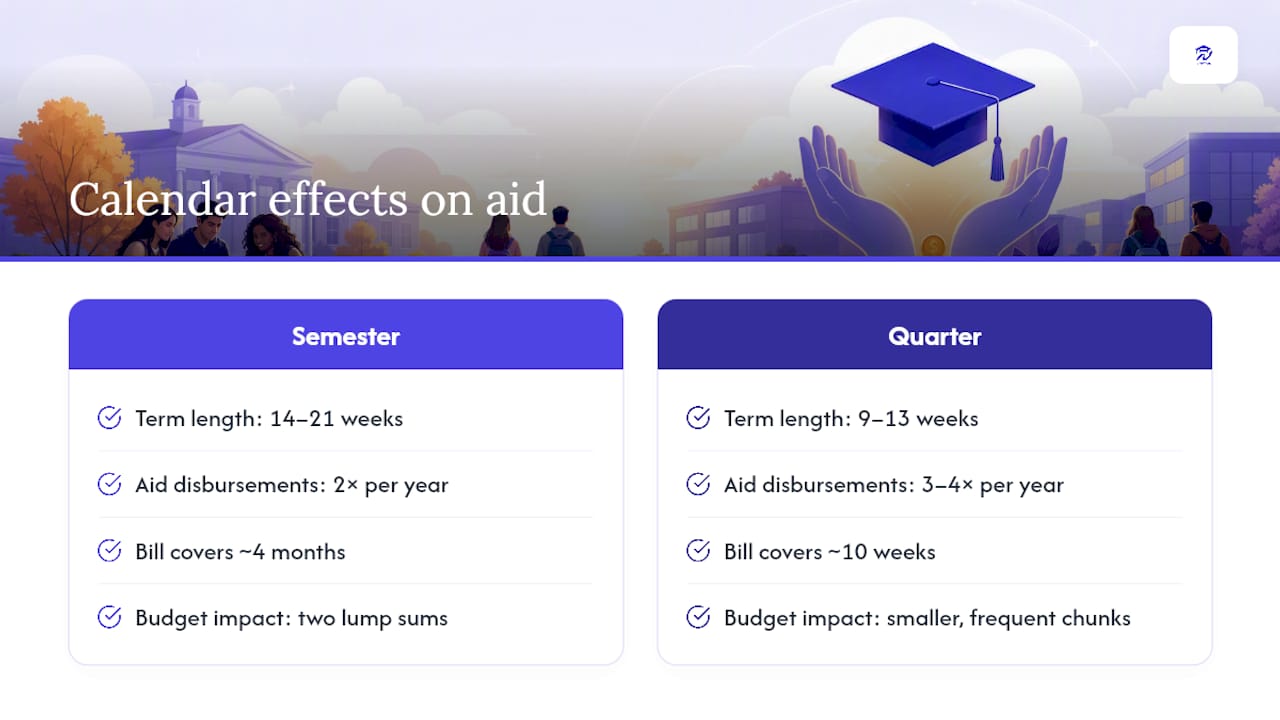
Financial aid formulas depend heavily on how your school defines a term, which is why the Federal Student Aid Handbook spells out standard length ranges: semesters generally run 14 to 21 weeks, while quarters run 9 to 13 weeks. These ranges matter because they feed directly into how your school calculates Pell Grant disbursements and academic-year definitions.
Semester schools typically disburse aid twice a year, once per term, which means two lump distributions to plan a budget around. Quarter schools disburse aid three or four times a year, which spreads the money into smaller chunks but also means more frequent paperwork and more opportunities to miss a disbursement deadline if you’re not paying attention.
Tuition billing follows the same rhythm. A semester bill covers roughly four months of instruction, while a quarter bill covers about ten weeks. That doesn’t necessarily change your total annual cost, but it does change your cash-flow planning. Quarter students often need to budget for tuition payments landing every ten to twelve weeks rather than settling into a twice-a-year rhythm.
Financial aid packages also interact with course load minimums differently. Because quarter terms are shorter, some financial aid definitions of “full-time” status require a different credit threshold per term than semester schools use, which is one more reason to confirm your specific school’s numbers with a financial aid officer rather than assuming the ratio translates evenly.
How Each Calendar Affects Workload and Stress
Semester students tend to describe their stress as a slow build. You might coast through October, then hit a wall of papers and exams in early December when three or four courses all reach their final projects within the same two-week window.
Quarter students describe something closer to a constant hum. Midterms arrive around week five, and finals show up again by week nine or ten, which means you’re rarely more than a few weeks from a major assessment. That rhythm suits some students who thrive on frequent checkpoints and dislike long stretches without feedback. It wears down others who need more runway to recover from a rough week.
The workload difference shows up most clearly in how much a single week matters. Miss a week of class due to illness in a 10-week quarter term and you’ve lost 10% of your instructional time. Miss the same week in a 15-week semester and you’ve lost closer to 7%. That gap sounds small, but it compounds across multiple courses and multiple absences.
Neither pattern is inherently worse, but they demand different coping strategies. Quarter students generally benefit from tighter weekly routines and less procrastination tolerance, since there’s less slack in the calendar to absorb a slow start. Semester students have more room to recover from a bad month, but that same room can encourage procrastination that catches up all at once during finals.
Comparing Breaks: Winter, Spring, and Summer
Winter break is where the two systems diverge most visibly. Semester schools typically build in a four to six week winter break between fall finals and the start of spring term, long enough for many students to take a part-time job, a short internship, or simply reset. Quarter schools usually compress winter break into two to three weeks, since fall quarter often runs into mid-December and winter quarter starts again in early January.
Spring break looks similar across both systems, generally a single week, though the timing shifts depending on when each term started.
Summer looks different depending on your system too. Semester schools typically have a long, open summer stretch, often 10 to 14 weeks, that leaves plenty of room for a full-length internship or a study-abroad program without disrupting your fall start date. Quarter schools often treat summer as an optional fourth term, which means some students take summer classes to catch up or get ahead, while others use it for internships that may need to start a bit later than a semester student’s summer would.
That compressed winter break at quarter schools is worth flagging to any student used to a semester rhythm. If you’re transferring from a semester high school routine into a quarter college calendar, the shorter winter reset can feel abrupt the first year.
Research Projects and Thesis Timelines Under Each System
Semester calendars generally suit long-form research better, simply because a 15-week term gives you more uninterrupted runway to develop a thesis, run experiments, or complete a capstone project without switching gears every ten weeks. Faculty advisors on semester calendars also have more consistent contact time to guide a project from proposal through defense within a single term.
Quarter calendars split that same work into smaller chunks. A thesis or capstone under quarters often needs to be structured as three connected mini-projects, one per term, since a single 10-week quarter rarely gives you enough time to complete meaningful original research from scratch. Students on quarter systems frequently start research planning a full year ahead of a spring deadline, breaking the work into fall (literature review and proposal), winter (data collection or drafting), and spring (analysis and defense).
This matters most for students eyeing graduate school or honors programs, where a substantial research component is often required. If your quarter school doesn’t build in a dedicated research term, you may need to enroll in an optional summer quarter or petition for an extended timeline. Ask your department directly. Research expectations vary widely even within quarter schools, and generic advice about thesis timing rarely reflects your program’s actual rules.
A Note on Advising Students Through This Decision
Students who need depth and mentorship tend to gravitate toward semesters. Explorers and double-majors often prefer the variety quarters offer. Either way, the advising tip that matters most is asking about internship timing and transfer plans before the first semester or quarter even starts, not after a schedule conflict forces the question.
— Ryan
Join the Univyze Waitlist and Plan Your Terms With Confidence
Figuring out how your credits convert, how AP and dual-enrollment courses fit, and how a transfer year affects your graduation timeline shouldn’t require a spreadsheet and a prayer. Univyze gives you a visual, term-by-term map of your degree that updates as your plans change, so you can run a “what if I transfer” or “what if I switch majors” scenario before you actually do it.
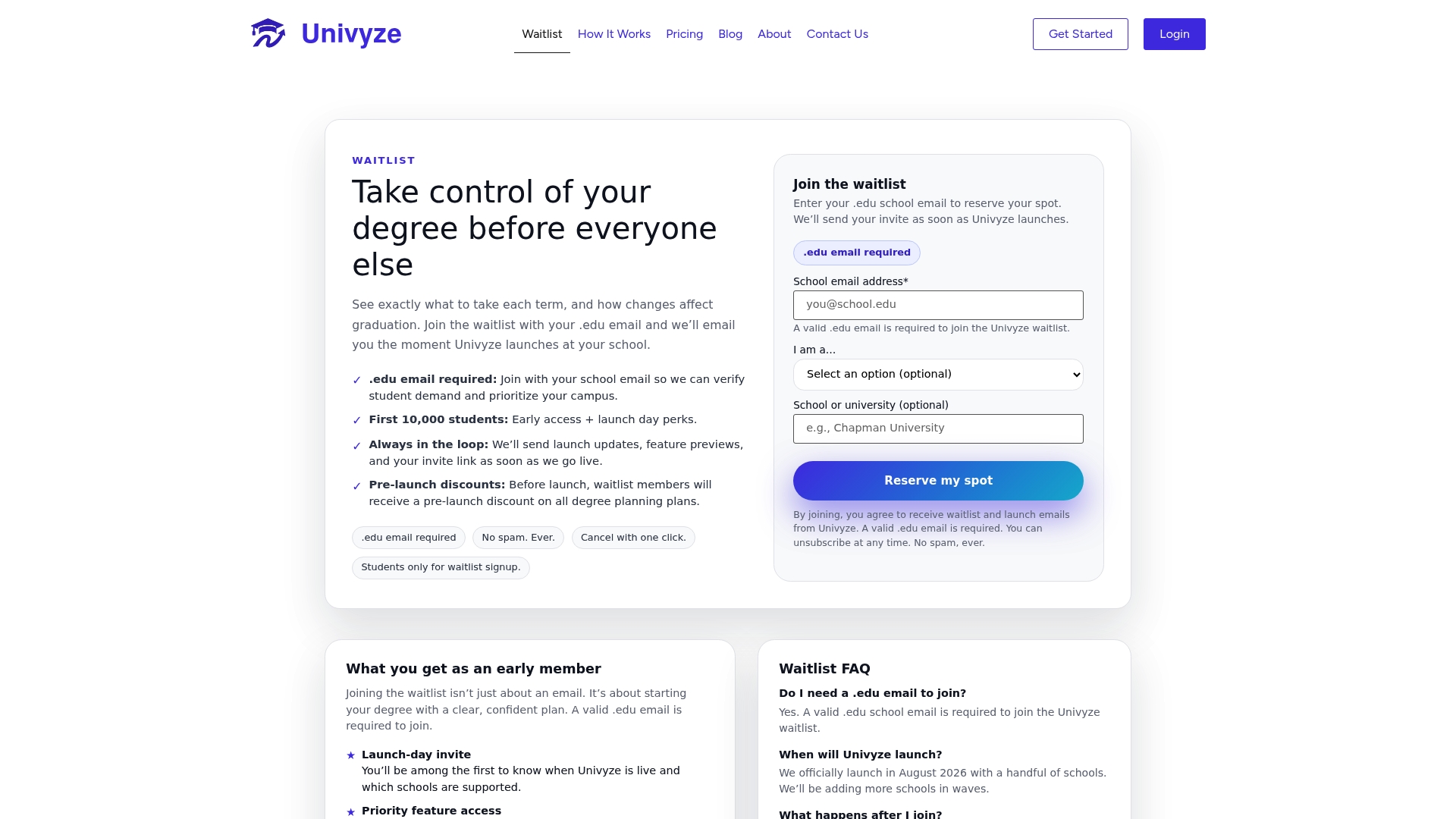
The dashboard is built to be simple enough that you can check your progress in a few minutes between classes, whether you’re on a quarter or semester calendar. Parents get the same visibility, which cuts down on the guessing game around whether a student is on track. Join the Univyze waitlist to get early access, and check out the College Schedule Building Basics Checklist for a practical starting point on mapping your first term. As always, confirm requirements with your official degree audit, catalog, registrar, and advisor. Univyze is a planning aid, not a substitute for that official record.
Sources
- Quarters vs. semesters — AEA Research (2022)
- College semester versus quarter — Drexel Online
- FSA Handbook — Academic years, academic calendars, payment periods and disbursements
FAQ
Is a Quarter System Better Than a Semester System?
Neither is strictly better. Semesters suit students who want depth and stronger faculty relationships, while quarters suit students who want faster pacing and more course variety across a degree.
Is Harvard on a Quarter or Semester System?
Harvard uses the semester system, consistent with the majority of U.S. colleges and universities.
Do Most Colleges Use the Semester or Quarter System?
Most U.S. colleges use semesters, with two main 15-week terms, while quarters remain more common at a smaller cluster of research universities and community college systems.
Which US Universities Use the Quarter System?
Quarter calendars are common at schools like the University of Chicago and several University of California campuses, along with a number of community colleges concentrated on the West Coast.
How Do I Convert Quarter Credits to Semester Credits?
Divide your quarter credits by 1.5 to get the semester-credit equivalent, since 1 semester credit equals 1.5 quarter credits.