

Most U.S. colleges set full-time status at 12 credits per semester, but that number won’t get you to a four-year degree on schedule. If graduating in four years matters to you, the real target is generally considered to be about 15 credits per semester, or roughly 30 per year. Twelve credits keeps your enrollment status and financial aid intact; fifteen is what actually gets you to 120 credits before you run out of semesters. Always confirm both numbers with your registrar, since exceptions are common.
TL;DR:
- Falling below 12 credits per semester can reduce your federal aid and extend your graduation timeline unless you use options like summer courses or credit by exam.
- Enrolling in 15 credits per semester, instead of 12, ensures you reach 120 credits in four years, avoiding additional semesters of tuition and housing costs.
- A typical full-time status for undergraduates is 12 credits, but 15 credits better reflect a pace that aligns with graduation requirements.
- Schools may report certain placements like co-op or clinical rotations as full-time despite low credits, depending on institutional policies.
- Confirm your exact full-time status, census dates, and aid impact with your registrar, especially when taking summer classes or making schedule changes.
Table of Contents
- How many credits is full time, and why do some schools push 15?
- What dropping below full-time does to your financial aid
- The 120-credit math: how 12 vs. 15 credits changes your timeline
- When the 12 or 15 credit rule doesn’t apply
- A step-by-step way to confirm your own credit status
- How Univyze helps you spot credit gaps before they become semesters
- Why 12 credits should be your floor, not your finish line
- Get early access: join the Univyze waitlist
- Sources
- FAQ
How many credits is full time, and why do some schools push 15?
Twelve credits is the number almost every registrar’s office uses to classify you as full-time. It comes from a federal reporting standard: IPEDS and most institutions define full-time undergraduate enrollment as 12 or more semester credits, while graduate programs typically set the bar lower, at 9 credits. That 12-credit line determines your student status for housing, insurance, athletic eligibility, and loan deferment. It says nothing about when you’ll graduate.
Here’s the math that changes the picture. A standard bachelor’s degree requires 120 credits. Take 12 credits a semester for eight semesters and you land at 96, not 120, which is exactly why Complete College America has spent years arguing that “full-time” should mean 15 credits, not 12. Their reasoning is blunt: 12-credit full-time was never designed as a graduation pace. It was designed as an enrollment threshold, and generations of students have mistaken one for the other.
There’s also a distinction worth locking in early:
- Enrolled credits count for your full-time status and financial aid eligibility that term.
- Earned credits count toward your degree, and not everything you enroll in converts one-to-one.
- Transfer and CLEP credit often satisfy degree requirements but may not count toward your enrollment intensity the same term you receive it.
Mixing those up is how students end up “full-time” on paper while quietly falling behind on the credits they actually need.
What dropping below full-time does to your financial aid
Your enrollment intensity, the percentage of full-time enrollment you’re carrying, directly drives how much federal aid you receive. The Federal Student Aid Handbook lays out how Pell Grant awards are prorated based on that fraction, using your school’s full-time credit number, commonly 12, as the denominator.
A student enrolled in 9 credits instead of 12 carries a lower enrollment intensity and typically sees their Pell award scaled down proportionally to that fraction, even while paying full price for housing and books that semester.
Tuition billing adds another wrinkle. Some schools charge per credit; others charge a flat rate once you cross into full-time range, often 12 to 18 credits. Under a flat-rate model, going from 12 to 15 credits can cost you nothing extra in tuition, which makes 15 credits one of the more cost-effective moves available to you if your course load and prerequisites allow it.
Two mistakes trip students up most:
- Dropping a class after the census date without realizing it locks in your enrollment status for that term, aid included.
- Assuming summer term follows the same full-time cutoff and pricing rules as fall or spring, when many schools price and calculate summer credits differently.
The 120-credit math: how 12 vs. 15 credits changes your timeline
Run the numbers side by side. Twelve credits per semester across eight semesters gets you to 96 credits, 16 short of a standard degree. Fifteen credits per semester across the same eight semesters lands you at exactly 120. That 24-credit gap is roughly two extra semesters of tuition, housing, and lost income if you’re stuck making it up after your original four-year window closes.
If you’re already behind, several paths can close the gap without waiting an extra year:
- Summer or winter terms. A single summer session covering 6 to 9 credits can erase most of a semester’s shortfall.
- Credit by exam. CLEP tests and AP scores can satisfy requirements quickly, though you should confirm they count toward your degree and not just elective credit.
- Credit overloads. Taking 16 to 18 credits in a term you have bandwidth for, where the school allows it, without an overload fee.
- Dual enrollment credit brought in from high school, if your school accepted it during admissions.
None of that matters if course sequencing works against you. A single capped or prerequisite-locked class can delay graduation by a full semester even when your total credit count looks fine on paper. Credits are necessary, but they’re not sufficient. Where you can, this is where mapping out how to choose classes that actually count toward graduation ahead of registration saves you from finding out too late that a required course only runs in the fall.
When the 12 or 15 credit rule doesn’t apply
The 12-credit standard bends in several common situations, and assuming it’s universal is how students misjudge their own status.
- Graduate and professional programs generally set full-time at 9 credits, not 12, reflecting heavier per-course workloads.
- Co-op placements and clinical rotations sometimes get reported as full-time enrollment even when the credit count looks light, because Penn State and comparable institutions document special reporting rules for these program types.
- Overload policies vary by school. Some cap credits at 18 or 19 without approval and charge a differential fee above that line.
None of these are guesses you should make on your own. Each one is a policy your specific school has written down somewhere.
A step-by-step way to confirm your own credit status
You don’t have to reconstruct these rules from scratch. Confirming your status takes maybe twenty minutes if you know where to look.
- Pull your official degree audit and compare it against your university’s current catalog, not last year’s.
- Call or email the registrar and ask directly: what’s the census date this term, and does dropping a class after it affect my enrollment status?
- Ask financial aid whether summer credits count toward enrollment intensity the same way fall and spring credits do.
- Confirm transfer and CLEP credit treatment separately for financial aid purposes versus degree requirements. These are frequently different answers.
- Get anything unusual in writing. An email confirmation from your advisor or registrar is worth more than a remembered conversation if a dispute comes up later.
Pro Tip: Screenshot or save the registrar’s census date and add/drop deadlines the day your schedule is finalized. Those dates move slightly every term, and missing one by accident is one of the most common ways students lose aid they didn’t know was at risk.
If a shortfall shows up, ask about a credit overload petition or a summer course before assuming you’re locked into an extra semester.

How Univyze helps you spot credit gaps before they become semesters
A degree audit tells you where you stand today. Univyze’s dynamic degree map shows where a missing 3 credits this term turns into a missing course next fall, and lets you test a what-if scenario before you register.
- Term-by-term planning that updates automatically as you complete courses.
- AP, dual enrollment, and transfer credit integration, so you can see how outside credit actually applies.
- What-if scenarios for adding a summer term or a credit overload before committing to either.
Univyze is a planning tool, not an official audit. Always confirm final numbers with your registrar and catalog.
Why 12 credits should be your floor, not your finish line
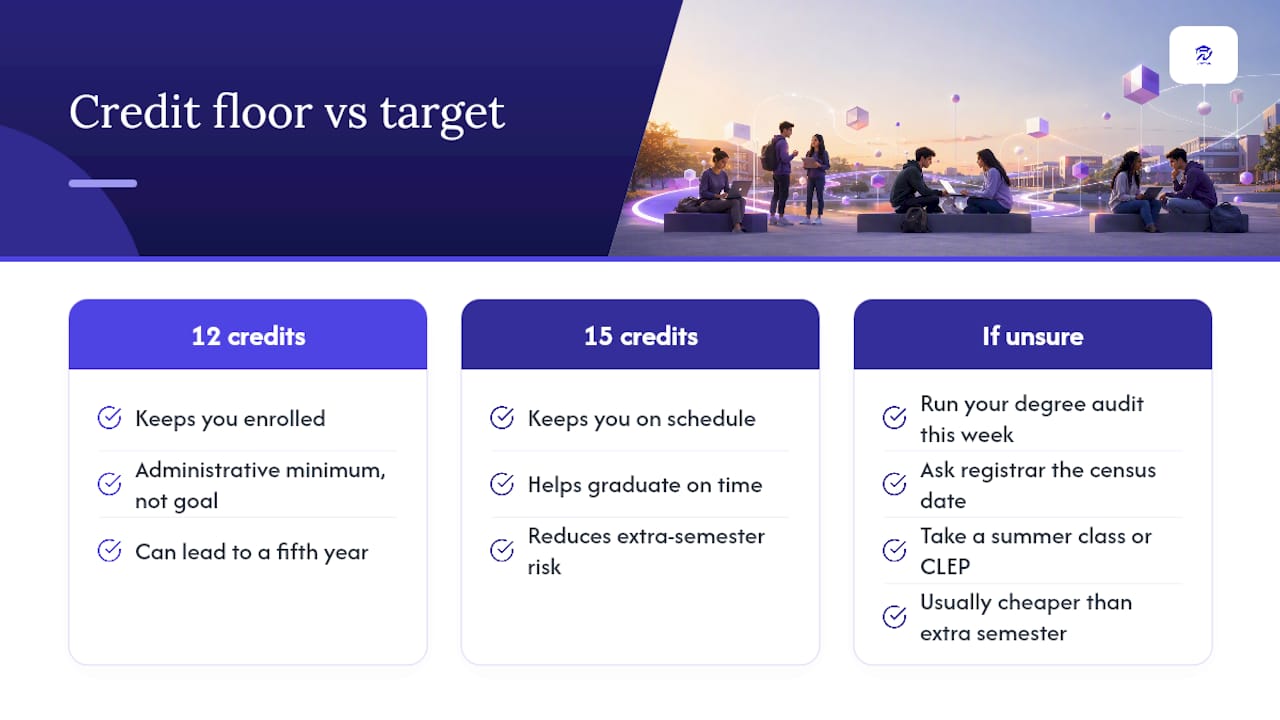
Twelve credits keeps you enrolled. Fifteen credits keeps you on schedule. Treating the administrative minimum as your actual goal is how students end up needing a fifth year they never planned for.
If you’re not sure where you stand, run your own degree audit this week, then ask your registrar the census date question directly. A summer class or a CLEP exam now is almost always cheaper than an extra semester later.
— Ryan
Get early access: join the Univyze waitlist
Univyze gives you one dashboard for your degree map, term-by-term planning, and what-if scenarios that show how AP scores, transfer credit, or a summer session change your path to graduation.

Joining the waitlist gets you early access as new features roll out, plus updates on free and paid tiers as they launch. It’s built to make the gap between “full-time” and “on track to graduate” visible before it costs you a semester, not after. If you want a clearer view of where your own credits stand, start with Univyze’s degree-planning roadmap and see how your current schedule maps against 120 credits. As always, treat it as a planning aid alongside your official degree audit, not a replacement for with your registrar or advisor. Join the Univyze waitlist to get started.
Sources
- Full-time credits | Twin Cities One Stop Student Services
- It’s Time to Redefine “Full-Time” in College as 15 Credits
FAQ
Is a full-time student 12 or 15 credits?
Twelve credits is the administrative threshold most schools use for full-time status and financial aid. Fifteen credits per semester is the pace advocates recommend if you want to finish a 120-credit degree in four years.
Is 14 credits full-time in college?
Yes. Any credit load at or above your school’s full-time threshold, commonly 12 credits for undergraduates, qualifies as full-time, so taking more than 12 credits clears that bar with room to spare.
Can you complete 30 college credits in one year?
Yes, and it’s exactly the pace Complete College America recommends: 15 credits per semester across fall and spring adds up to 30 credits a year, matching the math behind a four-year, 120-credit degree.
Are 3 college classes considered full-time?
It depends on the credit value of each class. Three classes at 4 credits each total 12 credits, which typically meets the full-time bar, but three 3-credit classes only add up to 9, which usually falls into three-quarter or half-time status.
Does dropping a class after the census date affect my full-time status?
Yes. Most schools lock in your enrollment status and financial aid based on your credit load as of the census date, so dropping afterward can leave you below full-time for aid purposes even though your schedule looks lighter going forward.