

Knowing whether you are on track to graduate college on time means comparing your completed credits and satisfied requirements against your school’s official degree plan. Most bachelor’s degrees require 120 credits, and only about 40% of students finish within the standard four-year window. That gap costs real money. An extra semester adds tuition, housing, and lost income. The good news is that a few concrete checks, done regularly, tell you exactly where you stand before a small gap becomes an expensive delay.
What credit and course requirements do you need to meet to graduate on time?
A standard bachelor’s degree requires approximately 120 credit hours. To finish in four years, you need to earn 30 credits per year, which works out to 15 credit hours per semester. That math sounds simple, but most students underestimate how many of those credits must come from specific categories.
Your degree has three distinct credit buckets:
- Major requirements: Upper-division and lower-division courses specific to your field. Many have prerequisites that must be completed in sequence.
- General education requirements: Writing, math, science, humanities, and social science courses required by your university regardless of major.
- Electives: Free-choice credits that fill the gap between your major and general education totals and the 120-credit minimum.
Failing to track each bucket separately is one of the most common reasons students end up one semester short. You might hit 120 total credits but still be missing a required upper-division writing course or a specific lab science.
For a clearer picture of how credit loads affect your timeline, the Univyze guide on credits per semester breaks down realistic planning scenarios by year.

Summer and winter sessions are also worth considering. A single three-credit course in the summer can replace a bottleneck course that would otherwise push you into a fifth year. Less than 5% of students graduate early, and those who do typically carry around 20 credits per semester with a GPA above 3.0. For most students, the goal is not early graduation but avoiding late graduation.
| Scenario | Credits per semester | Projected graduation |
|---|---|---|
| Standard pace | 15 | 4 years |
| Light load (12 credits) | 12 | 5 years |
| Heavy load (18 credits) | 18 | 3.3 years |
| Summer session added | 15 + 6 summer | Under 4 years |
How do degree audit tools help you track your graduation progress?
The most reliable way to assess your on-track status is a personalized degree audit tool that displays satisfied and unsatisfied requirements in real time. Simple credit counting tells you how many credits you have. A degree audit tells you whether those credits count toward the right requirements.
Tools like the Tar Heel Tracker at the University of North Carolina show each requirement category with a clear satisfied or not satisfied label. Most universities offer a similar system through their registrar or student portal. These tools typically show:
- Which general education categories are complete
- Which major requirements remain, including specific course codes
- How many elective credits you still need
- Whether transfer credits or AP credits have been applied correctly
The limitation of degree audits is that they reflect your current enrollment, not your planned future courses. A degree audit shows you where you are. It does not automatically tell you whether the courses you need are available next semester or whether prerequisites will create a bottleneck.
Pro Tip: Run your degree audit at the start of every semester, not just before you register. Catching a missing requirement in october is far easier to fix than catching it in april.
Using degree audit tools proactively with your academic advisor helps uncover unsatisfied requirements and plan course sequences before they become problems.
What steps should you take each semester to stay on track?
Tracking graduation progress is not a once-a-year task. It requires a short checklist at the start, middle, and end of every semester.
At the start of each semester:
- Run your degree audit and identify any newly unsatisfied requirements.
- Confirm that every course you registered for counts toward a specific requirement category.
- Check prerequisites for courses you plan to take next semester and register early if possible.
- Schedule a meeting with your academic advisor before or during the first two weeks of class.
During the semester:
- Use the Add/Drop period to make honest adjustments. The Add/Drop period is your best window to drop a course that is clearly beyond your current bandwidth without academic penalty.
- Monitor your grades in each course by week four. If you are failing a course by midterm, a late drop is still better than a failing grade on your transcript.
At the end of each semester:
- Confirm your transcript reflects all completed credits correctly.
- Check that your graduation application deadline is on your calendar. You must submit a formal graduation application by your school’s specified deadline to be officially eligible to graduate. Missing this step delays your degree conferral even if you complete every academic requirement.
Pro Tip: Prepare a one-page summary before every advisor meeting: your current credit count, remaining requirements by category, and your planned courses for the next two semesters. Advisors give better guidance when you arrive with a plan rather than a question.
What common mistakes disrupt your graduation timeline?
The most common pitfalls that extend graduation timelines are predictable and avoidable with early awareness.
Over-enrolling without a realistic pass rate. Taking 18 credits and passing 12 leaves you behind, not ahead. Failing a course means retaking it, which occupies a future semester slot that could have held a new requirement.
Ignoring course availability and prerequisites. Some required courses are offered only in specific semesters, and missing the offering window can push your graduation back by a full year. Check your department’s course rotation schedule at least two semesters in advance.
Changing your major late without a plan. Switching majors in your junior or senior year without mapping out the new requirements against your existing credits is one of the fastest ways to add a year. A what-if analysis with your advisor before you switch can show you exactly how many credits transfer to the new major.
Ignoring holds on your student account. Financial holds, advising holds, and health center holds can block you from registering for classes or from having your degree conferred. Check your student portal for holds at the start of every registration period.
“Students are not candidates for graduation until they submit an official application by the deadline. Ignoring this step prevents timely degree conferral even if all academic requirements are met.”
Choosing classes that count toward graduation is a skill that pays off every semester. Every elective that does not satisfy a real requirement is a credit slot that could have moved you closer to the finish line.
How do pass rate and course load scenarios affect your timeline?
Pass rate is the percentage of enrolled credits you actually complete and pass. It matters more than raw credit enrollment. Improving your pass rate from 70% to 85% often shortens your graduation timeline more than adding one extra course per semester.
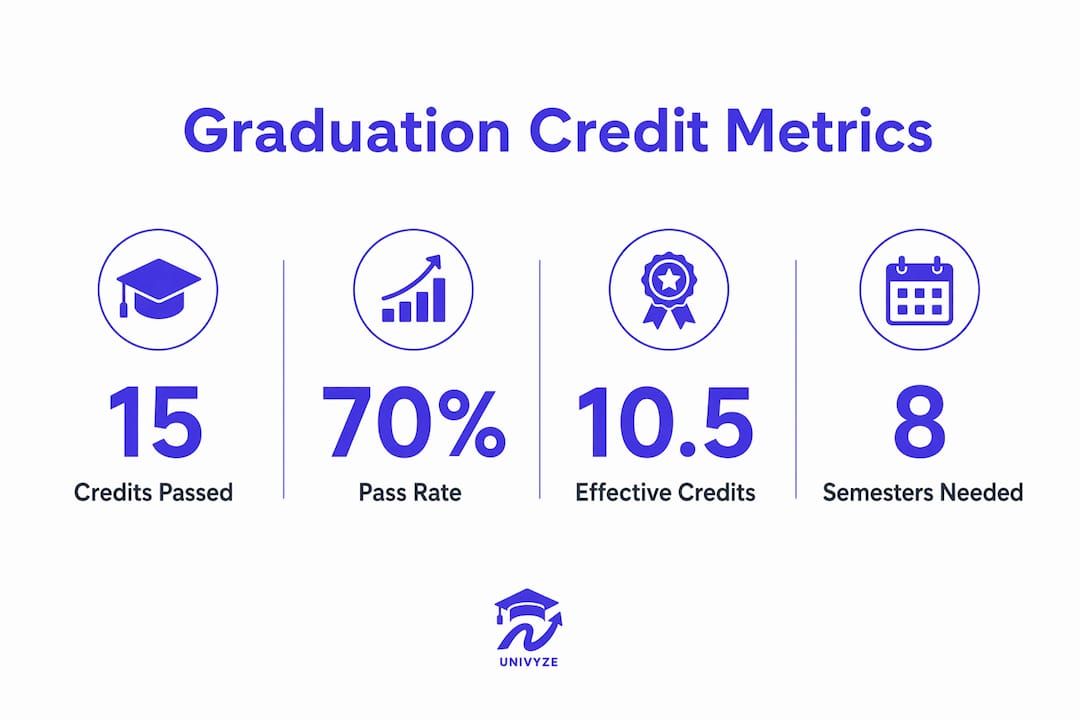
The math is straightforward. A student enrolled in 15 credits with a 70% pass rate earns 10.5 credits per semester. At that pace, a 120-credit degree takes nearly 12 semesters, or six years. A student enrolled in 15 credits with an 85% pass rate earns 12.75 credits per semester and finishes in under eight semesters.
| Course load | Pass rate | Credits earned per semester | Semesters to 120 credits |
|---|---|---|---|
| 15 credits | 70% | 10.5 | ~11.5 |
| 15 credits | 85% | 12.75 | ~9.5 |
| 15 credits | 100% | 15 | 8 |
| 18 credits | 85% | 15.3 | ~7.8 |
The table shows that a student passing all 15 credits per semester reaches the same pace as a student taking 18 credits with an 85% pass rate. The lower-load student carries less risk of burnout and course failure.
Pro Tip: Calculate your personal pass rate at the end of each semester by dividing credits passed by credits attempted. If it falls below 85%, reduce your next semester’s load by three credits before adding anything else.
Improving your grades is directly tied to your graduation timeline. The Univyze resource on getting better grades covers course management strategies that support a higher pass rate without requiring a heavier schedule.
Key Takeaways
Knowing whether you are on track to graduate on time requires checking your credit progress, requirement categories, pass rate, and administrative deadlines every single semester.
| Point | Details |
|---|---|
| Credit target per semester | Earn 15 credits per semester to complete a 120-credit degree in four years. |
| Use your degree audit | Run your school’s degree audit tool each semester to see satisfied and unsatisfied requirements. |
| Pass rate over enrollment | A pass rate above 85% shortens your timeline more than adding extra courses. |
| Submit your graduation application | File your formal graduation application by your school’s deadline or your degree will be delayed. |
| Catch course bottlenecks early | Check course availability and prerequisites at least two semesters ahead to avoid year-long delays. |
What I’ve learned about staying on track that most guides skip
Most graduation guides focus on credit counts. That is the wrong place to start. In my experience, the students who fall behind are not the ones taking too few credits. They are the ones taking the right number of credits but failing one or two courses per semester and never adjusting.
The pass rate insight changed how I think about this entirely. A student who takes 15 credits and passes all 15 is in a stronger position than a student who takes 18 and passes 13. The second student looks more ambitious on paper but is actually moving slower toward graduation.
The other thing most guides understate is the administrative side. Submitting your graduation application on time sounds obvious, but I have seen students complete every academic requirement and still delay their degree by a semester because they missed the application window. Put that deadline in your phone the first week of your final year.
My honest advice: treat your degree audit like a bank statement. Check it monthly, not once a year. The students who catch a missing requirement in their sophomore year have time to fix it. The students who catch it in their senior year do not always have that luxury.
— Ryan
How Univyze helps you plan smarter from day one
Unclear degree planning is one of the main reasons students end up paying for extra semesters. Univyze is a planning tool built to give students a clear, term-by-term view of their academic path, connecting degree requirements with real course offerings so nothing falls through the cracks.
Univyze accounts for AP credits, dual enrollment, transfer credits, and summer sessions automatically. Students can run what-if scenarios to see how a major change or a dropped course affects their timeline before making the decision. Parents can also view their student’s progress, which reduces the guesswork on both sides. Learn how the tool works at the Univyze planning overview, or join the waitlist to get early access and start planning with a clearer picture of your path to graduation.
FAQ
How do I know if I’m on track to graduate on time?
Run your university’s degree audit tool and compare your completed credits against your remaining major, general education, and elective requirements. If you are earning at least 15 credits per semester with a pass rate above 85%, you are on pace for a four-year graduation.
What is a degree audit and how does it help?
A degree audit is a real-time report from your university that shows which graduation requirements you have satisfied and which remain. Tools like the Tar Heel Tracker at UNC display each requirement category with a clear satisfied or not satisfied status, going beyond simple credit counting.
How many credits do I need per semester to graduate in four years?
A standard 120-credit bachelor’s degree requires 30 credit hours per year, or 15 per semester. Taking fewer than 15 credits per semester without a summer course plan extends your graduation timeline.
What happens if I miss the graduation application deadline?
You will not be eligible to graduate that term even if you have completed all academic requirements. Most universities require students to submit a formal application by a set deadline each semester, so confirm your school’s date well in advance.
Does changing my major affect my graduation timeline?
Changing your major without mapping your existing credits to the new requirements almost always adds semesters. Meet with your advisor before switching to run a what-if analysis and see exactly how many of your current credits apply to the new degree plan.