

A dual degree earns you two separate diplomas from two schools or programs, and it typically costs more time and credits than a double major, which awards one diploma with two areas of study noted on it. Most dual-degree students add roughly 30 extra credits and one to two extra years to their timeline. Whether that trade is worth it depends on your major combination, your career target, and how early you start mapping requirements.
TL;DR:
- Most dual degree programs add about 30 credits and one to two extra years beyond a standard four-year timeline, depending on the majors chosen.
- Schools often limit shared upper-division courses and require minimum exclusive credits for each degree, which can prolong completion and increase costs.
- Transfer credits and AP scores can significantly reduce your timeline if mapped early, but require careful pre-approval from both departments.
- Administrative delays often stem from conflicting credit caps, missing signatures, or miscounted course overlaps, making proactive tracking essential.
- A dual degree makes sense mainly when the fields are distinct and employers or graduate programs specifically require both credentials.
Table of Contents
- What Is a Dual Degree Planning Process, and How Does It Differ From a Double Major?
- How Dual Degrees Usually Work: Credits, Timelines, and Overlap Rules
- Eligibility, Approvals, and the Application Process You Must Follow
- Step-by-Step Dual Degree Planning Checklist and Term-by-Term Approach
- Common Administrative Pitfalls in Dual Degree Planning
- Financial Implications: Tuition, Summer Terms, and Aid
- When a Dual Degree Is Worth It: Career Alignment and Decision Criteria
- How Planning Tools Can Reduce Delay and Cost in Dual Degree Planning
- Transferring Credits From Other Institutions or Study Abroad Programs
- Author Perspective: Quick Rules of Thumb and Immediate Next Steps
- Univyze: A Practical Way to Build and Track Your Dual-Degree Plan
- Official Advising Pages and Policy Links to Check for Your Campus
- Sources
- FAQ
What Is a Dual Degree Planning Process, and How Does It Differ From a Double Major?
A dual degree means two diplomas: think a Bachelor of Arts and a Bachelor of Science, each with its own set of requirements, sometimes from two different colleges within the same university. A double major means one diploma with two majors listed on it. That distinction shows up on your transcript, your graduation paperwork, and often your tuition bill.
Dual degree programs typically require about 30 additional credits compared to a single degree, and the timeline often stretches beyond the standard four years. A double major usually fits inside four years because both majors draw from a shared pool of general education and elective credits.
Here’s how students typically sort themselves into one path or another:
- Double major: fields overlap enough that many courses count toward both (economics and political science, for example).
- Dual degree: fields are distinct enough that regulators, employers, or accreditors expect two separate credentials (engineering and business, or nursing and public health).
- Minor: you want exposure to a second subject without the credit load of a full major or a second degree.
How Dual Degrees Usually Work: Credits, Timelines, and Overlap Rules
Every campus writes its own rulebook, but the shape is similar almost everywhere. You’re not just doubling coursework. You’re satisfying two separate sets of graduation requirements that were never designed to run in parallel.
The 30-credit reality: Most dual degree programs require roughly 30 credits beyond a single bachelor’s degree, pushing typical completion from 4 years to 5 or 6. That’s not a rounding error. It’s often an extra year of tuition, housing, and lost early-career earnings.
Three rules drive most of the added time:
- Overlap caps. Schools commonly limit how many upper-division courses can count toward both degrees at once, and require a minimum number of exclusive credits for each major, meaning some courses can never double-count no matter how well they fit thematically.
- Home unit designation. You’ll typically pick one school or college as your “home unit,” which governs your tuition rate, your registration priority, and which residency requirements apply to you.
- Simultaneous conferral. Some institutions won’t issue either diploma until both sets of requirements are complete, even if one degree finished its coursework a semester early. Credit minimums vary a lot by school; the University of Washington, for instance, sets a 225-credit threshold for some double-degree combinations, well above a typical single bachelor’s total.
Eligibility, Approvals, and the Application Process You Must Follow
Getting into a dual degree program isn’t automatic, and missing a deadline can push your whole plan back a full academic year. The process generally follows this sequence:
- Confirm standing. Most programs require at least sophomore standing and a minimum number of completed credits before you can apply.
- Meet the GPA floor. A cumulative GPA around 3.0 is a common threshold, though some competitive combinations set the bar higher.
- Get both signatures. You’ll typically need approval from an advisor or dean in each participating school, not just your primary department.
- File before the deadline. Application windows are often tighter than they look; applying a full term ahead of your target start date gives you room to fix any missing paperwork.
Skipping any one of these steps is the single most common reason students get bounced back to a single-degree track.
Step-by-Step Dual Degree Planning Checklist and Term-by-Term Approach
Treat your dual degree like a project with two clients who don’t talk to each other. You’re the only one guaranteed to see both sets of requirements at once.
- Year 1: Map both degree requirements side by side before you declare anything. Flag which courses satisfy general education for both, and which upper-division courses are exclusive to each major.
- Year 2: Apply for formal dual-degree status once you hit sophomore standing and your GPA floor. Meeting with advisors in both departments as early as freshman year is the strongest predictor of finishing without added delay.
- Years 3 to 5 (or 6): Sequence prerequisite chains carefully, reserve seats for high-demand upper-division courses a semester ahead, and use summer terms to knock out electives that don’t need to compete with your fall/spring schedule.
Incoming AP scores and dual-enrollment credits posted before matriculation are often the single highest-impact lever for shaving a semester off a dual-degree timeline, because they clear general education requirements before you’ve even started.
Pro Tip: Build a simple two-column spreadsheet, one column per degree, and mark every course as “shared,” “exclusive to A,” or “exclusive to B.” That single document will save you more advising appointments than anything else.
Common Administrative Pitfalls in Dual Degree Planning
Most dual-degree delays aren’t academic. They’re paperwork problems that snowball because nobody was tracking both schools’ rules at once.
- Conflicting unit ceilings. Your home unit’s credit cap might not match the rules of your second school, so a class that “counts” on paper might not actually clear the exclusive-credit requirement.
- Overlap miscounts. Students often assume a course counts toward both degrees when the registrar’s system has it flagged for only one. Mapping exclusive upper-division requirements early prevents this exact surprise in your final year.
- The missing signature problem. Neither diploma gets issued until both sets of requirements clear, so one overlooked form can hold up graduation for a degree you already finished.
Pro Tip: Set calendar reminders for administrative deadlines exactly like you would for course registration. A signature deadline missed by one day can cost you an entire semester.
Financial Implications: Tuition, Summer Terms, and Aid
The extra year or two isn’t just tuition. It’s an added year of housing, meals, and lost salary from delayed entry into the workforce, plus the ripple effects on financial aid packages that assume a four-year timeline.
- Tuition and living costs scale roughly with your added time to degree, so a 5 to 6 year dual degree can mean one or two extra years of full cost of attendance.
- Financial aid and scholarships often carry renewal caps tied to standard timelines, so confirm whether your aid extends into a fifth or sixth year before you commit.
- Cost-management levers that actually move the needle: summer coursework, AP and transfer credit, and timing part-time work around lighter semesters rather than your heaviest ones.
When a Dual Degree Is Worth It: Career Alignment and Decision Criteria
The honest answer is that a dual degree pays off when the two fields are genuinely distinct and employers or graduate programs specifically expect both credentials. Career advisors generally frame the decision around fit with your goals, not the prestige of holding two diplomas.
- Choose dual degree when fields are unrelated enough that one diploma wouldn’t signal competence in the other (engineering plus business, nursing plus public health).
- Choose double major when fields overlap and a single diploma with two majors already tells the story.
- Consider alternatives like a minor, a certificate, or graduate school later, which can deliver similar career signals for a fraction of the added credits.
How Planning Tools Can Reduce Delay and Cost in Dual Degree Planning
Most of the delays described above come down to one thing: nobody had a single view of both degrees’ requirements at the same time. That’s the exact problem a planning dashboard like Univyze is built to solve.
- Visual degree mapping overlays both sets of requirements against actual course offerings, so shared and exclusive credits are visible in one place instead of two separate advising folders.
- What-if scenarios let you model how AP credit, transfer credit, or an added summer term shifts your projected timeline before you commit to a schedule.
- Approval and conflict tracking flags scheduling collisions between two departments’ course offerings before they turn into a missed prerequisite.
Transferring Credits From Other Institutions or Study Abroad Programs
Outside credit is often the fastest way to compress a dual-degree timeline, but only if it’s mapped correctly against both degrees’ rules, not just one.
Community college transfer credit, coursework from another four-year institution, and study abroad credit all typically go through an articulation or transfer-equivalency review before they post to your record. That review usually happens at the university level first, then gets checked against each individual degree’s requirements. A transfer course might satisfy general education for your home unit but fail to clear the exclusive-credit requirement for your second degree, which is exactly the kind of gap that surprises students in their final semester.
Study abroad credit adds another layer, since many programs run through a separate approval process that has to happen before you leave, not after you return. If a study abroad term is part of your plan, get the course equivalencies pre-approved in writing from both departments, not just your primary major. Waiting until you’re back on campus to find out a course didn’t count toward your second degree can add an entire semester you didn’t plan for.

The safest sequence is: request an official transfer credit evaluation as soon as you have a target school or program, cross-check the result against both degrees’ exclusive-credit lists, and confirm with each department in writing before you register for anything that depends on that credit landing. Registrar offices can tell you what transferred; only your department advisors can tell you what it actually satisfies.
Author Perspective: Quick Rules of Thumb and Immediate Next Steps
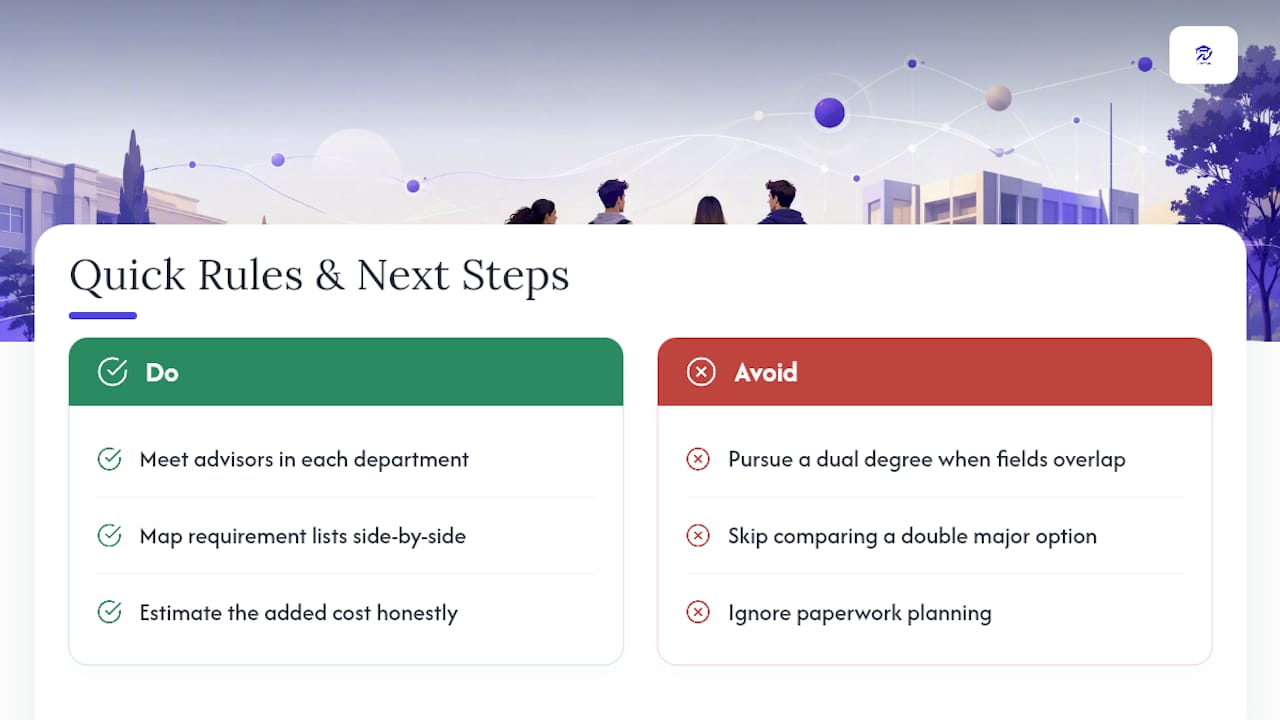
My rule of thumb: pursue a dual degree only when the two fields are genuinely distinct enough that one diploma can’t tell your story. If they overlap, a double major almost always gets you the same outcome for less time and money.
Three things to do this week: meet with an advisor in each department, map both requirement lists side by side, and estimate the added cost honestly before you apply. The trade-off is real. Two diplomas can open specific doors, but only if you plan the paperwork as carefully as the coursework.
— Ryan
Univyze: A Practical Way to Build and Track Your Dual-Degree Plan
There are planning tools that provide a dashboard where both degrees’ requirements sit next to your actual course offerings, term by term.

Some planning platforms allow you to model what-if scenarios for AP credit, dual enrollment, and transfer credits to see how they might shift your timeline, and help flag scheduling conflicts before they turn into a missed prerequisite. Univyze isn’t an official degree audit, and doesn’t replace your registrar, your university catalog, or your assigned academic advisor. These tools are built to make the planning conversations with advisors more productive, especially when managing two sets of requirements at once. If visual degree mapping sounds like something that would have saved you three advising appointments, join the Univyze waitlist and get early access to the dashboard when it launches.
Official Advising Pages and Policy Links to Check for Your Campus
Every campus writes its own dual-degree rules, forms, and deadlines. Start with your school’s degree-planning policies page to find the exact approval form and submission window before you apply.
Sources
- Dual Degree vs. Double Major: What’s the Difference? | SNHU
- Policies governing dual degree | University of Pennsylvania
- Multiple majors/dual degrees policies | University of Florida advising
FAQ
Is Dual Majoring a Good Idea?
It depends on whether your two fields are distinct enough to need separate diplomas. If they overlap significantly, a double major usually delivers the same career signal with less added time and cost.
Is It a Good Idea to Have Two Bachelor’s Degrees?
Two bachelor’s degrees make sense when employers or graduate programs in your target field specifically expect both credentials, such as engineering paired with business. For related fields, a double major or minor often achieves a similar outcome for far less added time.
What Are the Disadvantages of Dual Degrees?
The main disadvantages are added cost and time, typically 30 extra credits and one to two extra years, plus the administrative burden of tracking two schools’ overlap rules, signatures, and deadlines at once.
Are Dual JD Programs Worth It?
Dual JD programs, like a JD paired with an MBA or MPH, tend to be worth it when your target career explicitly requires both credentials, but they add substantial time and tuition, so confirm the career payoff with career services before committing.
How Do I Start Planning a Dual Degree Without Missing Requirements?
Meet with advisors in both departments as early as your first year, map every course as shared or exclusive to each degree, and use planning tools like Univyze to keep both requirement lists visible in one place as your schedule evolves.