

Course planning is the practice of mapping every class you take to a specific graduation requirement before you register, and it is the most direct way to reduce what you pay for college. The role of course planning in saving tuition goes far beyond picking classes you enjoy. Students who plan strategically, using credit transfers, community college stacking, and degree audits, can cut their total college bill by tens of thousands of dollars and finish a semester or more ahead of schedule. Tools like 529 plans and resources like Univyze make that planning concrete and trackable from day one.
How transferring credits and community college courses can reduce your tuition bill
Community college courses cost $50–$200 per unit, compared to $500–$1,500 per unit at four-year universities. That gap is not a rounding error. It is the foundation of one of the most powerful tuition savings strategies available to any student.
Transferring 15–30 credits from a community college to a four-year university can save $10,000 to $20,000 in tuition. That figure does not include housing, fees, or the income you keep by graduating earlier. The savings come from completing general education requirements and electives at community college rates, then transferring those credits so they count toward your four-year degree.

The timing matters more than most students realize. The critical savings window is 3–4 months before your university start date. Students who stack community college credits during that window can enter their four-year school with enough units to skip an entire semester of full-price tuition.
To make this work, every transfer credit must be verified before you pay for it. The website assist.org is the standard resource for California students checking whether a community college course transfers to a UC or CSU campus. Students at other schools should use their university’s official transfer equivalency database or speak directly with the registrar.
Here is what a credit transfer plan looks like in practice:
- Identify all general education requirements for your intended major before you register for any community college course.
- Cross-reference each course against your university’s transfer equivalency database.
- Complete English composition, math, and social science requirements at community college rates whenever possible.
- Aim for 15–30 transferable units before your first university semester begins.
- Confirm credit acceptance in writing from your university’s registrar before paying tuition anywhere.
Pro Tip: Register for community college courses as a non-degree-seeking student if you are still in high school. Many community colleges allow dual enrollment, which means you can start stacking transferable credits before you ever set foot on a university campus.
Why aligning every course with degree requirements prevents tuition leakage
Tuition leakage is the money students spend on courses that do not count toward their degree. An extra semester caused by misaligned course choices costs $4,500 or more in tuition alone, not counting room, board, and lost wages. It is one of the most common and most avoidable college expenses.
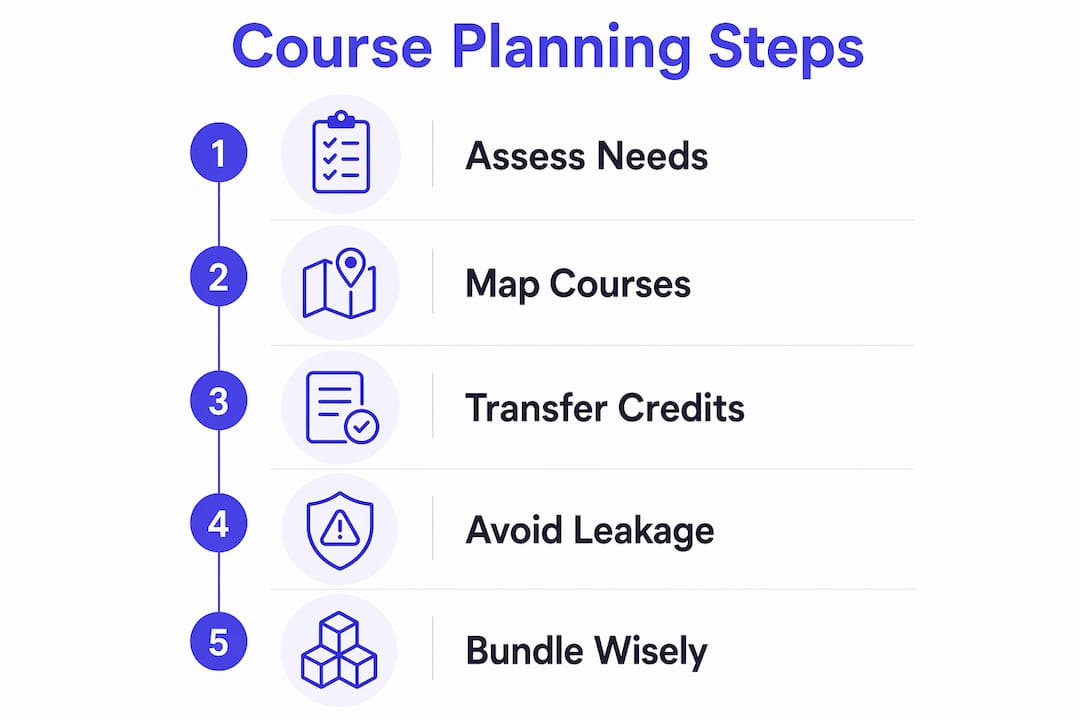
The fix is backward design. Backward design means starting with your graduation requirements and working backward to build your course list, rather than picking classes semester by semester and hoping they add up. Academic advisors at the University of Iowa and other institutions recommend this framework specifically to prevent redundant classes and wasted tuition spending.
Bad course choices driven by comfort or perceived ease, rather than degree relevance, can cost students $5,000 to $15,000 and add extra terms to their enrollment. That is a real financial penalty for choosing a class because it fits your schedule or sounds interesting, rather than because it satisfies a requirement.
A degree audit is the tool that makes alignment visible. Most universities provide a degree audit through their student portal. It shows which requirements you have met, which are in progress, and which remain open. Running a degree audit before every registration period is the single most effective habit for preventing tuition leakage.
Here is a four-step process for keeping every course aligned:
- Pull your official degree audit at the start of each semester and identify every open requirement.
- Map each course you are considering to a specific requirement on that audit before you register.
- Confirm the mapping with your academic advisor in writing, not just verbally.
- If a course does not satisfy a requirement, do not register for it unless you have completed all required courses first.
Pro Tip: Ask your advisor to flag any course that counts as an elective but not as a major or general education requirement. Electives feel harmless, but they are the most common source of tuition leakage for students who are close to graduation.
Bundled courses vs. individual courses: which saves more tuition?
Buying courses individually is the default for most students, but it is rarely the most cost-effective approach. Bundled courses reduce the cost per credit and help students finish required credits faster, cutting total tuition costs in the process.
| Factor | Individual courses | Bundled courses |
|---|---|---|
| Cost per credit | Higher, billed at full rate | Lower, discounted per-credit rate |
| Speed to completion | Slower, one course at a time | Faster, multiple requirements cleared at once |
| Risk of misalignment | Lower if planned carefully | Higher if bundle does not match degree audit |
| Best use case | Filling a single open requirement | Clearing a cluster of related requirements |
| Impact on graduation timeline | Neutral to negative | Positive when timed correctly |
The key risk with bundles is mistiming. A bundle purchased before you confirm which requirements remain open can include courses you do not need. That turns a discount into a waste. The rule is simple: run your degree audit first, then buy the bundle that matches your open requirements exactly.
Bundles deliver the best value when they clear a cluster of related requirements in one purchase. For example, a bundle covering three social science general education requirements at a reduced per-credit rate saves both money and registration time compared to buying each course separately at full price.
Practical steps to build a course plan that cuts your tuition bill
The importance of course planning shows up most clearly when students and parents treat it as a financial decision, not just an academic one. Every course you register for is a purchase. Treating it that way changes how you evaluate your options.
Start with these steps:
- Map your degree requirements first. Download your official degree map from your university’s registrar or academic department. This document lists every requirement for graduation and is the foundation of every cost-saving decision you make.
- Use a 529 plan in sync with your course calendar. A 529 plan is a tax-advantaged savings account designed for education expenses. Pairing withdrawals with your tuition payment schedule, rather than spending reactively, reduces out-of-pocket costs and maximizes the tax benefit.
- Meet with your academic advisor before every registration period. Advisors catch misalignments that students miss. A 30-minute advising appointment before registration is worth far more than the time it takes.
- Track your credits like a budget. Effective degree planning treats a four-year degree as a 120-credit puzzle, reverse-engineering from required credits to transfer opportunities to eliminate redundant spending.
- Plan your course load by semester. Taking too few credits per semester extends your enrollment and raises your total tuition bill. Taking too many raises your risk of failing or withdrawing, which also costs money. Find the right balance by reviewing credit load guidance before you register.
Parents play a direct role here. Visibility into your student’s degree progress is not a luxury. It is a financial safeguard. Knowing which requirements remain open, and whether your student is on track to graduate on time, lets you make informed decisions about tuition payments, housing contracts, and 529 withdrawals. Univyze gives parents that visibility through a shared dashboard that connects degree requirements to actual course offerings in real time.
Pro Tip: Set a calendar reminder 4 months before each semester’s registration window opens. Use that time to run a degree audit, review your transfer credit options, and confirm your course list with your advisor before seats fill up.
Key Takeaways
Disciplined course planning is the single most effective way to reduce total college tuition by preventing extra semesters, eliminating misaligned credits, and front-loading low-cost transfer options before full-price university enrollment begins.
| Point | Details |
|---|---|
| Transfer credits cut costs fast | Community college credits cost a fraction of university rates and can save $10,000–$20,000 when transferred strategically. |
| Tuition leakage is avoidable | Every course must map to a specific degree requirement. One misaligned semester costs $4,500 or more. |
| Backward design prevents waste | Start with graduation requirements and work backward to build your course list each semester. |
| Bundles save money when timed right | Buy bundled courses only after confirming which requirements remain open on your degree audit. |
| Financial and academic planning must connect | Pairing 529 plan withdrawals with a proactive course calendar reduces out-of-pocket tuition costs. |
The planning mistake I see students make every single time
Most students treat course selection as a scheduling problem. They look at what fits their week, what sounds manageable, and what their friends are taking. That mindset costs real money.
The students who graduate on time, or early, treat course selection as a financial decision from the start. They know exactly which requirements are open. They know which courses they can take cheaply at a community college and transfer in. They run their degree audit before they register, not after.
What I have seen repeatedly is that the students who struggle most are not the ones who picked the wrong major. They are the ones who picked the right major but filled their schedule with courses that did not count. An extra semester is not just an inconvenience. It is $4,500 in tuition, plus housing, plus the income you are not earning. That is a five-figure mistake that a single advising appointment could have prevented.
My strongest advice: treat your degree like a project with a budget and a deadline. Map every credit to a requirement. Front-load the cheap options. Use your advisor as a financial checkpoint, not just an academic one. And if you are a parent, get visibility into your student’s plan early. The common mistakes that delay graduation are predictable and preventable when someone is paying attention.
— Ryan
How Univyze helps you plan courses and protect your tuition budget
Unclear degree planning is one of the most expensive problems in higher education, and most students do not realize it until they are staring at an extra semester of tuition they did not budget for. Univyze was built to fix that.
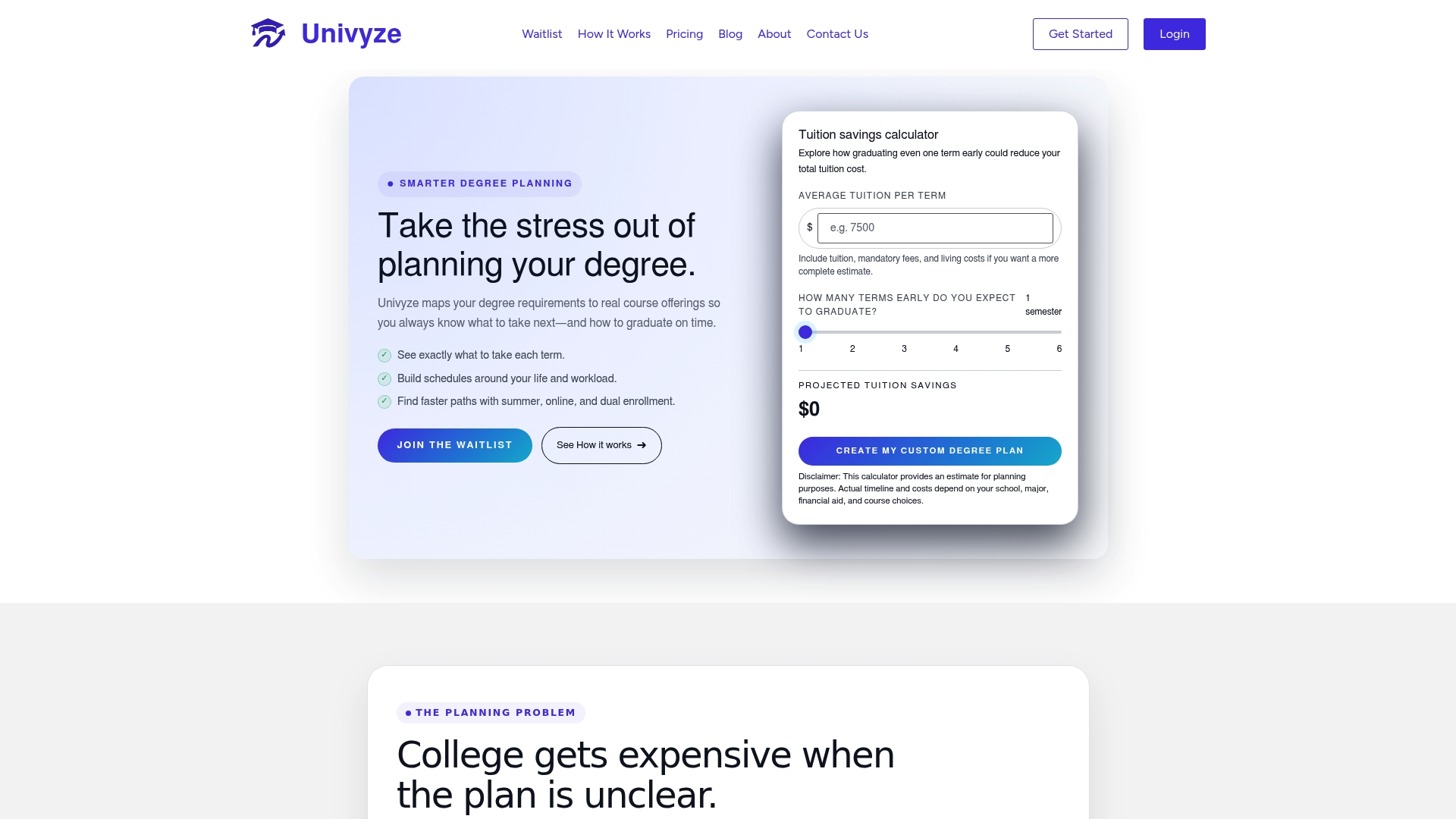
Univyze connects your degree requirements to real course offerings in a dynamic dashboard, so you can see exactly which classes count, which do not, and where your fastest path to graduation runs. Students use it to avoid schedule conflicts, catch misalignments before they cost money, and build a semester-by-semester plan that actually leads to graduating on time or early. Parents get visibility into their student’s progress without needing to chase down a transcript. If you want to see how it works, the full course planning overview walks through every feature.
FAQ
How much can course planning actually save on tuition?
Planning credit transfers strategically can save $5,000 to $15,000 and cut a full graduation semester. Students who also stack community college credits before university enrollment can save an additional $10,000 to $20,000.
What is tuition leakage and how do I avoid it?
Tuition leakage is money spent on courses that do not count toward your degree. Avoid it by running a degree audit before every registration period and confirming each course maps to a specific graduation requirement.
When is the best time to take community college courses?
The best window is 3–4 months before your university start date. Completing 15–30 transferable units during that period can eliminate an entire semester of full-price university tuition.
Should I use a 529 plan alongside course planning?
Yes. Pairing 529 plan withdrawals with a proactive course calendar maximizes your tax advantage and reduces reactive out-of-pocket spending. Financial planners recommend syncing both tools from the start of college planning.
How does backward design help with tuition savings?
Backward design starts with your graduation requirements and works backward to select courses, preventing redundant classes and tuition leakage. Academic advisors recommend it as the most reliable framework for staying on track and graduating without extra semesters.