

A four-year graduation plan is the single most effective strategy for minimizing college costs, reducing student debt, and accelerating lifetime earnings. The financial benefits four-year graduation plan delivers are not marginal. They compound across tuition savings, loan interest avoided, and earlier career income in ways most families never calculate until it is too late. Only about 50% of bachelor’s students graduate within four years, meaning the other half pays a steep and largely avoidable financial penalty. This article breaks down exactly what you save, and how to protect it.
1. What are the direct tuition and housing cost savings?
Graduating in four years instead of five saves $25,000 to $30,000 in direct costs at public universities and over $70,000 at private schools. That is one year of tuition, fees, room, and board you simply do not pay. The numbers are not abstract.
For 2025–26, average in-state tuition at public four-year colleges sits at $11,950 per year, excluding housing. Add typical room and board of $12,000 to $14,000 annually, and a fifth year at a public school costs roughly $24,000 to $26,000 out of pocket. At a private university, that same fifth year can exceed $60,000 when you include fees and living expenses.

The comparison is stark when you lay it out side by side:
| Cost Category | 4-Year Total | 5-Year Total | Extra Cost |
|---|---|---|---|
| Tuition and fees (public) | $47,800 | $59,750 | $11,950 |
| Room and board (public) | $52,000 | $65,000 | $13,000 |
| Tuition and fees (private) | $220,000 | $275,000 | $55,000 |
| Room and board (private) | $56,000 | $70,000 | $14,000 |
Pro Tip: Request a net price calculation from your school’s financial aid office every year. Institutional aid often does not extend to a fifth year, which means your out-of-pocket cost for that extra semester is higher than your first four years combined.
2. How does on-time graduation reduce student loan debt?
Every additional semester you borrow money costs more than just the principal. The average federal student loan interest rate for 2025–26 is 6.39%. Borrowing an extra $25,000 for a fifth year at that rate adds thousands in interest over a standard 10-year repayment period.
The situation gets worse when federal loan limits enter the picture. Undergraduate students can only borrow a set amount in federal loans each year. When students exceed those limits, they turn to private loans or Parent PLUS loans, both of which carry higher interest rates and fewer repayment protections. Federal loan limits push students toward costly private loans the moment they extend beyond four years of borrowing.
Here is what that means in practice:
- A student borrowing $27,000 in federal loans for a fifth year at 6.39% pays roughly $3,600 in interest over 10 years on that amount alone.
- Private loans for the same amount at 9–12% interest add $5,000 to $8,000 in total interest.
- Grant aid, which reduces net borrowing, typically does not cover a fifth year at the same level as earlier years.
Pro Tip: Use the Federal Student Aid loan simulator at studentaid.gov to model exactly how much a fifth year of borrowing adds to your total repayment amount. Seeing the real number is more motivating than any general warning.
Reducing total borrowing by graduating on time is one of the most direct student loan savings plans available to any student. You do not need a scholarship to benefit. You just need a clear plan.
3. What are the career income advantages of graduating on time?
Entering the workforce one year earlier has a compounding financial effect that most students underestimate. College graduates earn a median of $81,800 annually, which is 62% more than high school graduates, according to the College Board’s Education Pays 2026 Report. That gap starts the moment you accept your first offer.
One extra year in the workforce means one extra year of salary, retirement contributions, and employer benefits. The College Board data shows that college graduates receive employer-provided health insurance at a 66% rate versus 51% for high school graduates, and retirement plan access at 45% versus 37%. These benefits have real dollar values that compound over decades.
The lifetime math is significant:
- Year one of early entry: $50,000 to $65,000 in starting salary for a typical bachelor’s degree holder.
- Employer 401(k) match: Often 3–5% of salary, meaning $1,500 to $3,250 in free retirement money per year.
- Salary growth: Each year of experience raises your base, so starting earlier means every future raise builds on a higher foundation.
- Break-even advantage: The College Board calculates that the break-even age with high school peers is 34 for sticker-price students and 30 for those who received grants. Graduating on time pulls that break-even point earlier.
“The life cycle costs of delayed graduation compound the financial disadvantage compared to on-time graduates.” — College Board Education Pays 2026
The economic swing from graduating one year earlier, including avoided tuition and early earnings, can exceed $124,000 to $258,000 over a career when compounding effects are included.
4. How planning and credit management protect your timeline
The most common reason students take five or six years to graduate is not academic failure. It is poor course sequencing. Lack of coordinated course planning frequently leads to extra semesters even when students have accumulated enough total credits to graduate. They simply took the wrong credits in the wrong order.
Degree audits are the most direct fix. A degree audit maps every requirement you still need against every course your school actually offers and when it is offered. Students who run degree audits each semester catch prerequisite bottlenecks before they become schedule conflicts that push graduation back by a full term.
Several strategies consistently protect four-year timelines:
- AP and IB credits: Entering college with 6–12 credits already completed gives you scheduling flexibility and reduces required coursework per semester.
- Summer coursework: Taking one or two courses in summer sessions keeps you on pace without overloading fall and spring semesters.
- Early major declaration: Declaring a major by the end of sophomore year allows advisors to map a precise two-year completion path.
- Avoiding late drops: Dropping a required course late in the semester without a replacement plan is one of the most common mistakes that delay graduation.
Structured gap years can also support on-time graduation when used intentionally. Students who take a gap year often enter college with clearer goals, reducing the odds of major changes that reset credit progress. The key word is structured. An unplanned gap year without clear re-enrollment intentions does the opposite.
Pro Tip: Ask your academic advisor for a four-year course map during your first semester, not your second year. The earlier you see the full path, the more time you have to adjust before a bottleneck becomes a crisis.
5. Four-year vs. extended graduation: a financial comparison
The numbers below assume a public university at average 2025–26 rates. Private university figures are proportionally higher.
| Financial Factor | Graduate in 4 Years | Graduate in 5 Years | Difference |
|---|---|---|---|
| Total tuition and fees | $47,800 | $59,750 | Save $11,950 |
| Total room and board | $52,000 | $65,000 | Save $13,000 |
| Loan interest (federal, 6.39%) | Lower total | Higher total | Save $3,000+ |
| Private loan exposure | Minimal | High risk | Avoid $5,000–$8,000 |
| Year one salary (early entry) | Earned | Missed | Gain $50,000–$65,000 |
| Employer retirement match | Starts year 1 | Delayed 1 year | Gain $1,500–$3,250 |
The combined financial advantage of graduating on time versus one year late ranges from roughly $85,000 to over $100,000 when you include avoided costs and early income. That figure does not include the compounding effect of earlier retirement contributions or the salary growth that builds on a higher starting base.
Some universities, including Harvard, Bridgewater State, and the University of Massachusetts, offer institutional aid that reduces net price and makes four-year completion more financially accessible. Knowing what aid your school offers, and whether it extends to a fifth year, is critical information for any financial plan. You can also explore paying for college without loans as a complementary strategy.
Key takeaways
Graduating college in four years saves most students $85,000 to over $100,000 when you combine avoided tuition, reduced loan costs, and one additional year of career earnings.
| Point | Details |
|---|---|
| Tuition savings are immediate | A fifth year at a public school costs $24,000–$26,000 that a four-year graduate never pays. |
| Loan costs multiply with time | Borrowing beyond federal limits triggers private loans at 9–12% interest, adding thousands in repayment costs. |
| Career income compounds early | Entering the workforce one year earlier adds $50,000+ in salary and starts employer retirement matching sooner. |
| Planning prevents most delays | Degree audits and early major declaration eliminate the scheduling errors that cause most fifth years. |
| Institutional aid has limits | Grant aid often does not cover a fifth year at the same rate, making the extra year more expensive than it appears. |
Why I think families underestimate the real cost of a fifth year
I have spent years looking at how students and parents approach college finances, and the pattern is consistent. Families calculate the sticker price of one more semester and stop there. They see $6,000 or $8,000 in tuition and think it is manageable. What they miss is the full picture.
That fifth year is not just tuition. It is room and board, a year of loan interest, the loss of grant aid that does not renew, and the salary you are not earning. When you add those together, the real cost of one extra year is often three to four times what the tuition bill suggests. I have seen students with 120 credits who still needed two more semesters because no one mapped their prerequisites early enough.
The other thing families underestimate is how quickly federal loan limits create a private loan problem. Once a student hits the annual or aggregate federal limit, the next dollar of borrowing comes from a private lender at a significantly higher rate. That shift happens quietly, often without the student fully understanding the terms.
Proactive planning is not just an academic exercise. It is a financial defense. Tools like Univyze exist precisely because the gap between “I have enough credits” and “I have the right credits in the right order” costs real money. The students I have seen graduate on time almost always had a clear visual map of their remaining requirements. The ones who did not were the ones calling home in year five asking for more money.
— Ryan
How Univyze helps you stay on track and on budget
Unclear degree planning is one of the most expensive problems in higher education, and it is almost entirely preventable. Univyze gives students and parents a dynamic dashboard that connects degree requirements directly to real course offerings, so you can see your full academic path before a scheduling conflict costs you a semester.
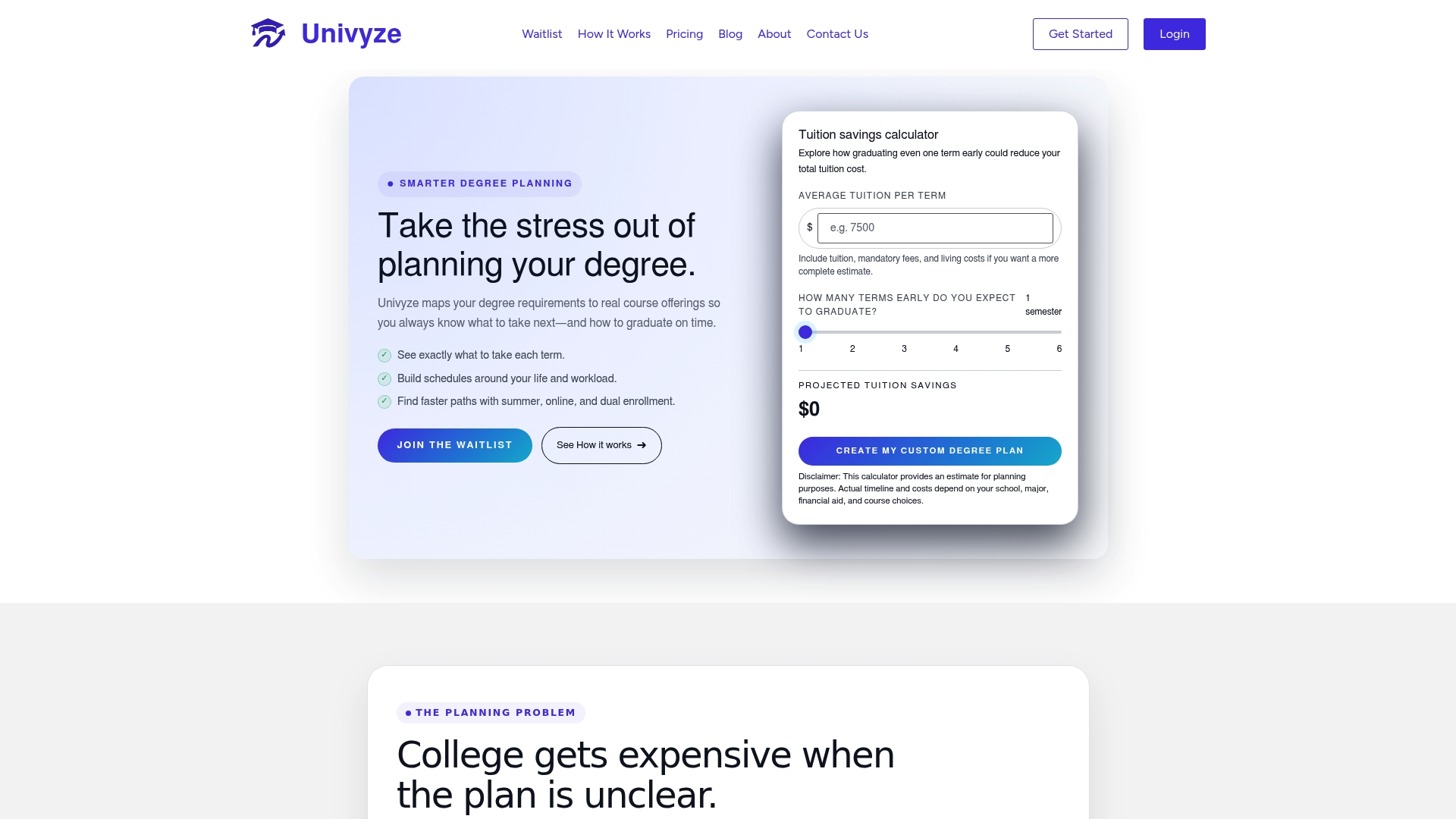
With Univyze, you can map every remaining requirement, spot prerequisite bottlenecks before they appear, and build a personalized schedule that keeps your four-year plan intact. Parents get visibility into their student’s progress, not just tuition bills. See how Univyze works and start building a plan that protects your timeline and your budget. If you want to go further, explore graduating college early as a strategy to save even more.
FAQ
How much does graduating one year late actually cost?
At a public university, a fifth year adds roughly $24,000 to $26,000 in direct costs plus lost salary income. The total financial impact, including loan interest and missed earnings, can exceed $85,000.
Does financial aid cover a fifth year of college?
Institutional grant aid often does not renew at the same level for a fifth year. Federal loan limits may also force students into higher-interest private loans, making the fifth year significantly more expensive per dollar borrowed.
What is the fastest way to protect a four-year graduation timeline?
Run a degree audit every semester and declare your major by the end of sophomore year. These two steps catch prerequisite conflicts and scheduling gaps before they push your graduation date back.
How do AP credits help with cost savings in college?
AP and IB credits reduce the number of courses you need to complete in college, giving you scheduling flexibility and lowering the risk of a fifth year. Each credit transferred in is one less credit you pay for.
Is a gap year a financial risk before college?
A structured gap year with a clear re-enrollment plan can reduce total college costs by improving focus and reducing the odds of major changes that reset credit progress. An unplanned gap year without a defined return date carries real financial risk.