

A college cost calculator is a tool that estimates the net price a family will realistically pay for college after financial aid is applied. It goes far beyond the sticker price by aggregating tuition, fees, room, board, books, and personal expenses, then subtracting estimated grants and scholarships. The standard industry term for this output is “net price,” and understanding it is the single most important step in college financial planning. Average cost of attendance runs about $28,000 per year at public in-state schools and $60,000 per year at private institutions in 2026. Those numbers shift dramatically once aid enters the picture.
What is a college cost calculator and how does it work?
A college cost calculator estimates your total cost of attendance (COA) and then subtracts expected financial aid to produce a personalized net price. COA is the standard term used by the National Center for Education Statistics (NCES) and the U.S. Department of Education to describe the full annual budget for attending a specific school. Every federally funded college must publish a net price calculator on its website. That federal requirement means you can find an official tool for virtually every accredited school in the country.
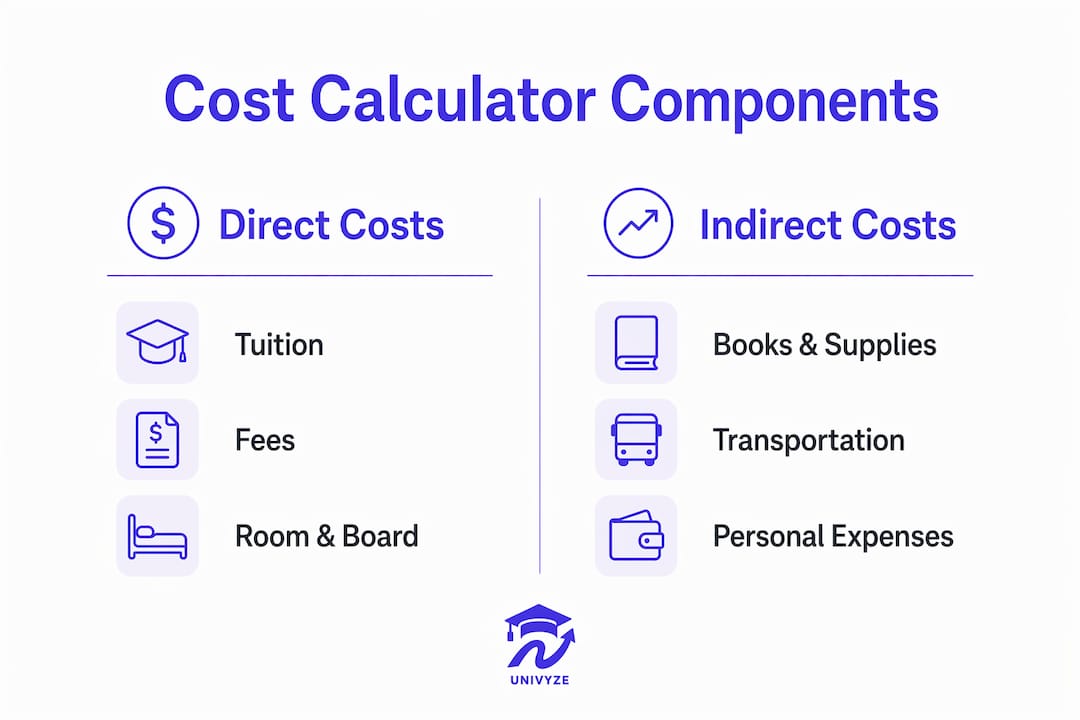
The calculator pulls together two categories of costs: direct and indirect. Direct costs are billed by the school. Indirect costs are real expenses you pay out of pocket but that the school estimates for you. COA as a ceiling for federal aid means the government will not award you more aid than your total COA, even if your financial need is higher.
Families often focus only on tuition and miss the indirect costs entirely. That gap leads to budgeting surprises in the first semester.

What costs are included in a college cost calculator’s estimate?
A college cost calculator draws from the full cost of attendance, which includes both direct and indirect expenses. COA components include tuition, fees, room, board, books, transportation, personal expenses, and loan fees where applicable.
Here is how those costs break down:
- Tuition and fees: The core direct cost billed each semester by the institution
- Room and board: On-campus housing and meal plan costs, or estimated off-campus equivalents
- Books and supplies: Typically $1,000 or more per year depending on your major
- Transportation: Estimated travel costs to and from campus each term
- Personal expenses: Clothing, toiletries, entertainment, and other day-to-day spending
- Loan fees: Origination fees on federal student loans, if applicable
| Cost Category | Type | Notes |
|---|---|---|
| Tuition and fees | Direct | Billed by school each term |
| Room and board | Direct | On-campus or estimated off-campus |
| Books and supplies | Indirect | Varies by major and course load |
| Transportation | Indirect | Estimated by school, varies by location |
| Personal expenses | Indirect | Often underestimated by families |
| Loan fees | Indirect | Applies only if borrowing federal loans |
Pro Tip: Families consistently underestimate indirect costs. Add a 10–15% buffer to the school’s indirect cost estimates when building your own budget.
COA is an average, not a fixed bill. Two students at the same school can pay very different amounts depending on housing choices, meal plan selection, and personal spending habits.
How do college cost calculators determine your personalized net price?
A net price calculator produces a personalized estimate by combining your family’s financial profile with the school’s aid formulas. The result is far more useful than any published tuition figure. Inputting financial and academic data typically takes 10–15 minutes per school, which is a small time investment for the clarity it provides.
Most calculators ask for the following inputs:
- Household income and assets: Adjusted gross income, savings, investments, and home equity
- Family size: Number of people in the household and number currently in college
- Student academic profile: GPA, test scores, and intended major
- Dependency status: Whether the student is claimed as a dependent on a parent’s tax return
- Enrollment plans: Full-time or part-time, on-campus or off-campus housing
Once you submit those inputs, the calculator applies the school’s aid model to estimate grants, scholarships, and work-study. It subtracts that estimated aid from COA to produce your net price. Net price is what you would actually pay, not what the school advertises.
Pro Tip: Use the exact same income figures and asset values when running calculators at multiple schools. Inconsistent inputs make comparisons meaningless.
The difference between sticker price and net price can be dramatic. A private school with a $65,000 sticker price might offer $30,000 in grants, dropping your net price to $35,000. That is less than many public schools charge after aid.
Why sticker prices mislead families
Sticker price does not reflect what most families actually pay. Net price fluctuates widely based on each family’s financial profile, and the gap between sticker price and net price is often larger than families expect. Most families are genuinely surprised when they see how much aid can reduce the final bill.
The practical consequence is serious. Families who compare schools by sticker price alone often rule out private colleges that would have been cheaper after aid. They also underestimate the real cost of public schools that offer little institutional grant money.
A college’s advertised tuition is the starting point for negotiation, not the final price. Your net price is the number that belongs in your budget. Comparing schools without comparing net prices is like comparing car prices without knowing the dealer discount.
A few realities worth keeping in mind:
- A school with a $70,000 sticker price and generous aid may cost less than a $30,000 public school with minimal grants
- Net price varies by income bracket, so a calculator result for one family tells you nothing about another family’s cost at the same school
- Aid packages change year to year, so a net price estimate is a starting point, not a guarantee
Use the calculator as an ongoing tool, not a one-time check. Revisit it each year as your financial situation changes and as schools update their aid formulas.
How to project college costs over four years
A single-year net price estimate is useful, but a four-year projection is what you actually need for financial planning. Tuition rises about twice as fast as general inflation, and annual increases of 3–6% are recommended for accurate future cost modeling.
Here is a practical method for building a four-year projection:
- Start with Year 1 net price: Use the official calculator result as your base
- Apply an annual inflation rate of 3–3.5%: Multiply Year 1 by 1.035 to get Year 2, then repeat for Years 3 and 4
- Add indirect cost increases separately: Transportation and personal expenses often rise faster than tuition
- Sum all four years: This gives you a total estimated cost of attendance for the full degree
- Subtract expected aid for each year: Aid amounts can change, so model a conservative scenario where grants stay flat
| Year | Base Cost (Example) | At 3.5% Annual Increase |
|---|---|---|
| Year 1 | $28,000 | $28,000 |
| Year 2 | $28,000 | $28,980 |
| Year 3 | $28,000 | $29,995 |
| Year 4 | $28,000 | $31,045 |
| Total | $112,000 | $118,020 |
Graduation timelines matter enormously here. Extra years add $30,000–$70,000 in direct and opportunity costs. A fifth year is not just one more year of tuition. It also means delayed income, continued living expenses, and potential loss of scholarship eligibility. The financial benefits of graduating on time are substantial and often underestimated.
Pro Tip: Build two projections: one assuming four-year graduation and one assuming five years. The gap between them is your financial incentive to stay on track academically.
Once you have a four-year total, subtract expected grants, savings, and income to identify your funding gap. That gap is the number you need to close with loans, work-study, or additional savings.
How to use college cost calculators effectively
Getting accurate results from a college cost calculator requires discipline and consistency. Using the same assumptions for each school is the single most important factor in making net price comparisons valid. Families who change their income figures or housing assumptions between schools end up comparing apples to oranges.
Practical habits that improve your results:
- Run the official calculator for every school on your list. Third-party estimators are useful for early research, but official school calculators use actual institutional aid data.
- Enter identical financial data at every school. Use the same tax year income, the same asset figures, and the same family size.
- Revisit results after receiving official aid letters. Calculator estimates and actual award letters sometimes differ. Use the real offer to update your budget.
- Factor in graduation rates. A school with a low four-year graduation rate may look affordable on paper but cost far more in practice.
- Treat the calculator as a planning habit, not a one-time task. Run it again each spring when your financial situation updates.
Knowing how to pay for college without loans starts with knowing your actual net price at each school. Calculators give you that number. What you do with it determines your financial outcome.
Key Takeaways
A college cost calculator produces your net price by subtracting estimated financial aid from total cost of attendance, and that net price is the only number worth comparing across schools.
| Point | Details |
|---|---|
| Net price beats sticker price | Always compare net prices across schools, not published tuition figures. |
| COA includes indirect costs | Books, transportation, and personal expenses add up fast and are often underestimated. |
| Consistent inputs matter | Enter identical financial data at every school to make comparisons valid. |
| Four-year projections are essential | Apply a 3–3.5% annual increase to Year 1 net price to estimate total degree cost. |
| Graduation timeline affects total cost | Extra years can add $30,000–$70,000 in costs beyond the original four-year estimate. |
Why I think most families use these calculators too late
Families typically run a net price calculator after they have already fallen in love with a school. At that point, the number feels like a verdict rather than a planning input. The smarter move is to run calculators before you build your school list, not after.
I have seen families eliminate genuinely affordable private schools because the sticker price looked scary. I have also seen families commit to “affordable” public schools without realizing that thin institutional aid made the real cost higher than expected. Both mistakes come from skipping the calculator step early.
The other common error is running the calculator once and treating the result as permanent. Aid formulas change. Your income changes. The calculator result from your junior year of high school may look very different from the result you get in the fall of senior year. Run it at least twice per school.
Multi-year projections are where most families leave real money on the table. A one-year net price estimate feels manageable. A four-year total that accounts for tuition inflation and a possible fifth year is the number that should drive your savings and borrowing decisions. Build that projection before you commit to any school.
The last piece most families miss is the connection between academic planning and financial planning. A student who takes the wrong courses, misses prerequisites, or changes majors late can easily add a semester or two to their degree. That delay costs real money. Tools like Univyze exist precisely to close that gap between financial planning and academic execution.
— Ryan
Univyze helps you plan the degree behind the budget
Knowing your net price is step one. Staying on track to graduate in four years is what actually protects that budget. Univyze gives students and parents a clear, term-by-term view of degree progress, integrating actual course requirements with real course offerings so nothing falls through the cracks.

Univyze accounts for AP credits, dual enrollment, transfer credits, and summer sessions, so your plan reflects your actual starting point. Parents get visibility into academic progress without needing to chase down their student for updates. Students avoid the schedule conflicts and missed prerequisites that quietly add semesters and costs. If you want your cost calculator projections to hold up in real life, you need an academic plan that matches them. Start building yours with Univyze’s multi-year degree planning tool and join the waitlist at univyze.com.
FAQ
What is a college cost calculator?
A college cost calculator is a tool that estimates your net price by combining your total cost of attendance with your expected financial aid. Every federally funded college is required to publish one on its website.
What is the difference between net price and sticker price?
Sticker price is the published tuition and fees before any aid is applied. Net price is what you actually pay after grants and scholarships are subtracted, and it varies significantly by family.
What expenses does a college cost calculator include?
A calculator includes tuition, fees, room, board, books, supplies, transportation, personal expenses, and loan fees. These direct and indirect costs together form your total cost of attendance.
How do I project college costs over four years?
Start with your Year 1 net price and apply a 3–3.5% annual increase for each subsequent year. Sum all four years and subtract expected aid to identify your total funding need.
How does graduation timeline affect total college cost?
Graduating in five years instead of four can add $30,000–$70,000 in direct and opportunity costs. Modeling both scenarios with a cost calculator helps you see the financial value of staying on track.