

Independent study credits are academic credits you earn by working one-on-one with a faculty member on a topic outside the regular course catalog. They show up on your transcript with a grade, like any other course. Most schools cap them, many require a signed proposal before the semester starts, and some will not let them satisfy major requirements. So the real question is not only “can I do one?” but “where will the credits land in my degree plan?”
This guide covers how the credits are earned, how many hours they take, how to get one approved, and how to check that they help your graduation timeline instead of quietly delaying it.
TL;DR
- Independent study is a faculty-supervised course on a topic you shape with a professor. It earns credit and a grade, usually 1 to 3 credits per course.
- Workload is tied to credits. Policies we reviewed range from about 37.5 hours per credit to 45 or even 180 hours for one full Duke credit.
- Approval paperwork, often signed by you, the professor and a chair, is usually due by the end of add/drop, so start before the term does.
- Schools cap total independent study credits and may refuse to count them toward your major. Confirm with your official degree audit, catalog, registrar and advisor.
- Put the credits into a term-by-term plan before you enroll so you can see what they replace and what they push back.
Table of Contents
- What independent study actually is
- How many credits an independent study is worth
- What workload to expect per credit
- Who can enroll: the usual requirements
- How to arrange and get one approved
- How independent study credits count toward your degree
- What it does to your semester load and costs
- Independent study versus other ways to earn credit
- Perspective: treat independent study as a planning decision
- A pre-enrollment checklist
- Planning independent study into your degree map
- Plan it in Univyze
- FAQ
- Sources
What independent study actually is
Independent study is a course where you work with a faculty member to pursue a topic that is not available in the regular curriculum, or to go deeper into one that is. BestColleges describes it as earning academic credit and a grade the way a typical course does. You are not auditing a class, and you are not simply doing a hobby project for fun.
The University of Wisconsin–Madison describes directed and independent study as a one-on-one learning experience in which faculty mentor a student in scholarly activity and give individual feedback. The same policy points out that these courses are highly variable, and sets minimum standards, including direct faculty instruction and meaningful interaction, so that the experience has integrity.
That variability matters for you. Schools use different names (independent study, directed study, directed readings, research credit), and UNC-Chapel Hill’s policy notes that the term has come to mean different things across disciplines, which is why it requires a written learning contract between instructor and student. Stanford, for example, frames its directed readings as a chance to work with faculty on a special topic not covered by a formal course, if an instructor is willing.
What it is not
Schools draw lines around what can be called independent study. Marquette’s bulletin says these courses may not award credit merely for serving as a lab assistant, for an internship, or to add credit to a regularly scheduled course. If a professor suggests tacking extra credit onto a class you are already taking, ask whether your school even allows it.
How many credits an independent study is worth
Most independent studies are worth 1 to 3 credits, and the faculty sponsor often sets the number. Saint Louis University, for instance, limits independent study and research courses to 1 to 3 credits per course, determined by the sponsor. At the University of Texas at Dallas, most independent studies are three semester credit hours. The University at Buffalo similarly says independent study typically carries 3 credits and counts toward elective requirements, with more or less in rare cases.
The credit value should match the amount of work. The next section shows how different schools translate that into hours.
What workload to expect per credit
The number of hours is where policies differ most. Here is what the schools we reviewed publish:
| School | What the policy says |
|---|---|
| UNC-Chapel Hill | A minimum of three hours of work per week for each credit hour |
| University of Michigan (Organizational Studies) | At least 3 hours of work per week per credit, plus at least 3 hours of face-to-face student and mentor meetings per credit |
| SUNY Polytechnic Institute | One credit equals 37.5 clock hours of student academic activity |
| Lexington Theological Seminary | One credit is 45 hours, three credits are 135 hours, and five credits are 225 hours |
| School of the Art Institute of Chicago | 0.5 to 3 credits, with expectations from 22.5 to 135 hours depending on credits |
| Duke University | 180 hours of work, including meetings and research, for 1.0 credit |
Duke’s 1.0 credit is a full course unit rather than a single credit hour, so do not compare it directly to the per-credit figures of other schools. The pattern still holds: a 3-credit independent study is a real course. Plan for roughly the same weekly effort as a regular 3-credit class, and in some policies more, because you are also responsible for the structure.
A quick worked example
Say your school uses the UNC-style standard of three hours a week per credit. A 3-credit independent study means about nine hours of work each week across the semester. If you are also carrying four other classes and a part-time job, that is a large addition. Our guide on how to schedule around work hours shows how to map shifts first so a project like this does not collide with them.

Who can enroll: the usual requirements
Requirements are set by each school and often by each department. Some are strict. The School of the Art Institute of Chicago requires students to be undergraduates in good academic standing who have completed Sophomore Seminar and at least 60 credits. Other schools set GPA minimums or restrict pass/fail grading.
Common patterns you will run into:
- Class standing, such as junior or senior status or a minimum number of completed credits.
- Good academic standing, sometimes a minimum GPA.
- A faculty member willing to sponsor you. Many schools allow only full-time regular faculty to do this. Marquette says these courses normally may be offered only by full-time regular faculty.
- A topic that is not simply a copy of an existing course.
Freshmen and sophomores should not assume they are out of luck, but they should expect to hear “not yet” at some schools. Ask your department what the earliest eligibility point is.
How to arrange and get one approved
Students find independent studies through a professor who knows their work, not through a registration screen. Here is a sequence that fits most schools.
- Start with a professor you already know. Visit office hours with a specific question you want to explore, not a vague request.
- Define the project together. At Stanford, students and faculty decide on the topic, course materials and expectations together.
- Write a short outline. Include the question, readings or methods, meeting schedule, deliverables and how the grade will be determined. Johns Hopkins requires that the academic product used for grading be determined at registration, not after the work is finished.
- Collect signatures. At Saint Louis University, you develop the outline with a sponsor, get signatures from yourself, the sponsor and the department chair or program coordinator, and submit it to the Registrar by the end of add/drop.
- Confirm the course number and credits. Ask the registrar or your advisor which course code it will carry and how many credits.
- Put it in your plan. Add it to your schedule so you can see the full-term workload and what happens to your requirements.
A small note on faculty side: professors usually take this on top of regular teaching. At the School of the Art Institute of Chicago, full-time faculty receive no additional compensation for supervising an independent study, while non-tenure-track faculty receive a one-time $500 payment. That is a good reason to arrive with a clear, well-scoped proposal. It makes saying yes easier.
How independent study credits count toward your degree
This is the section most students skip, and the one that costs the most when skipped.
Caps on total credits
Schools limit how many independent study credits can apply to a degree:
- Saint Louis University lets academic units set further limits for programs, majors, minors or certificates, and undergraduates may not exceed 12 total credits.
- SUNY Polytechnic Institute allows no more than eight independent study credits toward a degree.
- At the University of Texas at Dallas, a total of six semester credit hours may be applied to a degree plan.
Major, minor and elective status
Independent study often lands in the elective column. Marquette says independent studies normally may not fulfill major, minor or curricular requirements without a waiver. At Buffalo, the credits count toward electives. So if you hope an independent study will replace a required course, ask for that in writing before you enroll, and confirm it appears in your official degree audit.
When a required class is canceled
Sometimes independent study is used as a workaround when a needed class is unavailable. Seattle Pacific University says an independent study version of an existing course should be created only when the needed class is not available, and sets minimum consultation levels by credit load. If that is your situation, our guide on what to send when a course isn’t offered walks through what to bring to your advisor.
What it does to your semester load and costs
Independent study credits count toward your semester credit total, which affects full-time status and any credit cap. If you are near the ceiling, read our explainer on the U.S. semester credit limit and the 18-credit cap, and see how many credits full-time status takes so you know whether an extra 3 credits changes anything.
Tuition varies a lot. Johns Hopkins, for example, does not charge tuition for independent study credits in the summer, but part-time students pay for them during fall and spring. That is one school’s policy, not a rule. Check your bursar page, and use our tuition per credit hour guide to estimate what an added course could cost at your school.

Independent study versus other ways to earn credit
Independent study is only one tool. If your goal is to finish requirements efficiently, compare it with:
- AP and dual enrollment credit. These are earned before or alongside college and can free up room in later terms.
- Transfer credit. Courses from another institution can fill requirements, subject to limits. See maximum transfer credits.
- Summer sessions. A lighter summer course can sometimes absorb a requirement that does not fit during the year.
- Study abroad. Credits depend on preapproval, covered in our study abroad credits checklist.
- Self-directed learning outside the university. If you are weighing structured classes against working at your own pace, self-paced versus instructor-led learning is a useful way to think about which format fits your goals before deciding what to bring to a professor.
The difference is that independent study is custom, so approval is custom too. The others have more predictable rules.
Perspective: treat independent study as a planning decision
We see the same pattern again and again: a student gets excited about a project, signs up, and only later discovers the credits did not fill the slot they were counting on. The project was not the problem. The planning was.
Independent study is valuable. It can give you real research experience, a faculty mentor and a topic you care about. But it sits in a gray zone of degree rules: caps, elective-only treatment, signature requirements, and deadlines that fall early in the term. Those are exactly the details that are easy to lose track of across eight semesters.
That is why we built Univyze around a simple idea: see your whole path, term by term, and test changes before you commit. You can place an independent study in a future term, see what it does to your credit load, and use what-if planning to compare it with an AP, dual enrollment, transfer or summer option. Univyze is a planning tool. It does not replace your official degree audit or your advisor, and you should confirm every requirement with them. What it does is help you walk into that conversation with a clear draft instead of a blank page.
Ryan
A pre-enrollment checklist
Before you sign anything, confirm these points. Each is a short question for your advisor or registrar.
- Does my school allow independent study at my class standing and GPA?
- How many credits can it be worth, and who decides?
- How many total independent study credits can count toward my degree?
- Will it count as a major, minor, general education or free elective credit?
- Does it appear correctly in my official degree audit once registered?
- What is the registration deadline, and who has to sign?
- Is the grade pass/fail or letter graded, and does my major accept that grade type?
- Will tuition or fees change, particularly if I am part-time or enrolled in summer?
- What does it do to my total credits this term?
If you want a broader framework for lining courses up with graduation, our guide on planning college classes so they count toward graduation and our piece on how a degree audit becomes a plan pair well with this list.
Planning independent study into your degree map
Here is a simple way to place one in your plan.
- Write out your remaining requirements by term.
- Mark the terms in which you expect to be near your credit ceiling or working many hours.
- Choose a term with a manageable load for the independent study, ideally with a professor whose course you have already taken.
- Note what you are trading off: a free elective, a general education slot, or a required course (only if your school has approved that in writing).
- Build a backup in case the professor is unavailable or the proposal is not approved. Our course availability planning guide shows how to prepare backup schedules.
If you are mapping multiple years at once, building a multi-year degree plan shows how to keep the whole picture in view.
Plan it in Univyze
Univyze is a degree planning platform that connects your requirements to course offerings, builds term-by-term plans, and lets you try what-if scenarios for AP credit, dual enrollment, transfer credits, summer sessions and major changes. It also gives families and advisors a shared view of progress, so parents can see where a student stands without asking for a transcript.
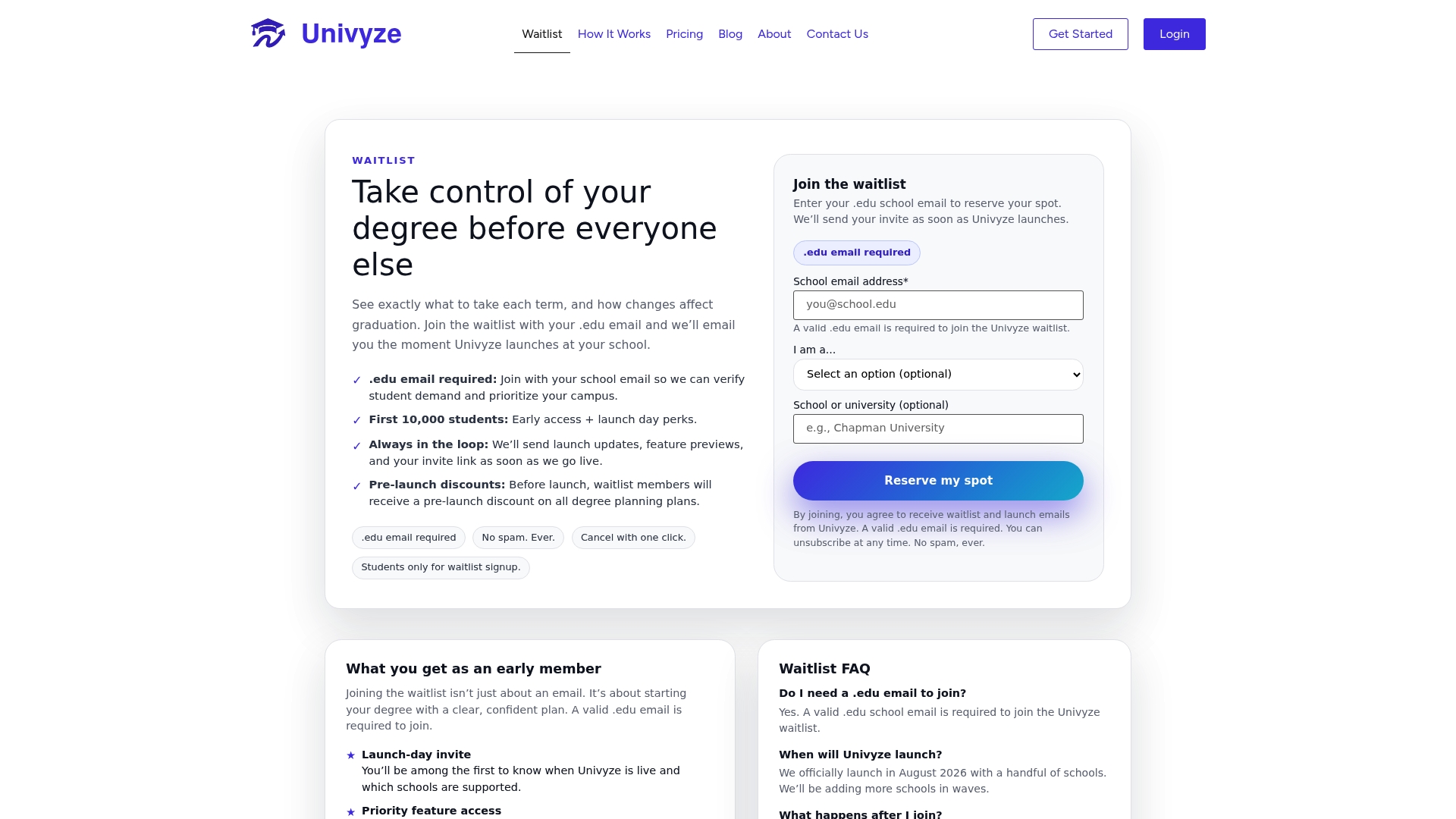
The Starter plan is listed at 0 USD, and paid plans are listed on our pricing page: for example, Core at 359.40 USD per year or 1095 USD one-off. Univyze does not guarantee course availability, credit acceptance or any academic outcome, and it does not replace your official degree audit or advisor. If you would like a clearer plan before your next registration window, join the Univyze waitlist at univyze.com.
FAQ
Is independent study the same as an internship or research assistant work?
Not usually. Some schools explicitly bar independent study credit for serving as a lab assistant or for an internship or career-development experience, as Marquette’s policy does. Other schools run research credit through a similar form, so ask your department which category your project belongs to.
How many independent study credits can I count toward my degree?
It depends on the school. Saint Louis University caps undergraduates at 12 total credits, SUNY Polytechnic Institute at eight, and UT Dallas allows six semester credit hours on a degree plan, according to their published policies linked above. Your department may set a lower limit for your major, so check your catalog and ask your advisor.
Can a freshman do an independent study?
Sometimes, but many schools set requirements first. The School of the Art Institute of Chicago, for example, requires at least 60 credits and completion of Sophomore Seminar. Ask your department for the minimum standing and GPA, and find a professor who knows your work.
Will an independent study replace a required course?
Only if your school approves it. Marquette normally does not allow independent study to fulfill major, minor or curricular requirements without a waiver, and Seattle Pacific University creates independent study versions of existing courses only when a needed class is unavailable. Get approval in writing and confirm it in your official degree audit.
Sources
- What Is Independent Study in College? (BestColleges)
- Directed/Independent Study for Undergraduates (UW–Madison)
- Independent Study Courses Policy (UNC-Chapel Hill)
- Directed Readings (Stanford)
- Independent Study Courses (Marquette University)
- Policy on Independent Study, Directed Study, and Research (Saint Louis University)
- Independent Study (UT Dallas EPPS)
- Independent Study Guidelines (University of Michigan Organizational Studies)
- Independent Study Authorization Form (SUNY Polytechnic Institute)
- Guidelines for Independent Studies (Lexington Theological Seminary)
- Independent Study (School of the Art Institute of Chicago)
- Independent Study (Trinity College, Duke University)
- Research, Internships, and Independent Study (Johns Hopkins)
- Independent Study (Seattle Pacific University)
- University at Buffalo