

Most U.S. colleges treat 12 credits as the federal full-time minimum, 15 credits as the pace that keeps a four-year degree on track, and 18 credits as the usual maximum before you need permission. Overloads above that typically require a petition, a cumulative GPA around 3.0 to 3.3, and evidence you’ve successfully handled a heavy semester before. Summer sessions cap much lower, often limiting total credits across all sessions combined.
TL;DR:
- Most colleges set 18 credits as the upper limit for a regular semester, with anything above requiring formal approval and often a GPA of at least 3.0.
- Registering for more than 15 credits is advisable only if you have strong prior success with heavy course loads or specific transfer and AP credits.
- Summer session credit caps generally range from 12 to 14 across all combined sessions, with approvals for overloads being rare due to compressed workload demands.
- Overload petitions are usually approved only up to 21 or 22 credits and must be filed during open enrollment with strong academic standing and a clear schedule.
- Checking your school’s specific credit limits and preparing your petition early helps avoid delays and increases chances of approval.
Table of Contents
- What “Full-Time” Actually Means for Your Semester Credit Limit
- Who Sets the Institutional Maximum and Why It Varies
- How the Credit Overload Petition Process Actually Works
- Why Summer and Short-Session Credit Caps Run Lower
- The Real Cost of Overloading: Grades, Burnout, and Tuition Surcharges
- Checking Your School’s Exact Limits and Filing an Overload Request
- Repeated Courses and Their Effect on Your Credit Total
- Univyze’s Take: Planning Ahead Beats Petitioning Later
- Plan Your Credit Load Before You Need a Petition
- Where to Verify Your Campus Credit Limits
- Sources
- FAQ
What “Full-Time” Actually Means for Your Semester Credit Limit
The number that shows up on your financial aid paperwork is not the number your advisor wants you hitting. Federal financial aid rules set full-time status at 12 credits per semester, which is the floor, not a target. That figure exists mainly for reporting and eligibility purposes, not academic planning.
Fifteen credits per semester is the pace most bachelor’s degree programs are actually built around. A standard 120-credit bachelor’s degree, divided across eight semesters, comes out to exactly 15 credits each term. Drop to 12 credits a semester and the math changes fast: you’re now looking at ten semesters instead of eight, which is an extra year most students don’t budget for financially or emotionally.
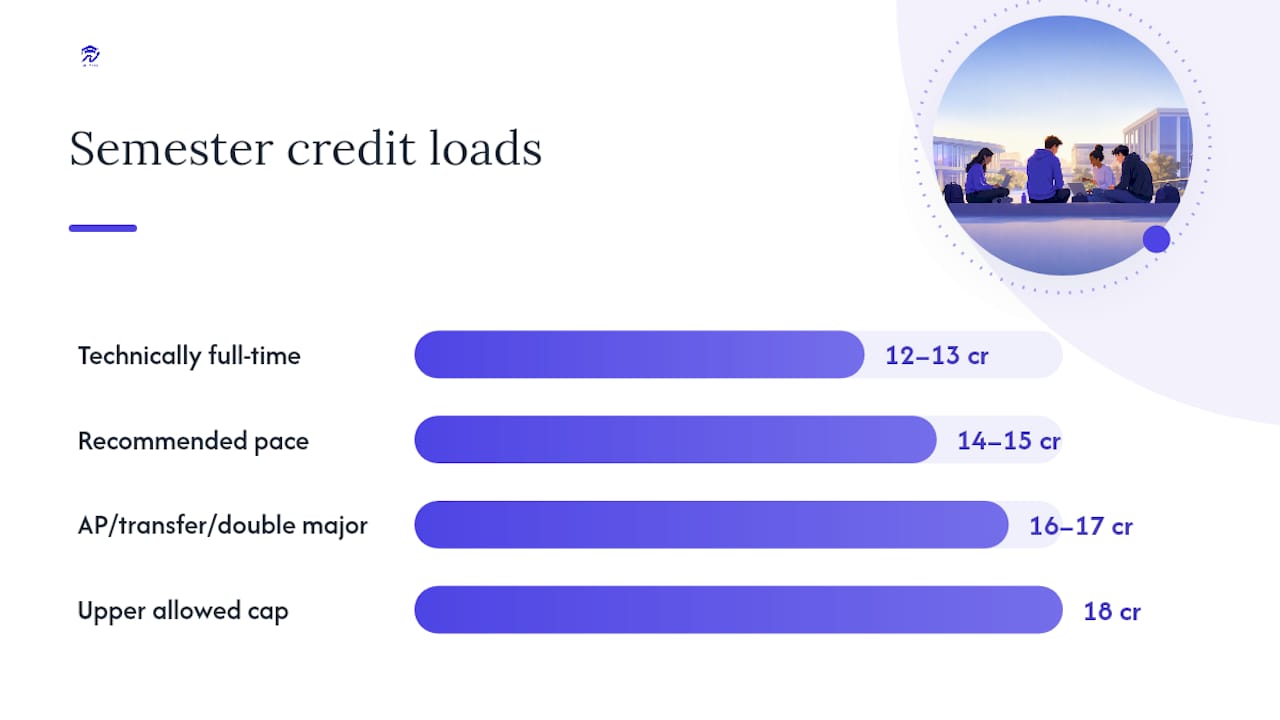
University catalogs draw this line explicitly. ASU’s academic catalog defines a standard full-time course load as 12 to 18 credits per fall or spring semester, with 15 credits flagged as the recommended pace for four-year completion. That range, 12 to 18, is the band you’ll see repeated across most American colleges, though the labels attached to each number shift.
Here’s how the ranges typically break down in practice:
- 12 to 13 credits: technically full-time, but this pace usually stretches a four-year degree closer to five.
- 14 to 15 credits: the sweet spot most academic plans are built around, and the number advisors push toward.
- 16 to 17 credits: common for students with AP credit, transfer credit, or a double major to fit in.
- 18 credits: the upper edge most schools allow without extra paperwork.
Course availability plays into this more than students expect. A 15-credit semester usually means four classes at 3 to 4 credits each, plus maybe a lab or seminar. Push to 18 and you’re adding a fifth full course, which tightens your schedule and raises the odds of a time conflict between two required classes.
Who Sets the Institutional Maximum and Why It Varies
Your registrar’s office, not a national standard, decides how high you can go. Each college or school within a university, engineering, business, liberal arts, fine arts, often sets its own ceiling, and those ceilings don’t always match.
Eighteen credits is the number you’ll see most often as a default maximum before a student needs a petition or advisor sign off. But that default isn’t universal. The University of Nebraska’s registrar publishes a maximum credit-hour chart showing real variation by college, with examples ranging from 19 to 21 credits depending on the program. Engineering programs, which often run heavier lab and studio loads, sometimes get a slightly different ceiling than a liberal arts college at the same school.
A few patterns show up again and again in these published charts:
- 18 credits as the general campus default across most colleges.
- 19 to 21 credits for specific schools like engineering, business, or fine arts, where prerequisite sequencing sometimes justifies a higher standard load.
- Hard caps around 20 credits at some institutions, meaning no petition, no advisor note, and no GPA gets you past that number under any circumstance.
- Session-specific maximums that apply on top of the semester cap, particularly at schools running A/B/C session structures within one term.
That last point trips students up constantly. A semester isn’t always one flat block. Some schools split fall and spring into overlapping sessions, and your total credit count across all of them still has to fit inside the semester ceiling. Registering for a heavy load in an early session can quietly block you from adding a later-session course once the combined total exceeds the cap.
The takeaway: never assume your friend’s 20-credit semester means you’re cleared for 20 too. Check your specific college’s chart, because the number tied to your major might be lower, or in rarer cases, higher.
How the Credit Overload Petition Process Actually Works
Wanting extra credits and getting approved for them are two different things. A credit overload petition is the formal request that authorizes a course load above your school’s standard maximum, and it almost always routes through an advisor, department chair, or committee rather than being an automatic click in your registration portal.
Approval criteria differ by campus, but the same few requirements show up repeatedly:
- Minimum cumulative GPA, commonly somewhere between 3.0 and 3.3. UMass Amherst’s College of Natural Sciences overload petition lists good academic standing and a strong GPA history as baseline expectations before a request even gets reviewed.
- No outstanding incompletes on your transcript. A committee reviewing your request wants to see that you finish what you start.
- Evidence of prior success with a similarly heavy semester, ideally one where you posted a solid GPA, not just survived it.
- Degree-seeking, enrolled status, since overload requests generally aren’t available to students taking courses outside a formal degree program.
Timing matters as much as the paperwork itself. Petitions typically need to be filed during open enrollment, before add/drop deadlines close, and many schools won’t even consider a mid-semester request to bump your credit total upward. The system enforces this at the registration level: you often can’t register for overloaded credits until the petition clears, which means a late filing can cost you the seat in a class you needed.
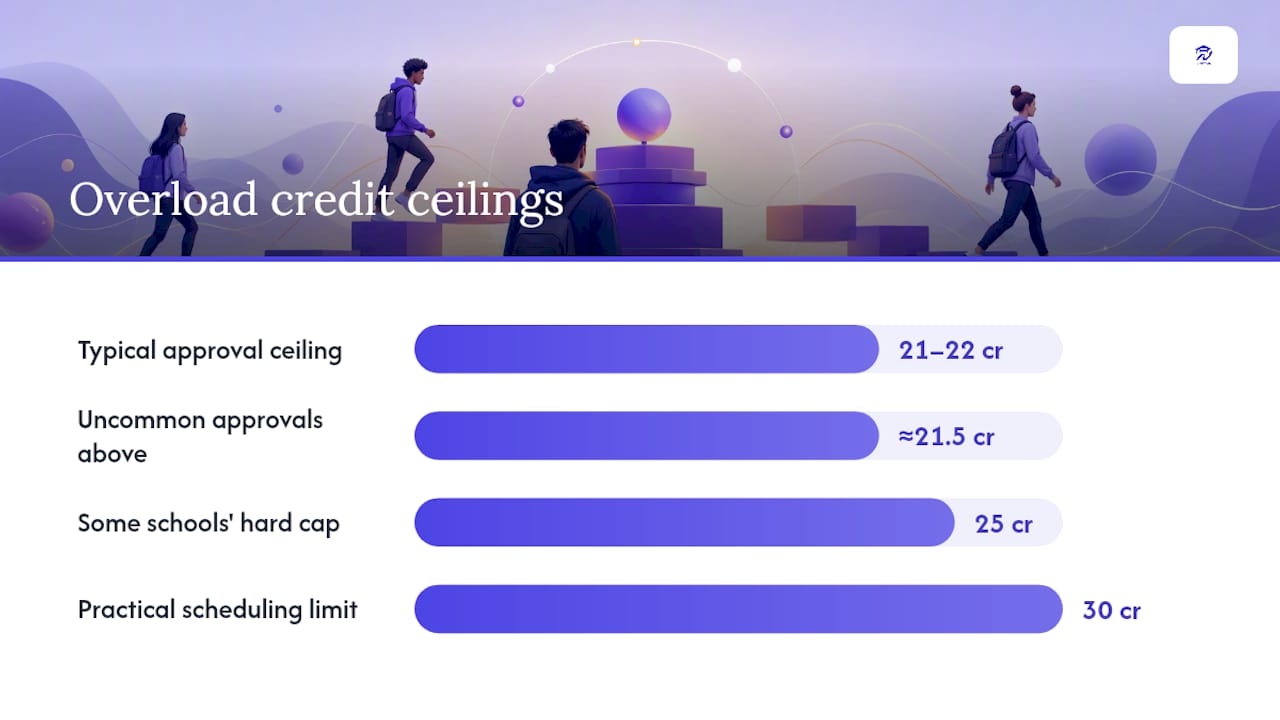
Realistic ceilings matter here too. Most schools rarely approve overloads beyond 21 to 22 credits, even for strong students. Hunter College’s advising office notes that overload approvals above roughly 21.5 credits are uncommon in practice, and some institutions flatly disallow anything past 25 credits regardless of GPA. If you’re picturing a 30-credit semester, that’s not a petition problem, that’s a scheduling impossibility at almost every American college.
Pro Tip: File your overload petition the same week registration opens, not the week before classes start. Advisors process these on a rolling basis, and the seats in your target courses won’t wait for committee review to catch up.
Why Summer and Short-Session Credit Caps Run Lower
Compress a semester’s worth of material into six weeks and the workload math changes completely. That’s why summer and short-session credit limits sit well below the standard 15 to 18 credit range, and why overload requests for summer terms get approved far less often.
Total summer credit limits commonly land around 12 to 14 credits across all sessions combined, not per session. UW-Madison’s registrar publishes specific per-session caps that illustrate how this adds up:
- 4-week sessions: typically capped around 3 to 4 credits, since there’s no realistic way to absorb more material in that window.
- 6-week sessions: often capped near 7 credits.
- 8-week sessions: commonly allowed up to 9 credits.
- Combined summer total: usually held to that 12 to 14 credit ceiling even if you’re stacking multiple short sessions back to back.
The logic is straightforward: a 3-credit class compressed into four weeks demands roughly the same total study hours as a full semester version, just packed into a fraction of the calendar time. Taking two of those simultaneously isn’t a lighter version of overloading, it’s a heavier one.
Summer overload approvals are rare for exactly this reason. If you’re weighing whether to push your summer load higher to catch up on credits, talk to your advisor about alternatives first, transfer credit from a community college, a dual-enrollment course completed in high school, or simply shifting one class to the fall semester instead.
The Real Cost of Overloading: Grades, Burnout, and Tuition Surcharges
An approved overload petition doesn’t mean overloading is free of consequences. It just means the paperwork cleared.
Heavier course loads correlate with lower grades in the courses students are least prepared for, and burnout risk climbs when five or six demanding classes compete for the same 24 hours in a day. A 3.8 GPA earned across 15 credits doesn’t automatically hold at 21 credits, especially in a semester stacked with lab sciences or writing-intensive seminars.
There’s a financial dimension too, and it catches students off guard. Many schools charge per-credit rates once you exceed a flat-rate tuition band, meaning your 19th and 20th credit can cost extra even if your first 18 were covered under a flat semester fee. Some institutions go further with an earned-credit plateau surcharge: UW-Milwaukee’s registrar policies describe a surcharge equal to 100% of resident tuition once a student accumulates roughly 165 earned credits, a policy designed to discourage students from drifting well past what their degree actually requires.
Before petitioning for extra credits, weigh the alternatives:
- Summer or winter session courses spread the load without inflating a single semester.
- AP, dual-enrollment, or transfer credit can shrink your remaining requirement without adding a heavier fall or spring term.
- A degree plan review with your advisor sometimes reveals overlap or substitution options you didn’t know existed.
If you’re already carrying a heavy load this term, Univyze’s guide to managing an overloaded semester schedule walks through practical ways to protect your GPA without cutting corners.
Checking Your School’s Exact Limits and Filing an Overload Request
Every campus publishes its own numbers, and guessing at them is how students end up filing petitions that get rejected on a technicality. Start with the source, not a forum thread or a friend’s guess.
- Pull up your registrar’s course load policy and your university catalog’s credit-limit section, the same kind of page ASU and Nebraska publish, since these list the exact maximum for your specific college or major.
- Check your degree audit, whether that’s DegreeWorks, DARS, or your school’s equivalent, to confirm the extra credits are actually necessary and not duplicating something you’ve already satisfied.
- Assemble your petition packet: GPA transcript, a note on prior high-credit semester performance, and a schedule map proving no time conflicts exist between your requested courses.
- Meet with your advisor before open enrollment closes, register for the maximum allowed credits first, then submit the overload request for anything above that.
- If denied, pivot fast: look at summer courses, transfer credit options, or a revised degree plan rather than resubmitting the same request and hoping for a different answer.
Pro Tip: Bring your degree audit printout to the advisor meeting, not just your transcript. Committees approve overload requests faster when they can see exactly which requirement the extra credits satisfy.
Before building that petition, a degree requirement checklist can help confirm you actually need the extra credits in the first place.
Repeated Courses and Their Effect on Your Credit Total
Retaking a class you already passed doesn’t always count the way students assume it will. Most colleges apply a repeat policy where the credits from a repeated course count once toward your total, even though the grade from the most recent attempt is usually what replaces the earlier one in your GPA calculation. That distinction matters when you’re mapping out how many more credits you actually need to hit your degree total.
Retaking a course you failed is different from retaking one to raise a grade you already passed, and policies often treat them separately. A failed course typically must be repeated to earn credit at all, while a passed course retaken for a higher grade may not add any new credits toward graduation, since you already banked those the first time.
This becomes a planning trap when students stack a repeat alongside a full course load, assuming the repeat is a light addition. It isn’t. A repeated course occupies a seat and a credit slot in your semester total just like any new class, and it counts against your semester credit limit the same way. If you’re already near your school’s cap and need to retake something, that repeat may be the reason you can’t add a fifth course this term.
Check your catalog’s repeat policy section specifically, since some schools also limit how many times a course can be repeated for credit or GPA replacement, and financial aid rules around repeated coursework can differ from your school’s own academic policy.
Univyze’s Take: Planning Ahead Beats Petitioning Later
The overload petition process exists because students often discover their credit gap too late to fix it gracefully. That’s a planning failure, not a paperwork failure. A dynamic dashboard that maps your degree requirements against real course offerings lets you spot a looming shortfall in sophomore year instead of scrambling for a 21-credit semester as a senior. Univyze does exactly that, running what-if scenarios and folding in AP, dual-enrollment, and transfer credit automatically. It’s a planning tool, not a substitute for your official degree audit or your advisor’s sign-off, but it can catch the sequencing problems that turn into overload requests.
— Ryan
Plan Your Credit Load Before You Need a Petition
Univyze is the planning layer between your degree requirements and the actual courses available each term, built so you catch a credit shortfall in sophomore year instead of a scramble senior spring.

The dashboard maps your remaining requirements against live course offerings, runs what-if scenarios for adding a minor or shifting a summer session, and folds in AP scores, dual-enrollment credit, and transfer coursework automatically instead of leaving you to reconcile three separate transcripts by hand. Parents get visibility into progress too, which cuts down on the “how many credits do you actually have left” conversation. None of this replaces your official degree audit, your university catalog, or a real conversation with your advisor. Univyze is a way to see the path clearly and decide, well before registration opens, whether an 18-credit semester is genuinely necessary or whether better sequencing gets you there without a petition at all. Plans start at $359.40 a year for Core, with a free Starter tier available if you want to try the dashboard first. Join the Univyze waitlist to get notified when full access opens up.
Where to Verify Your Campus Credit Limits
Registrar pages and catalog policy sections are the only fully reliable source for your school’s exact numbers, since every campus sets its own maximums and overload criteria.
- Your registrar’s course load and concurrent enrollment policy page, similar in structure to ASU’s course load catalog entry.
- Your college-specific maximum credit-hour chart, the kind Nebraska’s registrar publishes by school and term.
- The credit overload petition form itself, downloadable from your college’s advising office, similar to UMass Amherst’s Natural Sciences petition.
- Federal full-time enrollment definitions, relevant for financial aid reporting alongside your academic plan.
Sources
- Course load and concurrent enrollment | Academic Catalog
- Credit Overload Petition : College of Natural Sciences : UMass Amherst
- Maximum Credit Hour Load | Office of the University Registrar | Nebraska
- Credit load and ranges | UW-Madison KB
FAQ
Is there a credit limit per semester?
Yes, and it’s set by your specific college or university, not a national standard. Most schools cap standard enrollment at 18 credits per semester before requiring a petition, though some colleges within a university allow up to 19 to 21 credits depending on the program.
Can I get 24 credits in a semester?
It’s possible but uncommon, and it would almost always require an approved overload petition well above typical ceilings. Most institutions rarely approve overloads beyond 21 to 22 credits, and some cap overload approvals at 20 credits regardless of GPA, so 24 would exceed what nearly every U.S. college allows.
Can I take 12 credits in a semester?
Yes, 12 credits is the standard federal and financial-aid definition of full-time status at nearly every U.S. college. It’s a valid, common course load, though it stretches a typical 120-credit bachelor’s degree closer to five years instead of four.
Can I get 30 college credits in one semester?
No, this isn’t realistic at any accredited four-year institution under normal enrollment rules. Even the most generous overload policies rarely clear 25 credits, and most schools set hard ceilings well below that, since course scheduling and academic workload simply don’t allow for it.