

To keep federal financial aid, you have to meet your college’s Satisfactory Academic Progress (SAP) rules. They almost always come down to three numbers: a minimum cumulative GPA (often 2.0), a completion rate (often about 67% of the credits you attempt), and a cap on total credits (150% of your program’s length). Your school sets the exact version, so your financial aid office’s published policy is the one that counts. This guide explains each standard, shows how the math works, and covers what to do if you slip.
TL;DR
- SAP is a federal requirement, but each school writes its own policy within the Department of Education’s minimums.
- Typical standards: a 2.0 cumulative GPA, completing about 67% of attempted credits, and finishing within 150% of your program’s published length.
- Falling short can cost you federal aid, but you can appeal, and a successful appeal can lead to probation or an SAP academic plan.
- Withdrawals, repeats, changed majors and transfer credits all affect your numbers, so plan terms ahead instead of reacting after grades post.
- Always confirm your own school’s thresholds with the financial aid office.
Table of Contents
- What SAP is and who sets it
- The three SAP standards
- A worked example
- When SAP is checked and what counts
- What happens if you do not meet SAP
- What an SAP academic plan is
- Does SAP follow you if you transfer?
- Do private loans require SAP?
- How to stay on pace: plan before the grades post
- Where Univyze fits
- Our perspective
- FAQ
- Sources
What SAP is and who sets it
SAP policies measure whether aid recipients are earning the grades and completing the classes needed to finish their credentials at an appropriate pace. According to NASFAA’s SAP reference sheet, each school writes a policy that meets Department of Education minimums, with a qualitative part (grades) and a quantitative part (pace), checked at least once every award year. An award year is the July-to-June period that your aid package covers.
The federal rule behind this is 34 CFR 668.34. It also says your school’s SAP policy must be at least as strict as its standards for students who do not receive federal aid, and must be applied consistently within each student category. So the rules can be stricter than the federal floor, but never looser.
The three SAP standards

1. Minimum GPA
The regulation requires a specified GPA at each evaluation. For programs longer than two academic years, you need at least a C average, or the equivalent, by the end of your second academic year, or an academic standing consistent with the school’s graduation requirements.
In practice, 2.0 on a 4.0 scale is the common number. Many colleges set it exactly there. Some schools use a sliding scale. The University of Missouri requires a 1.67 cumulative GPA below 60 attempted credit hours and 2.0 from 60 hours on, with 3.0 for graduate programs. NASFAA gives another example of a scale: 1.50 for the first 12 credits, 1.75 for credits 13 to 24, and 2.0 after that.
One thing surprises students: the SAP GPA can be higher than the GPA your school needs to keep you enrolled. NASFAA’s example is a school that lets you stay enrolled with a 1.0 average while SAP asks for a cumulative 2.0. Being in good standing with the registrar does not automatically mean you are meeting SAP.
2. Pace (completion rate)
Pace is the share of attempted credits you actually complete. Many schools use 67%. Auburn University uses 67% of hours attempted, and Missouri uses 66.67%.
The number is not random. NASFAA explains that 67% follows from the 150% time cap: if you complete at least two-thirds of what you attempt (100 divided by 150), you stay on track to finish inside the limit.
What counts as “attempted”? Generally every credit you enroll in and stay in past the add/drop period, including courses you withdraw from, fail, or take an incomplete in. Check your school’s policy for the exact definition. The FSA Handbook adds that pass/fail courses count as attempts for pace but are not factored into GPA, unless the program is primarily or entirely pass/fail.
3. Maximum timeframe
For undergraduates, the maximum timeframe is no more than 150% of the published length of your program. That is measured in credits. A 120-credit bachelor’s degree gives you a ceiling of 180 attempted credits. A 60-credit associate degree gives you 90.
That ceiling counts everything you attempted, including credits from changed majors, repeats and withdrawals. Some schools also count transfer credits that apply to your program. This is why students who switch majors twice can hit the cap even with decent grades. If you are weighing a switch, our guide to a change-major plan that protects your aid walks through how to map it before you commit.
A worked example
Say you are in a 120-credit program at a school with a 2.0 GPA, 67% pace and 150% cap.
| Standard | Your limit | Example student | Result |
|---|---|---|---|
| Cumulative GPA | 2.0 | 2.3 | Meets |
| Pace this year | 67% | 24 attempted, 15 completed (62.5%) | Falls short |
| Maximum timeframe | 180 credits | 96 attempted so far | Meets, with 84 credits of room |
This student has a fine GPA and plenty of room, yet fails SAP because of pace. Dropping or failing nine credits in a year does that quickly. Two withdrawals and one F in a 15-credit semester can be enough to put you under 67%.
To get the other side: attempting 12 credits and completing 9 is 75%, comfortably above the line. Completing 8 of 12 is 66.7%, which is right at the edge, and whether it passes depends on whether your school rounds. Ask rather than assume.
When SAP is checked and what counts
For programs of one academic year or less, schools evaluate at the end of each payment period. For longer programs, they evaluate at the end of each payment period or at least annually, aligned with a payment period. Many colleges check after every term. Auburn, for example, evaluates at the end of each term and puts students who fall below the standards on a Warning status while they remain aid-eligible.
A few details that trip students up:
- Withdrawals and drops can hurt pace even when they do not touch your GPA. Dropping inside the add/drop window usually does not count as an attempt, but withdrawing later does. Read our explainer on withdrawal vs. drop and the 60% rule before you give up a class mid-term.
- Pass/fail classes count toward pace but not GPA at most schools, so a “P” helps your completion rate while a “NP” hurts it. You can model pass/fail requirements and outcomes before you pick that option.
- Repeats add to attempted credits each time. They can help your GPA but cost you pace and timeframe.
- Part-time enrollment is evaluated on the credits you attempt, but your aid amount depends on enrollment level. If you are unsure what counts as full time, see how many credits full time requires.
What happens if you do not meet SAP
Failing SAP means losing federal aid eligibility, but that is rarely the end of the road. Under the FSA Handbook, you may appeal based on injury or illness, the death of a relative, or other special circumstances. The appeal needs to explain what changed so you can now succeed.
Schools write their own appeal rules. Hancock College’s appeal form states that appeals must show the circumstances are resolved, that not knowing about SAP or being unprepared for coursework is not accepted, that appeals are due within the academic year, and that a denied appeal can be reviewed a second time with added documentation. Your school’s form will have its own wording.
A successful appeal can put you on financial aid probation for one payment period, with or without an academic plan. If you do not appeal, you can still regain eligibility by meeting the school’s SAP standards on your own. What does not work is simply sitting out a semester or paying for classes yourself. The FSA Handbook says neither restores eligibility by itself.
Two more points worth knowing:
- Federal rules do not provide for academic amnesty. According to an older FSA Handbook edition, schools must include courses that apply to your program in SAP, though the reasons behind an amnesty request can count as mitigating circumstances in an appeal.
- Schools may cap appeals. Santa Fe College, for example, limits students to three lifetime SAP appeals, though program-change appeals do not count against that limit.
What an SAP academic plan is
If your appeal shows you need more than one payment period to get back to the standards, the school and you develop an academic plan. The FSA Handbook says the regulations do not specify the contents, but the plan must ensure you meet SAP by a specific time or complete the program, and your progress is reviewed at the end of each payment period.
NCASFAA’s 2026 conference materials add that plans must be monitored, updated and documented with terms and benchmarks, and that you must appeal to change one.
What do the terms look like? They vary. Santa Fe College’s plan requires students to complete 100% of attempted courses with a C or better until they meet the SAP minimums. That is a tight standard, which means every course choice matters. Think about which classes you are most likely to pass, which ones are offered next term, and whether a summer session can help you catch up. For athletes, the stakes are even higher because eligibility rules stack on top of SAP. Need-based aid for athletes is worth reading for how aid and eligibility fit together, and our athlete course scheduling guide shows how to build a semester plan around it.

Does SAP follow you if you transfer?
Yes, in most cases. Seminole State College’s policy, for example, says a transfer student arriving with failed SAP is ineligible for aid for the first term, and transfer credits that count toward the current program count as attempted and completed hours. Eligibility can come back by meeting the standards or winning an appeal. The FSA Handbook says schools must at least count transfer credits that apply to your program.
So if you are planning a transfer, your old attempts and your pace travel with you. Ask the new school’s financial aid office how it evaluates incoming credits before you enroll.
Do private loans require SAP?
It depends on the lender. A university’s private lender information sheet from April 2024 lists some lenders without a SAP requirement and others with one. Some credit-union loans, such as DCU’s student loan, require you to meet your school’s minimum SAP criteria and can deny funding or close the line of credit if you fail. Read the terms of your specific loan, and ask your financial aid office which lenders apply to your school.
How to stay on pace: plan before the grades post
SAP problems rarely come from one big event. They build from small ones: a dropped class, a major change, a repeat, a course that was not offered when you needed it. Most are visible in advance if you map your terms.
A simple routine:
- Find your three numbers. Look up your school’s GPA, pace and timeframe rules on the financial aid website.
- Count your credits. Total attempted, total completed, and the 150% ceiling for your degree.
- Plan each term. Put your required courses in order, check prerequisites, and note which classes only run in certain terms. Our guides on course availability planning and prerequisites and corequisites help here.
- Use summers and credits you already have. AP, dual enrollment, transfer and summer credits can all change how many terms remain, subject to your school’s acceptance of them.
- Test changes before making them. Before dropping a class or switching majors, see what it does to your pace and timeline.
- Confirm with the school. Your financial aid office, registrar and academic advisor have the official answers.
Where Univyze fits
Univyze is a degree planning platform, not an official degree audit and not a replacement for your academic advisor. It links your degree requirements to real course offerings, lays out a term-by-term plan, and lets you run what-if scenarios for a major or minor change. It also handles AP, dual-enrollment and transfer credits, summer sessions and schedule conflicts, and gives parents and advisors a shared view of progress. Seeing the whole path makes it easier to notice when a term is too light, or when a withdrawal would leave you short.
There is a free Starter plan at $0. Paid plans are listed on the Univyze pricing page: Core is $359.40 per year, Plus is $599.40 per year and Pro is $1,199.40 per year, with one-time options too. Course availability and credit acceptance depend on your school, so confirm them there.
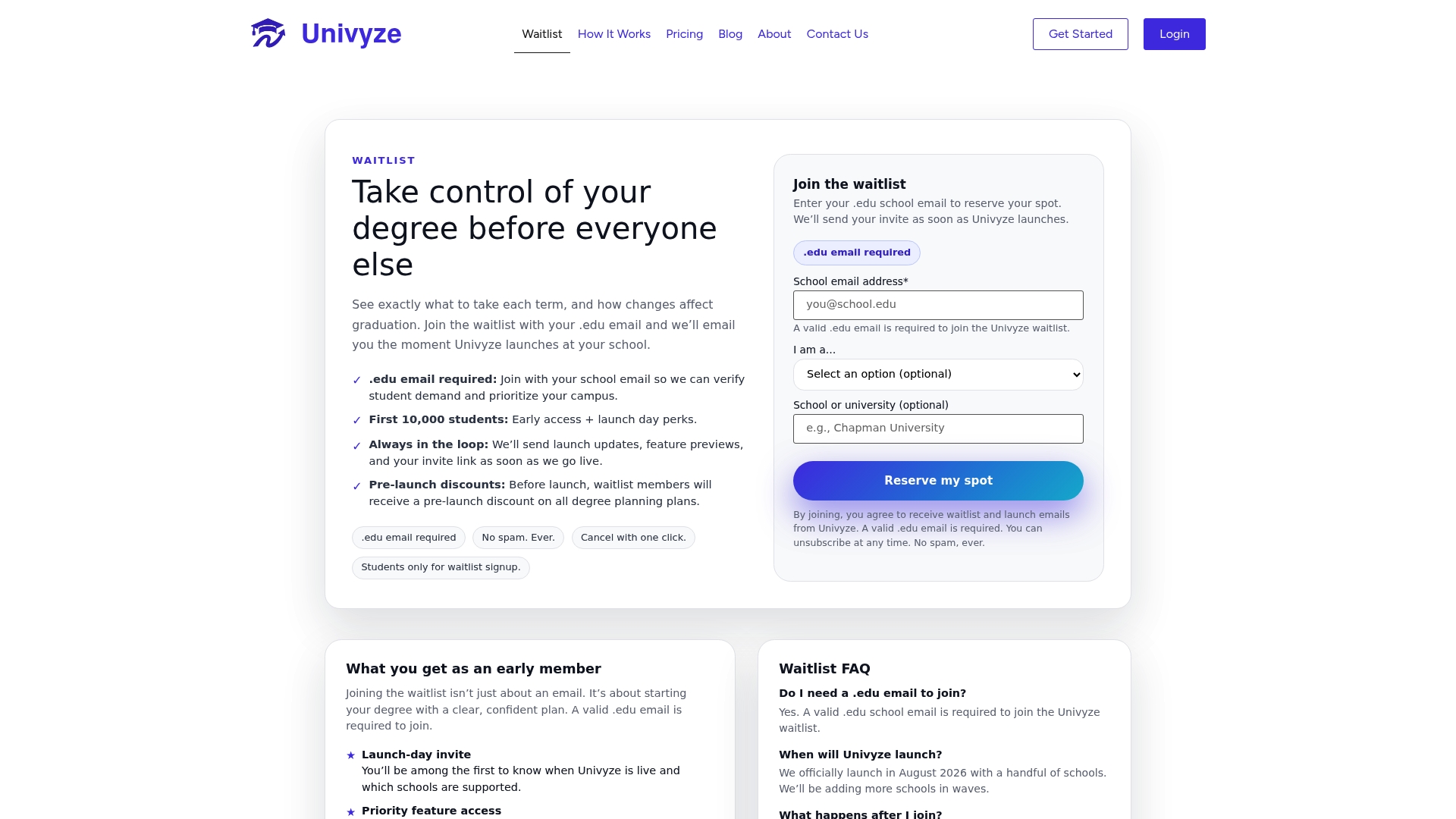
If you want to see your path before the next registration window, join the Univyze waitlist at univyze.com.
Our perspective
Most students first hear about SAP when they get an email saying their aid is at risk. By then the numbers are set. The grades are in, the withdrawals are filed, and the only move left is an appeal.
We built Univyze around a different idea: the reason students lose pace is usually unclear planning, not lack of effort. A required class is only offered in fall. A prerequisite was missed. A major change adds a semester nobody saw coming. Each of those is easier to handle when you can see the whole degree laid out term by term, with real course offerings attached.
That is why we focus on visual degree mapping, what-if planning and shared dashboards for families and advisors. They give you something concrete to bring to an advising appointment and a way to check your plan against your financial aid office’s published standards. They do not replace your official audit or your advisor, and we do not promise outcomes. They help you plan smarter, so fewer surprises reach your aid.
Ryan
FAQ
What GPA do I need to keep financial aid?
Most schools require a cumulative GPA of at least 2.0, which is a C average. Some use a lower standard in the first year, such as 1.67 under 60 attempted credits at the University of Missouri. Your school’s financial aid website lists its exact number.
What is the 67% rule in SAP?
It is the completion rate many schools require: you must earn at least about two-thirds of the credits you attempt. It matches the 150% maximum timeframe, since finishing 67% of attempts keeps you on pace to graduate within that limit. Withdrawals and failed classes count as attempted but not completed.
What is an SAP academic plan?
An academic plan is an agreement between you and your school, created after an appeal, when you need more than one payment period to meet SAP. It sets benchmarks you must hit, and the school reviews your progress at the end of each payment period. Changing the plan generally requires another appeal.
Does SAP follow me to another school?
Often it does. Many schools count transfer credits that apply to your program as attempted and completed, and some treat a student arriving with failed SAP as ineligible for aid for the first term until they meet the standards or win an appeal. Ask the new school’s financial aid office.
Do Sallie Mae loans require SAP?
One university’s April 2024 lender sheet lists Sallie Mae among lenders without a SAP requirement. Terms differ by lender and can change, so check your loan agreement and ask your financial aid office.
Sources
- NASFAA: Satisfactory Academic Progress reference sheet
- eCFR: 34 CFR 668.34, Satisfactory academic progress
- FSA Handbook 2026-2027, Student Eligibility
- FSA Handbook, earlier edition, Student Eligibility
- Auburn University: Maintain Aid
- University of Missouri: Satisfactory Academic Progress
- Hancock College: SAP appeal form
- Santa Fe College: Satisfactory Academic Progress
- NCASFAA 2026: Satisfactory Academic Progress
- Seminole State College: Satisfactory Academic Progress
- Point Park University: Private loan information sheet
- DCU: Student loan FAQ
- GetOffered: Need-based aid for athletes