

A prerequisite is a course or requirement you must finish before you can register for another class. A corequisite is one you take at the same time, or sometimes in a term right before, depending on the department. Mixing the two up is the fast track to a registration block: prerequisites can lock you out of a course entirely, while corequisites usually just require you to enroll in both classes together. When you’re not sure which rule applies, your degree audit and academic advisor have the final answer.
TL;DR:
- Prerequisites are strict requirements that must be completed before registration, while corequisites are courses taken simultaneously or sometimes earlier, depending on the department.
- Registration systems automatically enforce these rules by blocking or flagging courses if prerequisites aren’t met or corequisites are not enrolled in together, often triggering drops if violated.
- Bottleneck courses like sequential prerequisites can delay graduation significantly, making careful planning and early intervention essential to avoid unintentional delays.
- Waivers or overrides require documentation and approval from department officials, and students should proactively seek these to prevent registration issues.
- Inconsistent enforcement and variations across institutions can cause confusion, so students should always verify requirements directly with their specific university’s policies and advisors.
Table of Contents
- Corequisite vs Prerequisite: The Definitions You Actually Need
- What Corequisite and Prerequisite Rules Look Like in Practice
- How Registration Systems Enforce These Rules, and How to Fix a Block
- Why Requisite Planning Determines How Fast You Graduate
- How a Planning Dashboard Makes Requisite Chains Visible
- Where Prerequisite Rules Came From
- Do Corequisite and Prerequisite Rules Work the Same Everywhere?
- Do Prerequisites and Corequisites Actually Help Students Succeed?
- The Real Friction Points Students Run Into
- How Advisors Can Help Students Untangle Requisite Chains
- Why the Terminology Confusion Isn’t Really the Problem
- Sources
- FAQ
Corequisite vs Prerequisite: The Definitions You Actually Need
A prerequisite is a requirement, often a specific course, test score, or class standing, that you must complete successfully before the registration system will let you enroll in the next one. Skip it, and most schools will either block you from registering or administratively drop you once the enforcement check runs.
A corequisite works differently. It’s a course or requirement you take at the same time as the main class, though some departments allow you to satisfy it in a prior term instead. The most familiar example is a lecture paired with its lab: you register for both, and dropping one often forces you out of the other.
Two more terms show up constantly in course catalogs and confuse students just as often:
- Advisory (recommended preparation): suggested background knowledge that is not enforced. You can register without it, though you might struggle without the skills it covers.
- Exclusion / concurrent prerequisite: a rule that either blocks you from taking two overlapping courses at once, or links a prerequisite so tightly to a course that the system treats them as connected sections.
The distinction matters because advisories don’t block registration the way real prerequisites and corequisites do. Every campus writes its own version of these rules, so the exact enforcement mechanics differ from school to school even when the vocabulary sounds identical.
What Corequisite and Prerequisite Rules Look Like in Practice
- Lecture and lab pairing. Chemistry lecture plus chemistry lab is the textbook corequisite setup. You register for both in the same term, and the system usually links them as connected sections so you can’t drop one without a warning about the other.
- Sequential prerequisite chain. Chemistry I has to be completed, and usually passed with a minimum grade, before Chemistry II opens up. Fail Chemistry I, and Chemistry II disappears from your options next term.
- Concurrent prerequisite enrollment. Some systems let you register for an upper-level course while you’re still finishing the prerequisite, betting you’ll pass. If you don’t, you can be dropped during a later prerequisite check.
- Corequisite satisfied early. A math support course required alongside college algebra might be waived if you already passed a placement exam or earned transfer credit covering the same material.
How Registration Systems Enforce These Rules, and How to Fix a Block
Course registration platforms check prerequisites and corequisites automatically, usually the moment you try to add a class. If the system doesn’t see a completed prerequisite on your record, it either blocks the enrollment outright or lets you in provisionally and flags you for removal later. Corequisites often get treated as connected sections. Drop one, and the system may auto-drop the linked course unless you have special permission to keep it.
A few things to know before you hit a wall:
- Dropping a corequisite can force you out of its paired course without warning, depending on how the department linked the sections.
- Failing a prerequisite after you’ve already registered for the next course in the sequence typically triggers an administrative drop once grades post.
- Waivers and overrides are usually approved by a department chair, instructor, or the registrar, and they almost always require documentation. County College of Morris, for example, asks students to show proof of equivalent coursework or experience before granting an exception.
Pro Tip: If a class blocks you at registration, don’t wait. Email the department the same day, attach your transcript or test scores, and ask specifically what documentation they need for a prerequisite override. Departments process these faster earlier in the registration window, before their queue fills up with hundreds of other requests.
Why Requisite Planning Determines How Fast You Graduate
Certain classes function as bottlenecks. Miss the term when a required prerequisite is offered, and you can push every course that depends on it back a full year, not just a semester. This is especially common in engineering, nursing, and lab science programs where a sequence like Calculus I through III has to run in order with no shortcuts.
The fix starts with your degree audit. It’s the authoritative record of what you’ve completed and what still stands between you and your degree, and it updates automatically as you add, drop, or transfer courses. Pair it with your department’s course-offering pages, since not every prerequisite runs every term.
A few habits keep bottleneck courses from derailing your timeline; understanding how admissions tests like CASPer and PREview relate to your professional school prerequisites can be a key part of that planning (CASPer vs PREview: What Every Premed Must Know – MedSchoolPilot).
- Plan backward from the highest-level required course in your major, then map every prerequisite that has to happen before it.
- Use concurrent enrollment options when your department allows them, instead of assuming everything has to run strictly in sequence.
- Fill gaps with summer sessions, transfer credit, or AP credit where your program accepts them.
- Meet with your advisor every term and keep a written record of any waiver or override approval.
Missing a single prerequisite can trigger an administrative drop that quietly reorders your entire next year. Academic planners consistently point to semester-by-semester mapping as the best defense, since it surfaces these conflicts months before registration opens rather than the week of. A degree requirement checklist can help you build that habit early, and knowing how to choose classes that actually count toward graduation keeps you from wasting a registration slot on a course that doesn’t move you forward.
How a Planning Dashboard Makes Requisite Chains Visible
Reading prerequisite chains out of a course catalog is tedious, and it’s easy to miss a link buried three courses deep. A dashboard that maps your degree requirements against actual course offerings shows those dependencies visually, including which classes require concurrent corequisite enrollment, so the chain is obvious instead of hidden in fine print.
Some degree planning tools build term-by-term plans to address this challenge. They may factor in AP credit, dual enrollment, transfer credits, and summer sessions, and run what-if scenarios so you can see what happens to your timeline if you switch majors or add a minor. That kind of visibility can help catch bottleneck courses well in advance.
A few things worth knowing about how this fits into your planning:
- What-if sequencing lets you test a major change against your current credits without committing to anything.
- Term-by-term automatic planning updates as your credits and grades change, similar to how a degree audit refreshes.
- None of this replaces your official degree audit, university catalog, registrar, or advisor. Always confirm requirements with them before you register.
If you want to see how this looks for your own major, you can join the Univyze waitlist and get early access when it opens.
Where Prerequisite Rules Came From
Prerequisite systems grew out of a simple problem: as colleges added more course offerings through the 20th century, registrars needed a way to guarantee students had the background to succeed in advanced classes without manually checking every transcript. Sequential course numbering, still visible in labels like “Chemistry 101” leading to “Chemistry 201,” was an early attempt to signal order without formal enforcement.
Corequisites arrived later, largely as institutions restructured remedial education. Traditional developmental courses required students to finish remedial math or English before starting college-level work, which added a full term or more before students touched credit-bearing courses. Reform efforts pushed toward embedding support directly alongside the college-level course instead, so students take the credit course and the support session in the same term. Some schools now build that support directly into extra class meetings rather than a separate lab section, which changes how the course shows up on your schedule.
Digital registration systems accelerated all of this. Once enforcement became automatic instead of manual, colleges could apply prerequisite and corequisite rules consistently across thousands of sections, which is also why the language in course catalogs became more standardized nationally over the past two decades.
Do Corequisite and Prerequisite Rules Work the Same Everywhere?
Not even close. In the United States, prerequisite and corequisite enforcement is set at the institution or even department level, and community colleges tend to lean harder on corequisite remediation models than four-year universities do. A course that carries a strict enforced prerequisite at one school might carry only an advisory at another.
International systems diverge even more. Many European universities structure entire degree programs around fixed-year cohorts, where students take a set sequence of modules together, making the prerequisite question almost moot since there’s rarely an alternate path through the curriculum. The UK’s module-based system leans more heavily on formal prerequisites for specific specializations but rarely uses the corequisite label at all, describing linked requirements instead as “co-taught” or “paired” modules.
The practical takeaway for readers isn’t which system is better. It’s that catalog language is never universal. A term like “corequisite” carries different enforcement weight depending on which registrar’s office wrote the policy, so the Ohio State University SIS guidance and your own school’s catalog may define the exact same word slightly differently. Always read your specific institution’s definition rather than assuming it matches what a friend at another school describes.
Do Prerequisites and Corequisites Actually Help Students Succeed?
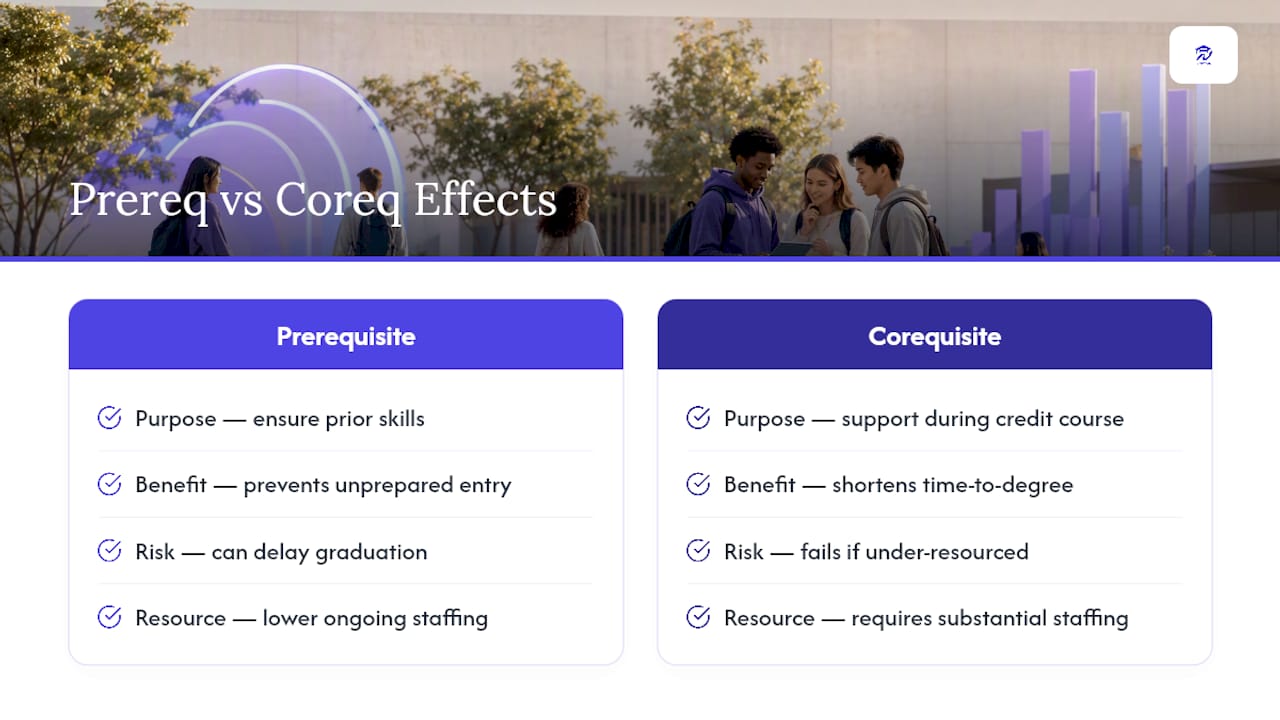
The argument for prerequisites is straightforward: they exist to make sure you have the skills a course assumes you already have. Walking into Organic Chemistry without General Chemistry usually ends badly, and the enforcement exists to prevent that outcome at scale rather than leaving it to individual judgment.
Corequisite models built for remediation show a different kind of benefit. Instead of making underprepared students clear a remedial course before touching college-level credit, corequisite support keeps them enrolled in the credit-bearing course from day one while providing help alongside it. That structure shortens time-to-degree for students who would otherwise stall out in a remedial sequence that doesn’t count toward graduation.
Neither model is free of downsides. Strict prerequisite chains can push graduation timelines back by a full year when a single required course only runs once annually and a student misses the window. Corequisite support courses, meanwhile, only work when the extra instruction is well resourced. Pair a large lecture with a token support session and understaffed tutoring, and the corequisite becomes a formality rather than real help.
The honest summary: both models work when the institution backs them with real capacity and clear advising, and both fail quietly when students don’t understand which requirement applies to which course.
The Real Friction Points Students Run Into
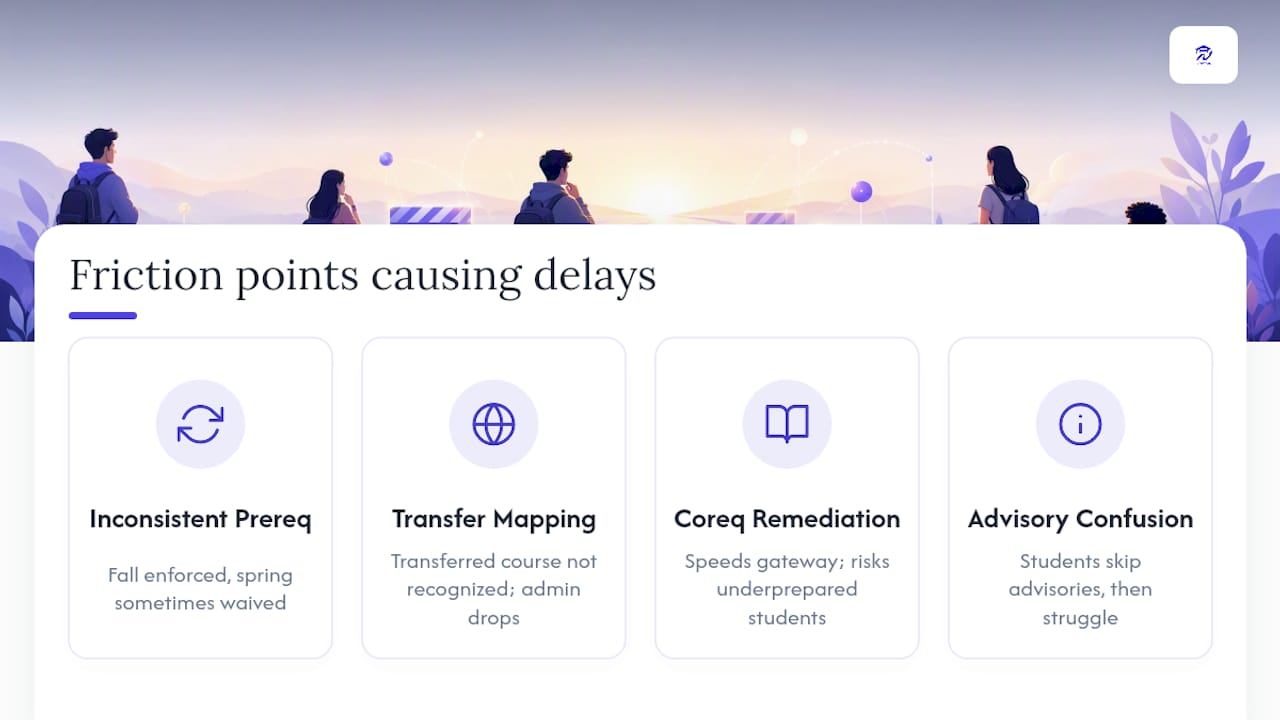
The most common complaint isn’t about the concept, it’s about inconsistency. A prerequisite that’s strictly enforced in the fall term sometimes gets waived informally in spring if the department is short on enrollment, and students rarely find out until they’re already mid registration.
Transfer students face a sharper version of the same problem. A prerequisite completed at one institution doesn’t automatically map cleanly onto the equivalent course at another, and articulation agreements don’t always keep pace with curriculum changes. This is one of the most frequent sources of unexpected administrative drops, since the receiving school’s system may not recognize a transferred course as satisfying its own prerequisite code.
There’s also a longstanding debate around corequisite remediation specifically. Supporters argue it gets students to credit-bearing coursework faster and reduces the number who quietly disappear during a remedial sequence that never counted toward their degree. Critics counter that it can push some students into college-level material before they’re ready, particularly when the support course is under-resourced. Both sides generally agree the policy needs enough funding to work, disagreement is mostly about execution, not the underlying goal.
Finally, plenty of students genuinely don’t know an advisory is different from an enforced requirement, and skip a recommended course assuming it’s optional filler, only to struggle in the next class because the system never blocked them, even though the skill gap was real.
How Advisors Can Help Students Untangle Requisite Chains
Good advising starts before a student ever hits a registration block. Advisors who walk incoming students through how their specific catalog defines prerequisite, corequisite, and advisory terms head off a huge share of confusion that otherwise surfaces during add/drop week.
A few practices separate advisors who catch problems early from ones who end up doing damage control:
- Reviewing a student’s degree audit every term, not just once a year, since audits update live as grades and transfer credit post.
- Flagging bottleneck courses the moment a student declares a major, especially ones offered only once a year.
- Walking transfer students through exactly how their prior coursework maps onto prerequisite codes at the new institution, rather than assuming the system will catch mismatches automatically.
- Helping students assemble waiver documentation in advance of registration, since approval usually requires proof of equivalent coursework and processing takes time.
None of this replaces a planning tool, but it does mean advisors and software work best together: one catches nuance and policy exceptions, the other keeps the full multi-term picture visible.
Why the Terminology Confusion Isn’t Really the Problem
The prerequisite versus corequisite distinction gets treated like a vocabulary quiz, but the actual risk is timing, not definitions. Most students who get burned aren’t confused about what the words mean. They’re confused about when their specific school enforces them, and that information lives in a catalog PDF nobody reads cover to cover.
Where I think the conventional advice falls short is the assumption that “check your degree audit” solves the problem by itself. Audits are accurate, but they’re reactive. They tell you what you’re missing right now, not what you’ll be missing in four semesters if a bottleneck course runs only once a year. That gap is exactly where students lose a semester without ever making an obvious mistake.
The better approach treats requisite mapping as an ongoing exercise, not a one-time catalog read during orientation week. Revisit it every time you consider a schedule change, a major switch, or a summer session. Tools that visualize dependency chains across multiple terms make that habit realistic instead of theoretical, but they’re a supplement to your advisor and official audit, never a substitute for either.
— Ryan
Sources
- Prerequisites & corequisites — Oklahoma State University registrar
- Build your academic plan — UC San Diego advising
- Prerequisites — County College of Morris catalog
- Build an academic plan — UCSD transfer advising
FAQ
What Is an Example of a Corequisite?
A common example pairs a lecture course with its lab, such as a chemistry lecture and chemistry lab you register for in the same term. Some math support courses also work as corequisites, required alongside a college-level math class rather than before it.
Can a Corequisite Be Taken Before the Main Course?
Sometimes, depending on department policy. Many corequisites must be taken concurrently, but some can be satisfied in a prior term if the department allows it, so check your specific course listing rather than assuming either rule applies.
Can I Drop a Corequisite Without Dropping the Main Course?
Usually not without consequences. Corequisites are often registered as connected sections, so dropping one typically triggers a warning or an automatic drop of the paired course unless you have special permission to keep it.
Can You Skip a Prerequisite in College?
Only with an approved waiver. Departments generally require documentation of equivalent coursework or experience before granting an override, and approval usually comes from a department chair, instructor, or the registrar rather than being automatic.