

If you are on an F-1 visa, your credit load is not just a scheduling choice. Undergraduates at a college or university must enroll in at least 12 credit hours per term to maintain a full course of study, and dropping below that without approval from your school’s designated school official (DSO) puts your status at risk. This guide explains the rule, how online classes count, when a reduced course load is allowed, and how to build a term-by-term plan that keeps you compliant and on track for your degree.
TL;DR
- F-1 undergraduates must enroll in at least 12 credit hours per term. Graduate students follow the full course of study their school certifies.
- No more than one online class, or three credits, counts toward your full course of study each term.
- A reduced course load (RCL) needs DSO approval before you drop credits. Qualifying reasons include initial academic difficulties, a temporary medical condition, or your final term.
- Dropping below full-time without approval can put you out of status, so talk to your DSO first.
- Twelve credits meets the visa rule, but a four-year degree usually needs more. Plan each term against your full degree, not just the minimum.
Table of Contents
- What a full course of study means for F-1 students
- How online classes count
- Full-time for visa purposes versus full-time for financial aid
- Why 12 credits is the minimum, not the plan
- When you can take a reduced course load
- How to request a reduced course load
- What happens if you drop below full-time without approval
- Perspective
- Planning your credit load term by term
- Plan your terms with Univyze
- FAQ
- Sources
What a full course of study means for F-1 students
The federal rule is simple at the undergraduate level. According to Study in the States, F-1 undergraduate students at a college or university must enroll in at least 12 credit hours per term. Postgraduate students must take a full course of study as certified by their institution, so the exact number depends on your program and your school’s policy. Your international student office will tell you the figure for your degree level.
A few points trip students up:
- Credits, not classes. A full-time load is measured in credit hours. Four 3-credit classes make 12. Two 4-credit lab courses and a 3-credit seminar make 11, which is not enough.
- Your school’s definition may be higher. The visa rule sets a floor. Your school, scholarship, or housing contract may ask for more.
- Non-degree programs use clock hours. F-1 students in non-vocational liberal arts, fine arts, or English language training programs must meet 18 clock hours per week when instruction is mostly classroom-based, or 22 clock hours per week when the program is mainly laboratory work, per the same Study in the States guidance.
If your school runs on quarters instead of semesters, the number of credits looks different on paper. Our quarter vs. semester conversion guide shows how to read credits when you move between systems. Always use your own school’s published full-time number as the one that counts.
Graduate and professional students should note that the threshold depends on the program. Many students see 9 credits mentioned for graduate work at their school. Treat that as something to confirm with your DSO rather than assume. If you want a plain-language overview of how minimums differ by program, this explainer on the F-1 minimum course load by program is a good starting point.
How online classes count
Online courses are the most common way international students accidentally fall short. The rule: F-1 students can count no more than one class, or three credits, per term or semester toward the full course of study if it is taken online or through distance learning. Study in the States states this directly.
Here is what that looks like in practice for a 12-credit undergraduate load:
| Schedule | Online credits | In-person credits | Meets the rule? |
|---|---|---|---|
| Four 3-credit classes, all in person | 0 | 12 | Yes |
| Three in person, one online (3 credits) | 3 | 9 | Yes |
| Two in person, two online | 6 | 6 | No, only 3 online credits count |
| Four online classes | 12 | 0 | No |
The second row is the safe ceiling. Registration systems do not always flag the problem for you, because a student with 12 registered credits looks full-time to the registrar. The immigration rule is separate from the school’s definition, so check your schedule against it before the add/drop deadline.
There is a second online-related requirement in your last term. F-1 students must take at least one course that requires physical attendance in their final academic term, according to a Study in the States reminder on online and distance learning. If you are planning a final semester of mostly remote classes, confirm the details with your DSO first.
Hybrid courses can be tricky too. Whether a hybrid section counts as in-person depends on how your school classifies it, so ask the international student office rather than guessing from the course title.

Full-time for visa purposes versus full-time for financial aid
Twelve credits shows up in more than one rulebook, which makes it easy to confuse them. For federal student aid, full-time in a standard-term undergraduate program is set by the institution and must be at least 12 credit hours, according to the 2025-2026 Federal Student Aid Handbook. Pell Grant amounts depend on enrollment intensity. Pell is a U.S. federal program for eligible students, and F-1 students generally are not eligible, so the point here is that 12 credits is a common national benchmark, not that you will receive that aid.
What matters to you more directly is your school’s own rules. Part-time status can affect scholarships, health insurance, campus housing, and other student services, depending on the school. Check your scholarship letter and your insurance plan before you change your load, not after.
Tuition also shifts with load. Some schools charge a flat rate across a band of credits, others charge per credit. Our guide to tuition per credit hour explains how to read your school’s billing so you know what an extra or dropped course really costs you.
Why 12 credits is the minimum, not the plan
Meeting the visa rule and finishing your degree on schedule are two different goals. Research from Columbia’s Community College Research Center points out that a 120-credit bachelor’s degree finished in four years without summer courses requires 15 credits per semester, and that the standard 12-credit definition of full-time often does not line up with on-time graduation. The same CCRC report on redefining full-time notes that high enrollment intensity and continuous enrollment are strongly correlated with college success.
The arithmetic is easy to check:
- 120 credits over 8 semesters is 15 credits per term.
- At 12 credits per term, the same degree takes 10 semesters, or five years.
- Every extra semester adds tuition and living costs. For international students, it can also mean another year of visa paperwork, housing, and insurance.
That does not mean you should load up on 18 credits to catch up. Heavy loads have their own risks, and many schools cap credits per term. Our piece on the semester credit limit and the 18-credit cap covers where overload becomes a problem. For a broader view of what to aim for, see how many credits to take per semester and the full-time credits that support on-time graduation.
A realistic approach for many international students is to use 12 credits as the floor you never go under, and 15 as a target you plan toward when your schedule, language load, and workload allow. Summer and winter sessions, AP credit, and dual enrollment can close the gap without overloading any single term. Read more about time to degree to see why four years is often not the real number.
When you can take a reduced course load
Sometimes dropping below full-time is the right call. The F-1 rules allow it, but only for specific reasons and only with authorization. According to Study in the States, a DSO may authorize a reduced course load for F-1 students for:
- Initial academic difficulties. These are specified issues early in your studies, such as adjusting to English-language instruction, reading requirements, or unfamiliarity with U.S. teaching methods.
- A temporary illness or medical condition.
- Your final term. If you need fewer than a full load of credits to complete your program, your DSO can authorize a reduced load.
Medical RCL has a few extra rules. A student may be authorized an RCL for a medical condition one or more times, as long as the total does not exceed 12 months per program level, according to USCIS and Study in the States. Medical authorizations require documentation from a licensed medical doctor, psychiatrist, doctor of osteopathy, licensed psychologist, or clinical psychologist. A note from a friend, a coach, or an unlicensed counselor will not do.
Notice what is not on the list. A schedule conflict, a class that filled up, a major change, a heavy work week, or simply wanting a lighter term are not reasons for an RCL. They are planning problems, and they have planning solutions, covered below.
How to request a reduced course load
The process is short, but the order matters.
- Talk to your DSO before you drop anything. Your DSO must approve the RCL before you start reducing your course load, according to Study in the States.
- Bring the right support. For a medical RCL, bring documentation from one of the licensed professionals listed above. For academic difficulty, bring your advisor’s input.
- Let the DSO record it. Your DSO enters the reason and dates in SEVIS, the government system that tracks F-1 records.
- Only then change your registration. Drop the course after the authorization is in place, and keep a copy of what your school gives you.
The common mistake is treating it like an ordinary course withdrawal: drop first, ask later. That reverses the required order.
What happens if you drop below full-time without approval
The consequence is serious. An F-1 student who drops below a full course of study without prior DSO approval is considered out of status, according to USCIS policy and Study in the States. Being out of status can affect your ability to stay in the country, work on or off campus, and continue your program.
If you are already in a situation where a class was dropped, a course was cancelled, or a grade changed your credit count, contact your international student office right away. Do not wait for the next term. They are the people who can tell you what options exist for your specific case, and some situations, such as a lost seat in a required course, may be fixable before the add/drop deadline.
Perspective
Most credit-load trouble we hear about is not a medical emergency or a hard semester. It is a planning gap. A required class fills up, a prerequisite was missed, a major changes in sophomore year, and suddenly a student is one course short of full-time with the deadline a day away.
For international students, that gap has higher stakes. A domestic student can drop to 9 credits and mostly deal with a delayed graduation. An F-1 student has to think about status too. That is why we built Univyze around connecting degree requirements to real course offerings, so you can see a term ahead what a schedule will look like, including a backup if a section is full.
We are clear about what Univyze is: a planning tool, not your official degree audit and not a replacement for your advisor or your DSO. Your DSO decides what counts for immigration purposes. What we can do is help you arrive at those conversations with a draft term-by-term plan, your AP, dual enrollment, and transfer credits mapped in, and a what-if view for when you change majors. Planning early makes the 12-credit floor something you never get close to.
Ryan
Planning your credit load term by term
The best way to avoid a credit emergency is to see it coming. A few habits help.
Build the plan from graduation backward
Start with your total degree requirement and divide across the terms you have left. Then mark what you have already earned from AP, dual enrollment, or transfer. How much transfer credit counts varies by school, so see our guide on maximum transfer credits and confirm acceptance with your registrar.
Keep every term at 12 credits with room to spare
Do not schedule exactly 12 credits with a single online class and no backup. If one course closes or is cancelled, you need another route. Our guide to course availability planning and building three backup schedules walks through how to do that. Also understand prerequisites and corequisites, since a missed prerequisite can lock you out of a required course for a full year.
Count online credits separately
Keep a running tally: total credits, and how many of them are online. If you have a hybrid or remote class, check its classification with your international office. A simple spreadsheet or planner column prevents the 6-online-credit mistake from the table above.
Use summer and winter sessions wisely
Extra sessions can add credits without overloading a term. They can also help if you are short in a future term. Our winter session planning guide shows how to add one without disrupting spring. Check how your school and your DSO treat enrollment in sessions outside the regular terms, since requirements for those terms can differ by situation.
Plan major changes before they happen
Changing majors is a common reason students end up in the wrong courses. Run a what-if comparison before you commit, and see which completed courses carry over. Then take the draft to your advisor. Our degree audit vs. planner guide explains how the two work together, and schedule conflict types helps you spot trouble early.
Verify with the right people
Use a planner for drafting, and use official people for decisions:
| Question | Who decides |
|---|---|
| Does this schedule keep my F-1 status? | Your DSO |
| Do these credits count toward my major? | Your degree audit and advisor |
| Will my AP or transfer credit be accepted? | Your registrar |
| Can I drop this class without penalty? | Your registrar and DSO together |
Plan your terms with Univyze
Univyze is a degree planning platform that links your degree requirements to real course offerings, then lays out a term-by-term plan. You can map AP, dual enrollment, and transfer credits, test a major change with what-if planning, and share a clear progress view with parents or advisors. It does not replace your official degree audit or your DSO, and it cannot promise course availability or outcomes. It is meant to help you plan smarter.
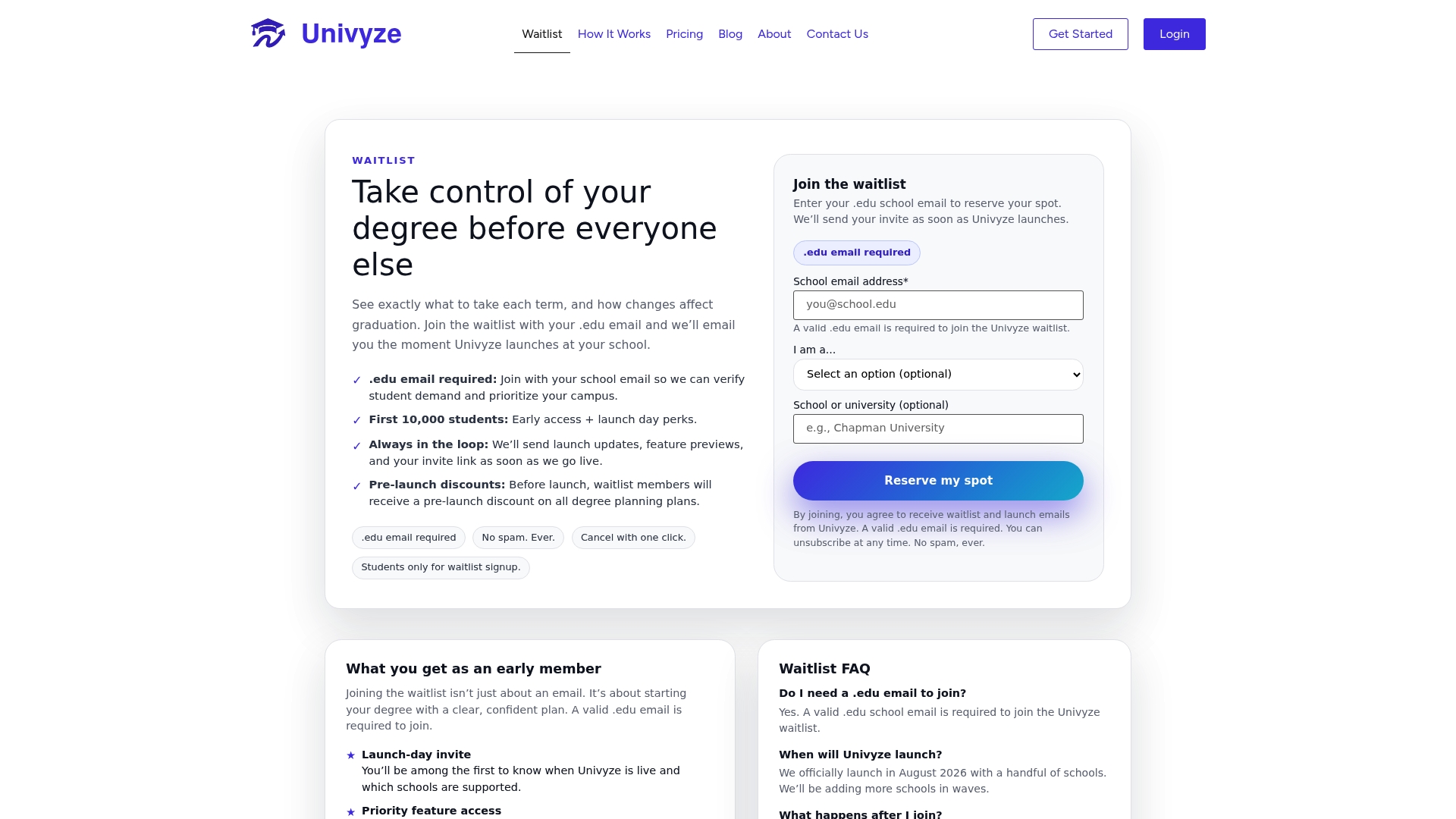
There is a free Starter plan for basic planning tools. Paid plans for fuller features are listed on the Univyze pricing page: for example, Core is 359.40 USD per year or 1,095 USD as a one-time payment. If you would like to be among the first to use it, join the Univyze waitlist at univyze.com.
FAQ
How many credits does an international student need to take?
F-1 undergraduates at a college or university must enroll in at least 12 credit hours per term. Graduate students must take the full course of study their institution certifies, which varies by program. Your DSO can confirm the number for your degree.
Can an F-1 student take a reduced course load?
Yes, but only for specific reasons and only with prior approval from your DSO. Qualifying reasons include initial academic difficulties, a temporary medical condition, or your final term. A medical RCL cannot exceed 12 months in total per program level.
Can international students take classes online?
Some, but not all. Only one online class, or three credits, whichever is less, counts toward your full course of study each term. The rest of your load needs to be in-person coursework. In your final term, you must also take at least one class that requires physical attendance.
Is part-time ever an option for F-1 students?
Not as a general choice. Part-time enrollment is allowed only through an authorized reduced course load. Dropping below full-time without DSO approval can leave you out of status, so talk to your international student office before changing your schedule.
Is 12 credits enough to graduate in four years?
Usually not. A 120-credit degree in four years without summer terms takes 15 credits per semester. Twelve credits meets the F-1 rule, but you will likely need extra credits from summer sessions, AP, dual enrollment, or heavier terms to graduate on schedule.
Sources
- Full Course of Study | Study in the States
- Reduced Course Load | Study in the States
- Reminders About Online and Distance Learning Courses | Study in the States
- USCIS Policy Manual, Volume 2, Part F, Chapter 3: Courses and Enrollment
- 2025-2026 Federal Student Aid Handbook: Pell Grant Enrollment Intensity and Cost of Attendance
- Redefining Full-Time in College | Community College Research Center