

Yes, you can almost certainly change your major, and most students do it without derailing graduation. The right first move isn’t calling your parents or googling your new major’s salary data. It’s pulling your degree audit and booking time with your intended-major advisor this week, before you decide anything else. Check your completed credits and any scholarship or aid conditions before you commit.
TL;DR:
- Switching majors early, such as in freshman year with fewer than 15 credits, generally results in minimal credit loss and low additional costs.
- A late switch, after accruing over 75 credits in a specialized program, may require an extra year or more of study and risk exceeding federal loan limits.
- Deadlines vary but most schools expect declaration before 90 credit hours or the end of sophomore year; beyond that, approval becomes more complex.
- Competitive majors like engineering or nursing often have capacity caps and GPA or prerequisite requirements that limit transferability of credits.
- Using a degree-planning tool to compare credit overlap can clarify the real cost in semesters and financial impact before officially requesting a major change.
Table of Contents
- Building a Change Major Plan Step by Step
- How Does Timing Affect the Cost of Switching Majors?
- What Deadlines and Restrictions Should You Watch For?
- Where Do You Actually Submit the Change Request?
- What Should You Bring to the Advisor Meeting?
- Are There Cheaper Alternatives to a Full Major Switch?
- Can a Planning Tool Actually Help With This Decision?
- Why Most Major-Change Advice Misses the Point
- Plan Your What-If Scenario Before You Submit Anything
- Sources
- FAQ
Building a Change Major Plan Step by Step
A major change usually fails for one of two reasons: the student skips a step that later blocks approval, or they don’t find out about a lost credit until it’s too late to fix it. Working through the process in order prevents both.
- Pull your degree audit or degree progress report. Count everything completed, including AP scores, dual enrollment, and transfer credit. This number is your starting point for every decision after it.
- Get the intended major’s catalog requirements and mark which of your finished courses overlap. A biology major switching to public health might keep 80% of their general education work; a nursing student moving into art history might keep almost none of the major-specific credits.
- Check eligibility rules. Some majors set a minimum GPA, require specific prerequisite courses, or cap enrollment entirely. Meeting the baseline doesn’t guarantee a seat in a capped program.
- Book advising appointments with both sides: your current advisor and the advisor for the major you want. Bring your degree audit and a printed or digital list of completed coursework to both meetings.
- Submit the official request. Most schools run this through an online form. Save the confirmation email or screenshot the tracking page.
- Follow up. If the request is denied, ask directly what an appeal or conditional plan looks like rather than assuming the door is closed.
- Don’t skip the current-major advisor meeting even if you’re certain about switching. They often know workaround credits the new department doesn’t advertise.
- Keep every email confirmation. Portals occasionally lose track of pending requests, and a saved confirmation is your proof it was submitted.
How Does Timing Affect the Cost of Switching Majors?
Credits are the real currency here, not enthusiasm. The earlier you switch, the more of your coursework transfers cleanly into the new plan, and the cost of switching majors tends to rise the longer you wait, since junior and senior year courses are more specialized and less transferable.
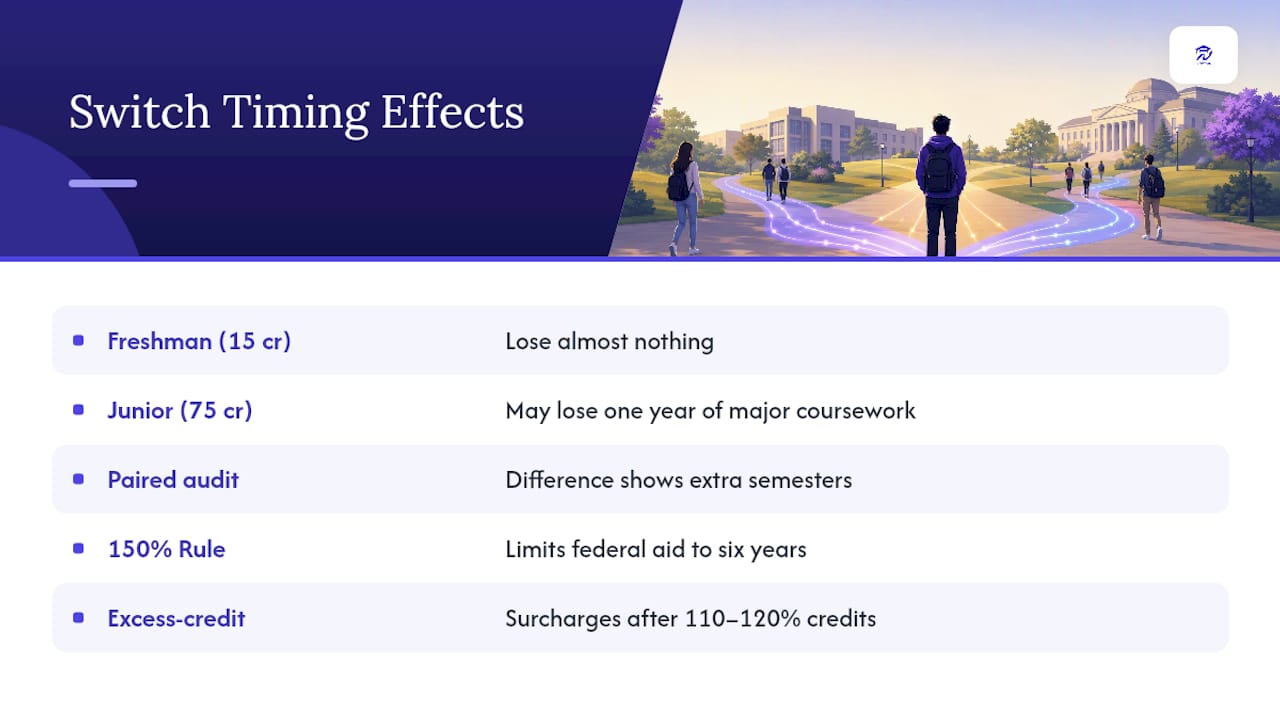
A freshman with 15 credits usually loses almost nothing in a switch. A junior with 75 credits in a specialized program might lose an entire year of major-specific coursework, even if their general education credits carry over fine.
To get a real number, run a paired degree audit: one for your current major, one for the major you’re considering. The difference between the two, in credits, tells you how many extra semesters you’re realistically looking at.
The 150% Rule: Federal student loans are capped at 150% of your program’s published length. For a standard four-year degree, that means six years of eligibility. A late major switch that pushes your timeline past that mark can mean running out of federal aid eligibility before you finish.
The financial exposure isn’t just tuition for an extra semester. It’s an extra semester of housing and food, plus the income you’re not earning because you’re still in school. Some state systems also apply excess-credit surcharges once a student passes 110 to 120 percent of the credits required for their degree, which can make a late switch cost more per credit than your original tuition rate. Call your financial aid office before you submit anything. Ask specifically whether your scholarship renewal depends on staying on a particular timeline, since many merit awards require steady progress toward a declared major or satisfactory academic progress.
What Deadlines and Restrictions Should You Watch For?
Every school phrases its rules differently, but a few patterns show up almost everywhere, and missing them is how students accidentally lock themselves out of a switch they were otherwise eligible to make.
- Most institutions expect students to declare a major before hitting roughly 90 credit hours or by the end of sophomore year, and students past that threshold often need dean-level approval to change plans at all.
- Competitive majors, engineering, nursing, business, and computer science among them, frequently run separate applications with capacity caps. Meeting the GPA and prerequisite minimums doesn’t guarantee a spot, since these programs admit a fixed number of students each term.
- Online change forms aren’t always available. Many schools disable them during active registration windows, and some limit students to one submission per day while certain majors require an advisor sign-off before the form even unlocks.
- Switching between colleges within the same university, not just majors, or carrying a high total credit count (often past 135 units) frequently triggers a higher tier of approval beyond your department advisor.
Pro Tip: If the online portal is locked during registration and you can’t wait for the next window, bring a signed advisor note or a departmental acceptance email straight to the registrar’s office. Staff can often process a manual override that the online system won’t allow.
Where Do You Actually Submit the Change Request?
Most schools route this through a specific tool inside your student portal, not a general contact form, and knowing the name in advance saves a lot of searching.
- Find the right menu. Look for wording like “Update Academics,” “Academic Plan Change,” or simply “Change Major.” Systems like LionPATH and DukeHub each label this slightly differently, but the function is the same.
- Have your information ready before you start: the catalog year you want to follow, your full list of intended majors or minors, and a short note explaining your reason if the form asks for one.
- Watch the status field after submitting. Most portals show pending, approved, or denied, and some let you cancel or resubmit while a request is still pending.
- Check both the portal and your university email. Decisions and comments from the reviewing department often land in your inbox before the portal status updates.
- If the online system won’t take your request, contact the major’s department directly or call the registrar. Paper forms still exist at most schools as a backup path.
What Should You Bring to the Advisor Meeting?
Show up with your current degree audit, an unofficial transcript, a full list of completed coursework including AP and dual enrollment credit, and a printed copy of the intended major’s catalog requirements. Advisors move faster when they don’t have to pull your records themselves.
- Ask directly: How many of my current credits will actually apply to this major?
- Ask: Realistically, how many extra semesters am I looking at?
- Ask: Are there GPA or prerequisite barriers I don’t already know about?
- Ask: Will my scholarship or financial aid status change?
- Ask about fallback paths: conditional acceptance, a provisional plan while you finish prerequisites, or a minor that gets you most of what you wanted at a fraction of the cost.
Are There Cheaper Alternatives to a Full Major Switch?
A full switch isn’t the only way to get where you’re headed, and it’s worth ruling out the cheaper options first.
- Add a minor or certificate if you mainly want a credential or skill set, not an entirely new degree path.
- Consider a double major when a what-if audit shows heavy overlap between your current and intended fields. You keep both credentials without starting over.
- Use summer sessions, AP credit, or community college courses to knock out prerequisites faster than waiting for the next fall or spring semester. Summer coursework alone can meaningfully shorten a stalled timeline.
- Finish your current major and pivot later through grad school, a certification, or a targeted internship, if switching now would cost more time and money than it’s worth.
Pro Tip: Run a what-if audit for the double-major option before assuming it will take longer. Overlap between related fields, like economics and business, is often bigger than students expect.
Can a Planning Tool Actually Help With This Decision?
A degree-planning tool won’t approve your major change and it isn’t a substitute for your advisor or your school’s official degree audit. What it does well is let you test scenarios before you walk into that advising meeting.
- Term-by-term mapping of what your schedule looks like under each major
- What-if scenarios that show credit overlap between your current and intended path
- AP, dual enrollment, and transfer credit handling so you’re not recalculating by hand
- Schedule conflict checks so you’re not surprised by two required courses in the same time slot
| What you bring | What Univyze shows you |
|---|---|
| Current completed credits | Term-by-term plan under the new major |
| Intended major’s catalog | Overlapping vs. missing requirements |
| Two “what-if” scenarios | Side-by-side timeline comparison |
Students juggling AP credit, dual enrollment, and transfer units often lose track of what actually counts toward a new degree, and that gap is exactly where a what-if sandbox earns its keep before a decision, not after.
Pro Tip: Build the what-if plan first, then bring the printout to your advisor meeting. It turns a vague “I’m thinking about switching” conversation into a specific one about real numbers.
Why Most Major-Change Advice Misses the Point
Most articles on switching majors focus on the emotional decision: how to know if you picked wrong, how to talk to your parents, how to silence the self-doubt. That’s not where students actually get hurt.
They get hurt by the credit-gap number they never calculated, the scholarship renewal clause they never read, and the 90-unit deadline they didn’t know existed until an advisor mentioned it in passing. The paperwork is boring, and boring is exactly why it gets skipped, and skipping it is exactly what turns a clean switch into an extra year of tuition.
The conventional wisdom says “follow your passion” and treats the logistics as an afterthought. The research says the opposite: passion for a new field matters, but the credit-gap number is what actually predicts whether that switch is a smart six-month decision or a very expensive two-year mistake. Run the audit before you fall in love with the new major. Do the math first, then let your interests make the final call, not the other way around.
— Ryan
Plan Your What-If Scenario Before You Submit Anything
Some degree-planning tools offer a way to see the tradeoffs before you commit to them. Instead of guessing how many semesters a switch might add, you build a term-by-term plan for both your current major and the one you’re considering, side by side.
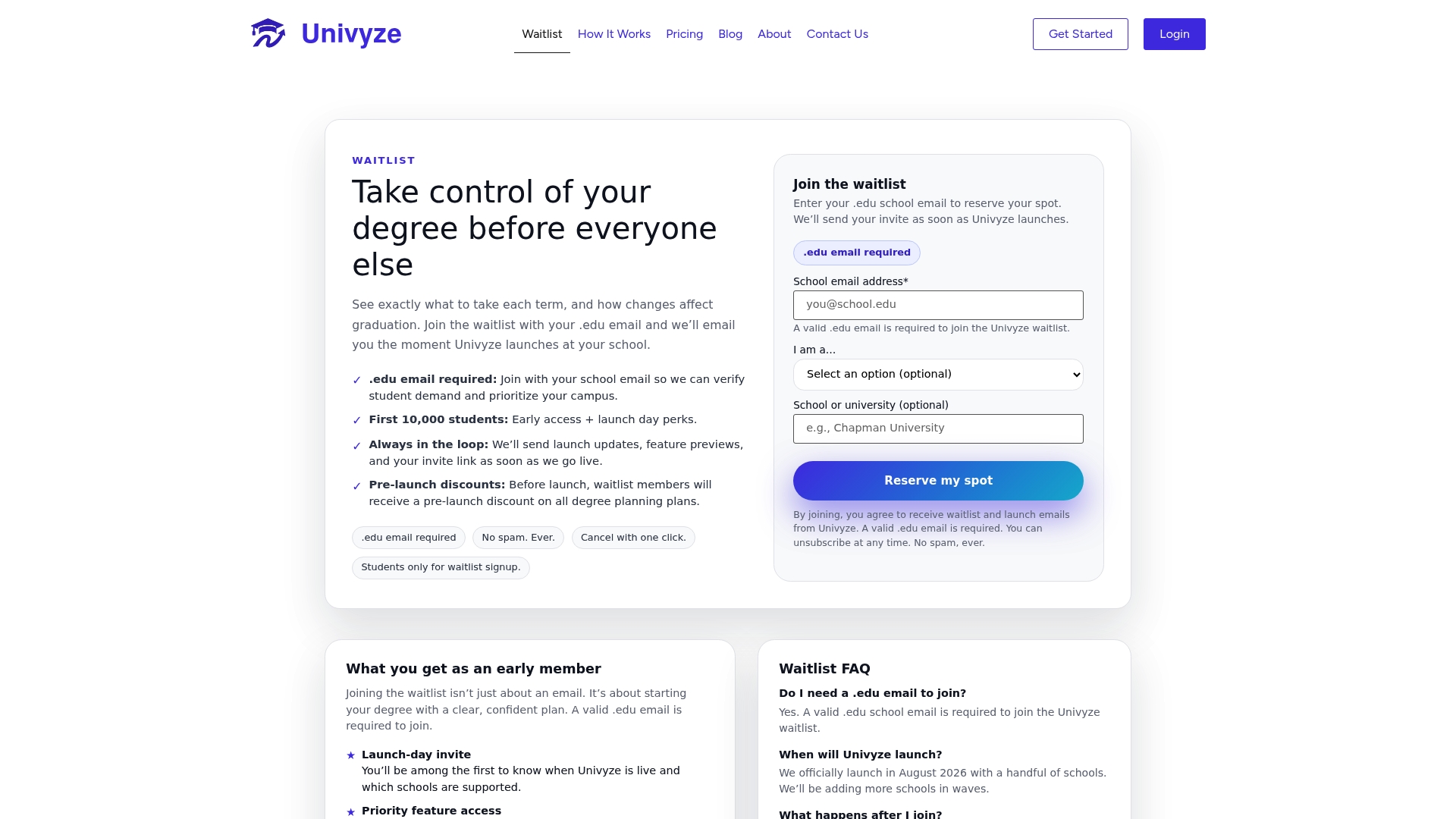
These tools may handle AP credit, dual enrollment, transfer units, and summer sessions automatically, so the what-if comparison reflects academic history instead of a generic template. Shared plans can make advising meetings shorter and more productive since everyone is looking at the same numbers. Univyze doesn’t replace your school’s official degree audit or or your advisor’s sign-off, and it can’t guarantee credit acceptance or graduation timing. What such tools can do is show you a clear term-by-term picture before you make the switch official. Join the Univyze waitlist to get early access and build your first what-if plan.
Sources
- Change your major | University of Louisiana at Lafayette student success
- Financial aid 150 percent rule — Allen University
- Help guide: Academic Plan Change | Duke registrar
FAQ
Is changing majors a good idea?
It can be, especially if you switch early and your new major has strong overlap with completed coursework. Weigh long-term career fit against the cost of extra semesters, since a better-aligned major can pay off over time even with some added cost upfront.
How late is too late to change my major?
Most schools flag 90 credit hours or the end of sophomore year as the point where changes get harder and may need dean approval. Past that, expect more paperwork and a real chance of added semesters.
Can I change my major if I already applied to college under a different one?
Yes. Most colleges let admitted or enrolled students submit a change request through their student portal once classes begin, though competitive majors like engineering or nursing may require a separate application with capacity limits.
What’s a good reason to change your major?
A mismatch between your interests and your coursework, a stronger fit discovered through electives, or a shift in career goals all count as solid reasons. The strongest switches happen when a student has actually tested the new field, through a class, an internship, or informational interviews with people already working in it, rather than switching on impulse.
Will changing my major affect my financial aid?
It can. Scholarships tied to a specific major or GPA benchmark may require renewal review, and federal loans are capped at 150% of your program’s published length. Confirm both with your financial aid office before submitting a change.