

Summer courses can shorten your path to a degree, but only when the credits actually apply to your requirements. The rule of thumb advisors use most: 6 to 9 credits earned over one or two summers can shave roughly a full semester off your graduation date. That math only works if the courses count toward your major, minor, or general education requirements, and if your school accepts them without a fight.
The catch is real. Students who enroll in summer session graduate within four years at rates about 5 percentage points higher than non-enrollees, a gap that widens for students who take a second summer of classes. But that boost disappears fast if you take the wrong electives, overload a five-week session, or skip the degree audit that confirms a course actually fits. Before you register for anything, check your requirements against what’s actually offered.
Key Takeaways
Summer courses shorten graduation timelines primarily when 6 to 9 credits apply directly to unmet degree requirements, confirmed through a degree audit and advisor before enrollment.
| Point | Details |
|---|---|
| Credit math that matters | 6 to 9 summer credits typically shave about one semester off graduation when applied to real requirements. |
| Second summer often pays off most | Enrollment before junior year clears gatekeeper courses and shows the strongest graduation-rate gains. |
| Confirm before you pay | Get transfer and equivalency approval in writing before registering, especially for outside institutions. |
| Match pace to capacity | Avoid stacking multiple intensive sessions; spread credits across summers if your schedule demands it. |
| Model it before committing | Use a degree-planning dashboard to simulate how summer credits shift your projected graduation date. |
Table of Contents
- Pros and Cons of Taking Summer Courses
- How Summer Credits Convert Into an Earlier Graduation Date
- Who Benefits Most From Summer Courses, and When
- Step-by-Step: Making Sure Summer Credits Actually Count
- Costs, Financial Aid, and the Logistics That Determine Feasibility
- Common Mistakes That Undermine the Graduation Benefit
- Modeling Summer Acceleration With a Degree-Planning Dashboard
- Summer Courses and Your Internship or Job Placement Timeline
- How Summer Enrollment Affects Financial Aid Renewal and Scholarships
- What Actually Moves the Graduation Date
- Sources
- FAQ
Pros and Cons of Taking Summer Courses
Summer session isn’t a universal fix. It works well for some students and backfires for others, depending on how it’s used.
The case for enrolling is straightforward. You pick up credits without competing for seats against a full campus, classes tend to run smaller, and a single tough course gets your undivided attention instead of splitting focus among four others. Institutional research backs this up: a multi-cohort analysis at California State University, Northridge found that students who took at least one summer course exhibited higher cumulative GPAs and on-time graduation rates compared to matched peers who did not enroll in summer courses.. Smaller, focused sessions also make it easier to master a prerequisite that gave you trouble the first time, and some students choose summer specifically for that reason.
The trade-offs are just as real:
- Condensed pace. A 15-week course compressed into 5 weeks means roughly three times the weekly workload, which can overwhelm anyone juggling a summer job.
- Cost variability. Summer tuition per credit isn’t always cheaper than the regular semester, and some schools charge different rates for summer sessions.
- Burnout risk. Skipping your only real break for two summers in a row catches up with most students by fall.
- Course mismatch. An elective that doesn’t map to any requirement burns money and time without moving your graduation date.
Pro Tip: Run the math before you commit. Divide the summer tuition by the number of credits and compare it against what you’d pay for the same credits during a regular semester, then weigh that against the cost of an extra semester of tuition and housing if you skip summer entirely.
How Summer Credits Convert Into an Earlier Graduation Date
The mechanics are simpler than most students expect. A typical bachelor’s degree requires around 120 credits, usually spread across eight semesters at 15 credits each. Add credits in the summer, and you either reduce the load in a future semester or finish a term early, depending on how your program is structured.
Here’s how the math typically plays out:
- 6 summer credits usually offset one course from a future semester, easing your load without changing your total number of terms.
- 9 summer credits, especially across prerequisite or gen-ed requirements, often lets you drop to 12 credits in your final semester or finish one term sooner.
- 12 or more summer credits, spread across two summers, can realistically eliminate an entire semester if those credits hit required courses rather than free electives.
Session format matters here too. A Maymester might get you 3 credits in three to four weeks, while Summer I and Summer II sessions typically run five to eight weeks each and can be combined for 6 to 9 credits total in a single summer. Longer sessions are usually easier to manage alongside a part-time job than back-to-back Maymester sprints.
There’s also a momentum effect worth knowing about. Research from the Community College Research Center at Columbia found that students who take summer credits tend to enroll in higher credit loads the following fall and post higher bachelor’s degree completion rates overall. Finishing a summer course seems to build confidence and scheduling habits that carry into the next term, not just a credit count.
None of this works if the credits don’t count toward your actual requirements. A degree planning tool that shows exactly where summer credits fit into your remaining requirements prevents the common mistake of banking credits that don’t move your graduation date at all.
Who Benefits Most From Summer Courses, and When
Not every student gets the same payoff from summer session. Your class year, your major’s bottlenecks, and your reason for enrolling all change the calculation.
- First-year students often use summer to knock out gen-ed requirements early, which frees up room later for major courses and reduces first-year retention risk.
- Students facing prerequisite bottlenecks, especially in STEM majors where courses are sequenced tightly, can use summer to unblock a stalled schedule instead of waiting a full year for the next section.
- Students on academic probation frequently use summer to retake a failed course quickly. Institutional guidance from CSUN recommends enrolling in the repeat course early in the summer so a strong grade posts before fall registration, which also helps with financial aid standing.
- Transfer students can use summer to close gaps between their transfer credits and the receiving school’s specific requirements.
- Students with fall internships sometimes use summer session to get ahead so a lighter courseload during the internship semester is possible.
Timing carries real weight. Colorado State’s institutional research found the graduation-rate gap for second-summer enrollees widened to 9 percentage points, compared to about 5 points for students who take just one summer. That second summer, right before junior year, tends to be when gatekeeper courses for upper-division majors come due, so clearing them early has an outsized effect. First-summer enrollment still helps, mostly by improving retention and building the habits that carry into sophomore year.
Step-by-Step: Making Sure Summer Credits Actually Count
Earning summer credits that don’t apply to your degree is one of the most common ways students waste a summer. Follow this sequence before you register for anything.
- Run your degree audit first. Pull your official audit and list every requirement you still need, separating “must-have” prerequisites from flexible electives. This single step prevents most wasted summer credits.
- Confirm course equivalency before enrolling. If you’re taking the course at a community college, another university, or online, check the transfer equivalency table and get written confirmation from your advisor or registrar. Don’t assume a course with a similar title will transfer the way you expect.
- Match session length to your actual capacity. A student working 30 hours a week should avoid stacking two five-week intensives back to back. Pick one session format, whether that’s Maymester, Summer I, or Summer II, that fits your schedule rather than the one that finishes fastest.
- Check financial aid and build a real budget. Summer aid rules differ from the regular academic year, and eligibility often depends on enrollment intensity.
- Document everything. Save every syllabus, keep enrollment confirmations, and request that transcripts get posted or evaluated for transfer as soon as the course ends, especially if credits are coming from outside your home institution.
Pro Tip: Screenshot your degree audit before and after registering for summer courses. If a requirement doesn’t visibly clear from your “still needed” list, don’t assume it will resolve itself later. Follow up with your advisor immediately.
A degree requirement checklist makes this process far less error-prone than trying to track it across separate emails and PDFs.
Costs, Financial Aid, and the Logistics That Determine Feasibility
The financial case for summer courses depends on comparing two numbers: what you’ll spend on summer tuition, and what you’d otherwise spend on an extra semester of tuition plus room and board. For most students, an additional semester costs far more than a few summer credits, even at a premium per-credit rate.
Financial aid for summer term works differently than the regular year. Enrollment intensity thresholds (often tied to half-time or full-time status) determine Pell Grant and institutional aid eligibility, and those thresholds vary by school. Institutional guidance from CSU’s summer program notes that aid policy and self-selection both affect summer outcomes, meaning students who plan carefully tend to see better results than those who enroll reactively.
A few practical options worth weighing:
- Community college summer courses are often cheaper per credit than your home institution, but transferability isn’t automatic. Confirm equivalency before you pay.
- Online summer sections at your own school usually transfer cleanly since they’re already part of your institution’s catalog.
- Dual enrollment or concurrent credits earned earlier can sometimes stack with summer credits to close a requirement gap faster than either alone.
Before you register anywhere outside your home institution, get an equivalency confirmation in writing, save the course description and syllabus, and request an official transfer evaluation as soon as the grade posts.
Common Mistakes That Undermine the Graduation Benefit
Most students who “take summer courses but don’t graduate faster” made one of three errors.
- Enrolling in electives that don’t apply to any requirement. The fix is simple: get advisor sign-off and cross-check against your degree audit before you register, not after.
- Overloading a condensed session. Two intensive five-week courses at once is punishing even for strong students. Spread the credits across two summers if your schedule demands it.
- Assuming transfer or dual-enrollment credits will post automatically. Course withdrawals and transfer complications can leave a confusing mark on your transcript if you don’t understand your institution’s articulation agreements ahead of time.
Pro Tip: Get transfer pre-approval in writing before the course starts, not after you’ve already paid and finished it. A verbal “that should transfer” from an advisor isn’t the same as a signed equivalency form.
Modeling Summer Acceleration With a Degree-Planning Dashboard
Manually tracking how summer credits interact with your remaining requirements is where most planning mistakes happen. A dashboard that links your degree requirements to actual course offerings shows in real time whether a summer course closes a specific gap or just adds credits with nowhere to go.
The value isn’t in guessing whether summer will help. It’s in seeing, before you register, exactly which requirement a course clears and how that shifts your projected graduation term.
With a tool like Univyze, you can simulate adding 6 to 9 summer credits and watch how your projected graduation date shifts before you spend a dollar. That kind of what-if modeling doesn’t replace your advisor or your official degree audit, but it gives you a clear starting point for that conversation.
- Save the simulation once you’ve mapped out a summer plan that works.
- Export it and bring it to your advisor for verification.
- Request a transfer evaluation immediately if any credits come from outside your home institution.
Pro Tip: Always confirm any projected graduation date change against your official degree audit and registrar records. A planning dashboard shows you the path, but your institution confirms whether you’re actually on it.
Summer Courses and Your Internship or Job Placement Timeline
Finishing degree requirements early changes more than your diploma date. It changes when you’re available for internships and full-time recruiting, both of which run on tighter calendars than most students expect.
Many competitive internship programs recruit sophomores and juniors a full semester or two in advance. If summer credits let you finish core requirements ahead of schedule, you have more flexibility to take a fall or spring internship without falling behind on coursework, or to accept a summer internship without needing to also take classes that same summer. That flexibility can matter more than the credits themselves for students in fields where internships strongly influence full-time offers.
The reverse is also true. Students who use every summer for coursework, with no break for internships, sometimes finish coursework on schedule but arrive at graduation without the work experience recruiters expect. If you’re weighing a summer internship against a summer course, ask whether the credits you’d earn are actually blocking your progress or just convenient. A prerequisite that’s genuinely holding up your major usually outweighs one internship summer. A general elective usually does not.
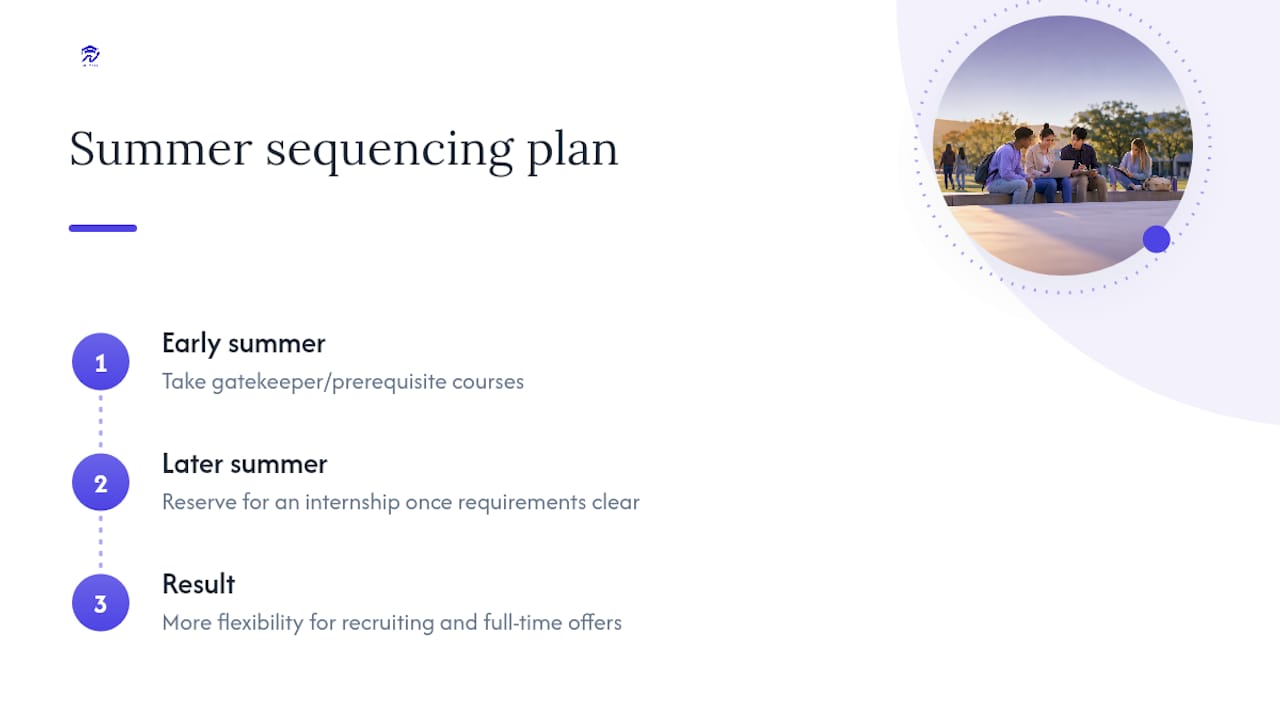
The best approach for most students is sequencing: use an early summer (before sophomore or junior year) for gatekeeper courses, then reserve a later summer for an internship once your major requirements are largely clear. That sequencing is exactly the kind of decision a term-by-term plan makes easier to visualize before you commit to either path.
How Summer Enrollment Affects Financial Aid Renewal and Scholarships
Financial aid renewal depends on maintaining satisfactory academic progress, which most schools define by credit completion pace and cumulative GPA. Summer courses can help on both fronts, but the effect isn’t automatic.
If you’re behind on the credit pace your aid package assumes, often measured as completing enough credits each year to finish within 150% of your program’s standard length, summer credits can help you catch up and protect your eligibility for the following year. This matters most for students who dropped a course, failed a prerequisite, or changed majors and lost credits in the process.
Scholarships tied to GPA benefit similarly. A summer course taken to retake a low grade, or to lighten a difficult regular-semester load, can protect the cumulative GPA that a merit scholarship requires. But summer courses funded through loans or out-of-pocket payment can also strain a family’s budget in ways that offset the benefit, so it’s worth checking whether your specific aid package or scholarship terms even cover summer enrollment before assuming it will help.
Not all aid applies to summer term the same way it applies to fall and spring. Institutional and federal aid rules around summer enrollment intensity vary by school, so confirm eligibility with your financial aid office before registering, not after you’ve already committed to a course.
What Actually Moves the Graduation Date
The conventional advice tells students to “take summer classes to graduate faster,” full stop. That’s incomplete, and it’s why so many students take summer courses without seeing any real change in their timeline. The credit math only works when the course fills an actual gap. An elective that doesn’t map to a requirement is just a summer spent on tuition with no return.
What the research actually supports is more specific: target prerequisite bottlenecks, prioritize your second summer if you can manage it, and get equivalency confirmed before you register, not after. The students who see the biggest graduation-rate gains aren’t the ones who take the most summer credits. They’re the ones who take the right ones, at the right time, and confirm they count before spending the money.
If there’s one habit worth building, it’s checking your degree audit before every summer registration, not just once at the start of college. Requirements shift when you change a minor, fail a course, or switch majors, and a plan that made sense freshman year might not apply by junior year.
Sources
- 7 Benefits of Taking Summer Courses in College – SUU
- Goodbye to summer vacation: The effects of summer enrollment on college and employment outcomes | CCRC (Columbia)
- Summer Course Enrollment and Student Success | CSUN Institutional Research
- Summer Sessions Benefits | Summer Sessions at NC State
FAQ
Do summer classes help you graduate faster?
Yes, when the credits apply to unmet degree requirements. Institutional data shows summer enrollees graduate within four years at rates about 5 to 9 percentage points higher than students who skip summer entirely.
Are summer classes worth more credits than regular semester courses?
No. Summer courses typically carry the same credit value as their regular-semester equivalents; the difference is pacing, since a 15-week course often compresses into 5 weeks or slightly longer.
Do summer courses boost your GPA?
Multi-cohort research at CSUN found that students who took at least one summer course had higher cumulative GPAs than matched peers who didn’t, likely due to smaller classes and focused pacing.
What happens if you graduate in the summer?
Summer graduation typically follows the same degree conferral process as fall or spring, though commencement ceremonies may not happen until the next scheduled ceremony date. Check with your registrar for your school’s specific summer conferral calendar.
Should I take summer courses if I’m not behind on requirements?
It depends on your goals. Getting ahead on gen-ed or major requirements can free up room for internships, lighter semesters, or an earlier graduation date, but it’s not necessary if you’re already on pace and prefer to use summer differently.
Ready to see how summer credits would actually shift your graduation date? Join the Univyze waitlist and get early access to a planning dashboard built to map term-by-term progress, model summer “what if” scenarios, and flag conflicts before they cost you a semester. Always confirm final requirements with your official degree audit, catalog, and academic advisor.