

Yes, you can build a class schedule around a paid job, as long as you map your fixed commitments first, cap your weekly hours at a sustainable level, and confirm every choice with your advisor. Start today with three moves: list every class, shift, and commute block on one calendar, pick sections that don’t overlap or crowd your day, and get your manager’s agreement on your availability in writing. A planning tool can help you test these schedules before you commit.
TL;DR:
- A master calendar should include classes, labs, shifts, commute time, and posted deadlines, then be checked against catalog rules before registration.
- Off campus work above about 20 hours is linked to lower grades and dropout risk; 10 to 19 hours may provide useful structure for some students.
- Give your manager a weekly availability grid, offer shift swaps or alternate days, and request written confirmation so agreed hours do not drift.
- Use a 15 minute Sunday review and a 30 to 60 minute minimum study plan per class to maintain progress during heavy work weeks.
- Schedule builders can compare sections and flag prerequisite conflicts, but confirm every plan against the official degree audit and with an advisor.
Table of Contents
- Map Your Week Before You Register for Anything
- How Many Work Hours Make Sense With a Full Course Load
- Negotiating Flexible Hours With Your Employer
- A Weekly Routine That Survives a Busy Work Stretch
- Using Schedule Builders and Degree Maps to Avoid Conflicts
- What I’ve Learned Watching Students Juggle Work and Class
- Try a Planning Dashboard Built for Students Juggling Both
- FAQ
- Sources
Map Your Week Before You Register for Anything
Before you touch a registration portal, build one master calendar that holds every fixed commitment you have: class times, labs, work shifts, and commute windows. Add syllabus deadlines and major assignments as soon as professors post them, so exam weeks don’t sneak up on you while you’re also closing at your job.
Writing out a full weekly schedule and color-coding each category of commitment helps you spot free study windows and catch conflicts before they cost you a semester, according to the UNC Writing and Learning Center. A consistent color system, one color per class, one for work, one for commute, makes gaps and overlaps obvious at a glance.
A few habits make this stick:
- Build a semester-at-a-glance view for big deadlines, not just a weekly grid.
- Color-code work shifts, classes, and commute time the same way every week.
- Cross-check any draft schedule against your university catalog and registrar rules before registering.
Google Calendar, your institution’s official schedule builder, or a paper planner all work for this step. What matters is that you see the whole week in one place, not scattered across your phone, your syllabus, and your work app.
Pro Tip: Build your master calendar before you finalize work availability, not after. It’s easier to negotiate a shift change than to drop a required class.
How Many Work Hours Make Sense With a Full Course Load
There’s no single number that fits every student, but the research gives you a useful range. Academic sources generally advise against working more than about 20 hours a week in off-campus jobs during your first two years, since heavier workloads correlate with lower grades and higher dropout risk. Other research suggests working 10 to 19 hours a week can actually add useful structure for some students, while 15 or more hours raises risk, especially for students from lower-income backgrounds.
A few tactics help you stay inside that range without sacrificing course options:
- Cluster your classes into tighter blocks (two or three days) instead of spreading them thin across the week.
- Favor evening or asynchronous sections when they fit your degree requirements.
- Leave buffer time between a class and a shift instead of scheduling them back to back.
If your job demands more hours than your course load can absorb, consider carrying fewer credits for a term rather than overloading both sides. Part-time enrollment can be a deliberate, strategic choice, not a setback, when it protects your GPA and keeps you on a realistic path. Always run your planned course list past your advisor and check your degree map first, so a lighter term doesn’t quietly turn into an extra semester you didn’t plan for.
Negotiating Flexible Hours With Your Employer
Most supervisors respond better to a concrete proposal than to a vague request for “more flexibility.” Before you talk to your manager, write down your fixed class times and treat them as non-negotiable, the same way you’d treat a doctor’s appointment. For guidance, see how to facilitate a leadership skills workshop for students.
- Draft a weekly availability grid that blocks out every class and shows the hours you can actually work.
- Offer alternatives, like shift swaps or different days, so your manager has options instead of just a list of restrictions.
- Ask for written confirmation of the agreed schedule, either by email or in a shared calendar, so there’s a record if hours drift later.
Student-employment guidance from ASU recommends sharing your class schedule directly with your supervisor and clarifying expected hours up front, rather than letting availability get worked out shift by shift. If midterms or finals are coming up, raise it early: ask about using paid time off if it’s available, and let your instructors know ahead of time if a shift change might affect attendance.
Pro Tip: If your shift changes midterm, find coverage first, then notify your instructor and advisor, so nobody is caught off guard the week an assignment is due.

A Weekly Routine That Survives a Busy Work Stretch
A sustainable schedule needs a routine you can run on autopilot, even during a heavy work week. A two-layer planning habit works well: a 15-minute weekly review every Sunday to see what’s coming, plus a few minutes each morning to confirm the day’s priorities, an approach recommended by NJIT’s online student resources.
For rough weeks, define a minimum study plan for each class ahead of time, something like 30 to 60 minutes of focused reading or one graded discussion post, so you keep moving even when a shift runs long. Block at least one lower-demand evening for recovery, and use commute time or lunch breaks for short review sessions instead of trying to find a long open block that may never come.
- Keep a standing 15-minute Sunday review to preview the week ahead.
- Set a minimum study plan per class for weeks when work takes priority.
- Protect one recovery evening and guard your sleep schedule, even during busy stretches.
Treating a minimum study plan as non-negotiable keeps you from losing an entire week of progress to one bad shift schedule. For more on building this kind of routine, our guide to time management in college walks through daily planning in more depth.
Using Schedule Builders and Degree Maps to Avoid Conflicts
Institutional schedule builders exist for exactly this problem: comparing multiple possible schedules side by side before you’re locked into one. Tools like San Jose State’s MyScheduler let you test section combinations and catch prerequisite or time conflicts before you register, instead of discovering them after the add/drop deadline passes.
A solid planning workflow looks like this:
- Import your work shifts and class times into one view before testing alternate schedules.
- Run a few “what if” versions, different sections, different course loads, to see which one actually fits.
- Save the version that protects both your paycheck and your degree progress, then confirm it with your advisor.
| What a planner should do | Why it matters for working students |
|---|---|
| Flag schedule conflicts early | Avoids wasted add/drop attempts around work shifts |
| Sequence courses term by term | Keeps you from missing prerequisites that delay graduation |
| Handle AP, dual-enrollment, and transfer credit | Prevents repeating coursework you’ve already earned |
| Run “what-if” scenarios | Lets you test a lighter term without losing sight of long-term progress |
Our dynamic dashboard links your degree requirements to live course offerings, so you can see which sections actually fit your work hours without guessing. It’s a planning aid, not a replacement for your official degree audit, so any schedule you build still needs a final check with your advisor.
What I’ve Learned Watching Students Juggle Work and Class
The students who struggle most aren’t the ones working the most hours. They’re the ones who register first and figure out their job schedule later, then scramble during add/drop week or hit a wall at midterms when two deadlines land on the same day as a double shift.
The fix is almost always the same: loop in your advisor early, keep your degree progress visible to anyone helping fund your education, and don’t treat part-time enrollment as a failure. A lighter, well-planned term beats a packed one that falls apart in October.
— Ryan
Try a Planning Dashboard Built for Students Juggling Both
![CTA image placeholder]
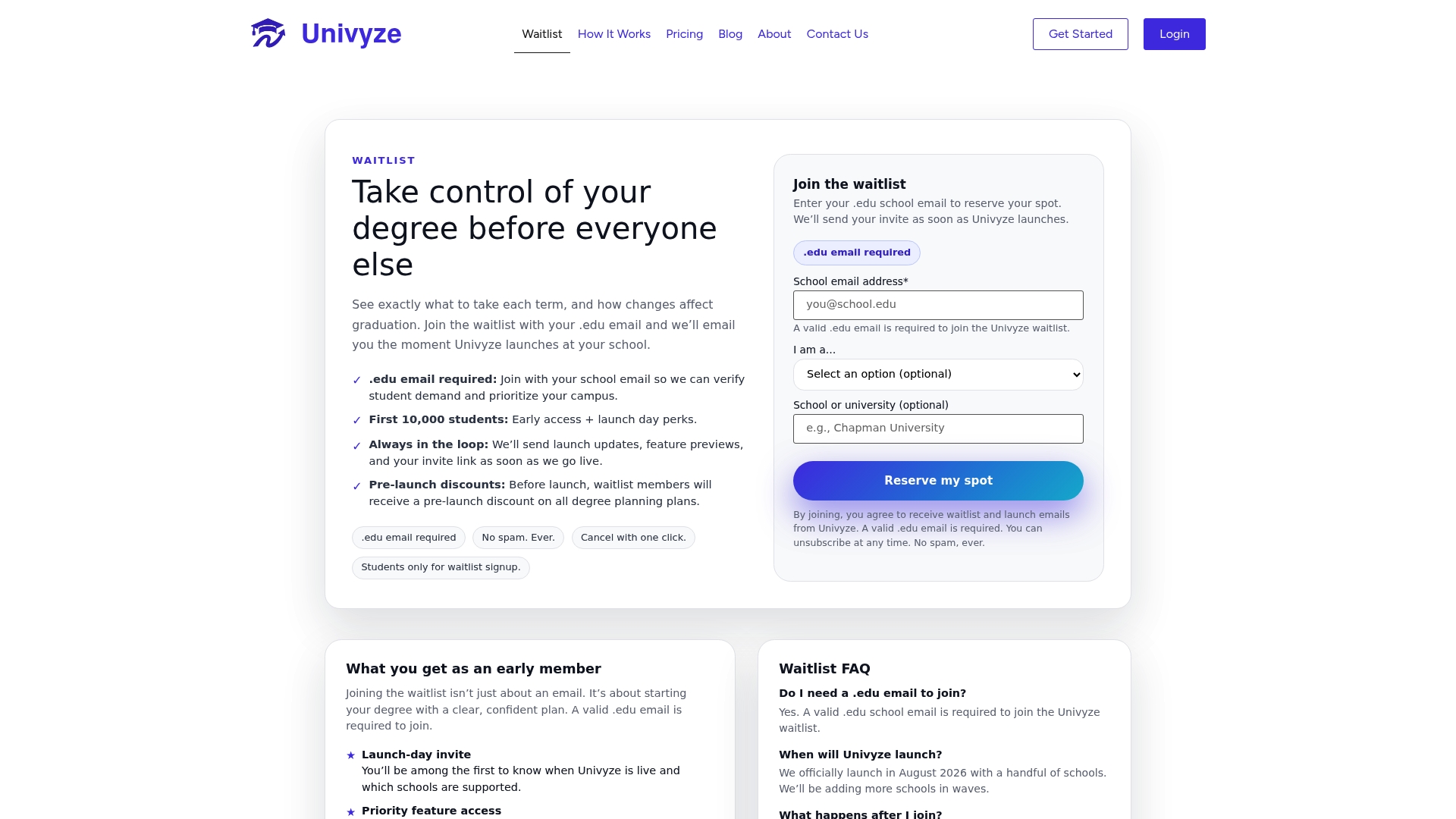
Everything in this guide, mapping your week, checking work-hour limits, testing alternate sections, is easier with a dashboard that integrates degree requirements. Such platforms can handle automatic term-by-term planning, track AP credit, dual enrollment, and transfer credits, and let you run what-if scenarios before you commit to a schedule, all through a simple interface built for students, not administrators.
- See conflict alerts before you register, not after.
- Test a lighter course load against your long-term plan without losing track of requirements.
- Give parents or sponsors visibility into your progress without extra explaining.
Join the Univyze waitlist to get access as new features roll out, and compare our Core, Plus, and Pro plans when you’re ready for full planning tools. As always, verify your final schedule against your official degree audit, catalog, and advisor before you register.
FAQ
How many hours a week should I work in college?
Many students manage 10 to 19 hours a week without major academic strain, while working beyond about 20 hours is linked to lower grades and higher dropout risk, especially in your first two years. The right number depends on your course load, so check in with your advisor if your job is asking for more.
How do I ask my employer for a flexible schedule around classes?
Draft a weekly availability grid that treats your class times as fixed, offer alternatives like shift swaps, and ask for written confirmation of the agreed schedule. Supervisors respond better to a concrete proposal than a general request for flexibility, according to ASU’s student employment guidance.
What’s a minimum study plan and when should I use it?
A minimum study plan is a short, prioritized checklist, like 30 minutes of reading plus one discussion post, for weeks when work takes over your schedule. It keeps you making progress in every class even when you don’t have time for a full study session, an approach outlined by NJIT’s student resources.
Can a planning tool like Univyze replace my academic advisor?
No. Our dashboard helps you test schedules, track AP and transfer credit, and run what-if scenarios, but it’s a planning aid rather than an official degree audit. Always confirm your final course plan with your advisor, registrar, and university catalog before registering.
What should I do if my work hours change in the middle of the semester?
Find shift coverage as soon as you know about the change, then tell your instructors and advisor early rather than waiting until an assignment is due. Early communication gives instructors time to work with you and gives you time to adjust your minimum study plan for that week.
Sources
- Effects of student employment — BYU HRS
- MyScheduler — San Jose State University
- Balancing jobs and academic expectations — UNC Writing & Learning Center
- Balancing work, school, and life as an online student — NJIT Online