

When a required course is not offered, contact your academic advisor and the department right away. The two fastest fixes are getting onto the waitlist or requesting a registration override for an open section, and if the course genuinely isn’t being taught, starting a substitution petition the same week. Waiting until the final semester cuts your options.
TL;DR:
- Contact your department or instructor first to secure an override for full classes or to explore alternative sections, as they can often grant immediate access.
- File substitution petitions promptly through your advisor if the course is unavailable for an extended period, providing clear evidence of course equivalency and outcomes.
- Substitution requests for protected courses like capstones are less likely to succeed if already at credit caps or if similar petitions were approved earlier, so plan accordingly.
- Overrides generally resolve within two weeks, and petitions for substitutions may take a week or more, making early action essential for timely graduation.
- Using planning tools like Univyze can help identify and address course gaps before they threaten your graduation timeline, saving time and reducing last-minute stress.
Table of Contents
- Who to contact first and what each person can do
- Quick actions to try the same day
- Filing a substitution or exception petition step by step
- What documentation actually convinces reviewers
- When petitions get denied, and why
- Alternatives that keep you on track for graduation
- How long overrides and petitions actually take
- Why proactive planning prevents last-minute surprises
- How Univyze helps you avoid the next course-availability scramble
- FAQ
- Sources
Who to contact first and what each person can do
Different offices solve different problems, so start with the one that matches your situation.
- Academic advisor: Reviews how the gap affects your degree, recommends a substitution or schedule change, and submits exception requests through authorized channels since students who file directly with central administration often get an instant rejection.
- Department or instructor: Can grant a registration override for a closed section and can explain the course rotation, making this the right first stop when a class is simply full rather than canceled.
- Registrar or records office: Processes the official substitution or exception form and records the final decision on your transcript.
- Program director or dean: The escalation point for protected courses, like capstones, or urgent cases where graduation timing is at risk.
Quick actions to try the same day
Before anything formal, work the tools already in front of you.
- Get on the waitlist immediately and check it daily. Many systems auto-enroll you if a seat opens, but only within a set confirmation window, so respond fast.
- Email the instructor or department for an override, stating your name, student ID, section number, and a specific justification such as a graduation requirement. Vague requests get deprioritized.
- Ask about a cross-listed or equivalent section that might not show up in a standard search.
- Follow up within three to five business days if you haven’t heard back, and copy your advisor so there’s a record of the request.
Pro Tip: Keep every override and waitlist email in one folder. If you end up filing a formal petition later, that paper trail becomes your timeline evidence.
Our override request guide has a short template you can adapt, and our waitlist strategy breakdown covers the exact timing that tends to work.

Filing a substitution or exception petition step by step
When the course truly isn’t running this term or next, the override route won’t help. This is where a formal petition comes in, and most universities require an advisor to submit it on your behalf.
- Meet with your advisor first to confirm the course is actually unavailable, not just full.
- Identify a realistic substitute course, ideally one at the same level with overlapping content.
- Gather your evidence: syllabus, course description, and any sample work for the proposed substitute.
- Complete the official substitution or exception form, usually through the registrar’s office.
- Submit for department-level review, where staff check equivalency on learning outcomes, course level, credit hours, and rigor.
- If approved, the request may still need dean-level sign-off for university-wide or core requirements.
Reviewers aren’t just checking whether two courses sound similar. Lower-division work rarely substitutes for an upper-division requirement, and many programs set a minimum grade, often a C or higher, for the substitute to count.
What documentation actually convinces reviewers
A thin petition gets sent back for more information, which costs you time you may not have. Build the file right the first time.
- Pull the course objectives, weekly topic list, assessment breakdown, and credit hours directly from the syllabus.
- Write a two to three sentence rationale that ties the substitute’s outcomes to the required course’s outcomes, not to your schedule convenience.
- If you took the course elsewhere, include a catalog description, textbook list, or graded work as proof of equivalency.
- Ask an instructor for a short letter only if the form specifically allows outside documentation.
Petitions that argue outcomes, not timing, tend to move faster through review.
When petitions get denied, and why
Some requests face long odds no matter how well they’re documented. Knowing this in advance helps you target your effort.
- Capstones, practica, and other milestone courses are commonly protected, since they’re designed to be taken near the end of a program on purpose.
- Many institutions cap the number or percentage of credits that can be substituted within a degree, so a strong case doesn’t guarantee approval if the cap is already met.
- An earlier approval for a similar substitution doesn’t bind the department to approve yours; each petition is reviewed on its own evidence.
- If your case involves a genuine scheduling conflict or medical issue, document the extenuating circumstance separately rather than folding it into the academic rationale.
Alternatives that keep you on track for graduation
If a substitution isn’t realistic, several fallback options can still protect your timeline.
- Take an open elective now and slot the required course in next term once it’s offered again.
- Use a summer session, consortium agreement, or accredited online course, but get pre-approval before you register so the credit actually transfers back.
- Consider transient enrollment at another school. This requires pre-approval and careful transcript routing, and a counselor’s checklist for protecting transfer credits is a useful reference before you commit.
- Rearrange your course sequence and use priority registration next term if your standing qualifies.
Each of these can carry its own cost, whether that’s summer tuition, an online course fee, or a transient enrollment charge, so confirm the price before you register.
How long overrides and petitions actually take
Timing drives almost every bad outcome in this process, so plan backward from your graduation term.
- Overrides typically resolve in days to about two weeks, depending on how quickly the department responds.
- Formal substitution petitions often take a week or more, and dean-level review adds time on top of that.
- Start the process the moment you spot the gap, not in your final semester. Petitions filed in a student’s last term are frequently given lower priority or may not be considered at all.
- Check your petition’s status weekly and send a brief, polite follow-up if you haven’t heard back as a deadline nears.
Why proactive planning prevents last-minute surprises
Most of the scramble described above is preventable. A visual, term-by-term degree map surfaces a course gap a year or two before it becomes urgent, which is a very different position than discovering it the semester you planned to graduate. Running a “what if” scenario when you’re considering a minor change or a schedule shift shows the downstream effect immediately, instead of after registration closes.
None of this replaces your advisor or your official degree audit. Always verify a plan against your university catalog, registrar policies, and an advising appointment before you act on it.
— Ryan
How Univyze helps you avoid the next course-availability scramble
We built Univyze so a canceled or closed course shows up as a flagged gap in your plan long before it becomes a graduation emergency. Our dashboard links your actual degree requirements to live course offerings, so a term-by-term plan updates automatically when something changes.
- We run “what if” scenarios so you can test a substitution or a schedule swap before committing to it.
- We handle AP credit, dual enrollment, and transfer credits in the same plan, so a transient course or summer class fits cleanly into your sequence.
- We provide visibility into progress to support family awareness without requiring them to track every registration deadline.
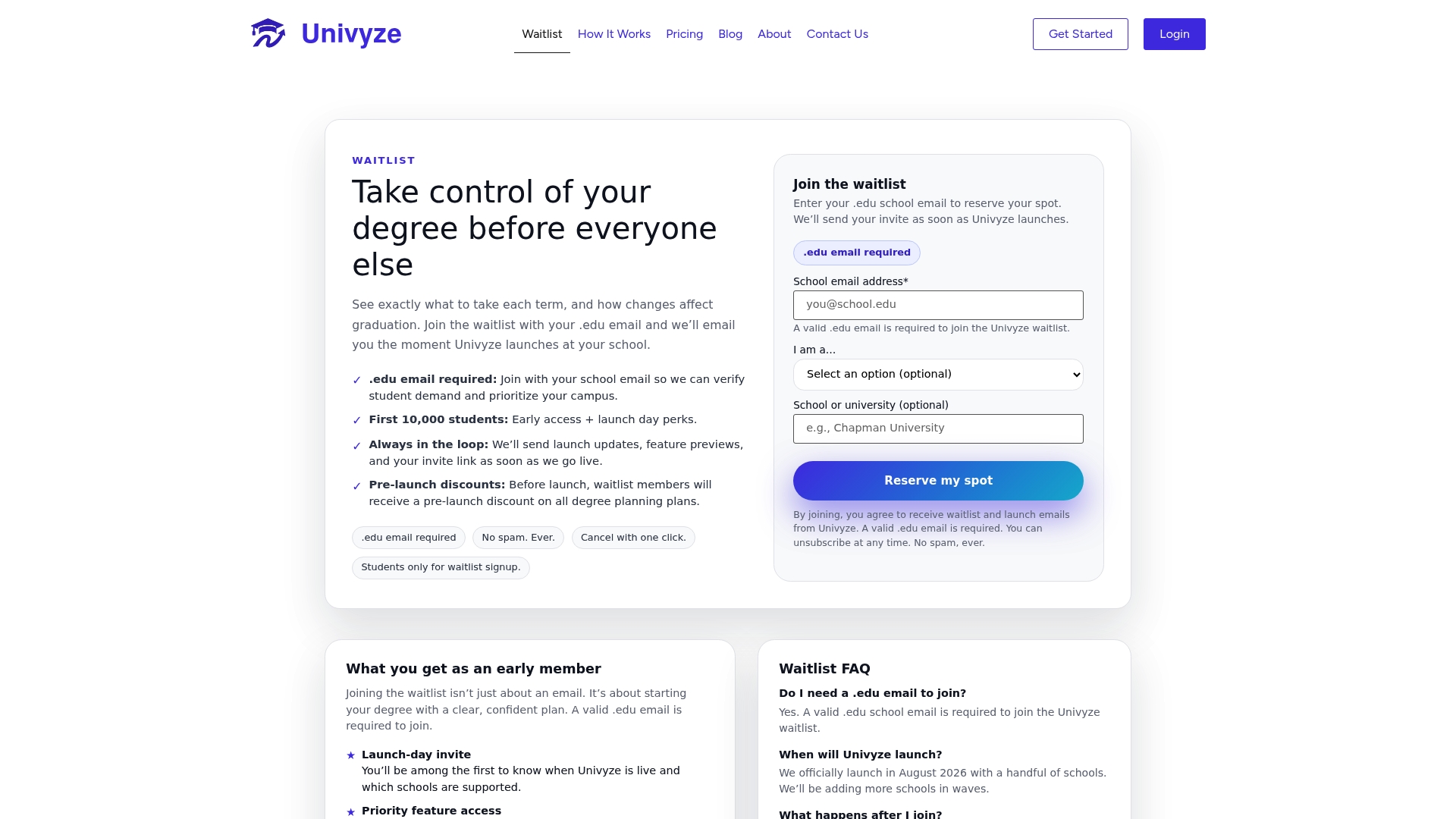
Univyze is a planning tool, not an official degree audit, so pair it with your registrar, catalog, and advisor before you finalize anything. If you want to see how the term-by-term view works, check our pricing options or join the Univyze waitlist to get access as spots open.
FAQ
What do you call classes that aren’t required?
These are typically called electives, meaning courses you choose to fulfill credit hours or personal interest rather than a specific degree requirement. Many programs let you count an elective toward your plan now and shift a required course to a later term.
What is the meaning of offered courses?
An offered course is one the department has scheduled to run in a given term, with an assigned instructor, meeting time, and open seats. Courses that haven’t run in recent years are sometimes flagged in institutional reports and may eventually be removed from the catalog.
What happens if you take a course without the prerequisite?
Most registration systems block enrollment automatically unless the department grants an override, which requires a specific justification tied to your academic need. If you do get in without the background, you may struggle with material the course assumes you already know.
What is a good reason to withdraw from a course?
Common accepted reasons include a documented medical issue, a major schedule conflict that can’t be resolved another way, or a genuine mismatch in course level discovered after the term starts. Simple scheduling convenience is rarely considered sufficient on its own, and advisors generally recommend a schedule adjustment before withdrawal when one is possible.
Sources
- Course Substitution Process – Registrar | Clemson University
- Enrollment requirements & prerequisites – Registrar | University of Illinois
- Course policies – University of Texas at Dallas Undergraduate Catalog 2025
- Course substitution policy – University of Detroit Mercy
- Exceptions for university requirements – USF Advisors