

An engineering course sequence is the order in which you take your required classes, semester by semester, so each course’s prerequisites are done before you need them. Math and physics come first, then statics, circuits, or data structures, then upper-division work. Most colleges publish a sample sequence for your major. Treat it as a starting template, then check it against your own catalog year, credits, and advisor.
This guide shows how those sequences are built, what a mechanical engineering and a computer science sequence look like, how psychology and business plans differ, and how to adjust a sample plan to your situation.
TL;DR
- Prerequisites, not preference, set the order of an engineering sequence. Calculus, physics, and intro engineering come first, and later courses depend on them.
- A sample sequence is a template. Your catalog year, AP, dual-enrollment, and transfer credits can change it.
- Some courses are offered only in certain terms, so a missed prerequisite can cost more than one class.
- Verify every plan with your official degree audit, your university catalog, the registrar, and your advisor.
- Univyze helps you lay out a term-by-term draft and test what-if changes before you meet your advisor.
Table of Contents
- Course sequence vs. degree plan: what is the difference?
- Why prerequisites decide the order
- A mechanical engineering course sequence, semester by semester
- A computer science course sequence
- Engineering degree plans vs. psychology and business sequences
- How to check a sample sequence against your own situation
- When schedules slip: conflicts, major changes, and extra semesters
- Using AP, dual enrollment, transfer credit, and summer terms
- Plan your sequence with Univyze
- FAQ
- Sources
Course sequence vs. degree plan: what is the difference?
A course sequence is the order of your required courses. A degree plan is the bigger picture: every course you need for graduation, including credits you already have, what remains, and which term each course lands in.
Virginia Tech describes an academic plan as an outline of every course needed to meet graduation requirements, including completed and transfer credits, remaining requirements, term placement, and later updates. Boston University’s College of Engineering draws the same line. Its planning sheets show a typical sequence of required courses, while a separate sequencing tool lets students and advisers customize term-by-term plans and scenarios. Course order stays flexible as long as prerequisites are satisfied.
So the sequence is the skeleton and your degree plan is the skeleton with your name on it. If you want to see how the two fit together across all four years, our guide to building a multi-year degree plan walks through it. Students comparing programs can also look at bachelor’s degree programs to see how technical majors are structured.

Why prerequisites decide the order
Engineering majors leave little room for shuffling. Oregon State says its engineering programs are structured with limited elective choice, so advising focuses mainly on the sequence in which required courses are taken, and prerequisites largely control that sequence.
Three things shape your order:
- Prerequisites and corequisites. A prerequisite must be finished first. A corequisite can be taken in the same term.
- Course availability. The University of Iowa advises students to check prerequisites, corequisites, and when courses are offered, because some courses are sequential or offered only in certain semesters.
- Placement. The University of Hawaiʻi at Mānoa gives a standard calculus path of Math 241, 242, 243, and 244, and notes that students placed into precalculus may first need Math 134 and Math 140X. Starting a level lower pushes every later course back.
The same handbook says its checksheets list requirements in required or recommended order, and that missing critical prerequisites can delay graduation. That is why one skipped course can ripple. If you miss a prerequisite that is only taught in the fall, the next course that needs it may wait a full year. Our checklist on prereqs and coreqs covers how to catch these before registration.
A mechanical engineering course sequence, semester by semester
Mechanical engineering is a good example because the dependencies are easy to see. The University of Arizona’s 2026–27 plan places calculus, chemistry, composition, and introductory engineering in semester one. Semester two adds Calculus II and physics. Semester three brings statics and programming. Semester four includes thermodynamics, dynamics, differential equations, electrical engineering, and CAD, per Arizona’s mechanical engineering plan.
That plan also spells out the links between courses:
| Course | What it depends on (Arizona’s plan) |
|---|---|
| Statics | Physics mechanics and Calculus II |
| Dynamics | Statics, plus differential equations (concurrent or completed) |
| Differential equations | Calculus II or vector calculus |
The University of South Carolina’s mechanical engineering map follows a similar shape. Its first two semesters include chemistry and Calculus I, then programming, computer-aided design, composition, Calculus II, and physics. Circuits, statics, numerical methods, and differential equations come later. The map also labels a recommended sequence and flags critical courses whose deadlines or completion can affect time to graduation.
Two schools, two slightly different orders, the same logic: math and physics first, mechanics and design next, specialized courses after.
A computer science course sequence
Computer science sequences are organized around programming dependencies. The University of Texas at Arlington’s 2026–27 example starts with introductory programming, Calculus I, composition, and core courses. It then moves to intermediate and object-oriented programming, discrete structures, computer organization, algorithms and data structures, physics, software engineering, operating systems, linear algebra, and higher-level CS work, per UTA’s suggested four-year plan.
The dependencies there are specific. Object-oriented programming (CSE 1325) follows CSE 1320. Algorithms comes after CSE 1320 and discrete structures. Operating systems comes after computer organization. Software engineering comes after intermediate programming, object-oriented programming, and discrete structures.

If you are building a CS course plan, draw the chain first. Find the longest string of prerequisites, then place those courses early so they never become the bottleneck in your last two years.
Engineering degree plans vs. psychology and business sequences
Not every major is this rigid. Psychology is a useful contrast.
- The University of Utah describes psychology as a 41-credit major with required foundation courses, core-area courses, and electives, with significant flexibility to choose courses around interests and schedules.
- Michigan-Dearborn requires at least 40 psychology credits, including 4 lower-level and 36 upper-level credits, so transfer students may complete much of the upper-level work in junior and senior years.
- The University of Tennessee’s psychology plan requires PSY 211 with at least a C after MAT 160 or higher, and PSY 312 before most 400-level courses. It also requires at least 124 credits for the B.A., per its four-year plan.
So a psychology plan is looser in the first two years and tighter in the upper division, where level requirements and course gates matter. Business roadmaps tend to work the same way: a core of foundation courses, then concentration courses with their own prerequisites. Whatever the major, the habit is the same. Find the gates, then plan around them. Our examples of four-year degree plans show how that looks across majors.
How to check a sample sequence against your own situation
A sample plan is written for a student who starts at the school’s expected level, in a specific year, with no outside credit. That is rarely you. Colleges say so themselves.
- Michigan-Dearborn states that its sample pathways are not universal degree requirements. Use the catalog for official requirements and the pathway for the year you declared your major. It also says prerequisite and corequisite exceptions are rarely made.
- USC Dornsife advises students to compare sample plans with their degree audit, which includes USC work and accepted transfer work, and to use the catalog year tied to their admitted term.
- UC San Diego calls its plans sample templates that must be modified for individual backgrounds, including AP, IB, and community-college work, and tells students to use a current degree audit.
- Virginia Tech tells students to record transfer and completed credits, verify prerequisites and whether courses run in the intended term, review the plan with an adviser, and keep updating it.
- Penn State recommends building a semester-by-semester plan from a degree audit and a recommended academic plan. It lists 12 credits as full-time and 14–18 credits as a typical load, per its schedule planning guide.
A practical routine:
- Find your catalog year and download the sample sequence for that year.
- List every credit you already have: AP, dual enrollment, transfer, and summer work.
- Mark each course your sample sequence still needs and cross out the ones you have covered.
- Trace prerequisite chains and note which courses are only offered in fall or spring.
- Spread the load so no term mixes several heavy courses.
- Bring the draft to advising. Our post on course scheduling strategies explains how to make that meeting productive.
If you attend UCLA, UCI, USC, or CSULB, verify every requirement with your official degree audit, the university catalog, the registrar, and your advisor. A planning tool is not the record of what counts toward your degree.
When schedules slip: conflicts, major changes, and extra semesters
Two things push students off a sequence: a class that will not fit, and a change of major.
A schedule conflict matters most when the course is a prerequisite for something else, or when it is offered only once a year. In that case, a conflict can push you back a full term or more. The fix is to know which courses are gates before you build your schedule, and to keep a backup section or alternative term in mind. If you are stuck, a prerequisite override request with a short, clear justification is sometimes an option, though the department decides.
Changing majors is similar. Early on, much of your coursework in math, science, and general education may still count. Switching into a tightly sequenced major later is harder, because you start the prerequisite chain behind your peers. A what-if comparison before you switch lets you see which completed courses carry over and what the new term-by-term map would look like. Verify the result with your advisor and registrar.
The money side is real. Each added term means more tuition and living costs, which we cover in why tuition increases with extra semesters. Midyear graduation is another route some students explore, and we cover it in our midyear planning guide. Neither is guaranteed: availability, credit acceptance, and policy differ by school.
Using AP, dual enrollment, transfer credit, and summer terms
Outside credit can shorten the front end of an engineering sequence, but only if your school accepts it and it matches the course the sequence requires.
- AP and dual enrollment: Calculus, physics, chemistry, and composition are the usual candidates. Check your school’s credit policy and whether the credit satisfies the specific course or only general credit.
- Transfer credit: Community-college courses may map to your major’s courses or only count as electives. Your degree audit shows what was accepted.
- Summer sessions: A summer term can lighten a heavy semester or catch up on a prerequisite, if your school offers the course then.
Tennessee’s psychology plan makes the point plainly: availability is not guaranteed, and placement, AP, dual-enrollment, or transfer credit may require adjustments. Plan for flexibility, then confirm. Our guides on data-driven planning with AP and transfer credit and classes that count toward graduation go deeper. If you are starting out, use the freshman year planning checklist.
Our perspective
We built Univyze because the sample sequence on a department page answers only half the question. It tells you the usual order. It does not tell you what your own credits change, what happens if you switch majors, or which term a course is likely to be offered.
We think a plan should be simple to read and easy to change. That means a term-by-term view you can open in a minute, what-if scenarios for a major or minor change, and room for AP, dual enrollment, transfer credit, and summer sessions. It also means a clear progress view that a parent or advisor can follow too, so no one is guessing.
Univyze is a planning tool. It is not your official degree audit and it does not replace your advisor. We designed it to help you arrive at advising with a draft and better questions, so the conversation is about decisions rather than starting from scratch.
Ryan
Plan your sequence with Univyze
Univyze is degree planning software built around term-by-term planning, visual degree mapping, requirement tracking, schedule conflict management, and what-if scenarios for changing majors or minors. It also supports AP, dual-enrollment, and transfer credit planning, and shared dashboards for families and advisors.
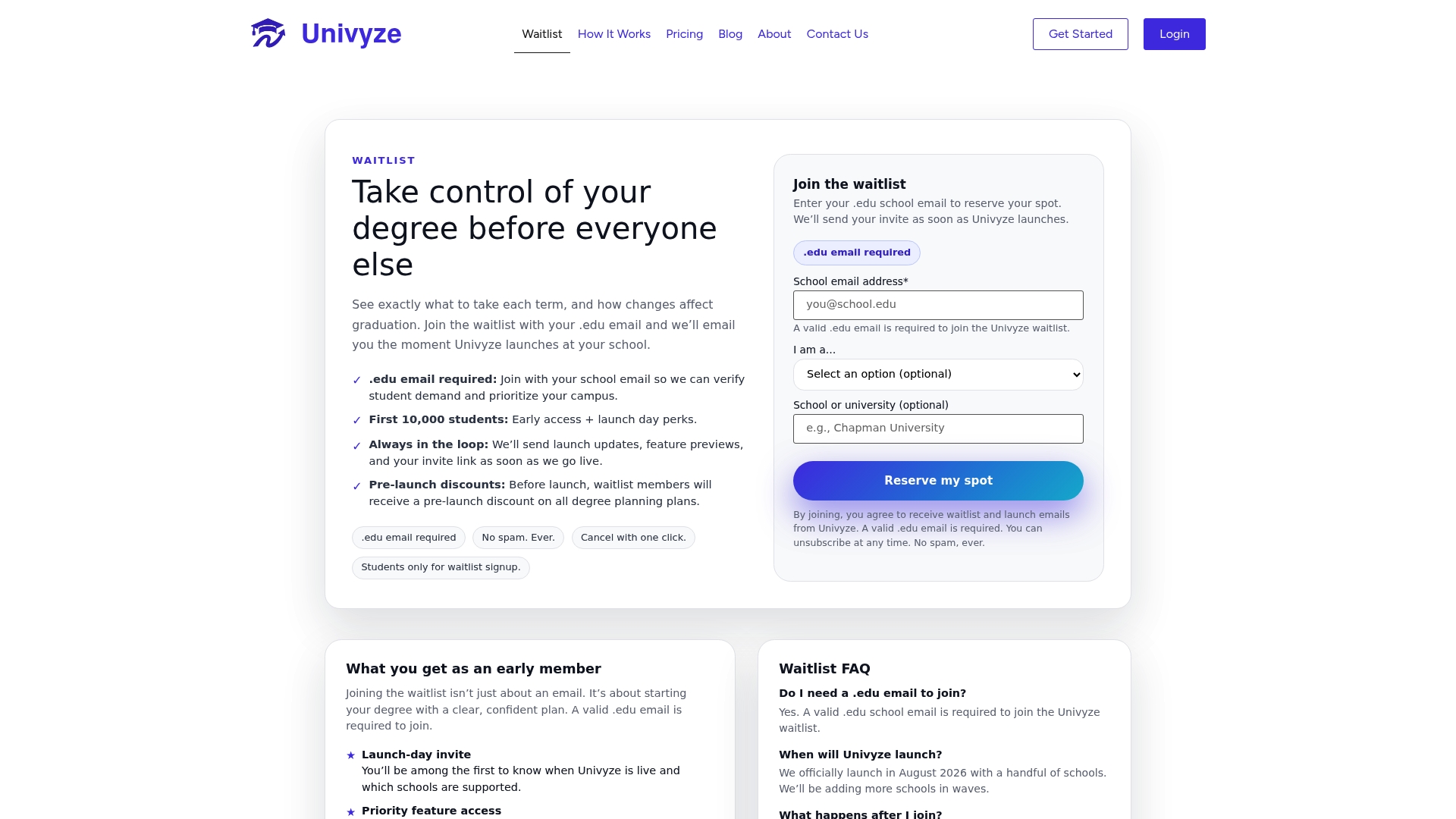
Pricing is published on the Univyze pricing page. The Starter plan is free. Paid annual plans are Core at $359.40 per year, Plus at $599.40 per year, and Pro at $1,199.40 per year. One-time options are Core at $1,095, Plus at $1,795, and Pro at $2,895. Parents can start from our parent page, and you can see how a planner differs from an audit in our degree audit vs. planner guide. We cannot guarantee course availability, credit acceptance, or graduation timing, so always confirm with your school. Ready to try it? Join the Univyze waitlist at univyze.com.
FAQ
What is the typical order of an engineering course sequence?
Most start with calculus, physics, chemistry for some majors, composition, and an intro engineering or programming course. Core engineering courses like statics, circuits, or data structures follow, then upper-division and electives. The exact order depends on your school’s prerequisites and your catalog year.
Can I take engineering courses out of order?
Sometimes. Boston University notes that course order stays flexible when prerequisites are satisfied. But some courses are sequential or offered only in certain terms, so check your catalog and ask your advisor before moving anything.
Is a sample four-year plan the same as my degree requirements?
No. Schools describe sample plans as templates. Your official requirements are in the catalog for your year and in your degree audit, which accounts for transfer and other credit. Confirm with your registrar and advisor.
Does a psychology or business plan work like an engineering plan?
Usually with more flexibility early on. Psychology programs often combine foundation courses, core areas, and electives, then require upper-level credits later. You still need to follow prerequisites and course gates, so a term-by-term draft helps in any major.
Sources
- ENG Undergraduate Program Planning Sheets, Boston University
- Academic Planning, Virginia Tech Engineering
- Undergraduate Advising Process, Oregon State University
- How to Find and Use a Sample Four-Year Plan, University of Iowa
- Undergraduate Handbook 2026–2027, University of Hawaiʻi at Mānoa
- Mechanical Engineering 2026-27, University of Arizona
- Mechanical Engineering B.S.E. major map, University of South Carolina
- 2026-27 Computer Science Suggested Four-year Course Plan, UTA
- Bachelor’s Program, Department of Psychology, University of Utah
- Psychology, University of Michigan-Dearborn Catalog
- Four-Year Degree Plan for Major in Psychology, B.A., University of Tennessee
- Curriculum Requirements and Course Sequences, University of Michigan-Dearborn
- Discover Dornsife: Crafting Your Course Plan, USC
- Academic Plans, UC San Diego Revelle College
- Schedule Planning, Penn State Division of Undergraduate Studies
- Bachelor programs, Metapilot Academy