

Why tuition increases when you take extra semesters

Less than half of college students graduate within four years, which means most students face the real financial consequences of extended enrollment. Every additional semester triggers a new tuition bill, often without the financial aid that covered earlier years. The real financial burden is substantial: according to recent analysis, the total cost of an extra year in college—including tuition, fees, living expenses, books, and lost wages—reaches $63,718 as of 2024.
Here is what drives tuition higher when you stay enrolled beyond the standard timeline:
- Per-semester billing: Colleges charge tuition each term, so every extra semester adds a full tuition payment.
- Financial aid expiration: Most grants and institutional scholarships cover only eight semesters. After that, you pay more out of pocket.
- Excess credit hour surcharges: Many public universities charge higher tuition rates once you exceed a credit threshold, sometimes reaching nonresident tuition rates.
- Living expenses: Housing, food, and transportation costs continue accumulating with every additional term.
- Lost income: Each extra semester delays full-time employment, reducing lifetime earnings.
Understanding these factors is the first step toward making a plan that keeps costs under control.
What economic forces push college tuition higher every year
Tuition does not rise in a vacuum. Broad institutional and economic pressures create an environment where annual tuition increases are nearly guaranteed, and those increases hit hardest when you are enrolled for extra semesters.

Pro Tip: Check your university’s published tuition history. Most schools post annual rate changes online, and seeing the pattern helps you project what an extra semester will actually cost two or three years from now.
Declining state funding is one of the most direct drivers. At the University of Michigan, for example, the state appropriation covered 64% of the General Fund in 1969–70 but fell to less than 14% by 2021–22. As state support shrinks, universities shift the burden onto tuition revenue. The result is that tuition and fees now cover nearly 75% of U-M’s General Fund, compared to 26% in 1969–70.
Rising operational costs compound the problem. Faculty salaries, technology infrastructure, building maintenance, and student services all cost more each year. Universities also spend heavily on campus amenities to attract students, and those costs get passed along through tuition.
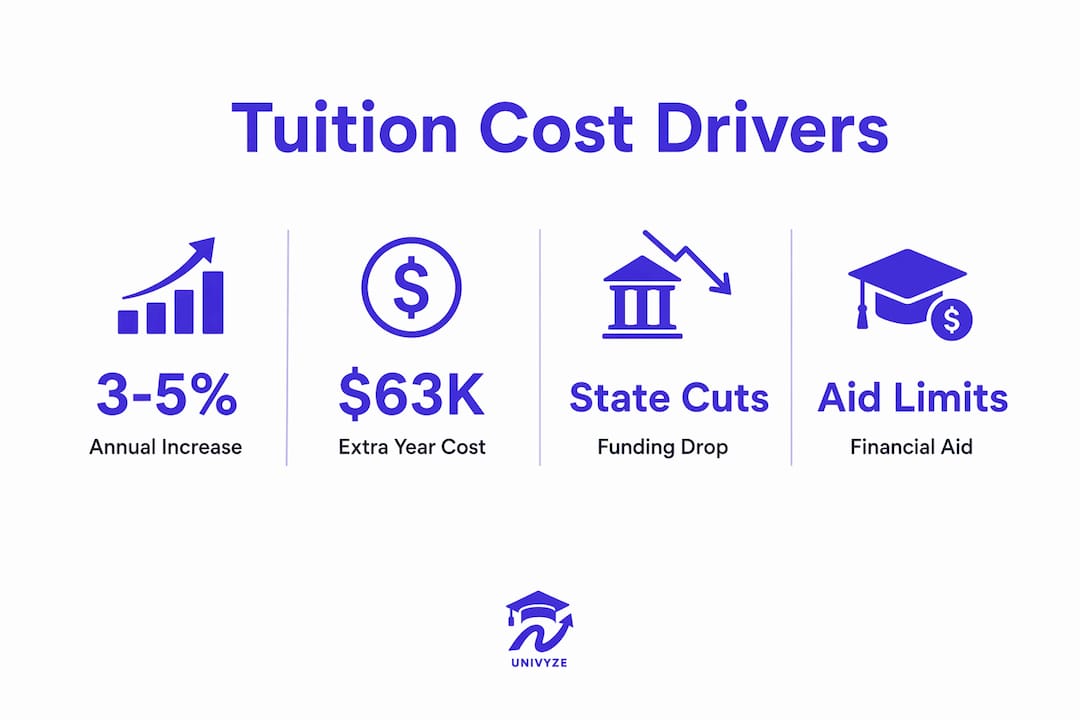
The Bennett Hypothesis adds another layer. Federal financial aid availability may actually enable tuition hikes, because institutions recognize that students have access to loans and grants to cover higher prices. A Congressional Research Service analysis of this relationship found that the correlation between rising aid and rising tuition is well documented, even if the causal direction is debated. Either way, the pattern holds: aid goes up, and tuition tends to follow.
How a longer graduation timeline directly raises your total cost
Taking five or six years to finish a degree does not just add one or two extra tuition bills. It reshapes the entire financial picture of your education.
Most students who extend their enrollment do so because of course availability problems, schedule conflicts, unexpected major changes, or simply taking fewer credits per semester than needed to stay on pace. Each of those situations adds time, and time adds cost.
- Tuition per extra term: Each additional semester means a full tuition charge, often at a rate higher than when you started due to annual increases.
- Reduced financial aid: Grants and scholarships typically do not extend past the standard four-year window, leaving you to cover more costs alone.
- Excess credit hour penalties: Once you exceed your degree’s credit threshold, many universities apply surcharges or switch you to a higher tuition rate.
- Lost wages: Every semester you stay in school is a semester you are not earning a full-time salary.
- Compounding living costs: Rent, food, and transportation do not pause while you finish your degree.
The total cost of an extra year in college, counting tuition, fees, living expenses, books, and lost wages, reaches $63,718. That figure puts the stakes in clear terms. Avoiding even one extra semester can mean tens of thousands of dollars saved.
Knowing which mistakes lead to delays is worth your time. Common errors like poor course sequencing or ignoring prerequisite chains are exactly the kind of planning gaps that add semesters without warning.
What extra fees and living costs pile on top of tuition
Tuition is the headline number, but it is rarely the whole story. When you stay enrolled for extra semesters, a set of additional costs accumulates alongside it.
- Housing and meal plans: Whether you live on or off campus, rent and food costs continue every term. An extra semester means another four to five months of those expenses.
- Course-specific fees: Lab fees, technology fees, and materials fees attach to individual courses. More semesters mean more of these charges.
- Health insurance and activity fees: Many universities charge these regardless of how many credits you are taking. They show up on your bill even in a light semester.
- Books and supplies: Textbooks and course materials add up quickly, especially in science, engineering, or art programs where materials costs are high.
- Transportation: Commuting costs, parking permits, or public transit passes are ongoing expenses that do not disappear just because you are taking fewer classes.
None of these costs are optional. They are built into the reality of being enrolled, and they make the financial burden of additional semesters significantly heavier than the tuition line alone suggests.
Sticker price vs. net price: what you actually pay for extra semesters
The sticker price is the official tuition rate your university publishes. The net price is what you pay after grants, scholarships, and institutional aid are applied. For most students in their first four years, those two numbers look very different. For students in a fifth year or beyond, they start to converge.
- Sticker price stays the same (or rises): The published tuition rate does not drop because you are a continuing student. It often increases annually.
- Financial aid packages shrink or disappear: Most institutional scholarships and state grants are structured for four years. Once you cross that line, the aid that reduced your net price is gone.
- Lost merit scholarships: Many merit awards have GPA and enrollment requirements. Extended timelines can disqualify students from renewals.
- Higher out-of-pocket costs: Without aid covering the gap, you pay closer to the full sticker price for every extra semester.
- Realistic budgeting matters: Students who understand the net price difference early can plan for the gap before it becomes a crisis.
The gap between sticker and net price is one of the least-discussed aspects of extended enrollment. A student who paid $8,000 per year net in years one through four might face $22,000 or more in year five, simply because the aid structure was never designed to stretch that far. Tracking your graduation progress regularly helps you see these gaps coming before they arrive.
How financial aid limits cut off support for students in extra semesters
Federal and institutional aid programs are built around a four-year model. Students who extend beyond that timeline run into hard limits that reduce or eliminate their support.
- Federal Pell Grant lifetime cap: Pell Grants have a 12-semester lifetime limit, tracked through a metric called Lifetime Eligibility Used (LEU). Once you hit 100% LEU, Pell eligibility ends, regardless of financial need.
- State and institutional scholarships: Most state grants and university scholarships cover only eight semesters. Students who need a ninth or tenth semester lose this funding entirely.
- Satisfactory Academic Progress (SAP) rules: Federal aid requires students to complete their degree within 150% of the standard program length. For a four-year degree, that means aid cuts off after six years, but many students hit the credit-hour cap sooner.
- Federal loan aggregate limits: Dependent undergraduates can borrow up to $31,000 in federal loans total. Independent undergraduates cap at $57,500. Students in extended programs often exhaust these limits before finishing.
- Private loans as a last resort: Once federal aid runs out, students turn to private loans, which carry higher interest rates and fewer borrower protections.
You can check your current LEU status on StudentAid.gov at any time. Knowing where you stand before your final semesters gives you time to adjust your plan rather than scramble for funding.
Pro Tip: Summer Pell Grants can help cover summer term credits, but they draw from your lifetime LEU. Use them strategically to accelerate graduation rather than just fill a schedule.
The real financial numbers behind extra semesters
The data on extended enrollment paints a consistent picture: most students are exposed to extra costs, and those costs are larger than most families expect.
| Cost category | What it includes | Notes |
|---|---|---|
| Tuition and fees | Per-semester billing at current rates | Rates typically rise annually |
| Living expenses | Housing, food, transportation | Continues every term enrolled |
| Books and supplies | Course materials per semester | Higher in STEM and art programs |
| Lost wages | Delayed full-time employment | Often the largest hidden cost |
| Total extra year cost | All of the above combined | $63,718 per extra year |
Excess credit hour policies add another layer of cost that students rarely anticipate. At the University of Arizona, undergraduates who accumulate 145 or more credit hours without completing a degree face a per-unit surcharge on top of regular tuition. Arizona State University charges resident students $174 per credit hour as an excess hours surcharge once they cross the same threshold, with nonresident students paying $298 per credit hour. These are not small numbers for a student taking 12–15 credits in a final semester.
State-level policies can push the annual cost of excess credits up by $10,000 to $30,000 per year, depending on the institution and the number of excess hours involved. Texas State University, for instance, charges the nonresident tuition rate for hours that exceed the degree plan by 30 or more credits.
The awareness gap around Summer Pell Grants is also worth noting. Using summer credits strategically to finish faster can reduce total costs, but students who do not know the LEU clock is running may burn through eligibility without accelerating their timeline at all.
How tuition increase patterns differ by program type
Not all programs follow the same tuition structure, and the cost of extra semesters varies depending on whether you are in an undergraduate, graduate, or professional program.
Undergraduate programs
Undergraduate tuition is typically charged per semester or per credit hour, with flat-rate pricing common for full-time enrollment. Annual tuition increases of 3–5% are standard at most institutions. Excess credit hour policies apply almost exclusively at the undergraduate level, making extended enrollment especially costly for students who accumulate credits without completing their degree. Financial aid is most abundant here, but it is also the most time-limited.
Graduate programs
Graduate tuition is almost always charged per credit hour, with no flat-rate full-time option. This means every course you add costs more, and there is no ceiling that makes taking extra credits “free.” Financial aid for graduate students is more limited, with most support coming through assistantships, fellowships, or federal loans. Extending a master’s or doctoral program adds tuition costs at the per-credit rate plus the loss of any stipend or fellowship tied to a specific timeline.
Professional programs (law, medicine, business)
Professional programs like law school, medical school, and MBA programs carry the highest per-year tuition of any degree type. They are also structured as fixed-length programs, so extending them is unusual but not unheard of. A student who takes a leave of absence or fails to meet progression requirements may face an additional year at full professional-program tuition rates, which can run well above $50,000 annually at private institutions. Financial aid in these programs is heavily loan-dependent, and aggregate borrowing limits can become a real constraint for students who extend their timeline.
The common thread across all program types is that athletic participation and other tuition benefits aside, extended enrollment means paying more with less support. The structure of aid and tuition billing consistently rewards finishing on time.
Plan smarter and avoid the extra semester trap with Univyze

Extra semesters are rarely planned. They happen because a required course was full, a prerequisite was missed, or a major change came late in the game. Univyze is built to help students see those problems before they become expensive surprises.
Univyze gives you a dynamic dashboard that maps your degree requirements against real course offerings, term by term. You can model what-if scenarios for major changes, see how AP credits, dual enrollment credits, and transfer credits apply to your plan, and spot gaps in your schedule before registration closes. Parents can also track progress alongside their student, so everyone is working from the same picture.
Univyze is a planning tool, not a replacement for your academic advisor or your university’s official degree audit. Always verify your requirements with your registrar, your university catalog, and your advisor. But having a clear visual plan before those conversations makes every advising appointment more productive.
Build your term-by-term degree plan and see where you stand. Join the Univyze waitlist today and start planning with clarity.
Key Takeaways
Extra semesters cost significantly more because tuition billing, financial aid limits, and excess credit hour policies all compound against students who extend beyond the standard four-year timeline.
| Point | Details |
|---|---|
| Extra year total cost | An additional year of college costs $63,718 when tuition, fees, living expenses, and lost wages are combined. |
| Pell Grant lifetime cap | Federal Pell Grants are limited to 12 semesters of eligibility, tracked through Lifetime Eligibility Used (LEU). |
| Excess credit surcharges | State policies can raise annual tuition by $10,000 to $30,000 once students exceed their degree’s credit threshold. |
| Aid drops after year four | Most state grants and institutional scholarships cover only eight semesters, leaving extended students to pay more out of pocket. |
| Net price gap widens | Students who extend enrollment often pay close to the full sticker price because the aid that reduced their net price has expired. |
FAQ
Why does tuition go up every year?
Tuition rises annually because universities face declining state funding, rising faculty and operational costs, and institutional pressure to maintain services. As state appropriations shrink as a share of university budgets, tuition revenue fills the gap.
What causes tuition to increase when students take extra semesters?
Each extra semester triggers a new tuition charge, often without the financial aid that covered earlier years. Excess credit hour policies, expired scholarships, and higher living costs all compound the total expense of extended enrollment.
How much will an extra semester or year actually cost?
An additional year of college costs $63,718 when tuition, fees, living expenses, books, and lost wages are all counted. Even a single extra semester represents a substantial unplanned expense for most families.
Do tuition fees increase every year?
Yes, at most U.S. colleges and universities, tuition increases annually. Annual increases of 3–5% are common at many institutions, meaning the tuition rate in a fifth year is likely higher than it was in year one.
Can financial aid cover extra semesters?
Federal Pell Grants are capped at 12 semesters of lifetime eligibility, and most institutional scholarships cover only eight semesters. Students who extend beyond the standard timeline typically lose a significant portion of their aid and must borrow privately or pay out of pocket.