

A course substitution lets a different course count in place of one your degree requires. The process is almost always the same: talk to your advisor, submit a form or petition with a syllabus, wait for the department chair (and sometimes a dean) to decide, then check that the registrar recorded it in your degree audit. The details change from school to school, so your own catalog and registrar page always win.
This guide walks through each step, shows what to put in a request, explains how a substitution differs from a waiver, and covers what happens to your requirements if you change a minor.
TL;DR
- A substitution replaces a required course with a comparable one. A waiver removes the requirement entirely. They are not the same thing.
- Most schools want a form, a syllabus for the course you want to use, and approval from the department chair or program director.
- Decisions often take about a week, but some take longer, so ask early and never assume approval before it is recorded.
- Changing or breaking enrollment in a program can nullify an earlier approval. Ask whether you need to file again.
- Verify everything with your official degree audit, catalog, registrar and advisor. Planning tools help you prepare, but they do not approve anything.
Table of Contents
- What a course substitution actually is
- Substitution, waiver and transfer credit: the differences
- Which courses qualify, and who approves
- The step-by-step process
- How long it takes, and when to ask
- Confirming it shows up in your record
- How changing a minor affects your substitution
- Our perspective
- Plan before you petition
- FAQ
- Sources
What a course substitution actually is
Los Angeles City College describes a course substitution as an academic petition to use a course with similar content and learning outcomes to fulfill a degree requirement. Randolph-Macon College words it similarly: an alternative, academically comparable course satisfies a specific major or minor requirement, and the approval applies only to that requirement. It does not shrink the total credits you need for the degree.
That last point catches people out. If you substitute a 3-credit course for another 3-credit course, your credit count is unchanged. You have simply changed which course checks the box.
Typical reasons students ask:
- A required course is not offered in a term you need it, or keeps conflicting with another required class.
- You took a similar course at another school, or in a different department on your own campus.
- You changed majors or minors and an older course now overlaps with a new requirement.
- A disability-related barrier makes a specific requirement impossible to complete. The University of Florida, for example, lets students with qualifying diagnoses petition for a substitution in general education math or foreign language, and a granted language petition comes with pre-approved cultural courses to complete instead.
If the real problem is a course that simply is not on the schedule, read what to send when a course isn’t offered first. A substitution is one possible answer, but not always the first one to ask for.
Substitution, waiver and transfer credit: the differences
These three terms get mixed up constantly, and the wrong request can waste a month.
| Substitution | Waiver | Transfer credit | |
|---|---|---|---|
| What it does | Swaps a required course for a different, comparable one | Removes the requirement | Brings outside credits onto your record |
| Total credits needed | Unchanged | Unchanged, so you may need other courses to fill the gap | Counts toward credits |
| Who decides | Department chair or program director, then registrar | Usually department and dean | Registrar or evaluations office |
| Shows on transcript | Often not | Not as credit | Yes |
San Jose State’s advising guide says a substitution replaces a required course with a different course, while a waiver removes a requirement and is used only when no acceptable substitution exists. City University of Seattle’s catalog adds that a waiver does not grant credit, so a student must make up the lost program credits with another course of equivalent level.
The Austin Community College biology department also draws a line between substitution and equivalency: a substitution is an internal process, and nothing changes on your transcript when one is approved, while an equivalency does update it. If you took the course at another school, your question may really be about transfer rules, which our guide to maximum transfer credits covers.
Which courses qualify, and who approves
Schools set their own rules, but the same themes keep showing up.
Comparable content and level. The University of Detroit Mercy requires that a substituted course match the required course in content, level and credit value and support the same program learning outcomes. Liberty University adds that a lower-level course used for an upper-level requirement cannot count toward the upper-level hours required.
Accredited source. Palomar College accepts only undergraduate courses from regionally accredited schools, and its department chairs may consider international undergraduate courses at their discretion. Work experience, graduate work and industry certifications are not eligible.
Adequate cause. The University of Wisconsin-Stevens Point says waivers and substitutions are granted only with adequate cause, and major or minor substitutions need approval from the department chair or head.
Limits. Some schools cap how many substitutions you can use. Detroit Mercy treats requests above its 25% limit, or involving a protected course, as exceptions that need extenuating circumstances and the dean’s written approval.

Who signs varies a lot. At some schools it is just the chair and registrar. At Savannah College of Art and Design, the form lists the advisor, two deans, a vice president and the registrar, and the substitution is not official until the registrar signs. At Citrus College, the petition is completed by a counselor only, so students start with a counseling appointment rather than a form.
The step-by-step process
- Read your catalog and registrar page. Search your school’s site for “course substitution” or “petition.” Note the form name, the deadline and who must sign.
- Check your degree audit. Identify the exact requirement you want to replace, by course code and requirement name, not just “my science class.”
- Book an advisor meeting. Advisors know which substitutions their department actually approves. Some schools require this step before you can file.
- Gather documents. Collect the syllabus for the course you want to use, a transcript or course description, and the catalog description of the required course.
- Submit the request. Use the school’s form, online petition or counselor. Brandeis, for example, lets students with a declared major or minor petition online and upload a syllabus that lists prerequisites, textbook information and individual class topics.
- Follow up politely. If a week or two passes with no word, email the person who holds the form.
- Confirm it was recorded. Check your degree audit after approval (more on this below).
What to include in the request
A strong request is short and specific. Include:
- Your name, student ID, major and catalog year
- The required course you want replaced (code and title)
- The course you want to use (code, title, school, term, grade if complete)
- Two or three sentences on why the content and level match
- The syllabus, attached
- The term you plan to finish the requirement, so the reviewer understands the timing
A sample email to an advisor might read:
Hi Professor Lee, I’m a sophomore in the biology major (catalog year 2025). I’d like to ask for a substitution of BIO 210 with BIO 225, which I took at a community college last summer. The syllabus is attached, and both courses cover cell biology at the same level with a lab. Could you tell me whether I should submit the department’s substitution form, and who signs it? I’m hoping to settle this before I register for spring.
Notice what is missing: pleading, long stories and promises. Reviewers want evidence that the content matches.
How long it takes, and when to ask
Timing depends on the school. Liberty University says it emails a decision within 5 to 7 business days of submission. UC San Diego’s Chemical and Nano Engineering department also quotes 5 to 7 business days, but warns that busy schedules, travelling faculty and sabbaticals can stretch review times, so it advises submitting as early as possible.
Some schools set a hard cutoff. Detroit Mercy requires the substitution and its approval to be processed by the registrar before the end of the first week of the semester in which it applies. A safe habit: ask before registration opens for the term you need it, not during add/drop.
You can often file before you finish the course. Brandeis lets students submit for courses in progress, though the substitution will not appear in the degree audit until a final grade posts. Keep that in mind when you plan next term’s schedule.
Confirming it shows up in your record
Approval in an email is not the finish line. Detroit Mercy’s policy says approved substitutions must be recorded in the degree audit system before the coursework can count toward a requirement, including for financial aid reporting. Liberty adds that an approved substitution applies in the degree requirements but does not change the transcript prefix, number or GPA.
A quick confirmation routine:
- Save the approval email or signed form as a PDF.
- Log in to your official degree audit one to two weeks later and find the requirement.
- If it still shows as unmet, email the registrar with the approval attached.
- Re-check after any change of major, minor or catalog year.
San Jose State’s advisor guide notes that requests involving in-progress courses are tracked as “Processing in Progress” for students who graduate in future terms. A status like that is normal, but it is a reason to check again closer to graduation. Our guide to moving from degree audit to planner shows how to carry audit results into a term-by-term plan, and the degree requirement checklist helps you keep track of each box.
How changing a minor affects your substitution
A minor change can quietly undo your plans. Many substitutions are approved for a specific program, so switching can mean starting over. Liberty states that changing programs or breaking enrollment may nullify the request, requiring a new one for the new degree program. Detroit Mercy says the same about a change of program or a gap in enrollment.
Changing a minor also changes which courses you owe. San Francisco State’s registrar warns that any change to your major, minor or catalog year will have an impact on your degree requirements, and recommends checking with the prospective department before you submit. It also notes that a minor requires fewer units than a major and is generally not a graduation requirement, which is why dropping one is usually lower risk than switching a major. Still, the courses you counted toward it may have been serving another purpose.
Before you change a minor, ask your advisor:
- Do my approved substitutions carry over, or do I need to refile?
- Do any courses I already took double count for the new minor?
- Does the new minor use a different catalog year?
- Will this change affect my planned graduation term or my class load in any semester?
If you are weighing a bigger shift, our change-major plan walks through protecting your timeline and aid.
Our perspective
Most students meet course substitutions at the worst possible moment: a required class is full, graduation is two terms away, and nobody has told them there is a form. We think the fix is to plan earlier, not to file faster.
When your requirements, completed courses, AP credit, dual enrollment, transfer credits and summer sessions sit in one term-by-term view, you can see a problem months before registration. That gives you time to talk to your advisor, collect a syllabus and ask for a substitution while the answer still matters.
Univyze is built as a planning tool, not an official degree audit and not a replacement for your advisor. We help you see the path and test “what if” scenarios, such as a changed minor, so you walk into advising with a draft and clear questions. Your school’s registrar decides what counts.
Ryan
Plan before you petition
If you want a clearer picture of what your degree still needs, Univyze maps requirements into a term-by-term plan, with what-if scenarios for major or minor changes and room for AP, dual enrollment, transfer and summer credit. It has a free Starter plan, and paid plans are listed on our pricing page: Core is $359.40 per year or $1,095 one-off, Plus is $599.40 per year or $1,795 one-off, and Pro is $1,199.40 per year or $2,895 one-off.
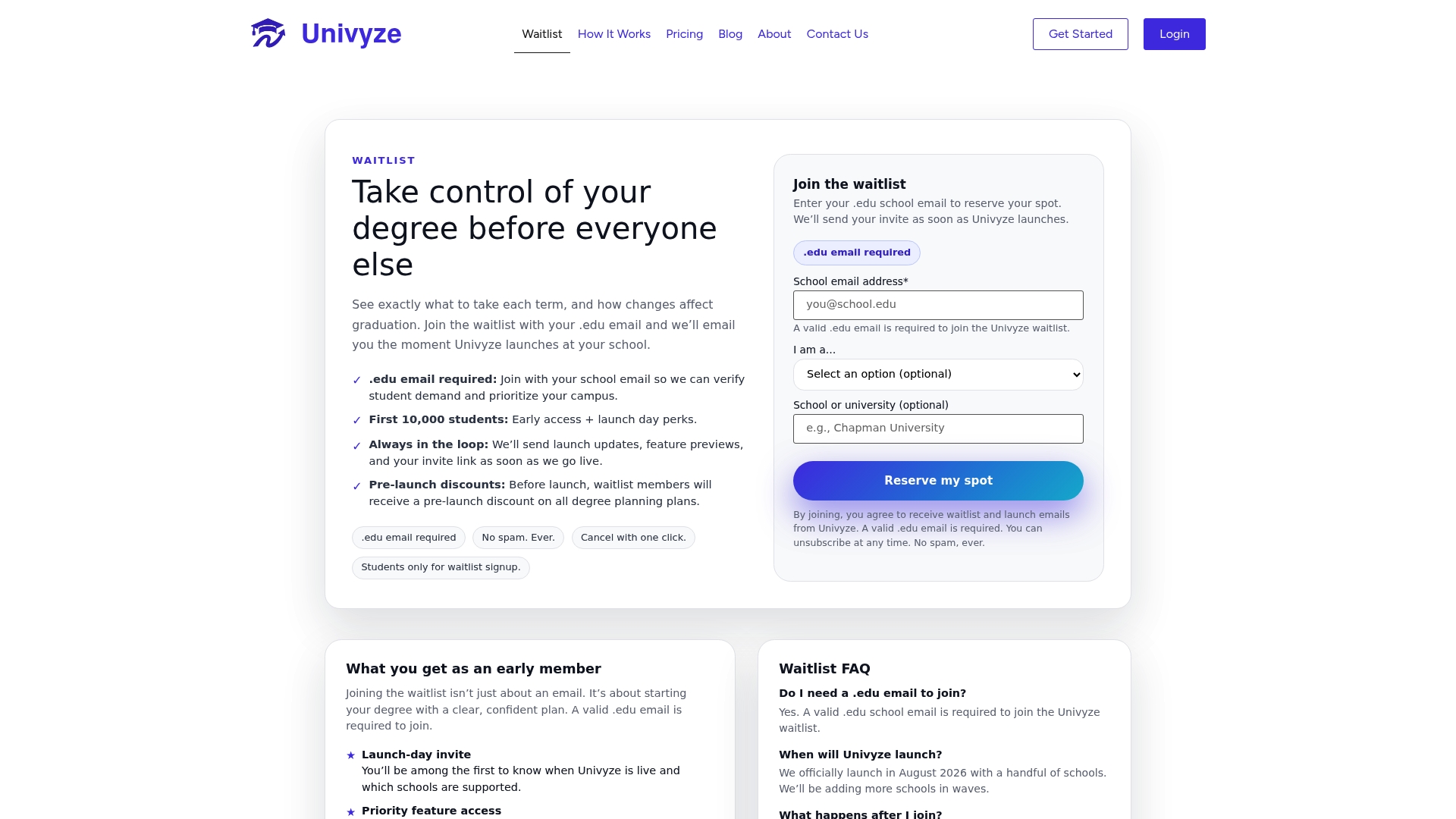
Univyze does not approve substitutions or guarantee course availability, transfer-credit acceptance or graduation timing. Use it to prepare, then confirm with your official sources. If that sounds useful, join the Univyze waitlist at univyze.com.
FAQ
What does it mean to waive a class?
A waiver removes a requirement instead of replacing it with another course. It does not give you credit, and some schools expect you to make up the credits with another course of similar level. Ask your advisor whether a substitution is available first, since advisors often consider that before a waiver.
How do I write an email asking to change a course?
Keep it to a short paragraph: name the required course, name the course you want to use, say why the content matches, and attach the syllabus. Ask which form to submit and who signs it. Include your major, catalog year and the term you hope to finish the requirement.
Does a course substitution change my GPA or transcript?
At many schools it does not. Liberty University says an approved substitution does not change the transcript prefix, number or GPA, and Austin Community College’s biology department says nothing appears on the transcript. The substitution shows in your degree audit instead, so check it there.
Can I substitute a class I am still taking?
Often you can file early, but the change may not appear in your audit until the final grade posts. Brandeis works this way, for example. Ask your registrar how your school handles in-progress courses and whether a deadline applies.
Sources
- Course Substitutions, Los Angeles City College
- Course Substitution, Randolph-Macon College
- Course Substitutions, University of Florida Disability Resource Center
- ARS Guide for Advisors, San Jose State University
- Course Options for Program Credit, City University of Seattle
- Course Substitution vs Course Equivalency, Austin Community College
- Course Substitution Policy, University of Detroit Mercy
- Course Substitution, Liberty University Registrar
- Course Substitutions and Waivers, Palomar College
- Course Waivers and Substitutions, UW-Stevens Point
- Request for Course Substitution, Savannah College of Art and Design
- What is a course substitution?, Citrus College
- Major/Minor Forms, Brandeis University Registrar
- Petitions and TEA, UC San Diego Chemical and Nano Engineering
- Change of Major or Minor, San Francisco State Registrar