

Adding a minor almost always follows the same sequence: talk to your advisor, get cleared by the minor department, submit a form through your student portal, and wait for registrar confirmation. Most minors typically require between a moderate and a substantial number of credits, and the single biggest mistake students make is waiting too long. Declare before you file your final graduation application, and if the timeline feels tight, ask your advisor about summer courses, AP credit, or overlap electives before you assume it’s not possible.
TL;DR:
- Students should declare a minor before submitting their final graduation application to avoid missing deadlines and course availability issues.
- The process typically involves advising, verifying eligibility in the student portal, departmental approval if required, and formal submission through a change-of-program form.
- Most minors demand between 15 and 30 credits, with some requiring a minimum GPA or limited enrollment windows, making early planning essential.
- Adding a minor is unlikely to affect federal aid but can impact scholarship renewal if it extends the time or increases credit load beyond original plans.
- Overlapping courses, summer classes, AP credits, and strategic course sequencing help minimize additional time when adding a minor without delaying graduation.
Table of Contents
- How Do You Officially Add a Minor?
- What Are the Eligibility Rules and Deadlines?
- Planning Tactics That Keep You on Schedule
- What to Bring to Your Advising Appointment
- Does Adding a Minor Affect Financial Aid or Scholarships?
- How Do You Change or Drop a Declared Minor?
- Common Minors and What They Typically Require
- When Does a Minor Make Sense, and When Doesn’t It?
- See Your Minor Before You Commit to It
- Sources
- FAQ
How Do You Officially Add a Minor?
The process is more paperwork than mystery, but skipping a step can cost you a semester. Here’s the order that actually works at most schools.
-
Book an advising appointment and bring your paperwork. Pull your degree audit and unofficial transcript before you go, and write down the minor’s required courses so your advisor can spot overlaps with your major on the spot.
-
Meet with the minor department or minor coordinator, if one exists. Some minors don’t require this step, but competitive or specialized ones often do, and skipping it when it’s required just means your form gets bounced back later.
-
Run an eligibility check in your student portal. Many schools now build this into the same system used for degree audits. NC State’s CODA portal, for example, requires students to clear an eligibility check, which typically means a minimum number of institution credits and sometimes a GPA floor, before the “Add a Minor” action even becomes available.
-
Submit the official change-of-program form or eForm. This is the step people forget takes real time. At schools like Georgia Tech, the change of minor form routes through DocuSign for departmental sign-off, which means your submission sits in someone’s approval queue, not just a database.
-
Confirm with the registrar and update your plan. Don’t assume it’s done just because you hit submit. Most portal-based systems confirm the minor’s addition through the registrar, and that confirmation is what actually locks the new requirements into your degree audit.
Treat each step as a checkpoint, not a formality. A form stuck in departmental review during your second-to-last semester is exactly how a minor turns into an extra term.
What Are the Eligibility Rules and Deadlines?
Every school runs its own version of this, but the shape is consistent enough to plan around.
- Credit range: most minors require a credit range typically within the mid-teens to around 30 credits, with some schools requiring a set number of credits earned at that institution specifically, not transferred in.
- GPA thresholds: some minors, particularly competitive ones, set a minimum GPA for admission, separate from your overall academic standing.
- Departmental limits: popular minors sometimes cap enrollment or run their own application windows, meaning you can’t just add them whenever you want.
- Declare-by deadline: the near-universal rule is that you must add the minor before you submit your final graduation application. Miss that window and the registrar may simply refuse the addition.
Waiting until your last semester is the riskiest move you can make. By then, required courses may not be offered again before you graduate, and there’s no time left to appeal a denied application. If you’re already close to the deadline, ask about summer sessions, a certificate instead of a full minor, or a smaller set of electives that still shows the interest on your transcript without the same credit load.
Planning Tactics That Keep You on Schedule
Adding 15 to 30 credits to a plan that’s already built around roughly 120 credits sounds like it should push graduation back. It doesn’t have to, if you plan the sequencing instead of just enrolling and hoping.
- Audit your elective space first. Most degree plans have some open elective credits already built in. If your minor’s requirements substantially overlap with those slots, you may not add a single extra term.
- Hunt for cross-listed or overlap courses. A course that satisfies both a major elective and a minor requirement is the single most efficient move you can make.
- Flag prerequisites early. Minors with sequenced upper-division courses create bottlenecks fast if you discover a prerequisite requirement in your junior year instead of your sophomore year.
- Use summer terms, AP credit, and transfer credits strategically. Filling gaps outside the fall/spring grind is often the difference between finishing on time and adding a semester.
- Consider a certificate instead. If you want a résumé-ready skill fast rather than broad academic depth, a certificate typically requires fewer credits and gets you there quicker.
Pro Tip: Run the math before you fall in love with a minor. Count exactly how many of its required courses overlap with electives you already need, then count how many are brand new additions. If more than half are new, ask your advisor whether a lighter certificate gets you a similar payoff with less risk to your timeline.
This is also where a planning tool earns its keep. Mapping out a full-time credit load against a proposed minor, semester by semester, shows you conflicts and overloaded terms before you’re stuck living them.
What to Bring to Your Advising Appointment
A productive advising meeting is the difference between walking out with a plan and walking out with more questions than you started with.
- Bring your current degree audit and unofficial transcript, plus a list of the minor’s required courses pulled straight from the catalog.
- Ask direct questions: Does this minor block or delay graduation? Are there admission limits or prerequisites? Which courses double-count toward my major? What’s the realistic processing timeline for the form?
- Leave with next steps, not just information: a completed eligibility check, a scheduled follow-up with the minor coordinator if one is required, and a clear submission plan for the portal or eForm.
If your advisor hands you a checklist of documents before the meeting even starts, that’s a good sign the process at your school is well-organized. A short prep list before you walk in saves you a second trip.
Does Adding a Minor Affect Financial Aid or Scholarships?
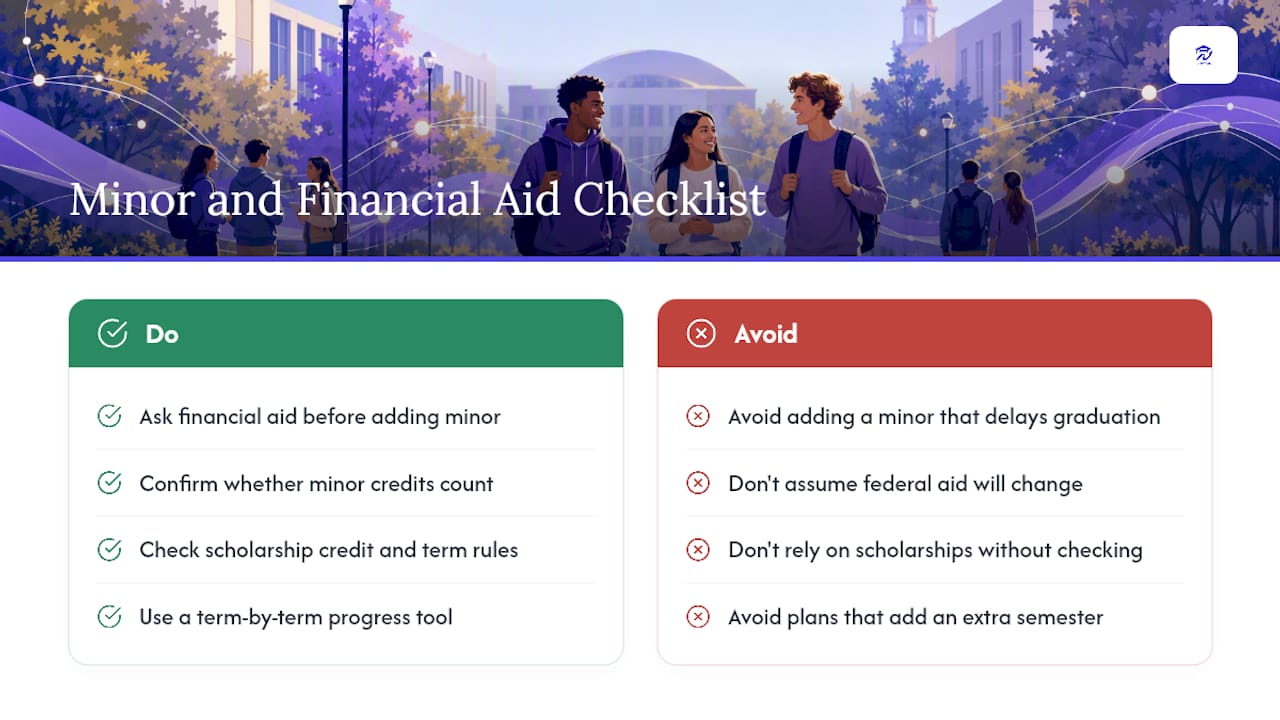
Adding a minor rarely changes your federal aid eligibility on its own, since most financial aid is tied to overall enrollment status (full-time versus part-time) and progress toward a degree, not the specific mix of major and minor credits. Where it can matter is scholarship renewal terms. Merit scholarships and many state grant programs require you to complete a set number of credits per year and stay on pace toward a defined degree timeline.
If a minor’s extra requirements push you past the credit load your scholarship expects, or if it stretches your plan into an additional semester, you risk a renewal review flagging you as off track. This is less about the minor itself and more about how it interacts with your existing pace. A scholarship that requires 30 credits a year doesn’t care whether those credits come from your major or your minor. It cares that you hit the number.
Talk to your financial aid office before you add anything, not after. Ask specifically whether your scholarship or grant has language about “satisfactory academic progress” tied to a defined number of terms, and whether minor coursework counts the same as major coursework for that calculation. Most offices can answer this in a five-minute conversation, and it’s a far better use of five minutes than finding out after a renewal denial. If progress tracking toward scholarship requirements feels murky, a tool built to track graduation progress term by term can make the pace easier to see at a glance.
How Do You Change or Drop a Declared Minor?
Dropping or swapping a minor generally runs through the same office and the same type of form you used to add one. Most registrars treat a change or removal as its own transaction, meaning you can’t just stop taking the classes and assume the minor disappears from your record.
The typical process looks like this: submit a change-of-program or eForm requesting the removal, get any required department sign-off, and wait for registrar confirmation just like you did when adding it. If you’re swapping one minor for another, some schools let you do that in a single form; others require you to formally drop the first before adding the second.
Timing matters here too. Dropping a minor late in your academic career, after you’ve already built your last few semesters around its requirements, can leave gaps in your schedule that are hard to fill on short notice. If you’re having second thoughts about a minor, raise it with your advisor as early as possible rather than waiting until credits are already sunk into courses you no longer need. The earlier you flag a change, the more options you have to fill that space with something that actually counts toward graduation.
Common Minors and What They Typically Require
Minors vary widely by department, but a few patterns show up across most catalogs.
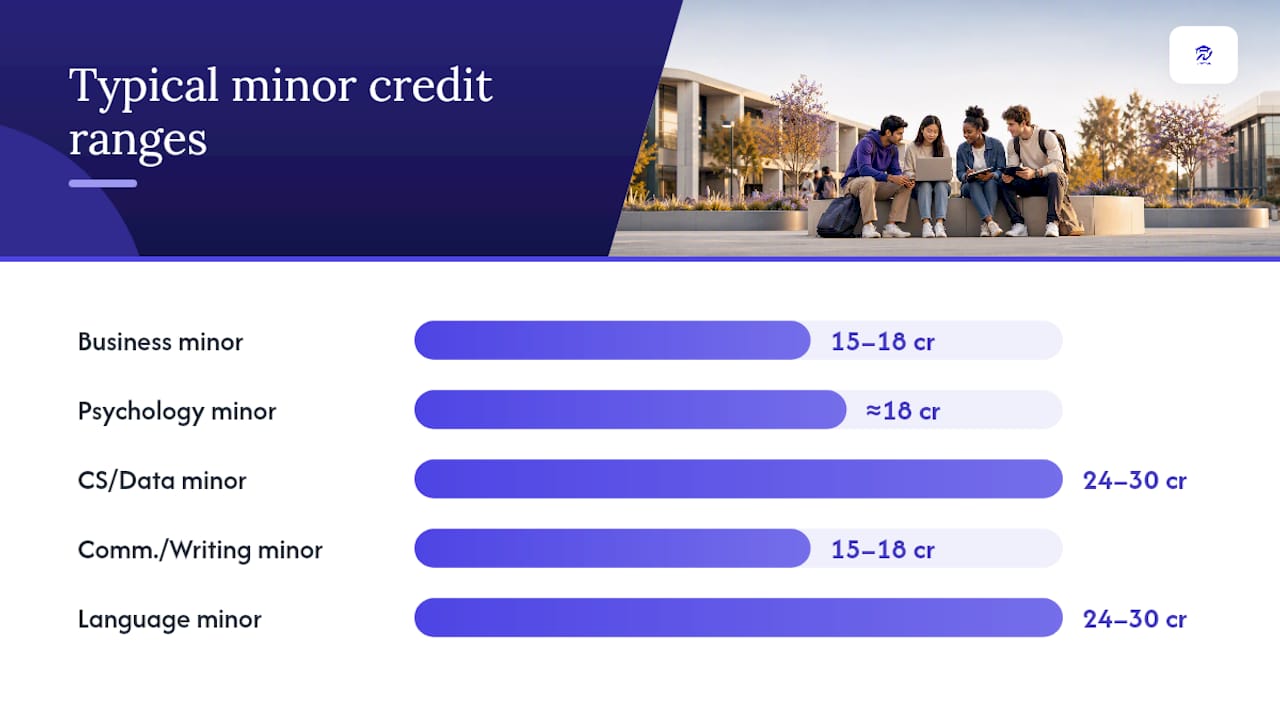
Business minors often run 15 to 18 credits and typically include an intro to business, a course each in accounting and marketing, and one upper-division elective. They’re popular with students outside the business school who want a credential recruiters recognize immediately.
Psychology minors usually require an intro course plus a handful of upper-division electives, often landing around 18 credits. Because psychology electives are broad, overlap with general education requirements is common, which makes this one of the easier minors to fit without adding time.
Computer science or data analytics minors tend to run higher, sometimes near 24 to 30 credits, because of sequenced prerequisite courses. These are also more likely to have departmental admission requirements, since seats in upper-division courses are limited.
Communication or writing minors are frequently in the 15 to 18 credit range and lean on courses that double as electives in many other majors, making them another relatively low-friction option.
Language minors vary the most. If you’re starting from scratch, expect closer to 24 to 30 credits across several sequenced course levels; if you’re already proficient, some schools let you test into a lower level and cut that number significantly.
Always check your own catalog. Credit counts and prerequisites differ by institution even for minors that share a name.
When Does a Minor Make Sense, and When Doesn’t It?
The honest tradeoff is time versus interest. A minor can genuinely strengthen a graduate school application or round out a major with a skill employers ask about, but it also adds coursework you have to sequence correctly or risk pushing into an extra term. Students applying to grad programs, or those who want documented breadth alongside a technical major, tend to get the most value. Students who mainly want a specific skill fast are often better served by a certificate or a couple of well-chosen electives instead of a full minor’s worth of prerequisites.
Be especially careful about stacking two minors on top of a demanding major. Each one adds its own sequencing risk, and the “just one more semester” trap is real. If your interest is broad rather than specific, a single well-chosen minor usually beats two half-finished ones.
— Ryan
See Your Minor Before You Commit to It
There are other ways to figure out if a minor fits: a spreadsheet, a long conversation with your advisor, or trial and error with your course registration each term. All of those work, but they take repeated manual effort every time your plan changes. Univyze is built to show you the same picture instantly, mapping your major and a prospective minor together so you can see overlaps, prerequisite bottlenecks, and extra-semester risk before you submit any paperwork.

Univyze’s dashboard handles term-by-term planning automatically, factors in AP credit, dual enrollment, and transfer credits, and lets you run “what if I add this minor” scenarios without touching your real schedule. It’s a planning aid, not an official degree audit. Always confirm final requirements with your university’s registrar and advisor before you submit anything. If you want to see how a proposed minor actually lays out across your remaining semesters, check out how Univyze works and join the waitlist to get early access.
Sources
- Declare a minor or certificate | MizzouOne
- CODA: Add a Minor | Student Services Center (NC State)
- Change/Adding a Minor | Chapman University
- Change of Minor Form (DocuSign) | Georgia Tech Registrar
- Differences in majors, minors, concentrations and certificates | GBC
FAQ
What does it mean to add a minor?
Adding a minor means officially declaring a secondary area of study, usually requiring completion of a set number of credits that get recorded on your transcript alongside your major
Is it worth adding a minor to your degree?
It depends on your goals. A minor is worth it if you want academic breadth or a stronger graduate school application; if you just need a fast, job-ready skill, a certificate is often the more efficient route.
What are the minimum requirements to add a minor?
Requirements vary by school and program, but many, including NC State’s CODA system, require a minimum number of credits completed at that institution and sometimes a minimum GPA before you’re eligible to apply.
How late can you add a minor?
You generally need to declare a minor before you submit your final graduation application, since most registrars won’t process an addition once that application is already filed.