

Scholarship renewal requires measurable academic progress because the money was never a one-time gift. It’s a conditional investment tied to your continued performance and your realistic path to a degree, and colleges check that condition every year. Miss the bar, and the award can pause, shrink, or disappear.
Three facts explain most of what students get wrong about this:
- GPA thresholds vary but cluster tightly. Many renewal policies set a minimum cumulative GPA somewhere between 2.5 and 3.0, with merit awards often landing at the higher end.
- Credit-hour pace matters as much as grades. Most schools expect 24 to 30 completed credits per academic year, which usually means staying full-time in both fall and spring.
- The review happens once a year, right after spring. Almost every institution checks your transcript at the end of the spring term, not mid-year, so a rough fall semester isn’t automatically fatal if you recover.
If you’re trying to figure out what to do right now, the sections on measurement details and practical steps below will matter most. If you already missed a requirement, skip to the consequences and appeal sections.
Key Takeaways
Scholarship renewal depends on hitting both a minimum GPA and an annual credit-completion pace, checked once a year at the end of spring term.
| Point | Details |
|---|---|
| Renewal is conditional, not automatic | Meet your award’s specific GPA and credit thresholds every year or risk probation or loss. |
| Two separate measures apply | Cumulative GPA and annual credit pace are tracked independently; passing one doesn’t cover the other. |
| AP and transfer credits can be excluded | Many schools don’t count pre-matriculation or transfer credits toward the annual renewal total. |
| Appeals exist but aren’t guaranteed | Committees expect documented extenuating circumstances and can take several weeks to decide. |
| Tools like Univyze help you see pace early | Term-by-term dashboards flag a slipping GPA or credit shortfall before it becomes a renewal crisis. |
Table of Contents
- Why Scholarship Renewal Requires Progress: The Checklist
- Why Do Schools Tie Scholarship Renewal to Academic Progress?
- How Is “Academic Progress” Actually Measured?
- What Happens When You Miss a Renewal Requirement?
- How Do Scholarship Appeals and Reconsideration Work?
- What Can You Do Right Now to Protect Your Scholarship?
- Why Progress Requirements Matter Beyond the Money
- Two Sample Award Clauses Worth Saving
- A Note From Ryan: Approach Renewal Like a Plan, Not a Deadline
- Plan Smarter With Univyze and Protect Your Scholarship Pace
- Where to Verify Your Own Scholarship Rules
- Sources
- FAQ
Why Scholarship Renewal Requires Progress: The Checklist
Every scholarship has renewal language buried somewhere in the original award letter, and it almost always mixes a few standard ingredients. Here’s the typical combination you’ll find, pulled from renewal criteria at large public universities:
Arizona State University’s renewal guide, for example, requires completing a minimum of 30 credit hours per academic year and maintaining a 3.00 cumulative GPA by the end of spring semester for many of its institutional merit scholarships. That’s on the stricter end, but it’s not unusual for flagship merit programs.
Pro Tip: Pull up your original award letter today and search for the words “renewal,” “satisfactory,” or “continued eligibility.” That clause is your actual contract, not whatever a friend on a different scholarship told you.
Why Do Schools Tie Scholarship Renewal to Academic Progress?
The GPA and credit requirements aren’t arbitrary hoops. They exist because a scholarship represents a bet that you’ll finish your degree on schedule, and institutions have real reasons to protect that bet.
- Donor intent matters. Most named scholarships come with legal terms specifying that funds support students making genuine progress toward graduation, not students who’ve stalled out.
- Completion metrics affect the whole university. Graduation rates influence rankings, accreditation reviews, and future funding, so schools have institutional incentive to keep scholarship recipients on pace.
- Renewal checks double as an early-warning system. A missed GPA threshold flags a student who might need tutoring, a lighter course load, or a conversation with an advisor before things get worse. Academic progress standards function partly as a support trigger, not just a gatekeeping mechanism.
- The rules echo federal financial aid standards. Scholarship renewal criteria frequently mirror Satisfactory Academic Progress (SAP) rules that govern federal aid eligibility through the FAFSA. Fall behind on one, and you may jeopardize the other.
That last point catches a lot of students off guard. A scholarship problem and a federal aid problem often stem from the exact same transcript issue.
How Is “Academic Progress” Actually Measured?
This is where things get technical, and where students lose scholarships over misunderstandings rather than outright failure. Progress typically gets measured on two separate axes, and you need to clear both.
The first is cumulative GPA, a qualitative measure of how well you’re performing across every course you’ve taken. The second is annual credit completion, a quantitative pace check confirming you’re accumulating credits fast enough to graduate in a reasonable timeframe. You can be strong on one and still fail the other.
Here’s where it gets counterintuitive: credits that count toward your degree don’t always count toward your annual renewal total. Many institutions explicitly exclude transfer credits and pre-matriculation credits like AP or IB scores from the yearly completion count, even though those same credits reduce your total credits needed to graduate.
| Scenario | Counts Toward Degree? | Counts Toward Annual Renewal Pace? |
|---|---|---|
| AP/IB credit earned in high school | Usually yes | Often no |
| Transfer credit from another college | Usually yes | Often no |
| Repeated failed course | Yes (once passed) | Only the retake attempt, not the original |
| Withdrawal (W grade) | No | No, and it may reduce your completion rate |
| Incomplete (I grade) | Pending | Typically not until resolved |
| Summer session credits | Yes | Sometimes, depending on the award |
This creates a real trap: a student can arrive with 15 AP credits, feel comfortable taking a slightly lighter course load, and still fail the annual completion requirement because those AP credits never entered the renewal calculation. If you’re not sure which of your credits count which way, a resource like Univyze’s breakdown of AP, dual enrollment, and transfer credit treatment walks through how schools typically categorize each type.
What Happens When You Miss a Renewal Requirement?
Missing the bar doesn’t usually mean an instant, permanent loss of funding, though outcomes vary by school and by award.
- Scholarship probation. Many programs give you one term of conditional renewal with a specific GPA or credit target you must hit by the next review.
- Suspension or cancellation. If probation terms aren’t met, or if the shortfall is severe, the award can be paused or ended outright.
- Reinstatement conditions. Some schools allow you to requalify in a future term once your cumulative GPA climbs back above the threshold.
- Ripple effects on federal aid. Because scholarship renewal criteria often track SAP standards, a GPA or pace failure can simultaneously put your federal aid at risk.
The review timeline is fairly predictable: most institutions check status at the end of spring term, and some scholarship offices will re-check eligibility after summer session if a student uses summer classes to close a credit gap. That’s a genuine remedy, but be careful. Summer coursework is frequently not covered by the scholarship itself, which means you might pay out-of-pocket to save an award that covers the fall and spring.
How Do Scholarship Appeals and Reconsideration Work?
If you’ve missed a requirement because of something genuinely outside your control, an appeal is often your best option, and it’s a real process with real odds of success, not a formality.
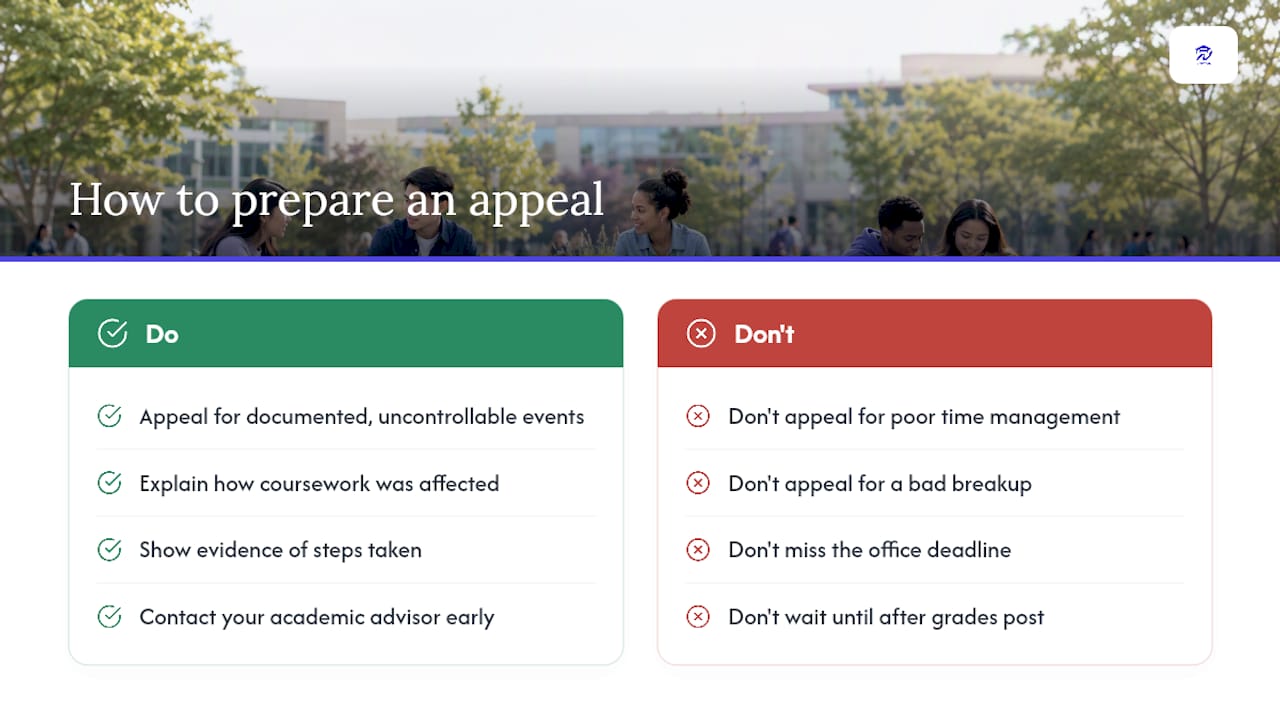
Committees review appeals case-by-case and generally look for three things: proof that the circumstance was beyond your control, a clear explanation of how it affected your coursework, and evidence of the steps you’ve taken since. A documented illness, family emergency, or similar disruption tends to qualify. A bad breakup, poor time management, or “the class was harder than I expected” generally does not, even if it feels just as real to you.
Logistics matter more than students expect. Appeals go to a specific office, usually financial aid or the scholarship’s sponsoring department, with a stated deadline you cannot miss. Reviews can take several weeks, and decisions are typically final for that academic year. There’s no guarantee of reinstatement even with a strong packet. Complete documentation and early advisor involvement improve your odds, but committees are evaluating dozens of cases with limited exceptions to grant.
Pro Tip: Contact your academic advisor the moment you suspect you’re at risk, not after grades post. A documented conversation from October carries more weight in an appeal than a scramble in June, and it shows the committee you noticed the problem before it became a crisis.
What Can You Do Right Now to Protect Your Scholarship?
Waiting until the spring review to think about renewal is the single most common mistake students make. Here’s a term-by-term approach that keeps you ahead of the deadline instead of reacting to it.
- Pull your degree audit every term and confirm which courses actually count toward your major, your gen-ed requirements, and your renewal pace, since these three lists don’t always overlap.
- Track your cumulative GPA and annual credit total separately, not just your semester GPA, since renewal reviews usually look at the yearly cumulative picture.
- Note your exact review date and calendar it, because “end of spring term” can mean different things depending on when grades officially post.
- Save your award letter and any renewal-specific email in one place. You’ll need the exact clause language if you ever need to appeal.
- Build a habit of checking in with your advisor at midterm, not finals week, so a struggling class gets addressed while there’s still time to recover.
- Treat summer courses as a last resort, not a plan A, and confirm with your scholarship office whether summer credits actually count before you register and pay.
- Keep full-time enrollment as your default unless you’ve confirmed part-time status won’t trigger a renewal issue.
Pro Tip: Start a single “appeal & awards” folder, digital and physical, the day you receive your award letter. Drop in the original offer, every renewal-related email, and any documentation of extenuating circumstances the moment they happen. Reconstructing this after a bad semester is far harder than building it as you go, and a dashboard that visualizes your credit pace and GPA trend term by term can make the tracking part far less tedious.
Why Progress Requirements Matter Beyond the Money
It’s tempting to treat renewal rules as an obstacle course designed to trip you up. Flip that framing, and the requirements start to look more like guardrails.
Measuring progress by both GPA and annual pace pushes students toward steady, term-to-term learning instead of a last-minute scramble to save a semester. That’s not an accident. Research on student success beyond GPA points to consistent, incremental performance as a stronger predictor of graduation than any single strong or weak term.
Students who stay on pace year over year tend to graduate closer to on schedule, arrive at internships and job searches with the credential in hand sooner, and avoid the extra tuition and living costs that come with a fifth or sixth year. Renewal checks force a conversation with yourself twice a year that a lot of students would otherwise avoid entirely.
This is also where visual planning helps. Seeing your credit pace and GPA trend charted term by term, rather than buried in a PDF transcript, makes it much easier to catch a slipping pattern before it becomes a renewal problem. That’s a planning aid, not a substitute for your official degree audit or your advisor’s guidance, but it closes a real gap between “I think I’m on track” and actually knowing it.

Two Sample Award Clauses Worth Saving
Real award letters vary wildly in wording, but two patterns show up constantly. Save language like this from your own offer the moment you get it.
Sample Clause A (Merit Scholarship): “Renewal requires a minimum cumulative GPA of 3.00 and completion of at least 30 credit hours per academic year, verified at the conclusion of the spring semester.”
If your award reads something like this, the two numbers to track obsessively are your cumulative GPA and your fall-plus-spring credit total. A strong fall doesn’t buy you slack in the spring if your annual total falls short.
Sample Clause B (Campus Scholarship): “Recipients must maintain continuous full-time enrollment. Renewal is limited to a maximum of eight semesters from the date of initial award. Leaves of absence may affect the renewal timeline.”
This version has a different trap: the continuous enrollment clause. A leave of absence, even a medically necessary one, can interact with your maximum semester count in ways that aren’t obvious from a casual read. Take a screenshot of the exact clause text, note the award’s official web page, and know your appeal deadline before you ever need it.
A Note From Ryan: Approach Renewal Like a Plan, Not a Deadline
The students who lose scholarships are rarely the ones who couldn’t handle the coursework. They’re usually the ones who didn’t realize the deadline had teeth until it was too late to fix anything. That gap between knowing the rule exists and understanding exactly how it applies to your transcript is where most avoidable losses happen.
My honest advice: treat your renewal clause the way you’d treat a lease agreement, not a suggestion. Read it in full the week you get your award letter. Ask your financial aid office directly what counts and what doesn’t, especially if you’re bringing in AP credit or transfer hours. Use your campus tutoring center or writing lab the moment a class feels shaky, not after midterms confirm the problem.
And use planning tools as a supplement, not a replacement, for the real thing. A degree audit from your registrar is the only document with official authority over your requirements. Your advisor is the only person who can tell you how a specific policy applies to your specific situation. Everything else, including any dashboard or planning tool, exists to help you see the picture clearly enough to have that conversation early.
Plan Smarter With Univyze and Protect Your Scholarship Pace
Most scholarship losses trace back to one thing: students not seeing the credit-pace problem coming until it was already a GPA problem. Univyze’s dashboard maps your degree requirements against real course offerings so you can watch your annual credit total and GPA trend build term by term, instead of discovering a shortfall the week grades post.
The platform handles the messy parts that trip up renewal calculations, including how AP credit, dual enrollment, and transfer hours factor into your term-by-term plan, and it runs “what if” scenarios so you can see how a lighter semester or a major change might affect your pace before you commit to it. None of this replaces your official degree audit or your advisor’s sign-off, and Univyze doesn’t guarantee graduation timelines, course availability, or scholarship outcomes. What it does is give you a clearer, earlier view of your own trajectory, which is exactly the kind of visibility that makes a renewal appeal stronger if you ever need to write one.
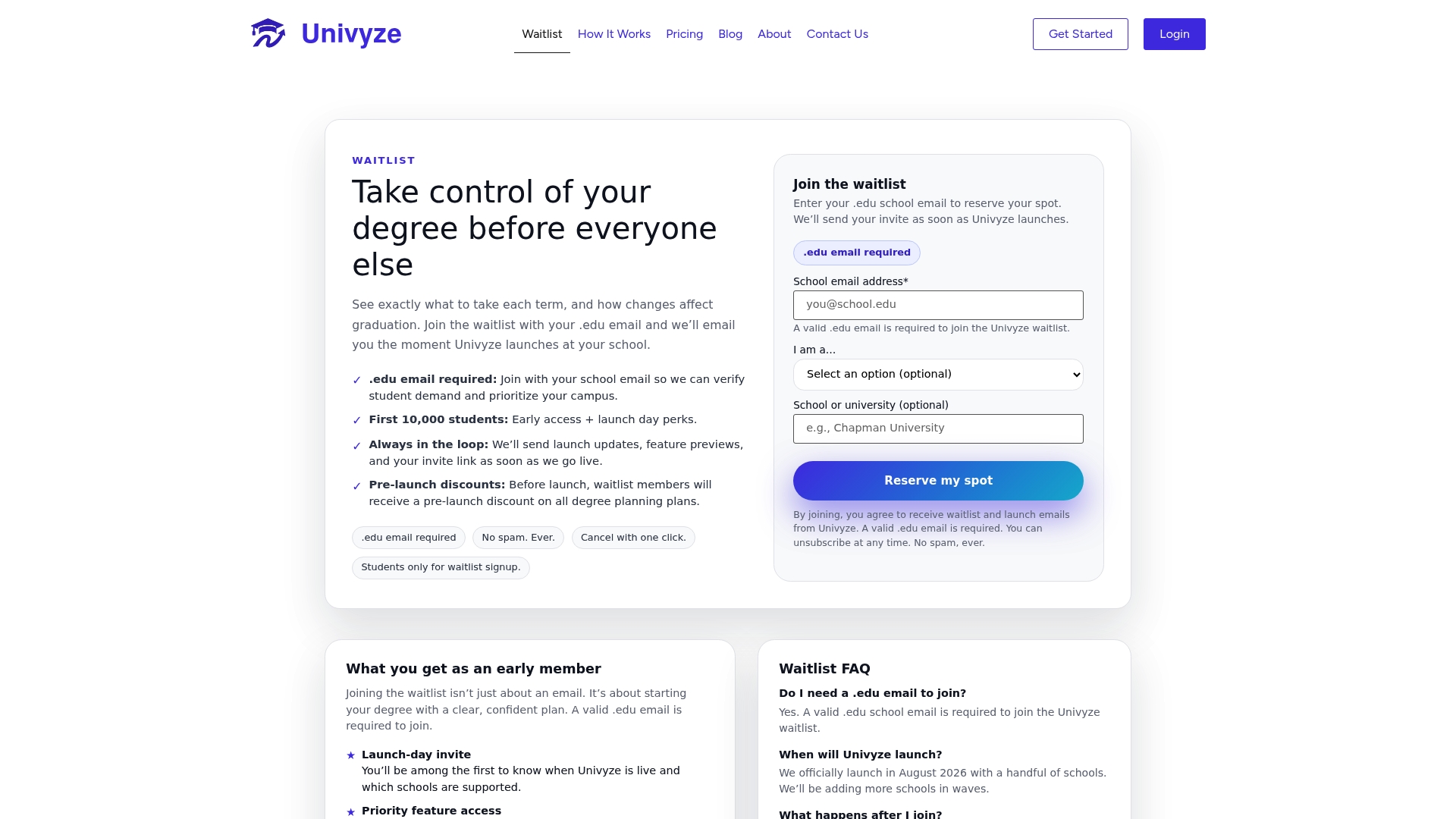
If staying on pace for your scholarship is on your mind, take a look at the student success dashboard and join the Univyze waitlist to get early access when it launches for your campus.
Where to Verify Your Own Scholarship Rules
Nothing in this article replaces the specific terms of your own award. Check these sources directly before making any decision:
- Your original award letter for the exact GPA, credit, and enrollment language that governs your specific scholarship.
- Your school’s Office of Scholarships & Financial Aid page for the renewal policy tied to your award name.
- Your official degree audit, available through your registrar, to confirm which courses count toward both your degree and your renewal pace.
- FAFSA and Satisfactory Academic Progress guidance at Studentaid if your scholarship interacts with federal aid eligibility.
- Your academic advisor, who can interpret how a specific policy applies to your transcript and your major.
Save the award’s official web link and the scholarship office’s contact information somewhere you’ll actually find them again.
Sources
- Scholarship renewal guide | Tuition and Aid | ASU
- Scholarship Reconsideration | Office of Scholarships & Financial Aid | Nebraska
- Renewing your Aid | Financial Aid | Oregon State University
- Scholarship Renewal Criteria and Review Process (KU)
FAQ
Do scholarships automatically renew each year?
No. Most scholarships require an annual review, typically at the end of spring term, and renewal is conditional on meeting GPA, credit-hour, and enrollment requirements stated in your award letter.
How long does it take to know if your scholarship is approved for renewal?
Timing varies by school, but most institutions confirm renewal status shortly after final spring grades post, and appeal reviews can take several weeks beyond that if you’re contesting a decision.
Why does my scholarship status say “pending”?
A pending status usually means your school is still finalizing spring grades or verifying your credit and enrollment totals against the renewal criteria; contact your financial aid office directly if it doesn’t resolve within a few weeks of grades posting.
What is the deadline to appeal a scholarship renewal decision?
Deadlines are set by each institution and stated in your renewal notice, so check that communication directly since there’s no universal date across schools.
Can summer classes save a scholarship I’m at risk of losing?
Often yes, since some scholarship offices re-check eligibility after summer coursework, but confirm first whether your award covers summer tuition, since many do not.