

Yes, you can get financial aid for summer, but how much depends on how many credits you take and how much aid you have left for the award year. Summer is usually treated as one more term of your aid year, so the credit count you choose decides both your aid and whether those courses actually move you closer to graduation. Plan the credits first, then check the aid.
This guide covers who qualifies, how many credits schools typically require, how year-round Pell works, and how to avoid the mistakes that cost students money. We built Univyze around that last part: seeing which courses your degree needs before you spend a summer, and the aid that goes with it, on the wrong ones.
TL;DR
- Federal aid (grants, work-study, loans) can be used for summer if you are enrolled and otherwise eligible. Most loans need at least half-time enrollment, and Pell can be paid for fewer credits.
- Credit minimums differ by school and aid type. Examples run from 1 credit for Pell to 6 credits for federal loans, so your own financial aid office has the final say.
- Year-round Pell lets eligible students receive up to 150% of their scheduled award in one award year, which is what makes a paid-for summer term possible.
- Aid limits are annual. Summer aid draws from the same pool as fall and spring, so plan the whole year together.
- Choose summer courses that fit your degree requirements, and confirm everything with your official degree audit, your catalog and your advisor.
Table of Contents
- Does financial aid cover summer?
- How many credits do you need for summer aid?
- How summer Pell works
- Summer aid is part of one yearly budget
- Choose summer credits that move your degree forward
- Mistakes that cost students aid
- Covering the gap without more debt
- Our perspective
- Plan your summer with Univyze
- FAQ
- Sources
Does financial aid cover summer?
In most cases, yes. Whatever aid you qualify for through the FAFSA (grants, federal student loans and work-study) can be used for any term, including summer, as long as you are enrolled at least half time. Your school’s financial aid office decides which FAFSA year the summer session belongs to.
That last point trips up many students. At some schools summer counts as the end of the prior academic year. UNC, for example, treats summer as part of the previous academic year, so summer 2026 aid there uses the 2025-26 FAFSA. Other schools attach summer to the upcoming year. The ETSU financial aid office, for instance, bases summer 2027 eligibility on the 2026-27 FAFSA and says you do not need a new FAFSA if you already filed one. So ask your school which year applies before you file anything.
Most schools do not require a separate summer aid application. Northwestern says there is no separate summer application, and students who filed the FAFSA for the academic year are reviewed automatically. The University of South Carolina says the same about automatic consideration for Title IV-eligible students who are enrolled in summer courses. Some schools do ask you to register early or submit a form, so check your own office’s summer page.
Title IV is simply the name for the federal student aid programs: Pell Grants, Direct Loans, work-study and a few others.

How many credits do you need for summer aid?
There is no single number. The federal baseline is that most aid requires at least half-time enrollment, and each school sets what half-time means for a summer session. Here is how a few schools handle it, which shows why you should never assume your own rule from a friend at another college:
| School | Summer credit requirement (as published) |
|---|---|
| Washington State University | At least 3 credits for summer grant funding, half-time (6 credits for undergraduates) for federal loans |
| UC Berkeley | At least 6 semester units (9 quarter units on a quarter system) |
| UNC Chapel Hill | At least 2 credit hours in a summer session |
| Northwestern | At least 1 credit for Pell, at least 2 units for Direct Loans |
| Colorado School of Mines | 6 credits for undergraduate federal loans, counted across the summer |
Two patterns show up. First, Pell Grants often need fewer credits than loans. Second, half-time can be reached across sessions. Mines gives the example of 3 credits in one session plus 3 in another to reach 6, so a split summer can still qualify you for loans.
A quick way to read your school’s rule
- Find your school’s summer aid page and look for the minimum credits for each aid type.
- Check whether the count is per session or across the whole summer.
- Note whether your school uses semester or quarter units, since the numbers change.
- Ask whether any courses you plan to take (online, transfer, or at another college) count toward your enrollment for aid.
That last question matters. Credits taken at a different school generally do not count toward your home school’s aid unless that school says so, so confirm before you enroll anywhere else.
How summer Pell works
The Pell Grant is federal grant money that does not have to be repaid. The 2026-27 maximum is $7,395, and that maximum is the scheduled award for a student enrolled full time for a full academic year.
Two ideas explain nearly everything about summer Pell.
Pell is prorated by enrollment. Part-time students in term-based programs have awards adjusted for enrollment intensity. College of the Canyons gives the example that 7 of 12 credit hours equals 58% of the award.
Year-round Pell lets you go past 100%. A student may be eligible for up to 150% of the scheduled Pell award in an award year. With a $7,395 scheduled award, that is up to about $11,092.50 across fall, spring and summer combined.

A worked example
The University of Nebraska-Lincoln gives numbers that make this concrete. On a $7,395 annual award, full-time summer enrollment (12 or more credits) may earn the equivalent of another full semester of Pell, $3,697. Seven summer credits earns 58% of that, about $2,144.
So if you used your full Pell in fall and spring and your award is the maximum:
- 12 credits in summer: up to about $3,697 more, bringing the year toward the 150% ceiling.
- 7 credits in summer: about $2,144.
- 3 credits in summer: a smaller prorated amount, based on your school’s full-time definition.
These are illustrations from one school’s published figures. Your own award depends on your Student Aid Index (SAI, the number the FAFSA produces to measure your eligibility), your cost of attendance, and how your school defines full time for summer. The FSA Handbook says a school must apply its full-time definition for summer consistently across all federal aid purposes.
What changed recently
Two changes are worth knowing.
- Beginning with summer 2024, the FAFSA Simplification Act removed the rule that you had to be enrolled at least half time to receive more than 100% of your scheduled Pell. The University of Louisiana at Monroe notes that a student now only needs to be otherwise eligible for Pell for the payment period.
- For 2026-27, an applicant with an SAI of $14,790 or more, twice the maximum Pell, is ineligible for a Pell Grant, with an exception for dependents of certain deceased servicemembers and public safety officers.
The Pell maximum is set each year, so look up the figure for the award year your summer belongs to.
Summer aid is part of one yearly budget
The most common surprise: there is no separate pot for summer. Annual aid limits extend across fall, spring, winter and summer, and your aid letter shows maximum amounts. If you take the full loan amount in fall and spring, you may have little or none left for summer.
Institutional aid works differently from federal aid. Northwestern explains that because summer is optional, its own summer aid is limited to tuition and fees and generally caps around 4 units, while Pell and Direct Loans can cover costs beyond tuition. Schools set their own rules here, so read yours.
There is also the matter of how costs are measured. For summer terms, the FSA Handbook says costs used to determine Pell eligibility are calculated as for any other payment period, based on a full-time student’s costs for a full academic year.
Choose summer credits that move your degree forward
Aid pays for enrollment, not for progress. A summer course your major does not need can use up Pell eligibility and loan limits while leaving your graduation timeline unchanged. That is the quiet cost of picking summer classes by what is open rather than what your plan needs.
Here is a practical routine:
- List your remaining requirements. Use your official degree audit and your catalog as the source of truth.
- Mark the courses that unlock others. Prerequisites and corequisites decide what you can take next term, so one missed course can push things back a full year. Our prerequisite and corequisite checklist walks through it.
- Match summer to the right slot. Summer works well for general education, a prerequisite chain, or a lighter load that frees your fall schedule. See how summer courses can shorten a graduation timeline.
- Count your credits against the aid rule. Confirm that the credits you pick reach the minimum for the aid you want, across sessions if needed.
- Check your load. Know your school’s cap and what full time means. Our guides on the semester credit limit and full-time credits for on-time graduation explain the numbers.
- Confirm with your advisor and financial aid office before you register.
If you bring AP credit, dual enrollment or transfer credit into the picture, summer may need fewer courses than you think. Whether a particular credit is accepted is your school’s decision, so confirm it with the registrar. Our guide to planning around AP, dual-credit and transfer credit shows how to lay it out.
Mistakes that cost students aid
Dropping below the minimum. UNC warns that changing your enrolled hours before or after the session may mean you have to repay aid already disbursed. A dropped course can also affect satisfactory academic progress, the standard schools use to decide whether you keep receiving aid. Read about withdrawing versus dropping before you act.
Waiting to register. ETSU asks students to register up front for all summer courses for aid purposes. Late registration can delay or reduce what you receive.
Expecting payment before classes start. At College of the Canyons, summer Pell is disbursed only if you have remaining entitlement, meet satisfactory academic progress, are enrolled and summer classes have begun. Budget for the gap.
Assuming last year’s rules apply. FAFSA year, deadlines and credit minimums change. Check your school’s summer page each year.
Spending the year’s aid too early. If fall and spring use your full allotment, summer may have nothing left. Look at all three terms together.
Covering the gap without more debt
Sometimes aid covers part of a summer term, not all of it. Before you borrow more, look at the full picture in our guide on paying for college without student loans. Some students also earn extra money alongside classes, and there are ways to earn side income during college without wrecking your grades. And if a summer course lets you skip a whole extra semester, it may save more than it costs. We explain the math in why tuition increases with extra semesters.
Our perspective
Most students ask about summer aid after they have already picked classes. We think the order should be reversed: figure out what your degree still needs, then see which summer credits fit your aid.
Aid rules are about enrollment, and degree progress is about requirements. Those two things only meet if you put them on one page, term by term, with AP credit, dual enrollment, transfer credit and summer sessions all in the same plan.
That is what Univyze is designed to do: connect your degree requirements to real course offerings so you can see an automatic term-by-term plan, try what-if scenarios when you change a major, and share a clear view of progress with parents or advisors. It is a planning tool. It is not your official degree audit and it does not replace your advisor, so always verify requirements with your university catalog, registrar and advisor.
We do not promise any particular outcome, and we do not decide your aid. What we want is for you to make the summer decision with the whole picture in front of you.
Ryan
Plan your summer with Univyze
Univyze is a degree planning platform for students, parents and advisors. It offers visual degree mapping, requirement tracking, term-by-term planning, what-if scenarios, and schedule conflict management, so you can see where a summer term might fit before you register.
There is a free Starter plan at $0. Paid plans are listed on our pricing page: Core is $359.40 per year, Plus is $599.40 per year and Pro is $1,199.40 per year, with one-time options also available.
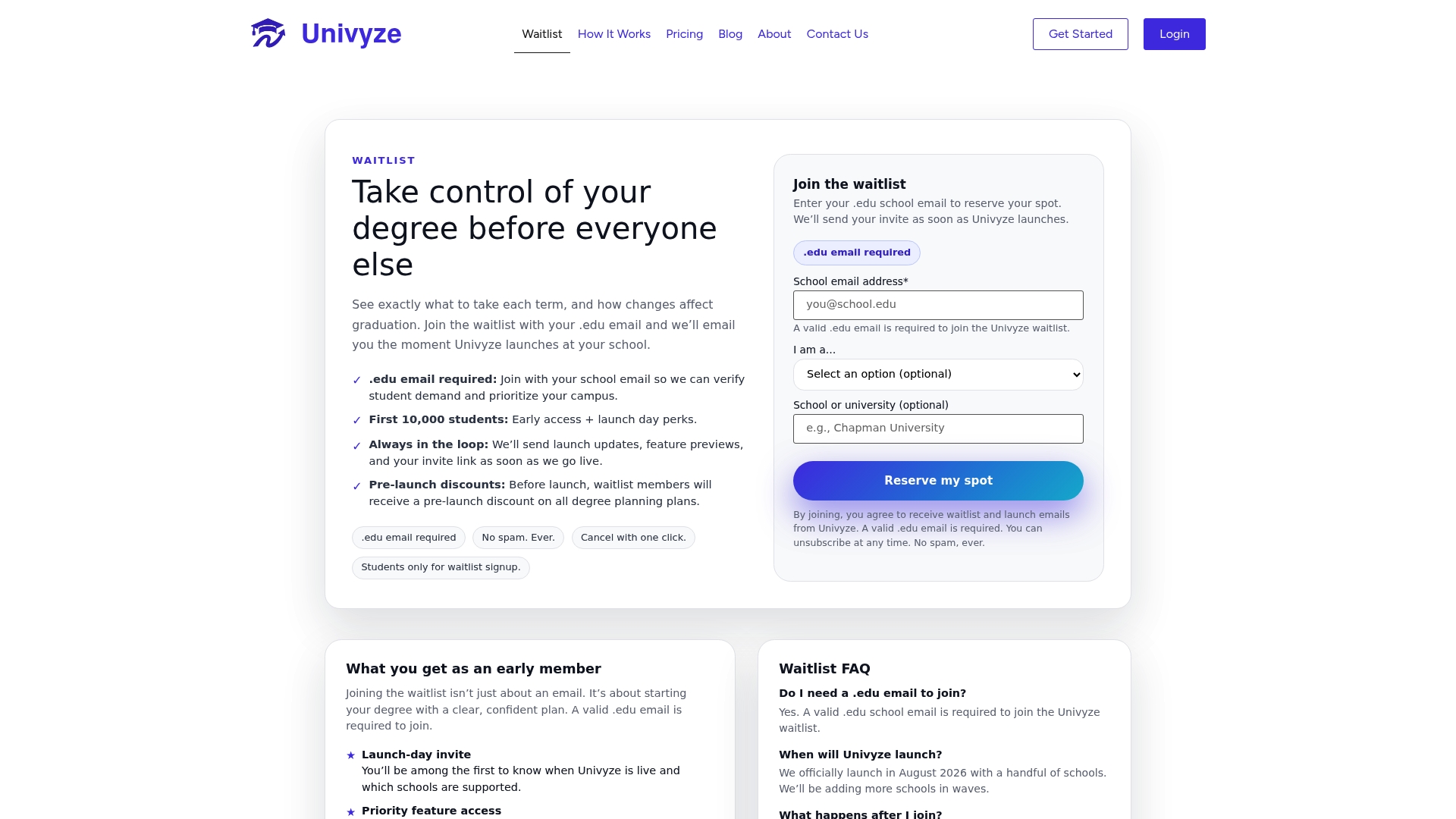
If you want to be among the first to try it, join the Univyze waitlist at univyze.com.
FAQ
Does FAFSA give aid for summer?
Yes. The aid you qualify for through the FAFSA can be used in summer if you are enrolled, usually at least half time for most aid types. Your school decides which FAFSA year the summer term belongs to, so ask the financial aid office.
How many credits do I need for financial aid in the summer?
It depends on the school and the aid. Published minimums range from 1 credit for Pell at some schools to 6 credits for federal loans at others. Check your school’s summer aid page and confirm with the financial aid office.
Do you get a full Pell Grant for summer?
It can be close. At one university, 12 or more summer credits may earn the equivalent of a full extra semester of Pell, while 7 credits earns 58%. Year-round Pell caps the total at 150% of your scheduled award for the award year, and only if you have remaining eligibility.
Do I need a separate application for summer aid?
Often not. Many schools review students who already filed the FAFSA automatically. Some schools ask you to register early or submit a form, so read your school’s instructions.
Sources
- When Does FAFSA Cover Summer Classes?
- ETSU Summer Financial Aid Information
- University of South Carolina Summer Financial Aid
- UNC Summer Aid
- Northwestern Summer Aid
- Washington State University Financial Aid FAQ
- UC Berkeley Summer Aid
- Colorado School of Mines Summer Financial Aid
- FSA Handbook 2026-27: Calculating Pell Grants
- FSA Handbook 2026-27: Summer Terms and Year-Round Pell
- 2026-27 Federal Pell Grant Maximum and Minimum Award Amounts
- College of the Canyons Pell Grant
- University of Nebraska-Lincoln Summer Financial Aid
- University of Louisiana at Monroe 2026-2027 aid document
- College Side Income: 12 Ways to Earn Without Wrecking Your Grades