

You can usually switch majors late in college. The real question is what it does to your timeline, your credits and your aid. Most schools allow a change at nearly any point before graduation, but a junior or senior switch often means new prerequisites and a longer path. The way to protect your time and money is to map the new major’s requirements against the credits you already have, term by term, before you submit the form.
This guide covers how late is actually too late, what a junior-year switch changes, how it touches tuition and aid, and how to build a plan you can bring to your advisor.
TL;DR
- Most universities let you change your major any time before graduation, but some majors have declaration deadlines or require you to finish the change within a set time to degree.
- A late switch rarely wipes out your progress. It does mean checking which completed courses count toward the new major and which new sequences you must start.
- Timing inside the semester matters for aid and billing: add/drop and census dates differ by school.
- Build a term-by-term plan for the new major first, then confirm it with your official degree audit and your advisor.
- A planning tool like Univyze can help you compare “what if” paths and see where credits land, but it does not replace your school’s official audit or your advisor.
Table of Contents
- How late is too late to change your major?
- What actually changes when you switch in junior year
- Will you still graduate on time?
- What switching can do to tuition and financial aid
- Will your GPA change?
- How to switch majors late: a step-by-step plan
- Our perspective
- See your switch before you make it
- Smaller moves that protect your timeline
- FAQ
- Join the Univyze waitlist
- Sources
How late is too late to change your major?
For most students, it is not too late. Stanford’s advising handbook says that, in general, you can change your major at any time before graduation, as long as you can fulfill the requirements. It also notes that some majors require you to declare a certain amount of time before graduating. Stony Brook’s catalog says students who have declared a major may change at any time before graduation.
So the rule is rarely “too late.” It is “can you finish the requirements in the time you have?” Some schools put a number on that. UCLA’s Center for Academic Advising lets students change majors provided they will graduate within normative time to degree: by spring or summer of the fourth year for students admitted as first-years, or by fall of the third year for transfer admits. At the University of Maryland, students who change majors must submit a realistic graduation plan to the academic unit of the new major for approval.
If you are at UCLA, UCI, USC, CSULB or any other school, the policy that counts is your own. Verify requirements with your official degree audit, your university catalog, your registrar and your advisor before you decide.
Earlier is easier, but late is common
The College Board’s BigFuture help center says the earlier you switch, the more likely you are to finish in four years, and that changing in your first year or at the start of your second is ideal. That is a reason to act promptly once you know. It is not a reason to stay in a major that is not working.
Changing is also normal. A study of graduating cohorts by Min Xu and Chandra de Silva found that 39% of graduates changed majors before finishing, and only 17% changed after formally declaring. Ed Venit of the consulting firm EAB told WHYY that students who pick a major right away and never change are slightly less likely to earn a degree than those who switch by sophomore year. Switching is not a sign you did something wrong.
What actually changes when you switch in junior year
The trouble with a junior-year switch is not paperwork. It is sequencing. Sallie Mae’s guide explains that by junior or senior year you may have finished many major-specific courses that do not apply to the new degree, and you may need to start a course sequence that takes several semesters.
That last part is where late switches get expensive. Think about three things:
- Prerequisite chains. If the new major starts with a course that unlocks the next course, which unlocks the next, you cannot compress them. Our guide to prerequisites and corequisites shows how a single missed prerequisite can push a required class back a full year.
- Courses offered once a year. Many upper-division classes run only in fall or only in spring. A plan that looks fine on paper can break if a required course is not offered when you need it.
- Credits that carry over. General education, electives and some lower-division courses often still count. Credits from your old major may count as electives, or may not count at all.
When the numbers work, a switch can be tidy. When they do not, you learn it early enough to choose between options such as a summer term, a minor instead of a second major, or a closely related major that reuses more of what you have done.
Will you still graduate on time?
Sometimes yes, sometimes no, and the honest answer depends on your credits. Sallie Mae says switching does not necessarily delay graduation, though it can. The biggest factors are when you switch, how many credits transfer into the new major and how many new requirements you must complete. It adds that a plan made with your advisor can keep you on track.
The odds shift with timing. WHYY, citing EAB research, reports that three-quarters of students who switch as late as the end of junior year or start of senior year take longer than four years or do not graduate. Take that as a reason to plan carefully, not as a verdict on your case. Those are averages across many students, and your result depends on your specific courses.
If you want to understand what “on time” means at your school, see our explainer on what graduating on time means.

A quick way to estimate the damage
Before you talk to anyone, do this on paper:
- List the courses you have completed or are enrolled in, with credits.
- List every requirement of the new major, including prerequisites, general education and any minimum GPA.
- Mark which completed courses count toward the new list.
- Count the remaining courses, and note which ones are sequenced.
- Divide the remaining credits by a realistic load per term, then adjust for sequences and course availability.
That gives you a rough number of terms. It will be rough, because course schedules and substitutions change, which is why the final check belongs with your advisor.
What switching can do to tuition and financial aid
The cost of a late switch is mostly the cost of extra terms. MyIdealCollege estimates an extra semester at a mid-range four-year university can run $12,000 to $15,000 in tuition, fees and housing, and more once you count the wages from a delayed start to your career. Your number will differ. For context, College Board data cited by Research.com put average published tuition and fees at $11,610 for in-state public four-year students and $43,350 at private nonprofit colleges in 2024-25.
For a deeper look, read our breakdown of what switching majors really costs and why tuition rises with extra semesters.
Aid depends on credits that count
Financial aid rules are why timing and planning matter. Pace University’s financial aid office explains that federal and state aid is based on credits that count toward your degree requirements, and undergraduates need at least 12 credit hours within their degree program to qualify for a full package. If you switch and some enrolled courses stop counting, your aid can be affected. Pace also says the change-of-major form must be submitted before the end of add/drop, the first two weeks of the fall and spring semesters, for the change to apply to that term’s review.

Billing has its own clock. The University of Colorado Boulder’s advising page says requests submitted by the census date, the third Friday of fall and spring semesters, will show on that semester’s tuition bill, while later requests will not affect that term’s bill. Other schools use different dates, so look up yours.
Scholarships may be tied to a college, department or major, and loan limits and satisfactory academic progress rules apply too, according to Research.com’s overview of how changing majors affects aid. Before you switch, ask your financial aid office whether your specific awards stay in place. Our guide on protecting your aid with a change-major plan walks through the questions to bring.
Will your GPA change?
Not automatically, but your record can be re-evaluated. SUNY Oneonta’s policy, summarized in the research above, says that when a student moves between curricula, the academic record is evaluated against the new program’s requirements, which may mean a loss of credit or an effective loss of credit. Check your own school’s policy on how grades and credits apply after a change.
On averages, the Xu and de Silva study found a small negative link between how many times students changed majors and their final cumulative GPA (r of about -0.13). The authors say this does not suggest changing majors is harmful for an individual student. In plain terms: one well-planned change is different from repeated changes with no plan.
How to switch majors late: a step-by-step plan
- Name the reason. Are you leaving a major because of grades, interest, career goals or a bad fit with the program? The reason shapes which new major makes sense. If you are still deciding, our guide to choosing the right college major can help.
- Pull the new major’s requirements. Use your university catalog, not a summary from a website. Note prerequisites, minimum grades, required GPA and any application or declaration deadline.
- Run a “what if” check. Many schools offer one. Penn State’s registrar says students thinking about changing majors can request a what-if audit to see how completed courses apply to the new major. San Francisco State’s Degree Planner has a what-if capability to explore a change before you decide. Purdue’s Smart Plan lets students plan by semester and run What-If plans for minors, certificates or major changes. Use yours if it exists.
- Map every remaining term. Put sequenced courses first, then fill in general education and electives. Check when each required course is offered.
- Test your levers. Could AP credit, dual enrollment or transfer credits satisfy anything? Could a summer session break a bottleneck? Could a minor capture courses you have already taken? Always confirm how your school treats those credits.
- Meet your advisor with a draft. Bring a plan, not just a question. Our list of three items to bring to advising can help you prepare, and choosing classes that count toward graduation shows how to avoid wasted credits.
- File the change at the right time. Submit it before add/drop or census dates if aid and billing matter to you.
- Review the plan every term. Course offerings shift, so check that your plan still matches the schedule.
What a good major-change planner should show you
Whether you use your school’s tool, a spreadsheet or software, look for these things:
| What it should show | Why it matters for a late switch |
|---|---|
| Completed courses mapped to the new major | Shows what counts and what becomes an elective |
| Term-by-term sequence | Reveals prerequisite chains and the earliest finish |
| Real course offerings | Catches classes that run only once a year |
| Schedule conflicts | Finds required classes that overlap |
| Side-by-side “what if” plans | Lets you compare two majors or a major versus a minor |
| Credits from AP, dual enrollment, transfer and summer | Shows where outside credit can shorten the path |
| A view you can share | Gives parents and advisors the same picture |
Our perspective
We built Univyze around one belief: most extra semesters come from unclear planning, not from a student’s lack of effort. A late switch is the clearest example. The decision itself is rarely the problem. The problem is that the student cannot see, in one place, how past courses fit the new major and which terms they will need.
That is what we designed Univyze to show. It connects degree requirements to real course offerings, lays out a term-by-term plan, and lets you run “what if” scenarios so you can compare a new major, a minor or a different path before you commit. It also accounts for AP credit, dual enrollment, transfer credit and summer sessions, and gives parents and advisors a shared view of progress.
We are clear about what Univyze is. It is a planning tool, not your official degree audit, and it does not replace your advisor. Your school’s audit, catalog and registrar decide what counts. We help you walk into that conversation with a plan instead of a worry.
Ryan
See your switch before you make it
If you are weighing a late change, Univyze is built to help you compare paths term by term. It is a planning tool, so confirm the final plan with your school’s official degree audit and your advisor. The free Starter plan covers basic planning tools. Paid plans are listed on our pricing page: Core is $359.40 per year or $1,095 one-off, Plus is $599.40 per year or $1,795 one-off, and Pro is $1,199.40 per year or $2,895 one-off.
Parents can see progress in the same view, which helps when a major change prompts questions about timing and cost. Our parent page explains how family access works.
Smaller moves that protect your timeline
You do not have to choose between staying put and starting over. Several options can reduce the impact of a late switch:
- Add a minor instead of switching. If your interest is partly about topic and partly about career, a minor can capture existing credits.
- Pick an adjacent major. Majors in the same department or field often share lower-division and some upper-division courses.
- Use summer terms for bottlenecks. A prerequisite taken in summer can open the sequence for fall.
- Ask about prerequisite overrides when justified. If you have equivalent experience, a short, clear justification can help. We have a five-minute checklist for override requests.
- Check the academic calendar. Knowing your school’s terms, add/drop and census dates helps you time the change. See our guide to what an academic calendar means.
- Lower living costs if a term is added. If you do end up with an extra term, housing is a big piece of the bill. You can find a student roommate to split costs.
Also review the common mistakes that delay graduation, since several of them show up in major changes: waiting to meet an advisor, skipping a prerequisite check and assuming credits will count.
FAQ
How late into college can you change your major?
At most schools you can change any time before graduation, as long as you can complete the new major’s requirements. Some majors require declaration a set time before you graduate, and some schools tie approval to a normative time to degree. Check your catalog and registrar for your school’s rule.
Is switching majors in junior year a bad idea?
It is not a bad idea, but it needs more planning than a freshman switch. By junior year you may have finished many courses that do not apply, and the new major may have a multi-semester sequence. If the new path fits your goals and a plan shows a workable timeline, it can be a sound choice.
Can you still graduate on time if you switch majors?
Sometimes. It depends on when you switch, how many credits count in the new major and how many requirements remain. Build a term-by-term plan and review it with your advisor to see where you stand.
Does changing majors affect financial aid?
It can. Aid is often based on credits that count toward your degree, and some scholarships are tied to a major or college. Ask your financial aid office about your specific awards before you file the change, and note your school’s add/drop and census dates.
Join the Univyze waitlist
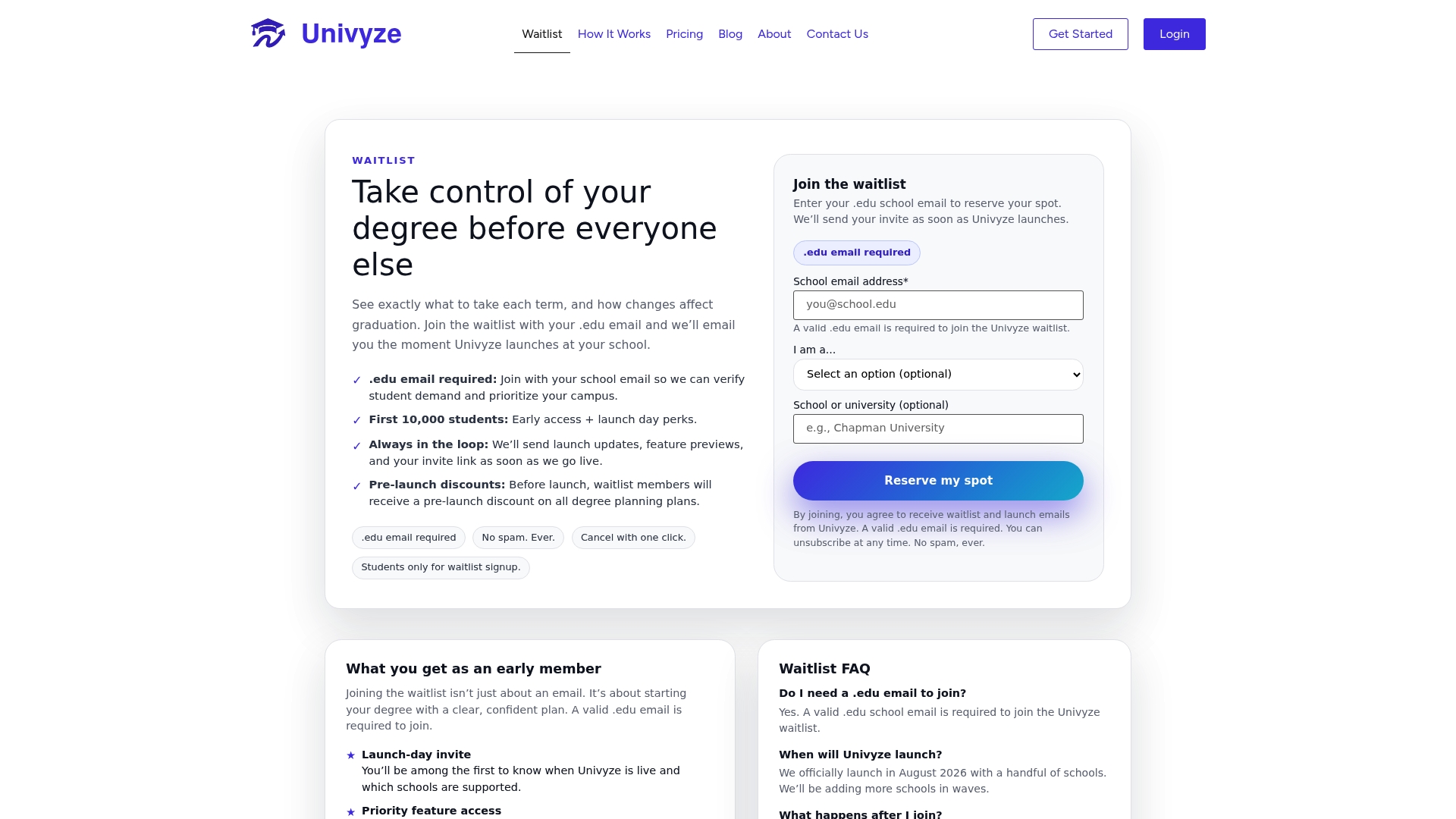
If you are thinking about a late switch, we would like to help you plan it clearly. Join the Univyze waitlist and be among the first to map your next terms.
Sources
- Stanford Academic Advising: Declaring Your Major
- Stony Brook University: Academic Major
- UCLA Center for Academic Advising: Change in Major or Minor
- University of Maryland: 2025-2026 Registration Guide
- College Board BigFuture: When is it too late to change your major?
- Xu and de Silva: How Changing Majors Impacts Academic Performance
- WHYY: The high cost of switching college majors
- Sallie Mae: Switching College Majors
- MyIdealCollege: The Real Cost of Changing a College Major
- Research.com: How Changing Your Major Affects Financial Aid
- Pace University: Course Program of Study (CPOS)
- University of Colorado Boulder: Arts & Sciences major changes
- Penn State Registrar: Degree Audit
- San Francisco State University: Degree Planner
- Purdue Registrar: Degree Planning
- Find a student roommate