

Talking to your student about their degree plan is the single most effective thing you can do to protect their graduation timeline. A degree plan, also called a degree map or four-year plan, is the term-by-term sequence of courses a student must complete to earn their degree. Students typically need about 15 credit hours each semester to graduate in four years. That number matters because falling even one course behind in a prerequisite chain can push graduation back by a full semester or more. Your role as a parent is not to manage the plan for them. It is to ask the right questions so your student stays in the driver’s seat.
What is a degree plan and why does it matter for your student’s success?
A degree map is a term-by-term course sequence that shows exactly which classes a student needs each semester to finish their major on time. It is not just a list of courses. It is a dependency chart, where each course often unlocks the next. Miss Calculus I in the fall, and you cannot take Calculus II in the spring. Miss Calculus II, and you cannot take Physics the following year. One gap compounds into many.

Universities publish degree maps through their registrar or academic department. These maps connect to the university catalog, which is the official record of degree requirements for a student’s enrollment year. A student’s transcript tracks what they have completed. The degree audit, a separate tool, compares the transcript against the catalog requirements and shows what is still missing. Parents who understand all three tools can have much sharper conversations with their students.
Bottleneck courses are the ones that trip students up most often. These are classes offered only once per year, usually in a specific semester, that serve as prerequisites for several upper-division courses. Missing a bottleneck course does not just delay one class. It can delay an entire cluster of courses and push graduation back by a full year. Proactive students mark these courses in their degree map during the first semester of college.
The table below shows how a typical four-year degree breaks down by component and timing.
| Degree component | Typical credit hours | When students usually complete it |
|---|---|---|
| General education requirements | 36–48 credits | Freshman and sophomore years |
| Major core courses | 30–45 credits | Sophomore through senior years |
| Upper-division major courses | 18–30 credits | Junior and senior years |
| Electives | 12–18 credits | Spread across all four years |
| Capstone or senior project | 3–6 credits | Senior year |
Understanding this structure helps you ask specific questions instead of vague ones. “Are you on track?” is hard to answer. “Have you completed all your general education requirements?” is not.
How can parents effectively discuss degree planning with their college student?
The most effective parental approach is to ask open-ended questions rather than check their work. There is a real difference between “Did you register for the right classes?” and “Walk me through how this semester’s courses connect to your four-year plan.” The first question puts you in the role of auditor. The second puts your student in the role of expert on their own education.
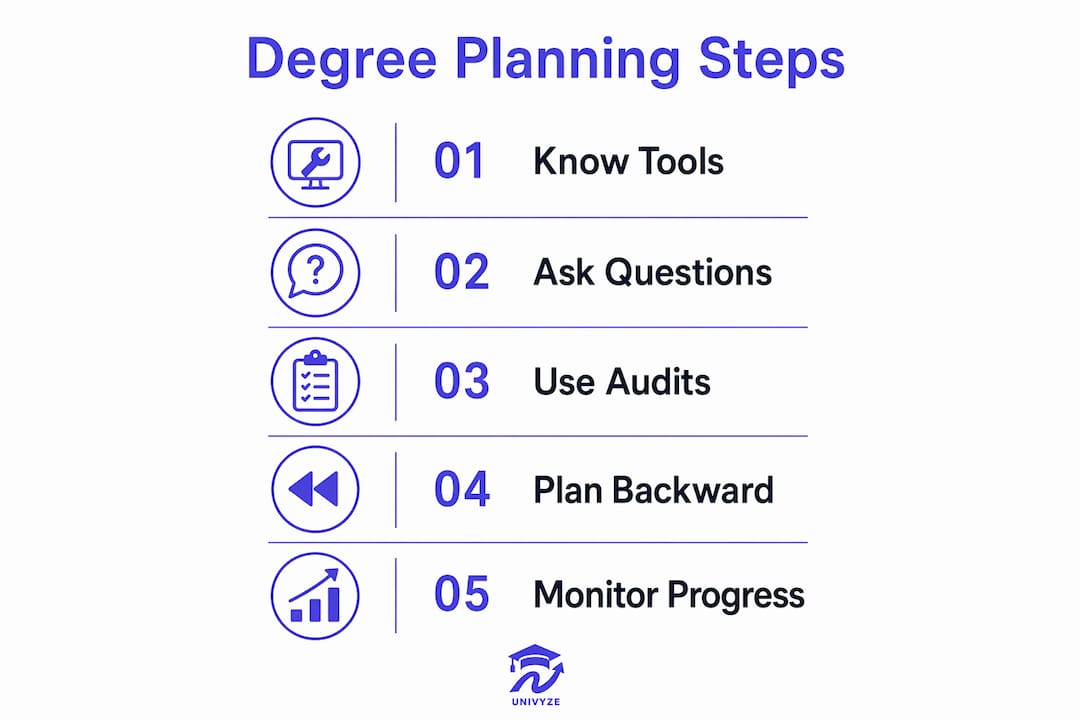
Timing your conversations well makes them more productive. The best moments to talk are the weeks before registration opens, right after an advising appointment, and at the start of each new semester. These are the points when decisions are being made and course corrections are still possible. A conversation in the middle of a semester about what went wrong is far less useful than one before registration that prevents the problem.
Four key questions every parent should ask before each registration period:
- “Have you reviewed your four-year degree map recently?”
- “Have you run a degree audit to see what requirements are still open?”
- “Have you met with your academic advisor this term?”
- “Does your planned schedule for next semester match your degree map?”
These four questions cover the full planning cycle without micromanaging. They prompt your student to check their own work rather than relying on you to catch mistakes.
Conversation do’s:
- Ask your student to explain their plan in their own words
- Celebrate when they catch a problem early
- Ask what their advisor said, not what you think the advisor should have said
- Treat major changes as a planning conversation, not a crisis
Conversation don’ts:
- Do not log into their student portal without their knowledge
- Do not contact their advisor directly without discussing it with your student first
- Do not treat a course withdrawal as a failure before understanding the reason
- Do not compare their pace to a sibling or friend
Pro Tip: Ask your student to explain their degree plan to you out loud, as if you know nothing about it. Students who can narrate their own plan clearly are far more likely to catch gaps and sequencing errors before they become problems.
What tools and resources should parents and students use to review the degree plan?
The degree audit is the most important tool in academic planning. It is a dynamic tracker that compares your student’s completed coursework against their official degree requirements. Unlike a static checklist, the degree audit updates automatically when grades post and when requirements change. Students should run their degree audit at least once per term, and always before meeting with their advisor.
The what-if degree audit is a separate but equally valuable feature. Students often change majors at least once, and the what-if tool lets them model a new major without committing to it. It shows which completed courses would transfer to the new major and which requirements would still be open. This prevents the panic of switching majors without knowing the cost in time and credits. Systems like Degree Works include this feature at many universities.
Academic advising appointments are more effective when booked early in the term, before registration deadlines arrive. Advisors catch prerequisite conflicts and scheduling issues that automated tools miss. Encourage your student to bring a printed or digital copy of their degree map and their current degree audit to every advising meeting. An advisor who can see both documents can give much more specific guidance.
Checklist for a productive advising appointment:
- Run the degree audit the day before the meeting
- List any courses that appear incomplete or unclear in the audit
- Write down two or three specific questions, not just “Am I on track?”
- Ask the advisor to flag any bottleneck courses coming up in the next two semesters
- Confirm that the planned schedule for next term matches the degree map
Scheduling conflicts and waitlists are a normal part of college registration. When a required course is full, your student should get on the waitlist immediately and identify an alternative course that keeps them moving forward. Sitting out a semester on a required course without a backup plan is one of the most common causes of delayed graduation.
Pro Tip: Encourage your student to plan backward from graduation. Starting from the senior year requirements and working back to the current semester reveals which courses must be taken earliest. Most students plan forward and discover late-stage prerequisites too late to act.
How to navigate common challenges in degree planning conversations?
Major changes are the most disruptive event in a degree plan, but they do not have to derail graduation. The what-if degree audit exists precisely for this situation. When your student is considering a new major, the right conversation is not “Are you sure?” It is “Have you run the what-if audit to see how many credits carry over?” That question moves the conversation from emotion to evidence.
Overloading STEM and lab courses in a single semester leads to burnout. Experts suggest no more than two STEM classes plus one lab concurrently to maintain performance and mental well-being. A student who burns out in the fall and withdraws from two courses loses far more time than one who took a lighter load and passed everything. Encourage your student to build a balanced course load each semester, mixing heavier and lighter courses intentionally.
The table below outlines common degree planning challenges and the most productive parental response for each.
| Challenge | Recommended parental response |
|---|---|
| Student wants to change majors | Ask them to run the what-if degree audit and share the results with you |
| A required course is full at registration | Encourage waitlist enrollment and ask about approved substitute courses |
| Student has a registration hold | Ask what type of hold it is and what step resolves it |
| Course load feels too heavy | Discuss dropping one course before the withdrawal deadline rather than failing it |
| Student missed a prerequisite | Ask the advisor whether a late add, summer course, or waiver is possible |
Treating the degree plan like an engineering problem means modeling constraints, identifying dependencies, and updating the plan when conditions change. Life changes. Internships, health issues, and financial pressures all affect course loads. A degree plan that cannot flex will break. The goal is a plan that bends without losing sight of the graduation target.
Key Takeaways
Consistent, question-based conversations about the degree plan are the most reliable way parents can support timely graduation without taking over their student’s academic decisions.
| Point | Details |
|---|---|
| Know the core tools | Degree map, degree audit, and what-if audit are the three tools every student should use each term. |
| Ask four key questions | Before each registration, ask about the degree map, degree audit, advisor meeting, and schedule alignment. |
| Flag bottleneck courses early | Courses offered once per year can delay graduation by a full year if missed; identify them in the first semester. |
| Balance the course load | Limiting heavy STEM and lab courses per semester prevents burnout and protects the overall timeline. |
| Treat the plan as a living document | Update the degree plan whenever life changes rather than waiting until a problem becomes a crisis. |
What I’ve learned from watching students plan their own paths
The parents who help their students most are the ones who ask the best questions, not the ones who know the most answers. I have seen parents pull up their student’s degree audit on their own laptop and start cross-referencing requirements, and I have seen that backfire badly. The student disengages. They stop owning the plan because someone else is managing it for them.
The most productive conversations I have witnessed start with something like, “Tell me what you’re thinking for next semester.” That one sentence hands the student the floor. It signals that you trust them to have a plan. And when they do not have a clear answer, that silence is far more instructive than any audit you could run for them.
Degree plans are living documents, not contracts. I have watched students change majors twice, pick up a minor, and still graduate on time because they kept revisiting the plan and adjusting. The students who struggled were the ones who made a plan freshman year and never looked at it again. Iteration is not a sign of failure. It is the whole point.
My honest advice to parents: resist the urge to solve. Ask your student what their advisor said. Ask them which course they are most worried about. Ask them what the degree audit shows. Then listen. Your job is to keep the conversation going, not to run it.
— Ryan
How Univyze supports your degree planning conversations
Parents who want visibility into their student’s academic path without taking over the planning process will find Univyze worth exploring. Univyze provides a dynamic dashboard that maps degree requirements against real course offerings, term by term.
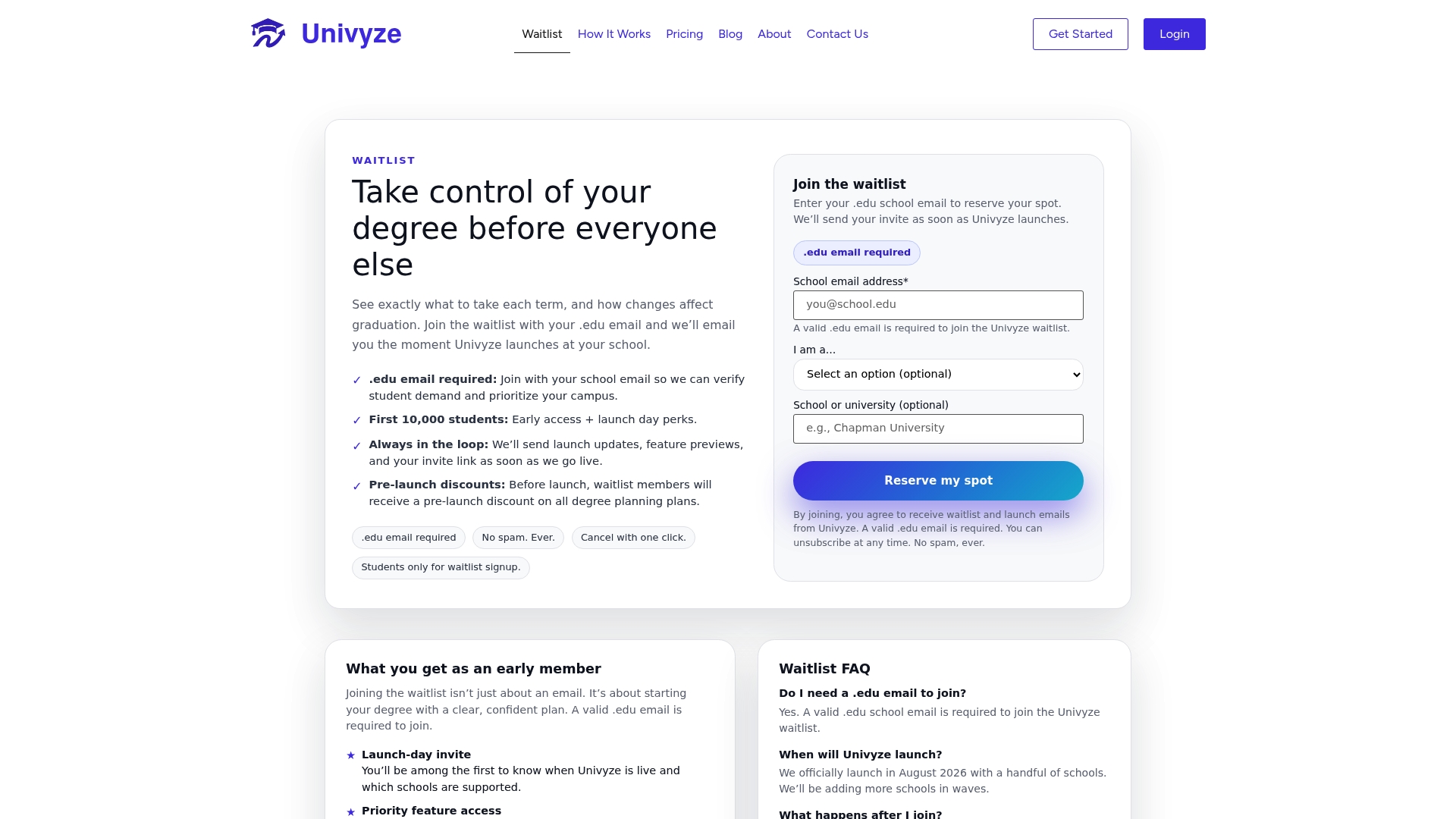
Students can model what-if scenarios for major changes, track progress against graduation requirements, and build schedules that account for prerequisites and course sequencing. Parents get a clearer picture of where their student stands without needing to decode a university audit on their own. Univyze is designed to complement academic advisors and official university tools, not replace them. Students should always verify their requirements with their university’s official degree audit, registrar, and advisor. If you want to see how Univyze can support your family’s degree planning conversations, join the waitlist at Univyze today.
FAQ
What is a degree plan in college?
A degree plan, also called a degree map or four-year plan, is a term-by-term sequence of courses a student must complete to earn their degree. It connects general education requirements, major courses, and electives into a structured timeline.
How many credits does my student need each semester to graduate on time?
Students typically need about 15 credit hours per semester to complete a four-year degree in four years. Falling below that pace in early semesters often requires overloading later, which increases burnout risk.
What is a degree audit and how often should students use it?
A degree audit is a dynamic tool that compares a student’s completed coursework against their official degree requirements. Students should run it at least once per term and always before meeting with their academic advisor.
What is a what-if degree audit?
A what-if degree audit lets students model a new major without officially switching, showing which completed credits would apply and what requirements would remain open. It is the right first step before any major change conversation.
How should parents bring up degree planning without overstepping?
Ask open-ended questions that put your student in the role of expert on their own plan, such as “Walk me through how this semester connects to your four-year map.” Avoid logging into their student portal or contacting their advisor without their knowledge.