

Seven week sessions are accelerated course blocks that deliver the same credit and learning outcomes as a full 15-week semester in about half the time, which means deadlines move fast and mistakes cost more. Before you register, check your school’s session-specific calendar, confirm how the schedule affects your financial aid, and avoid stacking too many accelerated courses at once. This guide walks through the calendar patterns, enrollment rules, and study tactics that make seven week sessions work in your favor.
TL;DR:
- Most colleges schedule two seven week sessions per semester, with each covering the same material and credits as a 15-week course, but with compressed timelines.
- Deadlines for registration, dropping, and withdrawal are usually tighter and specific to each session, requiring careful calendar tracking.
- Taking two seven week courses simultaneously can be considered an overload; limiting to one to three courses is generally advisable depending on commitments.
- Early weeks of a seven week course are critical, as missed work can be difficult to catch up on due to the accelerated pace.
- Use official college calendars and tools like Univyze to accurately plan and verify dates, credit load, and aid impacts before registering.
Table of Contents
- What is a seven week session, exactly?
- How seven week calendars work: session I, session II, and the dates to track
- Planning enrollment: credit loads, timing, and financial aid
- How to succeed once the seven week clock starts
- Where to find seven week classes and their exact dates
- How Univyze helps you map seven week sessions without guesswork
- A straight take on when seven week sessions make sense
- Plan your seven week sessions with a clearer view of the whole semester
- Where to check your official seven week dates and rules
- Sources
- FAQ
What is a seven week session, exactly?
A seven week session packs the same credits and learning outcomes as a standard 15-week course into roughly half the calendar time. Many U.S. colleges confirm that seven-week courses cover the same material and credit value as their full-term equivalents, just compressed.
That compression changes the day-to-day experience in a few ways:
- Classes often meet more frequently each week, or sessions include denser weekly assignments to cover the same content.
- Online, hybrid, and in-person formats are all common for seven week courses.
- The credit shows up on your transcript exactly like a 15-week course, and most institutions treat it the same for transfer purposes.
- Because the pace is faster, missing even a few days can put you behind quickly.
The tradeoff is speed for intensity. You finish sooner, but there is less room to recover from a slow start.
How seven week calendars work: session I, session II, and the dates to track
Most colleges split the semester into two seven week blocks, often labeled Session I and Session II (or 7W1/7W2, 7A/7B), with roughly a week’s break between them. Session I usually opens with the regular semester start date, and Session II begins about halfway through, after Session I wraps.
Each session runs on its own mini-calendar, with its own deadlines:
- Registration and add/drop dates specific to that session.
- A last day to drop for a full refund, typically within the first few days.
- A separate withdrawal deadline that falls well before the session ends.
- A last day of class and a grades-due date that do not match the full-semester calendar.
Exact dates vary by school. Sample seven week calendars published by registrars show how compressed refund and withdrawal windows really are compared to a standard term.
Seven week courses compress the same contact hours into a shorter span, so assignment pacing and assessments often shift earlier than students expect from a 15-week class. Always pull your own registrar’s calendar rather than assuming a national pattern, since session codes and structures differ by institution.

Planning enrollment: credit loads, timing, and financial aid
A full course load usually combines credits across both seven week sessions to equal a standard semester total, not just one session’s worth. That means dropping a Session II class without adding something else can quietly shrink your enrollment status for the semester.
Follow this sequence when building your schedule:
- Register for both sessions at the same time you register for the semester, so you hold your seat and protect your overall course load.
- Limit how many seven week courses you take at once. Colleges commonly recommend one to three concurrent seven week courses, depending on your work and family commitments.
- Check the academic calendar for each session’s specific drop, withdrawal, and refund dates before you make changes.
- Confirm with your academic advisor that the combination still satisfies your degree requirements.
- Verify aid impact before adding or dropping anything, since adding or dropping a course mid-term can trigger a financial-aid recalculation that changes your disbursement.
Pro Tip: Before you drop a seven week course, call your financial aid office first. A one-credit change can shift you from full-time to part-time status without you realizing it until the bill arrives.
If credit totals are getting tight, this semester credit limit guide explains how caps interact with accelerated sessions.
How to succeed once the seven week clock starts
The concentrated pace of a seven week course means the first week matters more than it would in a longer term. Missing early classes or falling behind on the first assignment is harder to recover from because there are fewer weeks left to catch up.
A rough planning rule: expect two to three hours of study time per week for every credit hour, condensed into a shorter window than a 15-week class would allow. That adds up fast if you are also carrying regular-length courses.
- Attend and participate from day one, especially in online sections where colleges expect consistent academic engagement, not just logins.
- Mix seven week and 15-week courses carefully. Two accelerated classes at once can feel like a full overload even if the credit count looks light on paper.
- Watch for early warning signs of overload: skipped readings, late assignments, or consistently studying past midnight for one class.
- Expect major assessments, including finals, to land at or near the last class meeting, since there is no extended exam period.
Pro Tip: Build a mini syllabus calendar for each seven week class the day it starts. Block study time immediately, since there is no slow first month to ease into the workload.
For students juggling multiple demands, this guide to managing an overloaded schedule walks through how to spot the warning signs before they become a problem.
Where to find seven week classes and their exact dates
Finding accelerated sections and their real deadlines takes a few consistent steps on almost any college website.
- Start at your registrar’s academic calendar page and look for a table or list labeled by session, not just by semester.
- Identify the session codes your school uses, such as 7W1, 7W2, 7A, or 7B, since these mark which classes run on the compressed schedule.
- Use the class search or course catalog filters to search by session or part-of-term, which usually isolates seven week offerings from full-semester ones.
- Read the refund and drop columns carefully. Dates are often listed in business days from the session start, not calendar days.
- Contact your registrar, advisor, or financial aid office directly if the calendar is unclear or if a deadline seems to conflict with your aid package.
Pulling these dates before registration opens gives you time to build a schedule that actually fits, rather than reacting after a deadline has already passed.
How Univyze helps you map seven week sessions without guesswork
Univyze is a degree planning tool built to help you see how accelerated sessions fit into your broader graduation timeline, not a replacement for your school’s official degree audit or your advisor.
- A dynamic dashboard links your degree requirements to real, live course offerings, so you can see how a Session I and Session II combination affects your progress.
- Term-by-term planning updates automatically as you add or drop courses, including seven week sections.
- What-if scenarios let you model a semester with two seven week blocks side by side before you commit to either.
- AP credit, dual enrollment, and transfer credit integration help you see the full picture, not just the current term.
- Family visibility gives parents a shared view of progress, which is useful when accelerated sessions shift a semester’s plan.
For example, you could model a semester where Session I carries two courses and Session II carries one, and check whether that combination still holds full-time status before you register. Always confirm the final numbers with your registrar and financial aid office, since Univyze supports planning but does not replace official enrollment records.
A straight take on when seven week sessions make sense
Seven week sessions work best when you need momentum: catching up after a slow term, using a summer session efficiently, or focusing hard on one or two subjects instead of spreading attention across five. They work less well for first-term students still learning how college pacing works, for anyone already carrying a heavy load, or when the aid impact is not fully clear yet. If you are unsure which category you fall into, ask your advisor before you register, not after the drop deadline has passed.
— Ryan
Plan your seven week sessions with a clearer view of the whole semester
Building a semester around seven week sessions gets complicated fast when you are tracking two calendars, credit totals, and aid rules at once. Univyze keeps that picture in one dashboard, so you can see how Session I and Session II fit together against your degree requirements before you register for either.
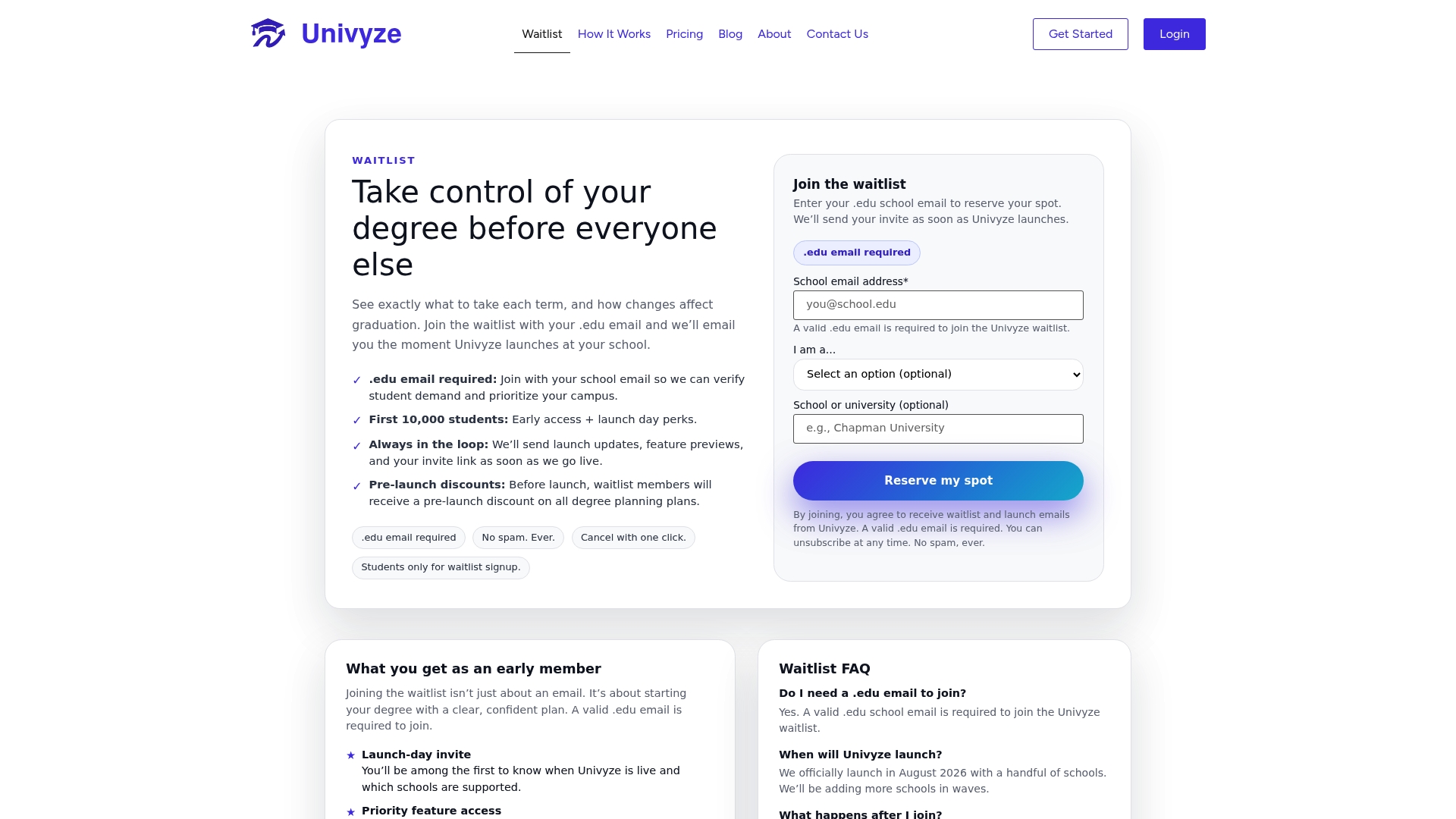
The Starter plan is free, and paid plans like Core, Plus, and Pro add deeper planning features including what-if scenarios and family visibility. If you want a preview of how the dashboard handles term-by-term planning, the student success dashboard overview walks through the core features. Join the Univyze waitlist to get access as new features roll out, and always confirm final enrollment and aid details with your registrar and financial aid office before you register.
Where to check your official seven week dates and rules
- Your college’s registrar academic calendar page lists exact session dates, refund windows, and grade due dates specific to your school.
- The financial aid office guidance on adding and dropping courses explains how enrollment changes can affect your disbursement.
- Your academic advisor can confirm whether a seven week combination fits your specific degree plan.
Sources
- 7-Week Sessions – CCRI
- 7-Week Classes | Grand Rapids Community College
- Adding/dropping a course and its impact on financial aid — UT Austin One Stop
FAQ
What is a 7 week session in college?
A seven week session is an accelerated course block that covers the same credits and material as a standard 15-week course, just in about half the time. Most U.S. colleges run two of these sessions per semester, often called Session I and Session II.
What are the semester dates in the USA?
Semester start and end dates vary by college, so there is no single national date. Each school’s registrar publishes its own academic calendar, and seven week sessions run on their own sub-calendar within that semester.
What is 7 semesters in years?
Seven semesters typically equals three and a half years, assuming a standard fall and spring semester pattern with no summer terms included. Adding summer sessions or seven week blocks can shift that timeline depending on how many credits you take each term.
How many school weeks are there in the USA?
A standard U.S. semester usually runs about 15 weeks of instruction, while a seven week session covers the same credit value in roughly half that span. Exact instructional week counts are set by each institution’s calendar, so check your registrar for your school’s specific schedule.
Can I take a 7-week course alongside a full 15-week course?
Yes, many students combine a seven week course with regular 15-week classes in the same semester. Just watch your total workload, since colleges often recommend limiting concurrent seven week courses to avoid an unexpected overload.