

An associate degree takes roughly 2 years and 60 credit hours to complete; a bachelor’s takes roughly 4 years and 120 credits. That gap in time and coursework translates directly into differences in career access, earning potential, and graduate school eligibility. According to BestColleges, bachelor’s degree holders earn about 37% more in median earnings than associate holders in aggregate, with a national median gap of roughly $22,620 per year.
Here is the short version of who should lean which way:
- Start with an associate if you need to enter the workforce quickly, have a specific vocational goal (respiratory therapist, dental hygienist, IT technician), or face real cost constraints and plan to transfer later.
- Start with a bachelor’s if your target career explicitly requires one (nursing BSN, engineering, teaching, federal employment), you have a clear major in mind, and you can commit to four years of study.
Table of Contents
- What is the difference between an associate and a bachelor’s degree?
- How long does each program actually take?
- How do the curricula actually differ?
- What does each degree actually cost?
- How do career outcomes and earnings compare?
- How does an associate degree transfer into a bachelor’s?
- What are the admission requirements and how fast can you start?
- Should you get an associate before a bachelor’s?
- What do AA, AS, AAS, BA, and BS actually mean?
- How to choose between an associate and a bachelor’s degree
- How to avoid extra semesters when planning your degree path
- Key Takeaways
- A realistic note on degree planning
- Univyze helps you plan your degree path clearly
- Authoritative sources and further reading
- FAQ
What is the difference between an associate and a bachelor’s degree?
| Dimension | Associate Degree | Bachelor’s Degree |
|---|---|---|
| Typical length | about two years | about four years |
| Typical credit hours | about 60 credits | about 120 credits |
| Typical annual tuition (in-state) | approximately $3,800 per year (community college) | approximately $10,600 per year (public four-year) |
| Program focus | General education + vocational/technical track | Major-focused upper-division coursework + general education |
| Career outcomes | Entry-level and licensed technical roles | Professional, managerial, and specialized roles |
| Earning potential | Lower median; varies widely by field | ~37% higher median earnings (aggregate) |
| Transferability | AA/AS transfer-oriented; AAS less so | N/A (terminal degree at undergrad level) |
| Admissions selectivity | Often open enrollment (HS diploma/GED) | GPA, test scores, essays for selective programs |
| Best for | Fast workforce entry, vocational goals, cost savings | Leadership tracks, grad school, credential-gated careers |
One concrete example: a registered nurse can enter the field with an Associate Degree in Nursing (ADN) and sit for the NCLEX, but many hospital systems now prefer or require a Bachelor of Science in Nursing (BSN) for clinical advancement and management roles. The ADN gets you in the door; the BSN keeps the ceiling higher.
How long does each program actually take?
The 60-credit associate vs. 120-credit bachelor’s framework is the starting point, but real timelines vary a lot depending on how you load your schedule.
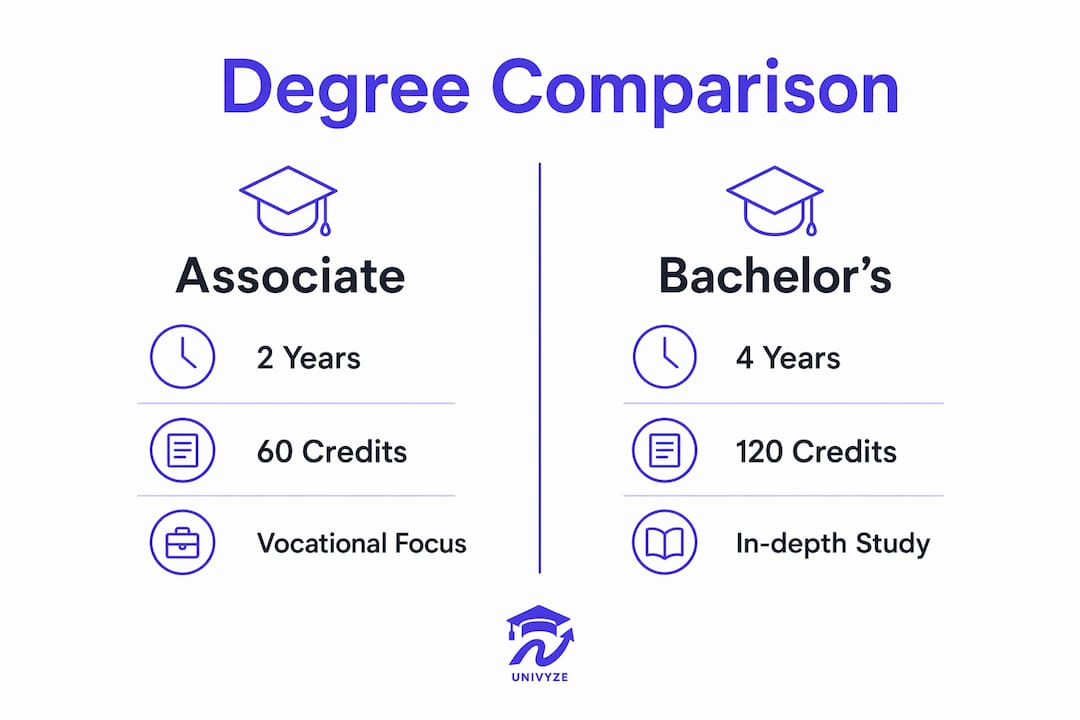
A full-time associate student taking 15 credits per semester finishes in four semesters, roughly two academic years. A full-time bachelor’s student on the same pace needs eight semesters. Part-time students, which describes a large share of community college enrollees, often stretch an associate to three years and a bachelor’s to five or six.
Several factors can compress or extend either timeline:
- AP and dual-enrollment credits earned in high school can knock out 6–30 credits before you set foot on campus, shaving a semester or more off either degree.
- Summer sessions let you complete 6–9 extra credits per year without overloading a regular term.
- Accelerated bachelor’s-completion programs at schools like Southern New Hampshire University (SNHU) and Northeastern University are designed for students who already hold an associate and want to finish the bachelor’s efficiently, often with flexible online scheduling.
- Transfer credit loss is the most common timeline killer. If your associate credits don’t map cleanly to the receiving institution’s requirements, you may repeat coursework you’ve already paid for.
Pro Tip: Before enrolling in any community college course you plan to transfer, pull the receiving university’s articulation agreement and confirm the course equivalency in writing. A verbal “it should transfer” from a counselor is not a guarantee.
How do the curricula actually differ?
The structural difference is straightforward: associate programs spend most of their 60 credits on general education requirements and either a vocational/technical track or a broad general studies foundation. Bachelor’s programs use the first two years similarly, then pivot to upper-division major courses, research opportunities, and electives that build genuine depth.

That depth matters to employers. As SNHU’s student services advisors note, bachelor’s degrees offer deeper specialization, and many hiring managers treat that depth as a deciding factor when candidates are otherwise comparable. A bachelor’s graduate in accounting has taken auditing, taxation, and financial reporting courses that an associate graduate simply hasn’t encountered. Understanding why majors have unit requirements helps clarify why that upper-division coursework isn’t just filler.
Where each degree is typically sufficient:
- Associate is often enough: licensed practical nursing, dental hygiene, radiologic technology, HVAC/electrical trades, paralegal work, some IT support and cybersecurity technician roles.
- Bachelor’s is commonly required: registered nursing (BSN track), engineering, social work licensure, K–12 teaching, most federal government positions, and virtually any role with a management or supervisory title.
Graduate school is a separate matter entirely. No accredited master’s or doctoral program accepts an associate as a terminal prerequisite. A bachelor’s from an accredited institution is the floor.
What does each degree actually cost?
Cost is where the associate degree’s advantage is most concrete. Georgia State’s admissions guidance cites in-state figures of roughly $3,800 per year for an associate program versus $10,600 per year for a bachelor’s at a public four-year institution. Over the full program length, that math is stark: approximately $7,600 total for the associate versus $42,400 for the bachelor’s at those rates, before fees, housing, and books.
The real total cost picture includes:
- Room and board: community college students who live at home eliminate this cost almost entirely.
- Books and supplies: roughly $1,000–$1,500 per year at most institutions.
- Fees: technology, activity, and lab fees vary by school and program.
- Opportunity cost: two extra years of full-time study is also two fewer years of full-time earnings.
Common financing strategies worth knowing:
- Pell Grants cover up to $7,395 per year (2024–25 award year) for eligible students and apply to both associate and bachelor’s programs.
- Institutional scholarships at community colleges are often underutilized because fewer students apply for them.
- Employer tuition assistance is one of the most underrated tools: enter the workforce with an associate, then let your employer help fund the bachelor’s while you earn a salary.
- The 2+2 transfer pathway effectively lets you pay community college tuition for the first half of a bachelor’s degree, then university tuition only for the upper-division years.
The earnings premium context: bachelor’s holders earn about 37% more in median annual earnings than associate holders, with a national median gap of roughly $22,620 per year. At that rate, the additional tuition cost of a bachelor’s can pay back in a few years of employment, though individual field and employer variation is significant.
How do career outcomes and earnings compare?
The earnings gap is real, but it isn’t uniform across every field. A licensed dental hygienist with an associate degree earns a strong median wage in a credential-specific role where the bachelor’s adds little immediate income. A business graduate with a bachelor’s has access to management tracks that are simply closed to associate holders, regardless of experience.

| Degree type | Representative occupations | Approximate median annual wage |
|---|---|---|
| Associate | Registered nurse (ADN), dental hygienist, paralegal, IT support specialist | Varies by role; dental hygienists ~$89,000 (BLS) |
| Bachelor’s | Accountant, civil engineer, social worker, marketing manager, teacher | Varies by role; accountants ~$79,000 (BLS) |
Two broader patterns from national data stand out. First, bachelor’s degree holders show lower unemployment rates and greater resilience when job markets tighten. Second, the bachelor’s degree functions as a credential ceiling-remover: many federal jobs, internal promotion tracks, and supervisory roles list it as an explicit minimum, meaning experience alone won’t substitute.
Northeastern University’s bachelor’s-completion program frames the key differences around five dimensions: length, focus, earnings, cost, and career opportunities. That framing holds up. The career-opportunity dimension is the one most students underestimate when they’re 19 and focused on getting into the workforce fast.
Understanding how interests guide career decisions before choosing a degree level can save years of backtracking.
How does an associate degree transfer into a bachelor’s?
The 2+2 pathway is the most common transfer model: complete an associate at a community college, then transfer into the junior year of a bachelor’s program. When it works cleanly, you pay community college rates for half your education. When it doesn’t, you repeat courses and lose time.
The mechanics that determine whether it works:
- Articulation agreements are formal contracts between a community college and a receiving university that specify which courses transfer as which equivalencies. If your community college has one with your target university, follow it exactly.
- Bachelor’s-completion programs at schools like SNHU and Northeastern are built specifically for transfer students and often accept more credits than standard programs. Some completion programs accept up to 90 of the 120 credits required for a bachelor’s, leaving only 30 upper-division credits to finish.
- AA and AS degrees transfer more readily than AAS degrees. The AAS (Associate of Applied Science) is designed for direct workforce entry, not transfer, and many of its technical credits don’t map to liberal arts or major requirements at four-year schools.
Step-by-step actions to protect your transfer:
- Identify your target bachelor’s program before you enroll in your associate program.
- Request the articulation agreement from your community college’s transfer center.
- Verify each course equivalency in writing, not verbally.
- Meet with an advisor at the receiving institution to confirm your plan.
- Keep syllabi for every course you complete, in case the receiving school needs to evaluate non-articulated credits manually.
Pro Tip: If you’re planning to transfer, choose an AA or AS over an AAS whenever your program allows it. The AA/AS is designed with transfer in mind; the AAS is designed for immediate employment. That distinction can cost you a full semester of repeated coursework if you pick the wrong one.
For a detailed walkthrough of the transfer process, the community college to university transfer guide covers the documentation steps in depth.
What are the admission requirements and how fast can you start?
Community colleges are designed for access. Most operate on open enrollment, meaning a high school diploma or GED is the primary requirement. Many have rolling admissions and multiple start terms, including January and summer sessions, so you can often begin within weeks of deciding to enroll.
Bachelor’s programs vary widely. A regional public university might admit students with a 2.5 GPA and no test score requirement. A selective private university might require a 3.8 GPA, SAT/ACT scores, two letters of recommendation, and a personal essay, with a single fall deadline. The admissions gap between open-enrollment community colleges and selective four-year programs is one of the most practically significant differences for students who need to start quickly.
Key points for different student situations:
- Recent high school graduates with strong grades can apply directly to bachelor’s programs and often receive merit aid that reduces the cost gap with community college.
- Adult learners returning to school often find community college the faster on-ramp, with evening and online sections that fit around work schedules.
- Transfer students applying to bachelor’s programs should check whether the target school has a separate transfer application deadline, which is often different from the freshman deadline.
- Students with prior college credits (dual enrollment, AP, military service) should submit those records early, since credit evaluation can take weeks and affects your placement and financial aid.
Should you get an associate before a bachelor’s?
The stepwise path, associate first then bachelor’s, is a legitimate strategy, not a consolation prize. But it only pays off when you plan it deliberately.
Reasons to start with an associate:
- Lower upfront cost, especially if you’re unsure of your major or career direction.
- Faster entry into the workforce if your target role accepts the associate credential.
- Employer tuition assistance becomes available once you’re employed, funding the bachelor’s at little or no out-of-pocket cost.
- A strong articulation agreement with your target university makes the transfer nearly seamless.
Reasons to start directly with a bachelor’s:
- Your target career explicitly requires a bachelor’s (engineering, teaching, social work licensure, federal employment).
- You have a clear major and a four-year institution you want to attend.
- You qualify for merit scholarships at a four-year school that close the cost gap significantly.
- You want to minimize total time-to-degree, since a poorly planned associate-to-bachelor’s path can take five or six years instead of four.
The decision rule in plain terms: if you know what you want to do and a bachelor’s is required to do it, start there. If you’re still figuring it out, or if cost is the binding constraint, the associate-first path with a confirmed articulation agreement is a sound move. Choosing a major that aligns with your actual interests matters more than most students realize at 18; the guide to choosing the right college major is worth reading before you commit.
What do AA, AS, AAS, BA, and BS actually mean?
These abbreviations show up on every college website and confuse a lot of students. Here is what each one means in practice.
Associate-level degrees:
- AA (Associate of Arts): General education-heavy, designed for transfer into a BA program. Common in liberal arts, social sciences, and humanities.
- AS (Associate of Science): Similar transfer orientation but with more math and science coursework. Common pathway into BS programs in biology, computer science, and business.
- AAS (Associate of Applied Science): Vocational and technical focus, designed for direct workforce entry. Dental hygiene, HVAC technology, culinary arts. Transfers poorly to four-year programs.
Bachelor-level degrees:
- BA (Bachelor of Arts): Broader general education requirement, typically in humanities, social sciences, communications, or fine arts. More elective flexibility.
- BS (Bachelor of Science): More technical and quantitative coursework in the major. Common in engineering, nursing, computer science, and natural sciences. Graduate programs in technical fields often prefer or require a BS.
A few related credentials worth knowing: certificates (non-degree, often 1 year or less, highly vocational) sit below the associate level and don’t transfer as degree credit. Some schools offer “associate-to-bachelor’s completion” programs under names like “bachelor’s completion” or “degree completion,” which are bachelor’s programs specifically structured around incoming transfer credits.
How to choose between an associate and a bachelor’s degree
Work through these questions in order. The answers will point you toward the right path.
Career-first questions:
- Does your target job posting list a bachelor’s as a minimum requirement?
- Does your field use degree level as a screening criterion for promotions or supervisory roles?
- Is your target role credential-specific (licensed allied health, trades), where the associate is the standard entry point?
Financial checklist:
- What is the net cost after grants and scholarships at each option?
- Does your employer offer tuition assistance you can use after starting work?
- Can you confirm an articulation agreement that protects your transfer credits?
- What is the realistic time-to-degree for each path given your schedule?
Academic checklist:
- Is your target major available at the community college level, or only at four-year institutions?
- Does the bachelor’s program you want have specific prerequisite courses that must be completed in sequence?
- Is the institution accredited by a regional accreditor (HLC, SACSCOC, WASC, etc.)? Employer and graduate school recognition depends on this.
Timing checklist:
- When is the next available start term for each option?
- Can you attend full-time, or do work and family commitments require part-time enrollment?
- Do you have AP, dual-enrollment, or transfer credits that could accelerate either path?
Next steps:
- Meet with an academic advisor at both the community college and your target four-year institution before enrolling.
- Request the articulation agreement in writing.
- Use a degree-planning tool to model your term-by-term timeline under different scenarios.
Pro Tip: Run a “what-if” scenario before you commit: map out the associate-first path with confirmed transfer credits and compare it against starting directly in a bachelor’s program. The difference in total cost and time-to-degree is often surprising, and it changes the decision for many students.
How to avoid extra semesters when planning your degree path
Extra semesters are the most expensive planning failure in higher education, and they almost always trace back to the same handful of mistakes: unconfirmed transfer credits, missed prerequisites, schedule conflicts, and undeclared or late-changed majors. Univyze’s own analysis of common graduation delays shows these planning failures consistently add cost and time that students didn’t budget for.
Concrete tactics to protect your timeline:
- Confirm course equivalency before you enroll, not after. Pull the articulation agreement, find the course on the equivalency list, and get written confirmation.
- Map prerequisites early. Some upper-division courses have two or three prerequisites that must be taken in sequence. Missing one in your sophomore year can push a required course to your senior year.
- Use AP and dual-enrollment credit strategically. These credits can satisfy general education requirements and free up space for major courses, but only if you submit official score reports before your first registration period.
- Track your Academic Requirements Report (ARR) or degree audit every semester. Waiting until junior year to check your progress is how students discover they’re missing a required course with one semester left.
- Plan summer sessions into your timeline. A 6-credit summer term can absorb electives or prerequisites and keep your fall/spring terms focused on major coursework.
Degree-planning tools like Univyze are built specifically for this kind of visibility. Univyze’s dynamic dashboard integrates degree requirements with actual course offerings, lets you map your term-by-term plan, run what-if scenarios for major changes or transfer credits, and flag schedule conflicts before they cost you a semester. It’s a planning tool, not an official degree audit — always verify your requirements with your registrar and academic advisor — but having a clear visual of your path makes those advisor conversations far more productive.
Pro Tip: If you’re an adult learner finishing a bachelor’s while employed, use your employer’s tuition assistance program to cover upper-division courses one or two at a time. Many completion programs at SNHU and Northeastern are designed for exactly this pace, and the financial math often works out better than taking out additional loans.
Key Takeaways
An associate degree and a bachelor’s degree differ most consequentially in time, cost, curriculum depth, and career access — and the right choice depends entirely on your specific career goal and financial situation.
| Point | Details |
|---|---|
| Time and credits | Associate ≈ 60 credits / 2 years; bachelor’s ≈ 120 credits / 4 years — the credit gap drives most cost and timeline differences. |
| Earnings gap | Bachelor’s holders earn about 37% more in median earnings than associate holders, with a national median annual gap of roughly $22,620. |
| Transfer pathways | AA/AS degrees transfer most cleanly; some completion programs accept up to 90 transfer credits, leaving only 30 upper-division credits to finish. |
| Cost strategy | Community college in-state tuition runs roughly $3,800/yr vs. $10,600/yr at a public four-year — the 2+2 path captures both rates strategically. |
| Univyze planning | Univyze’s term-by-term dashboard and what-if planning help students model transfer scenarios and track degree progress — join the waitlist to plan your path. |
A realistic note on degree planning
The single most consistent mistake I see students make is treating the associate-to-bachelor’s transfer as automatic. It isn’t. Articulation agreements are specific, course equivalencies expire, and receiving institutions change their requirements. The students who transfer without losing credits are the ones who documented everything from day one: syllabi, course descriptions, written equivalency confirmations, and advisor emails.
My honest advice: treat your degree plan like a contract you’re negotiating, not a form you’re filling out. Know exactly which courses satisfy which requirements before you register, not after grades post. If you’re planning to transfer, visit the transfer center at your community college and the admissions office at your target university in the same semester you start. The earlier you get both institutions aligned on your plan, the fewer surprises you’ll face at the finish line.
Pro Tip: Keep a dedicated folder, physical or digital, with syllabi, course descriptions, and any written transfer approvals you receive. If a course equivalency is ever disputed, that documentation is the difference between a quick resolution and repeating a semester.
Univyze helps you plan your degree path clearly
Unclear degree planning is one of the most common reasons students spend an extra semester or two finishing a degree they thought they were close to completing. Univyze is built to fix that specific problem.
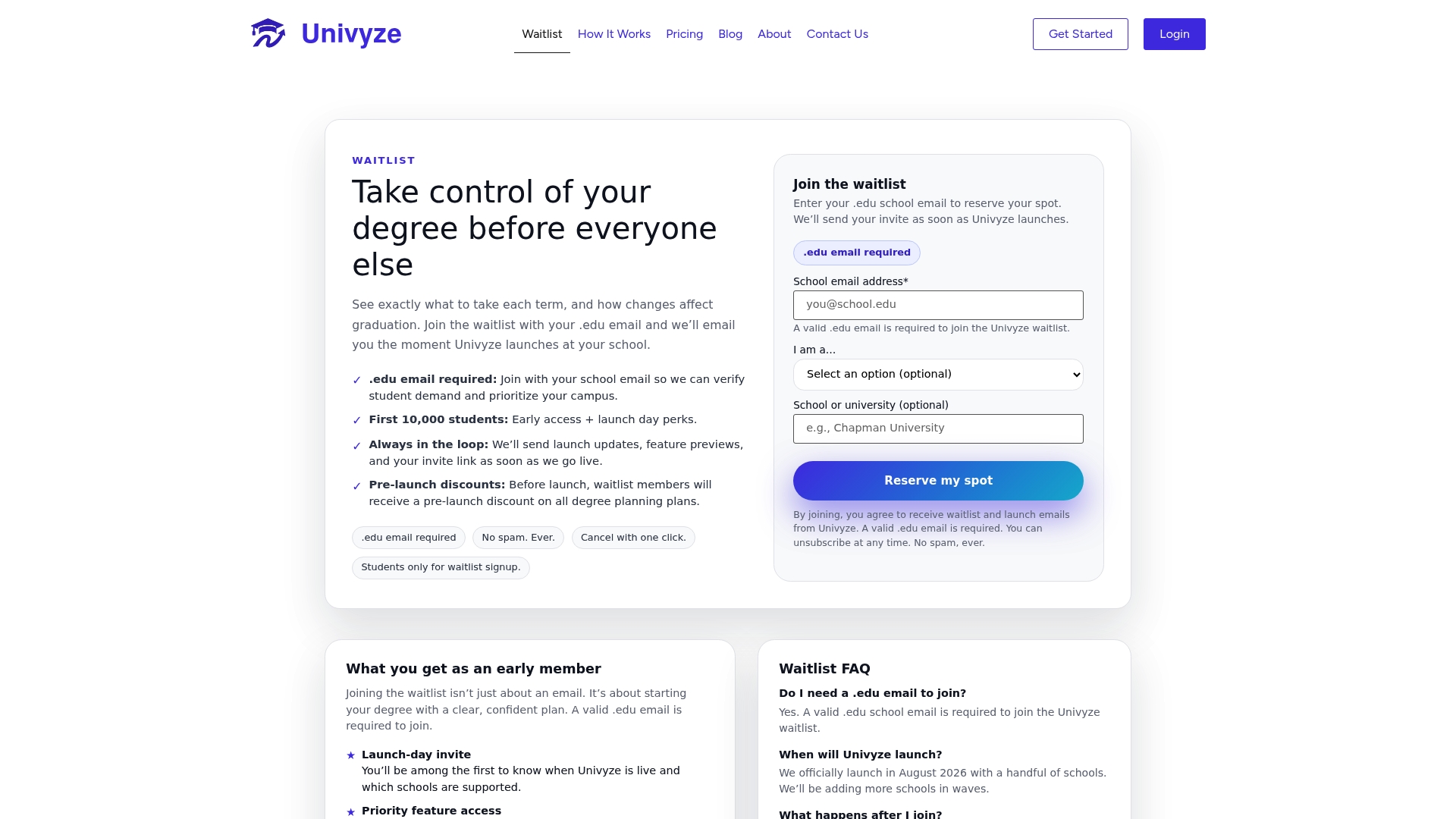
The Univyze dashboard integrates your degree requirements with real course offerings and builds a term-by-term plan you can actually see and adjust. You can map AP and dual-enrollment credits, model what happens if you change your major, simulate transfer credit scenarios, and spot schedule conflicts before they derail a semester. It’s a planning tool, not an official degree audit — always confirm your requirements with your registrar and academic advisor — but it gives you and your family a clear, current picture of where you stand and what comes next.
Univyze is currently accepting waitlist signups. If you want to see how term-by-term planning can help you finish on time and on budget, join the waitlist at univyze.com/waitlist.
Authoritative sources and further reading
These are the sources used in this article, along with a note on what each one offers readers who want to dig deeper.
- SNHU Newsroom: Associate vs. Bachelor’s Degree — Advisor-sourced guidance on specialization depth and employer expectations; useful for understanding curriculum differences.
- Northeastern University Bachelor’s Completion — Frames the five key differences (length, focus, earnings, cost, career) and explains completion program structures for transfer students.
- Georgia State Admissions: Associate vs. Bachelor’s — Provides concrete in-state cost comparisons and explains admissions differences between open-enrollment and selective programs.
- College Transitions: Associate vs. Bachelor’s — National earnings gap data, transfer credit caps, and job-market resilience analysis.
- BestColleges: Associate vs. Bachelor’s — Aggregate earnings premium data and career-intent guidance for choosing between degree levels.
- College Raptor: Associate vs. Bachelor’s — Clear credit-hour and timeline breakdowns for both degree types.
- Univyze: What Is a Degree Map? — Explains how degree-mapping tools work and how they help students visualize their academic path.
- Univyze: 7 Mistakes That Delay Graduation — Practical breakdown of the planning errors that most commonly add semesters and cost.
- Univyze: Degree Requirement Checklist — Self-serve checklist for tracking degree requirements and verifying progress each term.
Always verify your specific degree requirements with your institution’s official degree audit, university catalog, registrar, and academic advisor. Requirements vary by school, program, and catalog year.
FAQ
Is it better to get an associate’s or a bachelor’s degree?
It depends on your career goal. If your target role requires a bachelor’s (engineering, teaching, federal employment), start there. If you need fast workforce entry or have a specific vocational credential in mind, an associate can be the right first step, especially when paired with a clear transfer plan.
Is an associate’s degree the same as a bachelor’s degree?
No. An associate is roughly 60 credits and 2 years; a bachelor’s is roughly 120 credits and 4 years. The bachelor’s provides deeper major specialization, broader career access, and is the required prerequisite for any graduate program.
What is an associate’s degree equivalent to?
An associate degree is roughly equivalent to the first two years of a bachelor’s program in terms of credit hours. In transfer-friendly systems with articulation agreements, those credits can apply directly toward a bachelor’s, though equivalency is never automatic and must be confirmed with the receiving institution.
What are the four main types of college degrees?
The four main undergraduate and graduate degree levels are: associate (2 years), bachelor’s (4 years), master’s (1–2 years beyond bachelor’s), and doctoral (3–7 years beyond bachelor’s). Each level builds on the previous one, and most graduate programs require a bachelor’s as the minimum entry credential.
How much more do bachelor’s degree holders earn than associate holders?
Bachelor’s degree holders earn about 37% more in median earnings than associate holders in aggregate national data, with a median annual gap of roughly $22,620. Actual differences vary significantly by field and employer.