

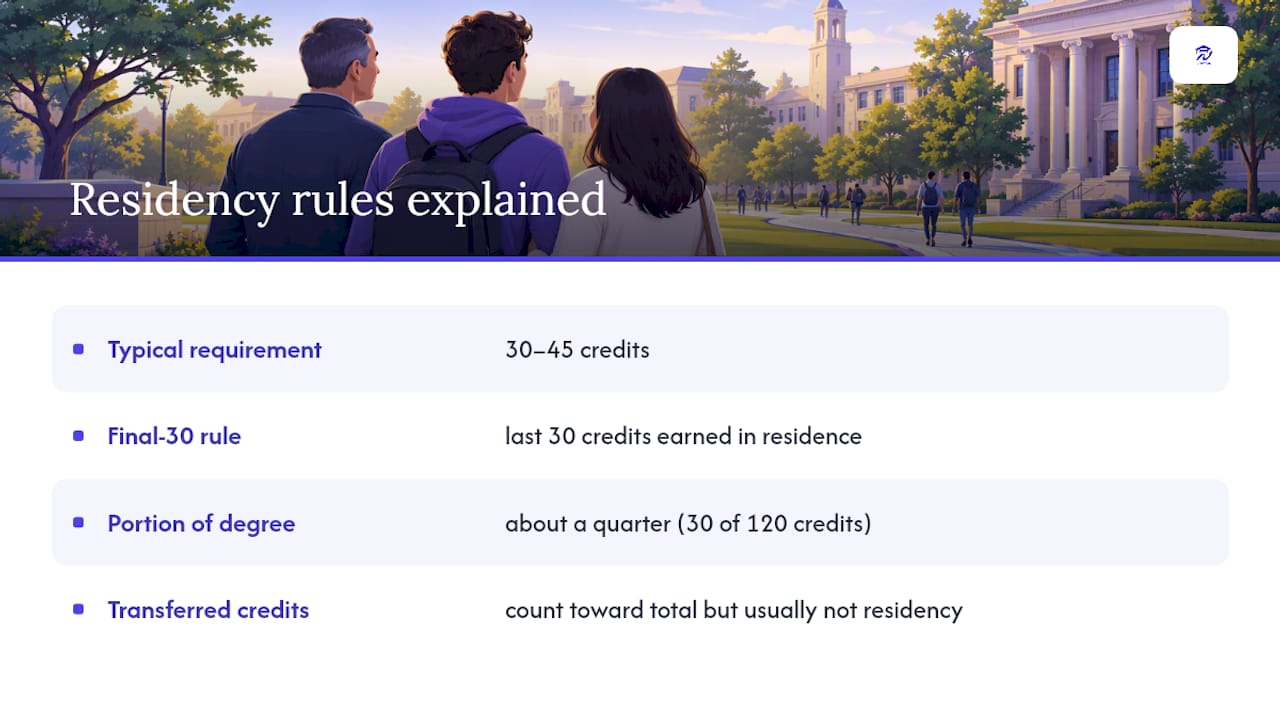
Credits in residence are the credits you must earn while enrolled at your degree-granting school, and most schools set that bar at 30 to 45 credits or roughly a quarter of your degree. Transfer credit, AP scores, and dual-enrollment units often satisfy your total credit count but not this specific residency requirement. Pull your catalog or degree audit today and email your registrar to confirm exactly which of your credits qualify.
TL;DR:
- Most schools require students to earn between 30 and 45 credits in residence, usually representing about a quarter of the degree, regardless of transfer credits.
- Transfer, AP, and dual-enrollment credits rarely count toward residency, which is specifically based on credits earned while enrolled at the degree-granting institution.
- Confirm your school’s residency requirements in writing early by reviewing the catalog, degree audit, and contacting the registrar to avoid surprises.
- Planning your final in-residence credits should start by mapping backward from your graduation date to prevent delays and unnecessary costs.
- Using degree planning tools helps visualize how transfer credits and schedule changes impact residency requirements, but always verify with official source documentation.
Table of Contents
- What Are Credit Residency Rules, and Why Do They Exist?
- How Do Transfer, AP, and Dual-Enrollment Credits Interact With Residency?
- How Do You Confirm Your School’s Residency Requirement?
- What Should You Do When Residency Threatens Your Graduation Date?
- How Univyze Helps You Track Your Residency Credits
- An Advisor’s Take on Getting This Right Early
- See Your Residency Block Clearly With Univyze
- Sources
- FAQ
What Are Credit Residency Rules, and Why Do They Exist?
Residency, in this context, has nothing to do with your home state or tuition rate. It refers to the credits you earn while actually matriculated at the school that will hand you your diploma, as opposed to credits you bring in from somewhere else.
Most schools set this requirement at a level generally between 30 and 45 credits, or about a quarter of your degree. Some use a “final 30” rule, meaning your last credits before graduation must be earned at that institution. Others require a somewhat higher or lower number within this range, according to university registrar guidance. Certain programs add an additional upper-division residency requirement on top of the general one.
Schools enforce this because accreditation standards and program integrity depend on the institution actually teaching a meaningful share of your coursework, not just stamping approval on credits earned elsewhere. Here’s where it gets concrete: a student who transfers in with 90 credits from community college and AP exams can still be required to earn 30 to 45 of those final credits in residence. Those 90 outside credits count toward your 120-credit total. They usually don’t count toward the separate residency line.
How Do Transfer, AP, and Dual-Enrollment Credits Interact With Residency?
External credit and residency credit are two different ledgers, and mixing them up is where most planning mistakes happen.
Transfer credits, AP scores, and dual-enrollment units typically apply toward your overall 120-credit graduation total. They rarely satisfy the in-residence requirement, because that requirement exists specifically to measure time spent enrolled at the granting institution. UMass Amherst illustrates this well: the school accepts up to 75 transfer or test credits, yet still requires students to earn at least 45 semester credits in residence. A student could arrive with more than half their degree already covered and still need well over a full year on campus.
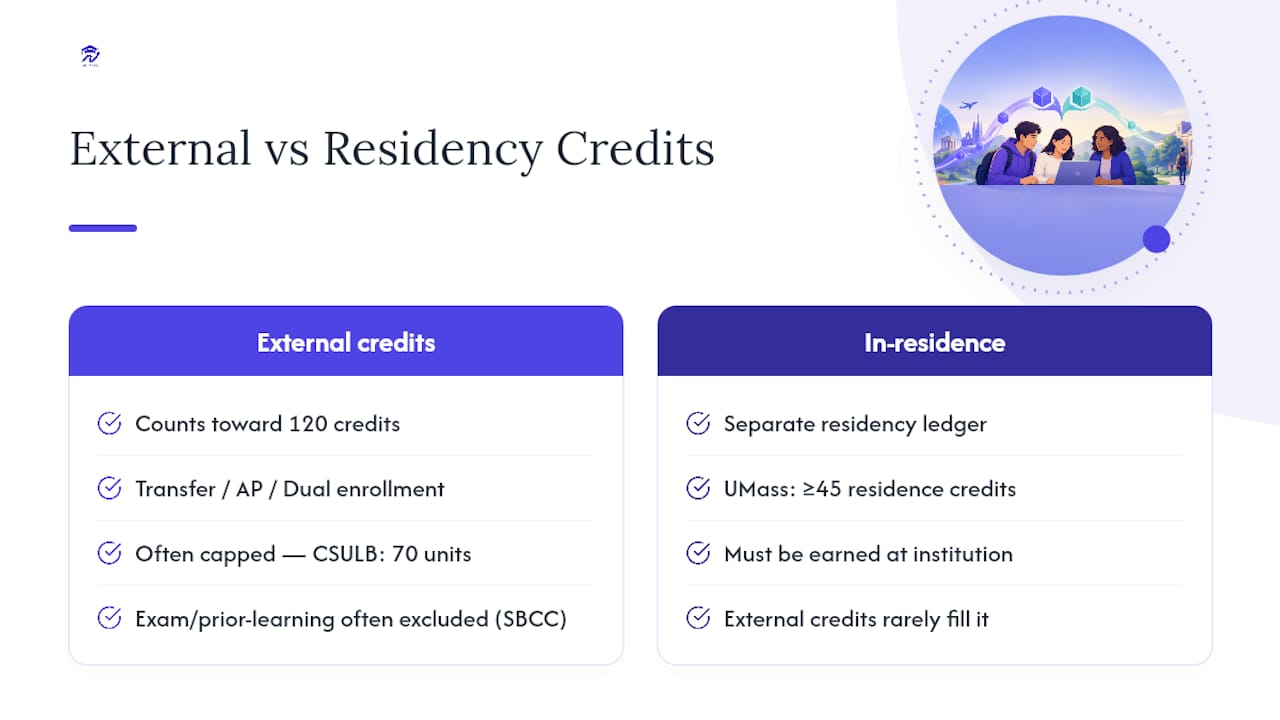
Caps compound the issue. CSULB, for example, limits community college transfer credit to 70 semester units, regardless of how many credits a student actually completed elsewhere. Community college districts often exclude credit-for-prior-learning and exam credit from residency hour calculations entirely, per SBCC’s credit-for-prior-learning policy.
Watch for three traps: double-crediting the same coursework across two requirements, reusing credits already applied toward a previous degree, and assuming a transferred elective satisfies an upper-division major requirement it was never evaluated against.
How Do You Confirm Your School’s Residency Requirement?
Don’t guess. Get it in writing, and do it early enough to still change your schedule if the answer surprises you.
- Search your current catalog for the terms “residency,” “in residence,” “last 30 credits,” or any program-specific residency language buried in your major’s requirements page.
- Pull your official degree audit and transfer-equivalency evaluation. Note your catalog year, since residency rules can shift between catalog years and older cohorts sometimes get grandfathered exceptions.
- Email your registrar or program coordinator one direct question: “Which credits can satisfy residency for my [major] under catalog year [XXXX]? Please confirm in writing.” Keep the reply.
- Map your remaining credits backward from your target graduation date to make sure the required in-residence block actually fits into the terms you have left at your home school.
Pro Tip: Ask specifically about your catalog year, not just the current one. Some schools apply the residency rule that was active when you first enrolled, and others apply whatever policy is current, so a registrar’s written answer settles that ambiguity for good.
What Should You Do When Residency Threatens Your Graduation Date?
Once you know your in-residence number, the planning question becomes: how do you fill it without wasting money or time?
Start by mapping your final block first. Count backward from graduation and identify exactly which terms must include in-residence credits, before you spend a dollar on outside coursework that won’t touch that requirement. From there:
- Prioritize courses that satisfy residency and an upper-division or major requirement at the same time, so one three-credit class does double duty.
- Check whether CLEP, DSST, ACE, or NCCRS exam credit can count toward residency at your school. Some do allow it; most don’t. Confirm before you register for an exam.
- Use summer sessions, systemwide exchange programs, or approved campus offerings to bank in-residence credits, since coursework from an outside institution almost never applies here.
- If a schedule change shifts you from full-time to part-time status, or delays your expected graduation term, talk to financial aid before you commit. Aid packages and loan disbursements are often tied to enrollment status and expected completion dates.
Residency rules exist to protect program integrity, and schools rarely grant exceptions once you’re past the point of easy correction. Treating the in-residence block as a fixed constraint, the same way you’d treat a prerequisite chain, is the difference between a smooth final year and an unplanned extra semester.
How Univyze Helps You Track Your Residency Credits
Univyze’s dashboard links your specific degree requirements to your school’s actual course offerings, term by term, so you can see where your transfer credits, AP scores, and dual-enrollment units land relative to graduation, not just whether they count toward your total.
You can run what-if scenarios to test how a summer course or a schedule swap affects your final in-residence block, without committing to anything. Parents get the same visibility into the plan, which matters when residency questions come up around a shared kitchen-table budget conversation.
Univyze is a planning tool, not an official degree audit. Always confirm your specific residency requirement with your degree requirement checklist, your catalog, and your registrar before finalizing any schedule.
An Advisor’s Take on Getting This Right Early
If there’s one thing worth repeating from years of watching students get blind sided by graduation surprises, it’s this: residency rules don’t bend for good intentions. Students who assume their transfer or AP credits automatically cover everything are the ones who end up paying for a surprise extra term.
Check your catalog before you build next semester’s schedule, not after. Bring your parents or your advisor into that conversation early, and once the registrar answers your question, save that email. It’s the only proof you’ll need later.
— Ryan
See Your Residency Block Clearly With Univyze
A degree planning tool can provide a term-by-term map of where transfer credits, AP scores, and dual-enrollment units land against degree requirements, helping reduce guessing about whether final terms satisfy the school’s in-residence rules. The dashboard runs what-if scenarios for summer sessions or schedule changes, and parents get the same view of the plan, which keeps everyone working from the same information.

Univyze offers a free Starter plan, with paid options including Core, Plus, and Pro tiers available as annual subscriptions or one-time payments. Join the waitlist to see how the planning dashboard works for your major and catalog year, and always confirm your specific residency numbers with your official degree audit and registrar before you register for your final terms.
Sources
- Academic residency policy — University registrar example
- Transferable courses and unit caps — CSULB catalog/policy
- Transferring credit — UMass Amherst admissions
- Transfercredit
FAQ
What Does “Credits in Residence” Mean?
It means the credits you must earn while enrolled at the school that grants your degree, separate from your total credit count. Most schools set this between 30 and 45 credits or as a percentage of your degree, according to registrar guidance.
Do Transfer Credits Count Toward Residency?
Usually not. Transfer credits typically count toward your overall graduation total, but institutions like CSULB cap transfer units and exclude them from the separate in-residence requirement.
Can AP or CLEP Credit Satisfy Residency?
Rarely, and only if your school explicitly allows it. Many community college and university policies exclude credit-for-prior-learning and exam credit from residency hour calculations, so confirm with your registrar before assuming otherwise.
How Do I Find My School’s Exact Residency Requirement?
Search your current catalog for “residency” or “in residence,” then request written confirmation from your registrar for your specific major and catalog year. Transfercredit recommends mapping this block before planning anything else.
What Happens if I Miss the Residency Requirement?
You’ll likely need an extra term to complete the missing in-residence credits, which pushes back your graduation date and adds tuition and living costs. Planning tools like Univyze’s degree mapping can help you spot the gap early, though your registrar’s written confirmation remains the final word.
Recommended
- How to Choose Classes That Actually Count Toward Graduation (And Avoid Wasting Time and Money)
- Avoid Overload: U.S. Semester Credit Limit and the 18 Credit Cap
- Avoid an Extra Semester: Students’ Change Major Plan to Protect Your Aid
- How Many Credits Should You Take Per Semester? A Complete College Planning Guide