

Most co-op students should plan for their degree to take about a year longer than a non-co-op path, though the exact effect depends on your program’s rules and how many rotations you complete. The Purdue Office of Professional Practice notes that formal co-op participation commonly adds roughly one year to time to degree. Before you commit, check your program’s required co-op count and when your final academic term needs to fall.
TL;DR:
- Most co-op students should expect their degree to take about one extra year due to rotations, with the exact delay depending on their program’s specific requirements.
- The number of required co-op rotations can vary widely, from two to five or more, influencing the total extension of your graduation timeline.
- Administrative factors such as lagging grades and mandatory final academic terms often delay degree conferral, so students must plan for at least one additional term after their last rotation.
- Proper early coordination with advisors and careful registration planning can reduce the typical one-year delay associated with co-op programs.
- Using tools like visual degree-mapping and securing clear, documented rotation sequences before registration helps prevent scheduling conflicts and unnecessary extensions.
Table of Contents
- What co-op programs actually look like term by term
- How registrar rules and grading timelines set your real graduation date
- Who qualifies for co-op and when you can start
- Planning strategies that keep your timeline from stretching further
- What a typical four-year path looks like next to common co-op paths
- Modeling your rotations before you commit to a schedule
- Is the extra year worth it
- Map your co-op rotations with Univyze before you register
- Where to verify your program’s co-op rules
- Sources
- FAQ
What co-op programs actually look like term by term
A co-op program is not the same as an internship. An internship is usually a single work placement, often over one summer, with no guarantee it repeats or connects to your later coursework. A cooperative education program, by contrast, alternates full-time academic terms with full-time paid work terms as a structured part of your curriculum, and it is designed to build toward a set number of rotations rather than one isolated experience.

Most students who complete a co-op sequence generally finish several work terms, adding a significant amount of career-related experience by graduation, according to the 2025 NACE internship and co-op report. That same report points to the alternating structure as the key difference from a standalone internship: co-op is built into your degree plan, contributes credit in many programs, and comes with its own registration and eligibility rules rather than functioning as a side job you pick up on your own.
Work-term length varies by school, but a few patterns show up again and again:
- Four-month rotations, often aligned with a standard academic term.
- Six-month rotations, commonly running January through June or July through December.
- Eight-month rotations, which combine two terms into one extended placement.
The Northeastern University cooperative education policy confirms that four, six, and eight-month patterns are all standard, with six-month blocks especially common. How many rotations you need depends heavily on your major. Some engineering colleges require five or more co-op terms as a graduation condition, while other programs treat two or three rotations as sufficient. That variation is exactly why a generic “add a year” rule of thumb only gets you so far. Your actual timeline hinges on your specific program’s rotation count, not a national average.
How registrar rules and grading timelines set your real graduation date
The structural math of co-op terms is only half the story. The other half is administrative, and it is where most surprise delays come from.
Co-op grades often post the semester after the work term ends rather than immediately, which affects when your degree audit can reflect completed requirements. Because of this lag, most colleges will not let you finish your degree while still enrolled in a co-op term. You need at least one academic term after your final co-op before your degree audit can clear and conferral can happen. Skipping this step, or assuming your last rotation counts as your last semester, is one of the most common planning mistakes co-op students make.
A few mechanics to watch closely:
- Co-op grade posting typically lags a semester, which can delay when a requirement shows as complete on your audit.
- A final academic term after your last work rotation is usually mandatory, not optional.
- Registration and add or drop deadlines for co-op terms are firm, and missing one can push your entire rotation sequence back a full term.
- Petitions to change your required rotation count usually go through a formal committee process, not just a quick sign-off from your coordinator.
The CEAS Co-op Handbook at the University of Cincinnati illustrates how rigid this can get: some engineering programs there require five defined co-op terms, and reducing that number requires formal approval at the college level, not an informal request. Students who assume rotation counts are flexible often find out otherwise after they have already built a schedule around a shorter sequence.
Pro Tip: Pull your program’s co-op calendar and registrar deadlines before you build any schedule, since a single missed registration window can force an extra semester you never planned for.
If you are also weighing a major change alongside your co-op sequence, understanding how to protect your financial aid during a major change matters just as much as your rotation math, since both processes run through similar advisor and registrar approvals.
Who qualifies for co-op and when you can start
Co-op eligibility rules exist to make sure students are academically ready before they leave campus for a work term, and missing one of these thresholds early can quietly cost you a semester later.
Common requirements include:
- A minimum cumulative GPA, often around 2.0 for undergraduates, though graduate programs frequently set a higher bar.
- Successful completion of a co-op preparatory course before your first work term, which many programs treat as a hard prerequisite.
- A minimum number of completed semesters before you are eligible to start co-op, which affects transfer students differently depending on how many credits they bring in.
- Restrictions on consecutive academic terms, since many programs prohibit taking a co-op during two required back-to-back semesters.
The Northeastern University co-op academic policies describe this GPA and preparatory-course requirement as standard practice across many co-op programs, and note that co-op is treated as a curricular component requiring coordination between your department, the co-op office, and the registrar, not something you can arrange informally.
International students face an added layer: work authorization and immigration timing can affect when a rotation is even possible, so planning that piece separately with international student services is worth doing early rather than close to your intended start date. Graduate co-op arrangements also tend to look different from undergraduate ones. Rather than three or four shorter rotations, many graduate co-op programs use one continuous placement, which changes how you sequence coursework around it.
Transfer students should pay particular attention to minimum-semester rules, since credits earned elsewhere do not always shorten the clock on co-op eligibility the way they do for general degree requirements.
Planning strategies that keep your timeline from stretching further
The one-year extension many co-op students see is not fixed. It is a range, and where you land in that range depends on decisions you make early.
- Use summer, winter, or other special sessions to knock out required courses that would otherwise wait for a full academic term.
- Apply AP credit, dual-enrollment credit, and transfer credit as early as possible to reduce your remaining course load before you even start co-op.
- Register for your co-op prep course and get certified early so you can secure rotations that actually fit your degree sequence, rather than whatever is left over.
- Sequence major prerequisites before your program’s co-op eligibility deadlines, so a missing prerequisite never blocks your first rotation.
- Schedule one combined planning meeting with your academic advisor and your co-op coordinator, and leave with a documented rotation sequence rather than two separate, possibly conflicting, plans.
Summer courses can meaningfully cut your graduation timeline when used to clear prerequisites that would otherwise sit between you and your next co-op eligibility window. The same logic applies to AP and transfer credit: the earlier those show up on your plan, the more room you have to absorb a co-op term without losing a full extra semester.
Pro Tip: Ask your co-op coordinator and your academic advisor for the same rotation sequence document, then compare them side by side. Mismatches between what each office expects are a common, avoidable source of delay.
Bringing the right material to that advising meeting also matters. A short checklist of what to bring to advising can keep the conversation focused on your actual rotation math instead of general degree questions.
What a typical four-year path looks like next to common co-op paths
Seeing the semester math side by side makes the timeline shift concrete rather than abstract.
A standard four-year, non-co-op path looks like eight consecutive academic terms: two terms per year for four years, with electives and major requirements distributed across that sequence and no work terms interrupting it.
A student completing three four-month co-ops typically adds one to two extra terms to that baseline. The rotations themselves consume roughly a year of the calendar, but because they often align with existing term boundaries, the net addition to enrolled academic terms can be closer to two extra semesters once you account for the required final term after the last rotation.
A student completing two six-month co-ops, paired with strategic summer coursework, often sees a smaller net delay. The six-month blocks add roughly a year to the calendar on their own, but summer terms used for required courses can offset part of that by clearing requirements that would otherwise wait for a fall or spring slot.
A few things to check with your registrar regardless of which pattern you follow:
- Confirm your final academic term lands after your last co-op, not during or before it.
- Verify which summer courses actually count toward your major, not just toward general credit totals.
- Ask whether your program allows a six-month rotation to replace two four-month rotations, since substitution rules vary.
Details on why many degrees run longer than four years even without co-op, and how those extra terms typically get absorbed, are covered in this breakdown of time to degree.
Modeling your rotations before you commit to a schedule
Rotation counts, prerequisite sequencing, and summer session decisions all interact, and trying to hold that entire picture in your head is where a lot of co-op students lose track of a requirement until it is too late to fix cheaply.
There are visual degree mapping tools that line up your remaining degree requirements against actual course offerings term by term, so you can see where a co-op rotation would sit inside your existing plan rather than guessing. A few ways students use it around co-op specifically:
- Build a term-by-term map that shows exactly where each rotation falls and whether your required final term lands after it.
- Run a what-if scenario to see how adding a summer session, applying transfer credit, or dropping one rotation changes your projected graduation term.
- Get a flag when a planned rotation would conflict with a prerequisite you have not completed yet.
- Share the plan with a parent or advisor so everyone is looking at the same sequence instead of comparing separate notes.
None of this replaces your official degree audit, your university catalog, or a conversation with your academic advisor and co-op coordinator. Univyze is built to help you walk into those conversations with a clear draft plan already in hand, which tends to make the meeting shorter and the outcome more precise. You can see how the underlying dashboard supports on-time graduation planning in more detail, and the full feature walkthrough covers how the what-if modeling works in practice.
Is the extra year worth it
A year added to your degree timeline sounds like a cost, and in tuition and delayed earnings terms, it can be. But for most students who complete a real co-op sequence, the paid work experience, the professional references, and the clearer sense of what they actually want to do after graduation tend to outweigh that delay by a wide margin. The mistake is not choosing co-op. The mistake is choosing it without a documented plan.
Students who coordinate early with both their advisor and their co-op coordinator, and who use summer sessions or transfer credit deliberately rather than as an afterthought, consistently manage a smaller delay than students who treat each rotation as a separate decision made in isolation. The schedule math is not complicated once you have all the deadlines in front of you. The hard part is gathering them before they gather you.
— Ryan
Map your co-op rotations with Univyze before you register
Building a rotation sequence by hand across multiple terms, prerequisites, and a co-op calendar is exactly the kind of planning problem Univyze was built for. Instead of juggling a spreadsheet and three separate office conversations, you get a visual, term-by-term map that already accounts for AP credit, dual enrollment, transfer credit, and summer sessions, plus what-if scenarios that show how one more or one fewer rotation shifts your projected graduation term.
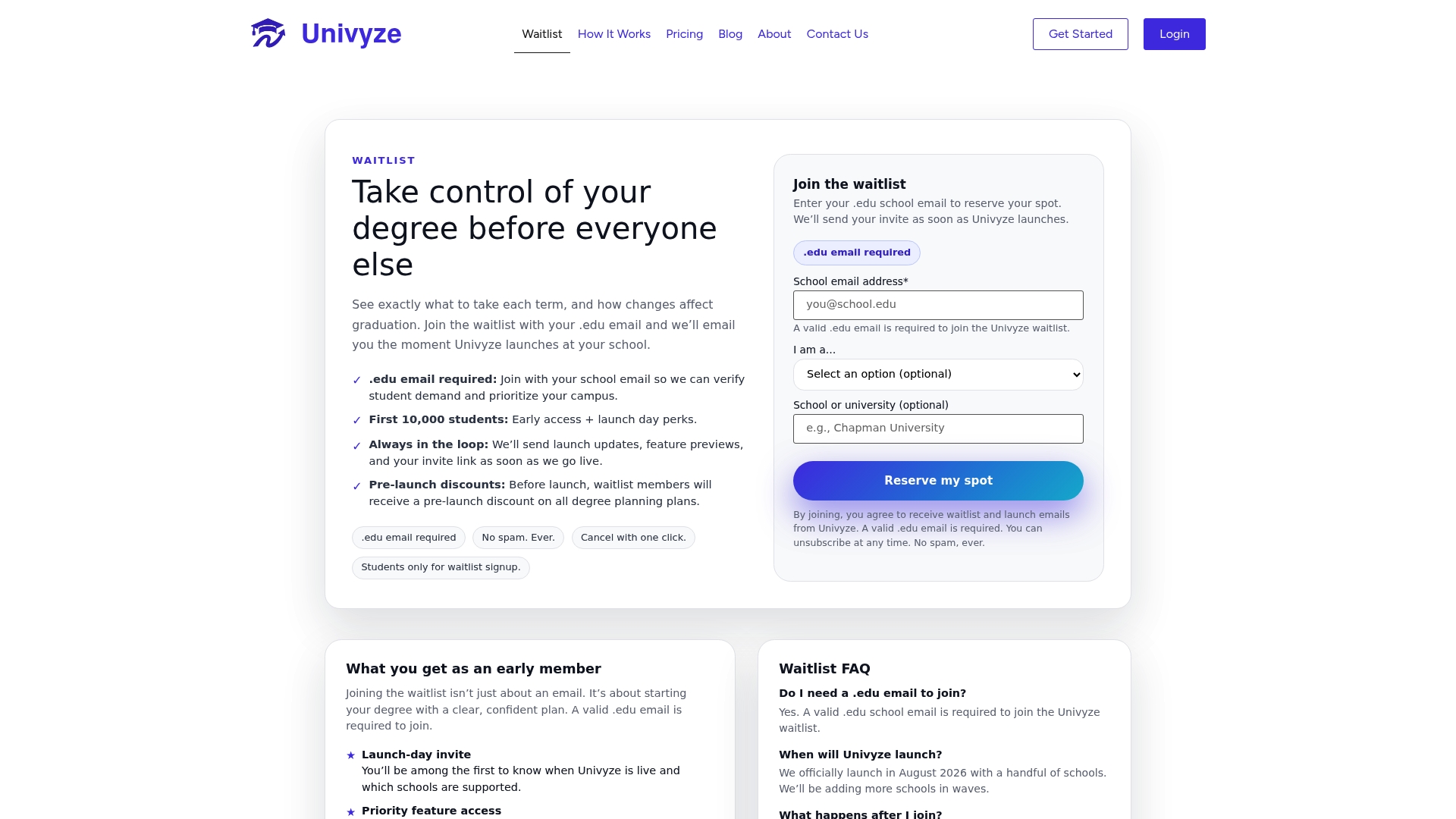
Join the waitlist to get early access to term-by-term planning built around AP credit, dual enrollment, transfer credits, summer sessions, and what-if scenario modeling, so you can walk into your advising and co-op meetings with a draft plan already mapped out. As always, confirm every rotation requirement and final-term rule with your registrar and academic advisor before you register. You can start at Univyze or join the Univyze waitlist directly.
Where to verify your program’s co-op rules
Every co-op program sets its own rotation counts, GPA thresholds, and registration deadlines, so treat the following as a starting point rather than a substitute for your own school’s documentation:
- The 2025 NACE internship and co-op report for national participation patterns and typical rotation counts.
- University-specific co-op handbooks and registrar calendars, such as Northeastern’s cooperative education policy and the University of Cincinnati’s CEAS Co-op Handbook, for program-specific rotation and petition rules.
- Your own college catalog, degree audit, and academic advisor, since rotation counts, GPA minimums, and final-term rules vary by institution and by major.
Sources
- 2025 NACE internship and co-op report executive summary
- Purdue Office of Professional Practice: Undergraduate co-op programs
- Northeastern University cooperative education policy
- CEAS Co-op Handbook (University of Cincinnati) — Fall 2026
FAQ
Can I complete a co-op after I graduate?
Co-op programs are generally structured as a curricular requirement completed before conferral, since many colleges require a final academic term after your last rotation before your degree audit can clear. If you finish coursework before completing required rotations, check with your co-op office and registrar about whether a postgraduate arrangement is possible at your specific school.
What is the typical order of events at a graduation ceremony?
Graduation ceremony order varies by school and is set by the registrar or commencement office, not by co-op or academic policy. Check your university’s commencement office page for your specific program’s ceremony sequence and honors recognition order.
How many semesters does a typical co-op add to my program?
Most co-op sequences run three to four work terms, and formal co-op participation commonly adds about one year to time to degree compared with a non-co-op path. The exact number of added semesters depends on your program’s required rotation count and whether you offset delays with summer coursework or transfer credit.
What is a 4.0 GPA called at graduation ceremonies?
Graduation honors terminology, such as summa cum laude, varies by institution and is typically tied to GPA bands set by each college rather than a single national standard. Check your university catalog or registrar’s honors policy for the exact GPA threshold and title used at your school.