

Data-driven degree planning means building your path to graduation on a term-by-term roadmap that links your actual degree requirements to real course offerings, so you can see conflicts and gaps before they cost you a semester. The approach catches prerequisite bottlenecks, missing credits, and scheduling collisions early. The sections below walk through exactly what to track, how to build the plan, and which tool can run the process for you.
TL;DR:
- A real degree plan should include requirement mapping, live course offerings, prerequisite links, incoming credit records, and scenario testing to prevent delays.
- Building an effective roadmap requires collecting accurate data, sequencing prerequisites carefully, and revisiting the plan each term after grades post.
- Degree audits show completed work but do not forecast future courses; using planning tools for “what-if” scenarios helps avoid scheduling and credit gaps.
- Confirming transfer and AP credits early with the relevant offices ensures credits are properly applied and reduces risks of unexpected delays.
- A planning tool complements advisor-guided review but cannot guarantee on-time graduation, making regular updates and verification essential.
Table of Contents
- 1. What a data-linked plan includes and why it pays off
- 2. What to capture in a term-by-term plan
- 3. How do you build and test a term-by-term roadmap?
- 4. Why degree audits and planners are not the same tool
- 5. Who to contact to verify your plan before you commit
- 6. Common pitfalls that quietly delay graduation
- 7. A student’s honest take on planning tools
- 8. How the Univyze dashboard puts this plan into practice
- FAQ
- Sources
1. What a data-linked plan includes and why it pays off
A real roadmap pulls together several moving pieces instead of treating them separately. The core features worth having in any plan:
- Requirement mapping that lists every major, minor, and general education box still open.
- Live course offerings showing which terms each needed class actually runs.
- Prerequisite linkage that flags the chain a course depends on, not just the course itself.
- Incoming-credit tracking for AP, dual enrollment, and transfer coursework.
- What-if scenarios that model a major change or a new minor before you commit.
The payoff shows up in fewer late semesters, cleaner schedules with less last-minute scrambling, and room left for an internship or study abroad term without pushing graduation back. Tracking incoming credit matters more than most students expect: nearly 2.5 million U.S. high school students took dual-enrollment courses in 2022-23, so a large share of incoming students arrive with credit that needs to be verified and slotted into a plan correctly. Family visibility is a quieter benefit: when parents can see the same roadmap, conversations about course load and timeline stop being guesswork.
2. What to capture in a term-by-term plan
A plan only works if it holds the right data. Before you sequence a single course, record these pieces:
- Catalog year and major or minor requirements, including every general education category still unmet.
- Course offering patterns, meaning which terms a class runs, typical section times, and whether it tends to fill up.
- Prerequisite and co-requisite chains, mapped as a sequence rather than a single requirement, since one course can gate three others downstream.
- AP, dual-enrollment, and transfer credit records, each noted with its source, the score or grade, and whether your institution has validated it yet.
- Constraints, such as unit caps per term and financial aid or satisfactory academic progress rules that limit how light or heavy a term can be.
Our degree requirement checklist breaks these categories down further if you want a template to start from.
Prerequisite chains deserve extra attention because they behave differently than a single missing requirement. NACADA’s advising guidance frames effective advising as helping students use complex curriculum information to reach graduation, and prerequisite sequencing is exactly where that complexity lives: skip one link in the chain and every course that depends on it slides a term, sometimes a year.
Pro Tip: Mark an alternate course for every prerequisite link that only runs once a year, so a canceled section or a missed grade does not strand your whole sequence.
3. How do you build and test a term-by-term roadmap?
Building a plan that actually holds up follows a repeatable sequence rather than guesswork.
- Gather your sources. Pull your official catalog, your current degree audit, upcoming course schedules, and any AP or transfer credit evaluations you have on file.
- Map remaining requirements to real courses. For each open requirement, note which terms the course is actually offered, not just that it exists somewhere in the catalog.
- Sequence prerequisite chains. Lay out dependent courses in order and assign a backup option for any single-offering class.
- Run what-if scenarios. Test a major change, an added transfer credit, or a study abroad term and check how far the ripple effects reach into later semesters.
- Share the plan and update it. Send the roadmap to your advisor and, if helpful, your family, then revisit it every term as grades, credit evaluations, and course schedules shift.
A few habits make this sequence more reliable:
- Rebuild the plan right after grades post each term, not just at registration time.
- Keep a running note of every credit decision your institution confirms in writing.
- Treat any “tentative” course offering as unconfirmed until the official schedule posts.
Our guide on moving from a static degree audit to a working planner walks through this same sequence with more detail on each step.
4. Why degree audits and planners are not the same tool

A degree audit tells you what you have already completed. It does not forecast what happens if you add a course next term, which is where a separate planning step comes in. Most campus audit systems, like the setup described in UC Merced’s MyDegreePath guidance, are built as a record of finished work, not a forward-looking planner.
To bridge that gap:
- Run an “audit with planned courses” or “what-if” report using the courses you intend to take, not just completed ones.
- Treat the result as a draft, then confirm it with your registrar or advisor before registering.
- Watch for common audit pitfalls: a catalog-year change that alters requirements, transfer credit applied to the wrong category, or an elective substitution the system does not recognize automatically.
None of this replaces your official audit. It just gives you a way to test decisions before they become permanent.
5. Who to contact to verify your plan before you commit
Once your roadmap looks solid on paper, get it checked by the offices that actually control your record.
- Your academic advisor, with a printed degree audit and your planned course list in hand.
- Your registrar’s office, for questions about catalog year, unit limits, or petition deadlines.
- Your transfer or AP credit office, bringing syllabi or exam score reports for any credit still pending evaluation.
Ask about deadlines specifically: catalog-year locks, petition windows, and transfer evaluation turnaround times vary by term and can quietly derail a plan built around the wrong date. Once you get a confirmation, whether by email or an updated audit, save it and rerun your plan to reflect the change. The U.S. Department of Education’s credit mobility playbook points to the same pattern at scale: technology can map transfer pathways and equivalencies quickly, but staff review still catches what automated matching misses.
6. Common pitfalls that quietly delay graduation
A few mistakes show up over and over in student plans:
- Missing one link in a prerequisite chain and discovering it a term too late.
- Assuming a course will run simply because it appears in the catalog.
- Letting AP, dual-enrollment, or transfer credit sit unverified for a year or more.
Pro Tip: Confirm AP and dual-enrollment credit the summer before you arrive. College Board and ACE guidance notes that many exam scores of 3 or higher earn credit that can let you skip an introductory course entirely, but only if your institution has logged it correctly.
Before each registration cycle, run through a short checklist: confirm your remaining prerequisite chains, check whether any planned course has moved terms, and verify that your latest credit evaluations appear in your record. A buffer term or a summer session can absorb the surprises that slip through anyway.
7. A student’s honest take on planning tools
Planning software is only as good as the information you feed it and the follow-through after. We built this guide around a simple belief: you own the plan, the tool just makes the math visible. No dashboard replaces a conversation with your advisor, but skipping that conversation because you assumed the software caught everything is how students lose a semester.
— Ryan
8. How the Univyze dashboard puts this plan into practice
We built this planning tool around the exact workflow above: dynamic requirement mapping that updates as you complete courses, live course offerings layered onto your plan, prerequisite sequencing that flags chain dependencies automatically, and what-if scenarios for testing a major change or added transfer credit before you commit to it.
A few things this kind of dashboard can handle:
- Automatic term-by-term scheduling that adjusts when a course moves terms or fills up.
- Tracking of AP, dual-enrollment, and transfer credit in one place, so nothing sits unverified.
- Features for family visibility, so parents can see progress without digging through a portal.
- Summer session planning for closing gaps without adding a full extra term.
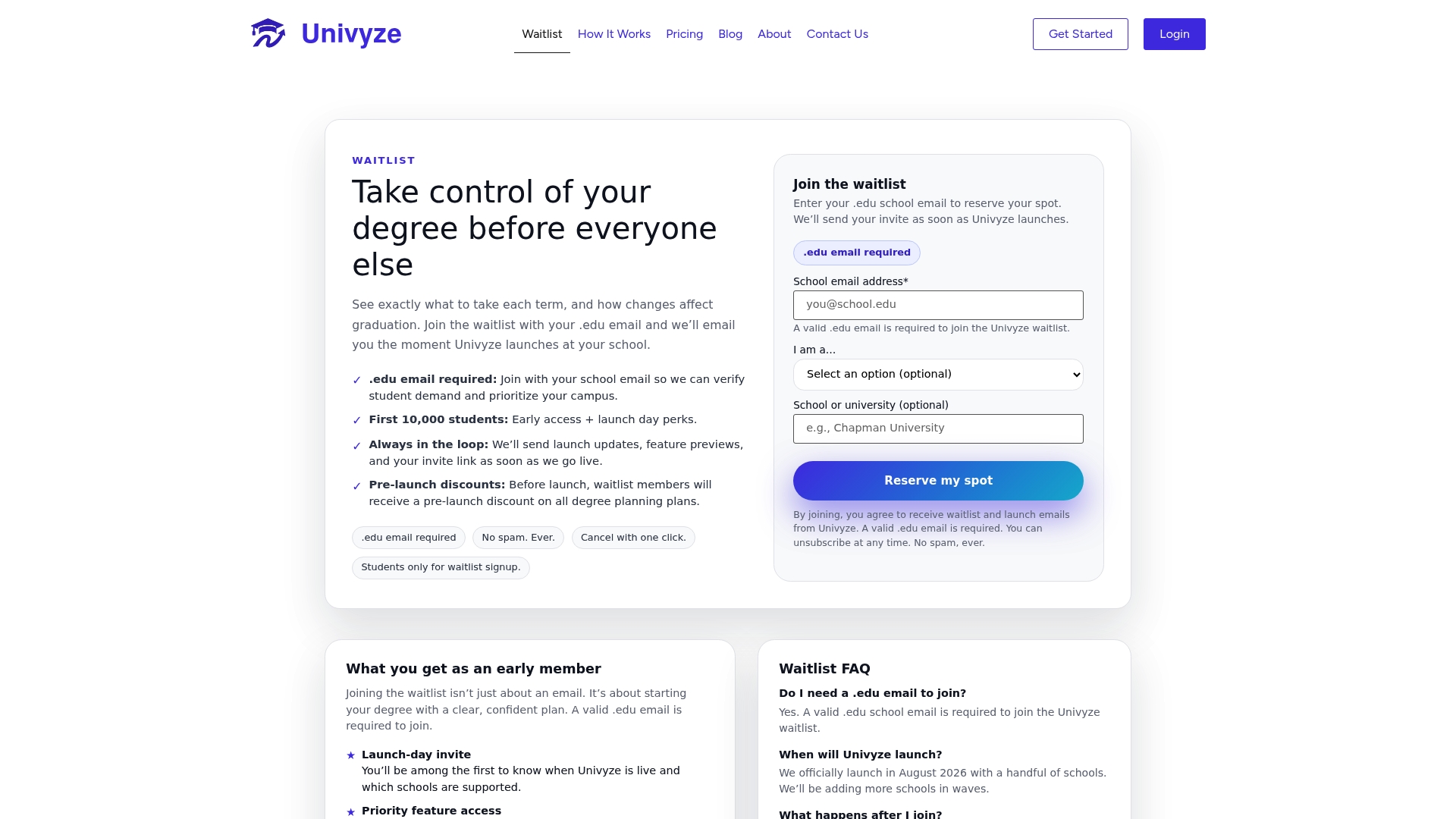
We built Univyze to supplement your official degree audit and your advisor, never to replace either one. Your registrar and catalog still have the final word on what counts. If this kind of term-by-term clarity sounds useful, join the Univyze waitlist and we will let you know when a plan fits your situation, including pricing details for Core, Plus, and Pro once you are ready to go further than the free Starter tier.
FAQ
What does data-driven degree planning actually mean?
It means building your graduation roadmap from real data: your specific requirements, actual course offering terms, and your incoming credit record, rather than a generic checklist. The goal is to catch scheduling conflicts and prerequisite gaps before they cost you a term.
How is a degree audit different from a degree plan?
A degree audit is a record of what you have already completed, while a plan forecasts what happens if you add future courses. Tools like MyDegreePath note that audits are often static snapshots, so you need a separate what-if report to test upcoming decisions.
How do I make sure my AP or transfer credit gets applied correctly?
Confirm the evaluation directly with your transfer or AP credit office using your official score report or transcript, since College Board and ACE note that many scores of 3 or higher qualify for credit at many institutions. Do this early, ideally before your first term, so the credit shows up before you plan around it.
Can a planning tool guarantee I graduate on time?
No tool can guarantee graduation timing, since course availability, grades, and institutional policy changes are outside any planner’s control. What a tool like Univyze can do is surface conflicts and credit gaps early enough for you to address them with your advisor.
What should I bring to an advising appointment about my plan?
Bring a printed copy of your official degree audit, your planned course list for upcoming terms, and any pending credit documentation like AP score reports or transfer syllabi. This lets your advisor verify your sequencing against the current catalog in one sitting.
Sources
- How many students are taking dual-enrollment courses in high school? (CCRC/Columbia)
- NACADA core competencies
- AP credit-granting recommendations (College Board / ACE)
- Improving credit mobility and transfer support playbook (U.S. Dept. of Education)
- MyDegreePath (UC Merced) — degree audit vs planner guidance