

Graduating on time means completing your degree within the standard time frame for your program: typically about four years for a bachelor’s degree and two years for an associate degree. The four-year benchmark generally assumes earning a full course load each semester to meet credit requirements. A master’s degree varies more widely, but most run one to two years of full-time study beyond the bachelor’s.
Here’s the quick breakdown by degree type:
- Bachelor’s degree: ~120 credits, ~4 years (8 semesters at 15 credits each)
- Associate degree: ~60 credits, ~2 years (4 semesters at 15 credits each)
- Master’s degree: typically 30–60 credits, 1–2 years full-time
These are starting points, not guarantees. Accelerated programs, summer terms, AP credit, and part-time enrollment all shift what “on time” looks like for any individual student.
Pro Tip: Run a degree audit every semester and aim for 15 credits per term. That pace is the planning baseline advisors use to keep a standard bachelor’s on a four-year track.
Table of Contents
- Why does graduating on time matter financially and emotionally?
- How do colleges actually measure whether you graduated on time?
- Why do so many students miss the four-year target?
- How to stay on track: a semester-by-semester checklist
- What to do if you fall behind
- Key Takeaways
- The clock matters less than the plan
- Univyze helps you see your path clearly
- Useful sources
- FAQ
Why does graduating on time matter financially and emotionally?
The financial case is direct. Every extra semester adds tuition, fees, room and board, and living costs on top of what you’ve already spent. Beyond the tuition bill, there’s the earnings you’re not collecting while still in school. A New York Federal Reserve analysis of delayed graduation found that extra years carry substantial net present value costs, including both added expenses and forgone salary. Students who take five or six years to finish give up one to two years of post-graduation earnings at a point in their career when that income compounds into future raises and retirement savings.

The California State University system put numbers to this. Their Graduation Initiative 2025 analysis found that first-time freshmen who graduated roughly seven months earlier saw a total immediate financial gain of $31,093, factoring in both increased earnings and reduced educational costs. That’s not a rounding error.
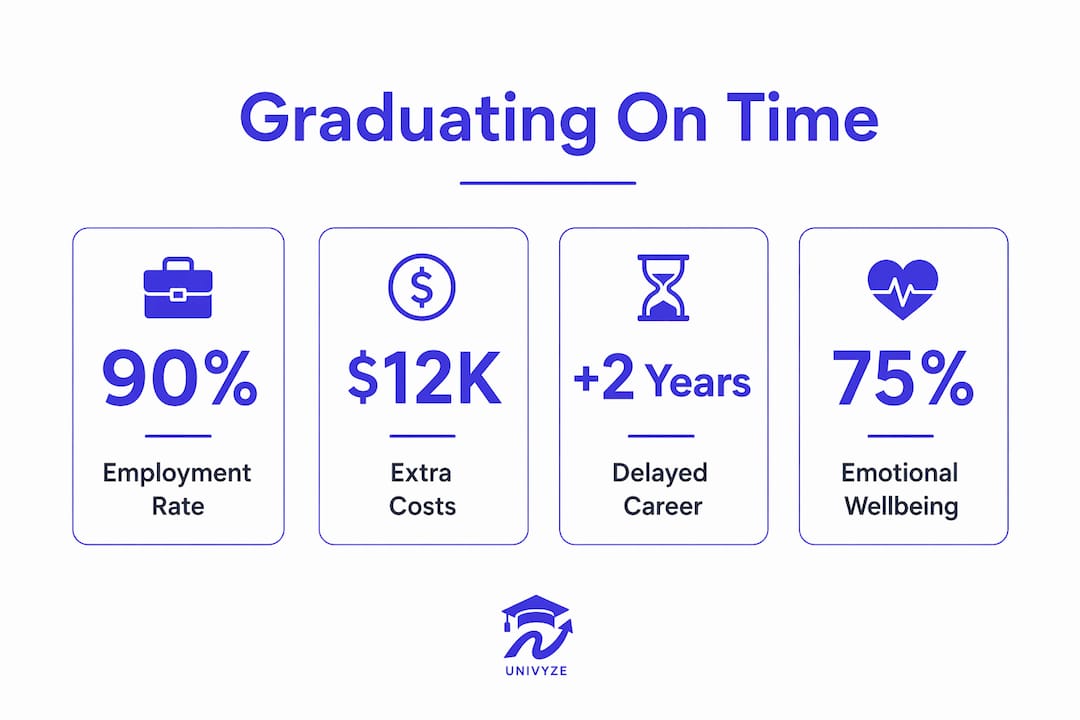
Career timing matters too. Employers hire in cycles, and a May graduate who finishes a year late misses an entire recruiting season. The gap between a four-year and a five-year graduate isn’t just one year of salary. It’s a year of experience, a year of promotions, and a year of professional network-building.
The emotional side is real but less discussed. Students who finish on schedule report clearer transitions into post-college life and lower burnout rates. Staying enrolled longer than planned, especially without a clear end date, can increase stress and erode motivation. Knowing you have a defined finish line changes how you approach each semester.
Pro Tip: If you’re weighing whether to stretch your timeline, talk to your financial aid office first. One extra semester can affect your loan interest, your aid eligibility, and your Satisfactory Academic Progress status.
How do colleges actually measure whether you graduated on time?
The federal standard comes from IPEDS, the Integrated Postsecondary Education Data System. Under IPEDS graduation rate definitions, institutions track full-time, first-time degree-seeking students and report completion at 100% of normal time (four years for a bachelor’s) and 150% of normal time (six years). A separate GR200 component extends tracking to 200% of normal time, or eight years.
What this means practically: when a school reports a “four-year graduation rate,” they’re counting students from a specific entering cohort who finished within exactly four years. That number often looks lower than you’d expect because it excludes transfer students, part-time students, and anyone who took a leave of absence.
| Degree Type | Typical Credits | Normal Time | 150% Window |
|---|---|---|---|
| Bachelor’s | ~120 credits | 4 years | — |
| Associate | ~60 credits | 2 years | 3 years |
| Master’s | 30–60 credits | 1–2 years | Varies by program |
A few important exceptions:
- AP/IB and dual enrollment credit can reduce the on-campus credits you need, potentially shortening your timeline. Acceptance policies vary by institution and department, so verify with your registrar before counting on them.
- Transfer credit works similarly. Credits may transfer but not apply to your specific major requirements.
- Accelerated programs and summer terms can compress a four-year plan, but seat availability and prerequisites still apply.
- Part-time enrollment shifts your personal timeline without changing the institution’s published “normal time” definition.
Why do so many students miss the four-year target?
Less than half of students at many four-year public institutions graduate in four years. The reasons cluster around a few predictable patterns.
The 12-credit trap. Federal financial aid defines full-time enrollment as 12 credits per semester. Many students take exactly 12 and assume they’re on track. They’re not. Twelve credits times eight semesters equals 96 credits, which falls 24 credits short of a typical 120-credit degree. You’d need two extra semesters just to close that gap. The 15-credit pace is what actually gets you to 120 in four years.
Major changes. Switching majors mid-stream often means some completed courses no longer count toward your new requirements. The further along you are when you switch, the more credits you may need to retake or replace.
Bottleneck courses. Some required classes run once a year, or have seats for 30 students in a major with 200. Missing the window for one of these can add a full semester or more to your plan, especially in STEM, nursing, and education programs. This is one of the most underestimated structural risks in degree planning.
Part-time enrollment and life commitments. Work, family responsibilities, and financial pressures push many students to take lighter course loads. That’s sometimes the right call, but it needs to be a deliberate choice with a revised timeline, not a default that quietly extends your graduation date.
Transfer credit delays. Credits that transfer in but don’t apply to your major requirements are a common surprise. Always confirm with your department coordinator, not just the registrar, before assuming transferred credits count.
How to stay on track: a semester-by-semester checklist
The single highest-impact behavior is meeting with your academic advisor every semester, not just when something goes wrong. Academic advisors recommend treating your degree plan as a living document that you update each term as course availability, major requirements, and your own goals shift.
Here’s a practical checklist to follow from orientation through senior year:
- Orientation term: Run your first degree audit. Confirm AP, IB, dual enrollment, and transfer credits are posted correctly. Map out all required courses and identify any that run only once per year.
- Freshman fall and spring: Target 15–16 credits per semester. Complete English and math requirements early. These gateway courses often unlock prerequisites for upper-division work.
- Sophomore year: Declare your major if you haven’t. Identify bottleneck courses in your program and register for them as early as your enrollment window opens.
- Junior year: Run another degree audit. Check that every completed course is applying to the right requirement. Flag any gaps with your advisor and build a contingency plan.
- Senior year: Apply for graduation two semesters before your target date. Confirm your remaining requirements with the registrar, not just your own notes.
A sample freshman-year plan supporting a four-year bachelor’s path might look like this: Fall semester, 15 credits covering a first-year writing course, calculus or statistics, a general education science course, an intro course in your intended major, and one elective. Spring semester, another 15 credits building on those foundations with the next course in your major sequence, a second general education requirement, and a prerequisite for a sophomore-level bottleneck course.
Univyze is a planning tool that helps you visualize this kind of term-by-term path. It integrates degree requirements with actual course offerings, lets you test what-if scenarios (like a major change or a semester abroad), and tracks how AP and transfer credits apply to your plan. It’s not an official degree audit and doesn’t replace your advisor, but it gives you a clearer picture of where you stand before you walk into that advising appointment. You can explore multi-year degree planning as a starting point.

Pro Tip: For every bottleneck course in your major, identify a backup section, an approved equivalent, or a summer offering. Build that contingency into your plan before you need it.
What to do if you fall behind
Delays are common, and most are recoverable with the right steps taken quickly. The worst thing you can do is wait until senior year to address a gap that showed up sophomore year.
Recovery options worth knowing:
- Summer and winter sessions are the fastest way to make up credits without extending your academic year. Some programs also allow summer coursework to satisfy requirements that aren’t available during the regular year.
- Course overloads (typically 18+ credits) are possible at most schools with advisor approval, but they carry real academic risk. Use them selectively.
- Online and consortium courses can fill gaps when your home institution doesn’t offer a required course in a given term. Confirm transferability before enrolling.
- Petitioning for course substitutions is underused. If a course you’ve already taken is substantially equivalent to a requirement, your department coordinator can often approve a substitution.
- Credit by exam (CLEP, departmental exams) works for some general education requirements and can recover credits without additional coursework.
Administrative checklist when you fall behind:
- Meet your advisor and ask specifically about course offering cadence for any missing requirements.
- Contact the department coordinator about substitution options.
- Visit the financial aid office to understand how a schedule change affects your Satisfactory Academic Progress (SAP) status and aid eligibility.
- Check your enrollment status. Dropping below full-time can trigger loan repayment periods and affect certain scholarships.
NCES data shows that only 44% of 2015–16 bachelor’s degree recipients completed their degree within 48 months of first enrolling. You’re not alone if you’re off the four-year pace. The goal is degree completion, and a clear recovery plan beats a vague hope that things will work out.
Key Takeaways
Graduating on time means finishing your degree within the standard credit and time benchmarks for your program, and the financial, career, and emotional costs of missing that target are concrete enough to plan around.
| Point | Details |
|---|---|
| Standard benchmarks | Bachelor’s degrees target ~120 credits in 4 years; associate degrees target ~60 credits in 2 years. |
| The 12-credit trap | Taking 12 credits per semester yields only 96 credits in 4 years, leaving you 24 credits short of a typical bachelor’s. |
| Financial stakes | Data from California State University indicates that graduating roughly seven months earlier translates to an immediate financial gain of $31,093 for the average first-time freshman. |
| Recovery is possible | Summer sessions, course substitutions, and early advisor contact can close most gaps before they become costly. |
| Univyze for planning | Univyze helps students visualize term-by-term requirements and test what-if scenarios; always verify any plan with your official degree audit and registrar. |
The clock matters less than the plan
Students spend a lot of energy worrying about whether they’re “on time” and not enough energy building a plan that makes the question answerable. The four-year benchmark exists because it’s financially and practically optimal for most students, not because finishing in five years makes you a failure. What actually separates students who graduate efficiently from those who don’t is rarely motivation. It’s information: knowing which courses are bottlenecks, knowing that 12 credits a semester isn’t enough, knowing to run a degree audit before junior year instead of after.
The stigma around taking longer than four years is real but often misplaced. A student who takes five years because they changed majors once, worked 20 hours a week, and still graduated with a strong GPA made reasonable tradeoffs. A student who takes five years because nobody told them about a prerequisite sequence is a planning failure, not a personal one. Steady, informed progress toward completion matters more than hitting an arbitrary calendar date.
That said, don’t use “it’s okay to take longer” as a reason to avoid planning. The costs of an extra semester are real, and they compound. Use the tools available to you, meet your advisor, and treat your degree plan as something worth updating every term.
Univyze helps you see your path clearly
Most students don’t fall behind because they’re not working hard enough. They fall behind because nobody showed them the full picture until it was expensive to fix.

Univyze is a degree planning tool that gives you that picture upfront. It’s not an official degree audit and doesn’t replace your academic advisor, but it does something most campus tools don’t: it maps your term-by-term requirements against real course offerings, so you can see scheduling conflicts, prerequisite gaps, and bottleneck courses before they derail a semester. You can model what happens if you change your major, add a minor, or use AP credits. Parents can also see their student’s progress in one place, without a phone call.
Specific features relevant to staying on track:
- Automatic term-by-term planning based on your degree requirements
- AP, dual enrollment, and transfer credit handling
- What-if scenario modeling for major changes or summer terms
- Progress tracking with visibility for parents
Always verify any plan Univyze generates with your official degree audit, registrar, and advisor before making enrollment decisions.
Ready to see your degree path laid out term by term? Join the Univyze waitlist and get early access when it opens for your school.
Useful sources
These are the primary sources worth bookmarking for your own research and planning.
| Source | What It Covers |
|---|---|
| IPEDS Graduation Rate definitions | Official federal definitions of normal time, 150%, and 200% completion windows |
| National Student Clearinghouse Research Center | National data on time-to-degree and completion rates for U.S. students |
| NCES Fast Facts: Time to Degree | Federal data on how long bachelor’s degree recipients actually take to finish |
| Federal Student Aid (studentaid.gov) | Enrollment status rules, SAP requirements, and financial aid implications |
| Your institution’s registrar and degree audit | The only authoritative source for your specific requirements and credit application |
| Univyze: Are You on Track? | Planning checklist and progress-tracking resource for U.S. college students |
This article is general educational information, not academic or financial advising. Confirm your specific degree requirements, credit policies, and financial aid status with your institution’s registrar, advisor, and financial aid office.
FAQ
What does graduating on time mean for a bachelor’s degree?
It means completing your degree within four years, typically by earning about 120 credits across eight semesters at a 15-credit-per-semester pace, as defined by IPEDS normal-time standards.
Do most students graduate on time?
No. Fewer than half of students at many four-year public institutions finish within four years, and national data shows the average time to a bachelor’s degree exceeds four years.
Why don’t students graduate on time?
The most common causes are taking only 12 credits per semester instead of 15, changing majors, missing bottleneck courses that run infrequently, and part-time enrollment due to work or family commitments.
How can I graduate on time?
Meet with your advisor every semester, run a degree audit each term, target 15 credits per semester, identify bottleneck courses early, and use summer or winter sessions to stay on pace. Tools like Univyze can help you visualize your term-by-term path, though you should always verify your plan with your official degree audit and registrar.
Is graduating on time financially important?
Yes. Every extra semester adds tuition, fees, and living costs while delaying your entry into the workforce. CSU’s Graduation Initiative analysis found that graduating roughly seven months earlier translated to an immediate financial gain of $31,093 for the average first-time freshman.