

Your major does not lock your future. Skills, experience, and planning matter far more than the name on your degree. Around 30% of students switch majors at least once, and most go on to careers that have little to do with their undergraduate field. The decision feels enormous, but the research says it is far more flexible than the myths suggest.
The three things that actually move outcomes:
- Transferable skills and demonstrated experience (internships, research, projects) carry more weight with employers than your major title.
- Course sequencing and degree planning determine whether a major change costs you one semester or three.
- Professional advising is underused. Only about 28% of students sought college adviser guidance when choosing their major, which is one reason these myths persist.
Before you read further: always verify your specific degree requirements with your official degree audit, registrar, and academic advisor. A tool like Univyze can help you visualize what-if major changes, but it does not replace official advising.
Table of Contents
- The most common misconceptions about college majors, debunked
- How to actually decide your major: a practical checklist
- What the research actually shows about majors and earnings
- How changing your major affects your graduation timeline and costs
- Key Takeaways
- What advisors wish students knew sooner
- Univyze helps you plan smarter before you commit to a change
- Useful sources and further reading
- FAQ
The most common misconceptions about college majors, debunked
Myth 1: Your major determines the rest of your life
This is the biggest one, and it is wrong. Duke University’s Career Hub puts it plainly: your major is one data point among many. Most people work in careers that are not directly related to their undergraduate field. What employers actually screen for is evidence that you can communicate, solve problems, and deliver results. Those skills transfer across industries.
Actionable step: List three skills you want to build this semester. Then find one class, project, or campus organization that develops each one, regardless of your major.
Myth 2: STEM always guarantees the highest lifetime earnings
STEM majors do earn more on average, but averages hide enormous spread. A Webber analysis cited by The New York Times found that the top quartile of English majors can out-earn the bottom quartile of chemical engineers over a lifetime. The field matters less than what you do inside it.

Pro Tip: When comparing earnings data, always look at the range within a major, not just the median. A major with a wide earnings spread rewards high performers regardless of the field.
Actionable step: Pull up the Georgetown Center on Education and the Workforce earnings data for any major you are considering. Look at the 25th and 75th percentile, not just the median.
Myth 3: Being undecided means you will fall behind
Academic advisors consistently report that entering college undecided rarely prevents on-time graduation when students plan carefully and use advising. Most universities build exploration time into the first two years through general education requirements. Undecided students who meet with advisors regularly often graduate on the same timeline as students who declared a major on day one.
Actionable step: If you are undecided, schedule an advising appointment this week. Ask specifically which general education courses count toward the most majors you are considering.

Myth 4: Liberal arts and humanities majors have limited career options
This one has real staying power, and it is largely a college major stereotype that does not hold up. Employers increasingly hire for transferable skills like critical thinking, writing, and analysis, which humanities programs develop deliberately. The challenge is not the major itself. It is that humanities students sometimes fail to frame their skills in terms employers recognize.
Actionable step: Build a “skills inventory” document. For each class you take, write down one transferable skill it sharpened and one project that proves it. That document becomes the backbone of every cover letter you write.
Myth 5: You must major in X to enter career Y
Pre-med students do not need a biology major. Law schools accept applicants from every undergraduate field. Many tech companies have dropped formal degree requirements entirely in favor of demonstrable skills and certifications. The actual requirement for most competitive careers is a set of prerequisite courses, not a specific major.
Actionable step: Look up the actual admissions requirements for your target career or graduate program. Write down the specific courses required, then check how many of those you can complete under a different major.
Myth 6: Intro survey courses are the best way to test fit
Penn State’s advising office cautions that intro courses are broad by design. They are built to attract students, not to represent what the upper-level work actually feels like. A student who loves Intro to Psychology and hates Research Methods is not a psychology person. The real test is whether you want to do the work the major actually requires at the 300- and 400-level.
Pro Tip: Ask a junior or senior in the major what the hardest required course is, then sit in on one class session before you commit.
Actionable step: Find one upper-level course in your prospective major and attend a single lecture as a visitor. Most professors allow it when asked politely.
Myth 7: Double majors always look better to employers
Career centers warn that overloading on majors often crowds out internships, research positions, and leadership roles. Those out-of-class experiences matter more to employers than a second major on a transcript. A focused major plus one strong internship and a targeted certification usually signals more to a hiring manager than two majors and no practical experience.
Double-majoring makes sense when the two fields genuinely overlap in your target career (data science and statistics, for example) and when you can complete both without extending your graduation date. Otherwise, a minor or a certificate is usually the smarter trade-off.
Actionable step: Map out your remaining required courses for both majors. If completing both pushes graduation past your target date, consider dropping one to a minor and using the freed-up time for an internship.
Myth 8: You should choose your major based on current hiring trends
Hiring trends shift faster than a four-year degree. A field that is booming when you enroll as a freshman can be saturated by the time you graduate. Market analysts recommend pairing a primary major with targeted certifications or applied experience to capture both academic depth and job-market signal, rather than chasing whichever field is hot right now.
Actionable step: Research the five-year job outlook for your target field, not just the current one. Then identify one certification or applied skill you can build alongside your major to stay adaptable.
Myth 9: Some majors are just harder, and you should avoid them
Difficulty is relative to fit. A student who genuinely thinks in systems will find organic chemistry easier than a student who memorizes without understanding. The real question is not “Is this major hard?” but “Does the way this major asks me to think match how I actually think?” Advising resources at Penn State emphasize that upper-level coursework and independent research are far better tests of fit than reputation or a single difficult intro course.
Actionable step: Take one skills-based assessment, such as the Myers-Briggs Type Indicator, CliftonStrengths, or the Strong Interest Inventory, available through most campus career centers. Use the results as a conversation starter with an advisor, not as a definitive answer.
How to actually decide your major: a practical checklist
Start with self-assessment, not a course catalog. Before you enroll in anything, spend thirty minutes answering four questions: What subjects hold your attention without effort? What kind of work environment do you want in ten years? What are your strongest academic skills? What types of assignments do you find energizing rather than draining?
Once you have rough answers, use this checklist:
- Sample strategically. Enroll in one upper-level course in a major you are considering, not just the intro survey. The freshman year planning guide from Univyze walks through how to build a first-term schedule that leaves room for exploration without sacrificing required credits.
- Attend departmental events. Most departments host info sessions, research showcases, or alumni panels. These give you a realistic picture of where graduates actually land.
- Talk to faculty directly. Ask one professor in your prospective major: “What does a typical career path look like for your graduates?” and “What do students underestimate about this program?” The answers are usually more honest than the department website.
- Do a short applied experience. A semester of part-time volunteering or a summer internship in a related field tells you more about fit than any course.
- Run a what-if scenario on your degree plan. Before committing, map out what switching would cost you in time and credits. Tools like Univyze let you choose the right college major by modeling different paths side by side.
- Use career assessments as conversation starters. The Strong Interest Inventory and CliftonStrengths are available free or low-cost through most campus career centers. Bring the results to your next advising appointment.
Questions to ask your advisor or a faculty member:
- What are the hidden prerequisites for upper-level courses in this major?
- Which courses are only offered once a year, and when should I take them?
- What do students who struggle in this program usually underestimate?
- What internships or research opportunities are realistically available to sophomores?
Your 30–90 day action plan:
- First 30 days: Complete a skills assessment, schedule an advising appointment, and sit in on one upper-level class in your prospective major.
- Days 30–60: Attend one departmental event and talk to at least two students currently in the program.
- Days 60–90: Map your current credits against the major’s requirements. Identify any prerequisite gaps and plan which summer or next-term courses close them.
What the research actually shows about majors and earnings
The headline earnings comparisons between majors are real, but they are also misleading without context. The most cited finding comes from economist Douglas Webber’s analysis, reported in The New York Times: the top quartile of English majors out-earn the bottom quartile of chemical engineers over a lifetime. That single finding dismantles the idea that picking a high-earning major is a reliable strategy on its own.
What this means in practice: your earnings outcome within any major depends heavily on what you do with it. Internships, certifications, and the industries you target after graduation shape your trajectory more than the major name itself.
The practical interpretation is straightforward. Choosing a major purely for its median salary is a bet on being average in that field. Choosing a major where you are genuinely strong and pairing it with applied experience is a bet on being in the top quartile. The second bet has better odds for most students.
Market analysts also note that some employers, particularly in tech, have begun dropping formal degree requirements in favor of demonstrable skills. That trend does not make a degree irrelevant. It does mean that certifications and a portfolio of real work increasingly complement your transcript in ways that matter to hiring managers.
How changing your major affects your graduation timeline and costs
A major change does not automatically cost you a semester. Whether it does depends entirely on how much overlap exists between your current credits and the new major’s requirements, and how quickly you identify the gap.
The most common delay triggers:
- Switching late in your junior year, when you have already completed courses that do not count toward the new major.
- Missing a prerequisite that is only offered once a year.
- Failing to account for AP or transfer credits that could satisfy new requirements.
- Not using summer sessions to close prerequisite gaps.
Before you switch, run this checklist:
- Pull your current transcript and list every completed course.
- Map those courses against the new major’s requirements. Count how many credits transfer directly.
- Identify any prerequisites you are missing and check when they are next offered.
- Check whether AP credits, dual enrollment credits, or transfer credits satisfy any new requirements.
- Model two scenarios: a standard switch (fall/spring only) and an accelerated switch using one summer session.
- Confirm the plan with your registrar and academic advisor before submitting any paperwork.
A realistic timeline example:
A sophomore switching from business to psychology in February, with 45 completed credits, might find that 30 of those credits satisfy general education and elective requirements in the new major. The remaining gap is two prerequisites and four upper-level courses. Taking one prerequisite in summer session closes the gap without adding a semester. Skipping that summer course and waiting until fall pushes graduation back by one term, which at most universities means an additional $5,000–$15,000 in tuition and living costs depending on the school.
Academic advisors note that planning a major change early in a term and using summer sessions can often keep a student on track, reducing additional tuition and living costs.
Pro Tip: Use a degree-planning tool to model the switch before you commit. Univyze’s multi-year degree planning feature lets you run what-if scenarios so you can see the timeline impact before you walk into the registrar’s office. Always confirm the output with your official degree audit and advisor.
Managing the financial side of a potential extra semester is worth thinking through early. A student budget checklist can help you calculate the real cost of an additional term before you commit to a switch.
Key Takeaways
Your major is one input, not a verdict. Skills, experience, and smart planning consistently matter more than the field printed on your diploma.
| Point | Details |
|---|---|
| Major does not equal career | Most people work in fields unrelated to their undergraduate major; transferable skills and experience drive outcomes. |
| Earnings vary within majors | Top-quartile liberal arts earners can out-earn bottom-quartile STEM earners over a lifetime, per Webber’s analysis. |
| Undecided is not a setback | Around 30% of students switch majors; entering undecided rarely delays graduation when students plan and use advising. |
| Switching majors has a cost | Late switches without summer planning can add one or more semesters; audit credit overlap before committing. |
| Univyze supports smarter planning | Univyze’s what-if and term-by-term tools help you model major changes before committing; always verify with your registrar and advisor. |
What advisors wish students knew sooner
The most common regret advisors hear is not “I chose the wrong major.” It is “I waited too long to ask.” Students who discover a mismatch in their junior year have fewer options than students who catch it in their first or second year. The earlier you test your assumptions about a major, the cheaper and less stressful the correction.
Advisors also see a pattern with students who overcommit academically. A student carrying two majors and a minor with no internship experience often looks less prepared to employers than a student with one focused major and two summers of relevant work. The transcript signals effort. The internship signals readiness.
The behavioral change that advisors recommend most often is simple: treat your advising appointment as a planning session, not a check-in. Come with specific questions about prerequisites, timeline impacts, and career pathways. Advisors have seen hundreds of students navigate the same decisions you are facing. That knowledge is free and available to you every semester.
One realistic change you can make this term: book an advising appointment before the end of the first month of classes, not at the end of the semester when your options are already limited.
Univyze helps you plan smarter before you commit to a change
Switching majors without a clear picture of your remaining requirements is how students end up paying for an extra semester they did not see coming. Univyze gives you that picture before you commit.
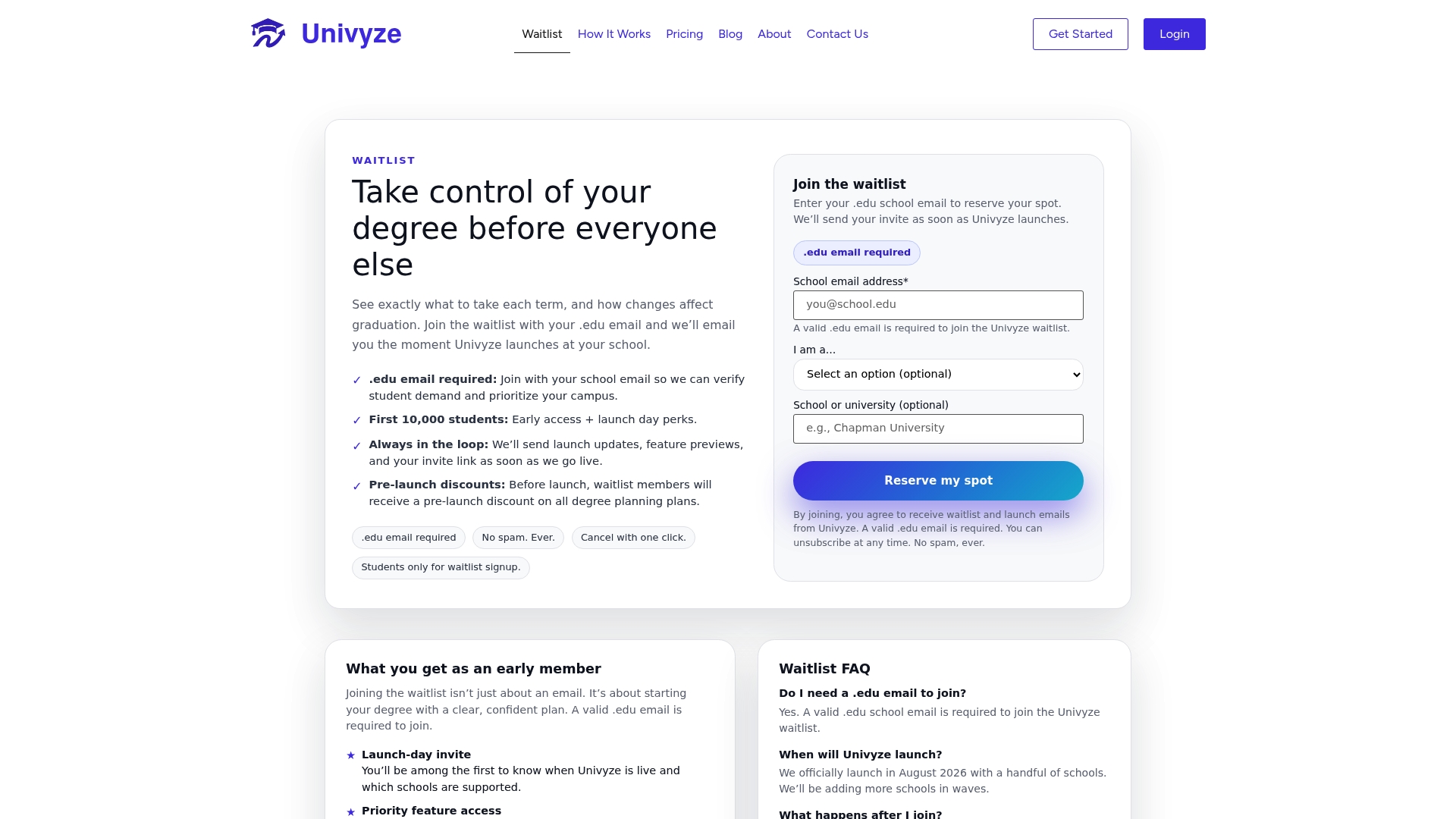
The platform maps your current credits against any major you are considering, flags prerequisite gaps, and shows you a term-by-term path to graduation. You can model what happens if you switch now versus next semester, apply your AP or transfer credits to the new requirements, and check for schedule conflicts before they become a problem. It is the kind of what-if planning that used to require three separate advising appointments.
Univyze is a planning tool, not an official degree audit. Always verify your final requirements with your registrar, official degree audit, and academic advisor before making any changes.
Ready to see your path clearly? Join the Univyze waitlist and be among the first to plan your degree with confidence.
Useful sources and further reading
These are the primary sources and guides used throughout this article. Each one is worth reading in full if you want to go deeper on a specific topic.
- MythBusters: Does My Major Define Me? — Duke University Career Hub — Duke’s career center breaks down the most persistent myths about majors and career outcomes, with practical framing for how to present your skills to employers.
- Six Myths About Choosing a College Major — The New York Times — The source for the Webber earnings analysis and the Education Department’s switching statistics. Required reading before you make any major decision based on salary data.
- Major Myths — University of Tampa Academic Advising — A concise advising-office resource on why being undecided is not a liability and how exploration works in practice.
- Myths About Majors — Penn State Division of Undergraduate Studies — Covers the intro-course myth and the difficulty-reputation myth with clear advising guidance.
- Myth Buster: Why Your Major Does Not Equal Your Career — University of Colorado Career Center — Explains why double majors are not always the right move and why out-of-class experience carries more weight.
- Many College Degrees Are Now ‘Useless’ — Forbes — Covers the skills-based hiring trend and the case for pairing a major with certifications or applied experience.
- How to Plan College Classes So They Actually Count Toward Graduation — Univyze — Step-by-step guidance on keeping your courses aligned with graduation requirements, especially useful when considering a major change.
- Building a Multi-Year Degree Plan for Students — Univyze — Explains how what-if planning and term-by-term mapping work in practice.
Join the Univyze waitlist to start planning your degree with clarity.
FAQ
Does your college major determine your career?
No. Most people work in careers unrelated to their undergraduate major. Employers prioritize transferable skills, demonstrated experience, and certifications over the specific field of study on your transcript.
What are common stereotypes about college majors?
The most persistent ones are that STEM majors always earn more, that liberal arts degrees lead nowhere, and that being undecided is a sign of poor planning. Research consistently shows all three are oversimplifications.
What are the most regretted college degrees?
Regret tends to cluster around majors chosen for prestige or salary projections rather than genuine interest or fit. Students who chose a field based on family pressure or hiring trends without testing their own aptitude report the highest dissatisfaction, regardless of the specific major.
Is it bad to be undecided about your major?
Not at all. Around 30% of students switch majors at least once, and advising offices report that undecided students who plan carefully and use advising regularly graduate on the same timeline as students who declared early.
How can Univyze help if I am thinking about switching majors?
Univyze lets you model a major change term by term before you commit, showing you which credits transfer, where the prerequisite gaps are, and how the switch affects your graduation timeline. It is a planning tool, not an official degree audit, so always confirm the results with your registrar and advisor.
Recommended
- 7 Mistakes College Students Make That Delay Graduation – univyze.com
- How to Choose Classes That Actually Count Toward Graduation (And Avoid Wasting Time and Money) – univyze.com
- How to Avoid College Burnout: 10 Realistic Tips for Students – univyze.com
- How to Choose the Right College Major – univyze.com