

CLEP credit can shorten your path to a degree, but only if your college accepts the exam, the score, and the way the credit fits your major. Each school sets its own rules, so the same score can earn 6 credits at one college and nothing at another. This guide shows how that works, what limits to look for, and how to place exam credit in a term-by-term plan, with IB credit covered alongside.
TL;DR
- Every college decides which CLEP and IB exams it accepts, the minimum score, and the credits awarded. There is no national rule.
- Exam credit may count as general education, a major requirement, or plain elective credit. That difference decides whether it saves you a class.
- Watch for credit caps, rules against duplicating a course you already took, and timing limits on when you can test.
- Check your official degree audit and talk to your advisor before you register for a class your exam credit might replace.
- Put accepted credit into a term-by-term plan so you can see which semesters it frees up.
Table of Contents
- How colleges decide what exam credit is worth
- What CLEP and IB credit looks like at real colleges
- Where the credit lands: general education, major, or elective
- Limits that can keep exam credit from counting
- If you transfer or change majors
- Planning your degree with CLEP and IB credit
- Perspective
- See your exam credit in a term-by-term plan
- FAQ
- Sources
How colleges decide what exam credit is worth
CLEP is a set of exams that let you earn college credit for what you already know. IB is a high school program with exams that many colleges also reward. Neither one comes with a guaranteed credit count, because the college receiving the score is the one that awards credit.
In Virginia, for example, state policy asks public institutions to grant as much credit as possible for passing AP, IB, Cambridge, or CLEP scores. It also lets faculty set subject-level policies, so awards can vary by exam, score, and major.
Departments often hold the final say. Texas State’s policy notes that academic departments control which courses accept CLEP, AP, and IB and set the cut-scores. If a department declines credit for a course, no other unit can accept the same exams for that course.
Policies also change. UW–Madison states that its test-credit policies are subject to updates pending review by academic departments and its curriculum committee. So use the current catalog year, not a friend’s experience from three years ago.
What CLEP and IB credit looks like at real colleges
The examples below show how much the numbers move from campus to campus. They are examples of policy at those schools, not a promise about yours.
| College | CLEP | IB |
|---|---|---|
| Western Colorado University | College Composition at a score of 50 earns 6 semester credits; the Modular version earns 3; the CLEP maximum is 18 credits | Biology Higher Level at a 4 earns 8 credits; Standard Level at a 4 earns 4 |
| Binghamton University | Counts toward a combined exam cap | Higher Level only: scores of 4 or 5 earn 4 credits, 6 or 7 earn 8 |
| Hamline University | Counts toward a combined cap | Higher Level only, minimum score of 4 or 5 depending on subject, 4 or 8 credits per exam, 20 IB credits maximum |
| UAB | Listed in its credit equivalency pages | Credit may be awarded for scores of 5 or higher on Standard or Higher Level exams, using its IB credit table |
| University at Buffalo | Listed in its credit pages | A completed diploma with a score of 30 awards 30 credits; otherwise Higher Level exams with a 5 or higher are guaranteed credit |
Three patterns show up again and again:
- Score thresholds differ. One school wants a 4, another a 5.
- Level matters for IB. Several schools reward Higher Level exams only.
- The same exam can yield different credit amounts, from 3 credits to 8.
If you are still in high school and comparing colleges, look up the exam credit policy for each school on your list. It is one of the few places where a few hours of testing can turn into real tuition savings, and it is a fair question for an admissions office.
Where the credit lands: general education, major, or elective
Earning credit is only step one. The next question is which requirement it fills.
UW–Madison explains that exam credit can be awarded toward general education requirements, degree requirements, or elective credit. It also states the purpose: to recognize advanced work, prevent duplicate courses, and give you the flexibility to graduate early or complete multiple majors or certificates.
Here is why the landing spot matters:
- General education credit removes a required class, so you can take something else or lighten a semester. Our guide to how general education requirements work shows how to spot the slots exam credit can fill.
- Major credit can skip you past an intro course and into upper-level work sooner.
- Elective credit adds to your total credit count but may not replace any required course. It helps you reach 120 credits only if you have room for electives.
Binghamton shows how specific this can be. Its SUNY General Education requirements can be satisfied by Higher Level IB exams in five of the ten areas of competency, and the foreign language requirement is met by a score of 4 to 7 on either level.
Who decides the equivalency? At Bay Path University, the Registrar assesses whether score requirements were met and sets the course equivalency. At UMass Amherst, the Registrar’s Office evaluates whether a course transfers, whether it has a lower-division equivalent, and whether it fulfills General Education. Expect the same kind of review at your school.
Limits that can keep exam credit from counting
Most surprises come from fine print. Read these before you pay for an exam.
Credit caps
Many schools cap how much exam credit you can bank. Examples from the published policies:
- Gordon College caps combined AP, IB, and CLEP awards at 32 credits, and that credit does not meet core, major, or minor residency requirements.
- Binghamton allows a maximum of 32 exam credits from all sources.
- Utah Tech says credit by examination or prior learning can be no more than 25% of the credits required for a degree.
- UAB applies no more than 45 semester hours of alternative credit toward a degree.
If you also have AP scores and dual enrollment, these caps are shared. Our explainer on AP, dual enrollment, and transfer credits and the guide to maximum transfer credits walk through how they stack up.
Residency
Exam credit is not earned in residence. UMass Amherst, for instance, allows up to 75 transfer or test credits but requires at least 45 semester credits in residence and 120 total to graduate. Our page on credit residency rules explains why this matters when you plan your last two years.
Timing and eligibility
- UW–Madison requires CLEP exams to be completed before you reach 16 semester hours of college credit, not counting dual enrollment taken in high school.
- Utah Tech says only matriculated students can receive credit by examination, so you may need to enroll first.
- UAB posts IB credit only to undergraduate degree-seeking students enrolled in classes there.
Duplicate content
You usually cannot earn credit twice for the same material. UW–Madison says students do not receive credit for multiple exams covering the same or similar content. Fort Hays State awards no credit for a course you already completed or audited with a grade. Reynolds Community College likewise bars credit that duplicates a course passed there. So test before you take the class, not after.
How it appears on your transcript
Exam credit is usually pass-only and does not touch your GPA. Bay Path records it with a TR grade that is not calculated into the cumulative GPA, UAB posts IB credit with a grade of P, and Fort Hays State records CLEP as CR. That is helpful if you want credit without risk to your GPA, but remember that a grad school or scholarship will not see a grade for those courses.
If you transfer or change majors
Credit that counted at one school may not count at the next. Fort Hays State tells students that CLEP credit may or may not be accepted by other institutions and to verify policies at each school they attend. Reynolds Community College gives the same caution about credit for prior learning.
Changing majors can shift things too. Fort Hays State notes that CLEP credits may not be accepted in all degree programs, and students are responsible for checking with an advisor if they switch. A CLEP exam that filled a business requirement could land as a plain elective in a science major.
The practical move: before you declare a new major or send transcripts to a new school, ask what each exam credit becomes under the new rules. Then rebuild your plan from that answer.
Planning your degree with CLEP and IB credit
Here is a workflow that keeps exam credit working for you.
- Find the policy. Search your college’s catalog or registrar page for the exam credit table for your catalog year. Note the score, the credits, the course equivalent, and any cap.
- Match exams to requirements. List the general education and major courses an exam could replace. Skip exams that would only create elective credit unless you have electives to fill. Our guide on planning classes so they count toward graduation helps with this step.
- Prepare on purpose. Practice tests help you decide if you are ready before you pay for an exam. Here are practice exams for major tests to see how mock exams are typically organized.
- Test before you enroll in the class. Duplicate-content rules punish the reverse order.
- Send scores and confirm posting. Check that the credit appears on your transcript and degree audit, and ask your registrar about anything missing.
- Update your term-by-term plan. Remove the replaced courses, then check prerequisites and credit load. Your semester credit limit still applies if you decide to pile on courses to finish early.
- Review every term. Policies, majors, and course offerings shift, so a plan is something you revisit, not something you finish.
At UW–Madison, students can view their processed test-credit evaluation in MyUW Student Center and consult an advisor for help interpreting it. Most colleges have an equivalent portal. Use it as the source of truth.
A worked example

Say your college awards 6 credits for a score of 50 on a composition exam and counts them toward your first-year writing requirement. If you plan to take that writing class in fall of freshman year, the credit removes it, freeing a seat for a course in your major or a lighter load. If instead the college counts the credit as elective and you have no open elective slots, nothing in your schedule changes. Same exam, same score, very different value. That is why the landing spot matters more than the credit count.
Perspective
Students tend to treat exam credit as a bonus. We see it as a planning input. A passed exam changes which classes you need, which semesters are lighter, and sometimes how fast a major sequence can run.
The trouble is that the answer lives in several places: the catalog, the registrar’s credit table, and your degree audit. That is a lot to hold in your head, especially if you change majors.
We built Univyze so students and parents can see requirements, credits, and course offerings in one term-by-term view, including AP credit, dual enrollment, transfer credits, summer sessions, and what-if scenarios. It is a planning tool, not an official degree audit and not a replacement for your advisor. Use it to draft the plan, then confirm it with the people who make it official.
Ryan
See your exam credit in a term-by-term plan
Univyze helps you place AP, dual enrollment, transfer, and exam credit into a simple term-by-term plan, then test what changes if you switch majors or add a summer session. There is a free Starter plan, and paid plans are listed on our pricing page: Core is $359.40 per year, Plus is $599.40 per year, and Pro is $1,199.40 per year, with one-time options also available.
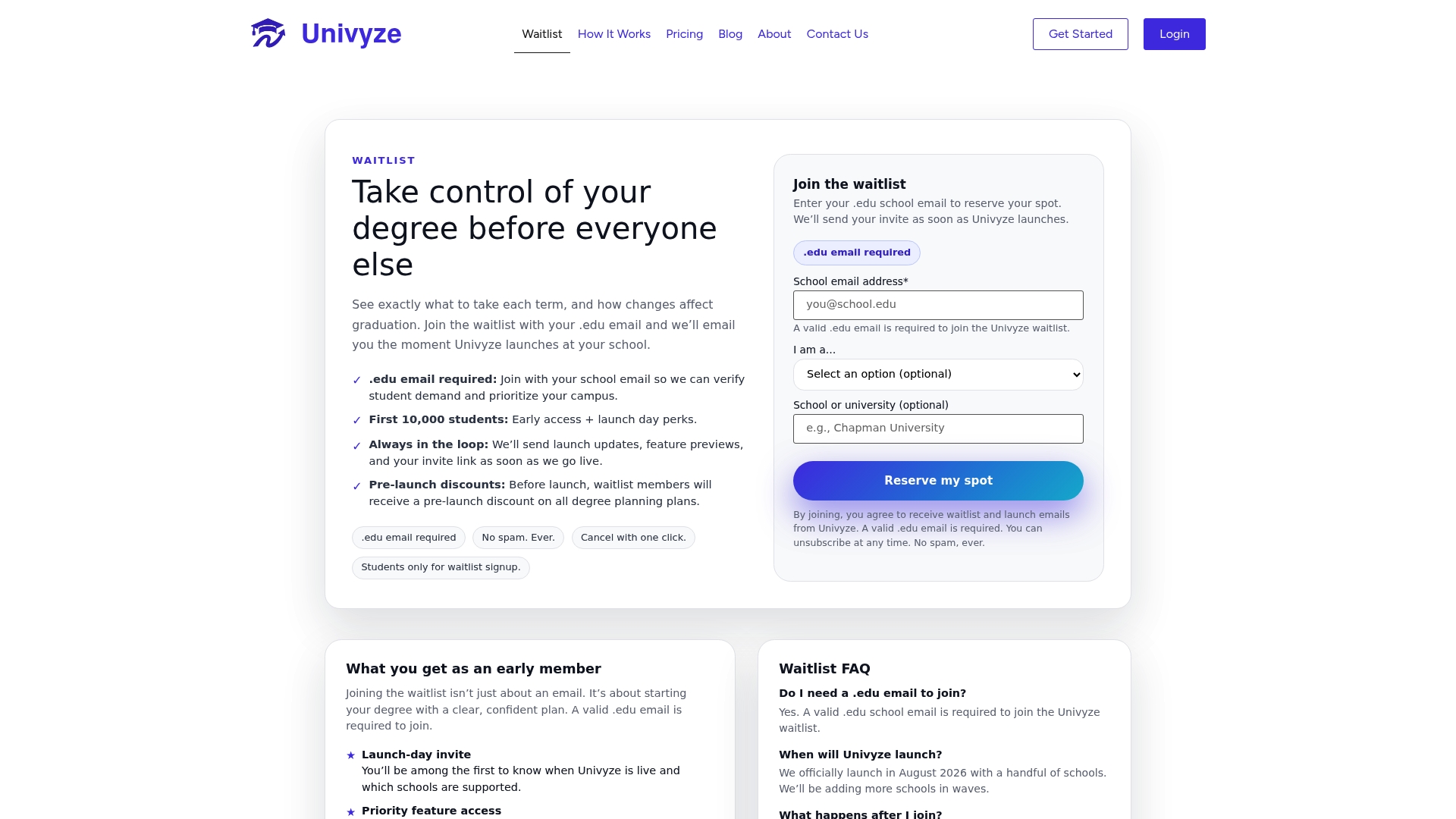
Parents can follow progress too. Our guide to degree planning for families shows how dual credit and exam credit interact with state caps. Ready to get started? Join the Univyze waitlist at univyze.com and be among the first to build your plan.
FAQ
Do all colleges accept CLEP credit?
No. Many colleges award CLEP credit, but each sets its own exams, scores, and credit amounts, and some departments decline certain exams. Check the registrar’s published policy for your catalog year and confirm with your advisor.
Do IB credits count the same way as CLEP credits?
Not usually. Many schools reward IB Higher Level exams more generously than Standard Level, and some accept only Higher Level, as Binghamton does. CLEP is generally scored against a single credit-granting score the college chooses. Always read the school’s own table.
Will CLEP credit affect my GPA?
At the schools cited here, exam credit is recorded as pass or credit and is not calculated into GPA, for example at Utah Tech. Your school may differ, so check its transcript policy.
Can I take a CLEP exam for a class I already took?
Usually not for credit. Policies like Fort Hays State’s exclude courses you completed or audited with a grade. Test first, then enroll in what remains.
How do I know CLEP credit satisfies a requirement?
Check your official degree audit after the credit posts, and ask your advisor or registrar if a requirement still shows as open. A planning tool like Univyze can help you draft the schedule, but your college’s audit is the official record.
Sources
- Credit for AP, IB, Cambridge and CLEP Exams, State Council of Higher Education for Virginia
- Texas State credit by examination policy
- UW–Madison test credit evaluation process
- Western Colorado University AP, CLEP and IB credit
- Binghamton University IB exam credit
- Hamline University transfer articulation guidelines
- UAB IB, AP and CLEP college credit
- University at Buffalo alternative exam and transfer credits
- Bay Path University advanced credit policy
- UMass Amherst transferring credit
- Gordon College AP, CLEP and IB exams
- Utah Tech University credit by examination policy
- Fort Hays State University CLEP credit
- Reynolds Community College credit for prior learning manual
- Practice exams for major tests