

Winter session can shave a semester off your timeline or plug a prerequisite gap, but it is not a casual add on. It runs as a compressed 3 to 6 week term with its own registration window, its own billing cycle, and a workload that hits like a full semester crammed into a few weeks. Before you enroll, confirm your dates, register separately from spring, check your credit limit, and block out roughly 30 to 40 hours a week for a single 3 credit course.
TL;DR:
- Winter session runs for 3 to 6 weeks, requiring 30 to 40 hours per week for a 3-credit course, and it is not a casual or light term.
- Registration is separate from spring, with deadlines in November, and tuition often bills with spring, so early planning is crucial.
- Courses typically count toward spring transcripts, affecting GPA and transfer records, and should target prerequisite or bottleneck classes rather than electives.
- Students must verify course equivalency with advisors, document approvals, and prepare in advance to handle the compressed schedule efficiently.
- Access to housing, financial aid, visas, and tech support can differ during winter, so thorough pre-term checks prevent avoidable disruptions.
Table of Contents
- What Is Winter Session, and Who Can Enroll?
- When Does Winter Session Start, and How Do I Find the Exact Calendar?
- Registration, Billing, and Credit Limits You Need to Confirm Early
- How to Pick a Winter Course That Actually Counts
- Surviving the Compressed Course: Time Management and LMS Prep
- Housing, Financial Aid, Visas, and Tech Support: The Details People Forget
- Testing a Winter Course Before You Commit: A Univyze Workflow
- When Winter Session Is Actually Worth It
- Plan Your Winter Course Without the Guesswork
- Registrar Pages Worth Bookmarking Now
- Sources
- FAQ
What Is Winter Session, and Who Can Enroll?
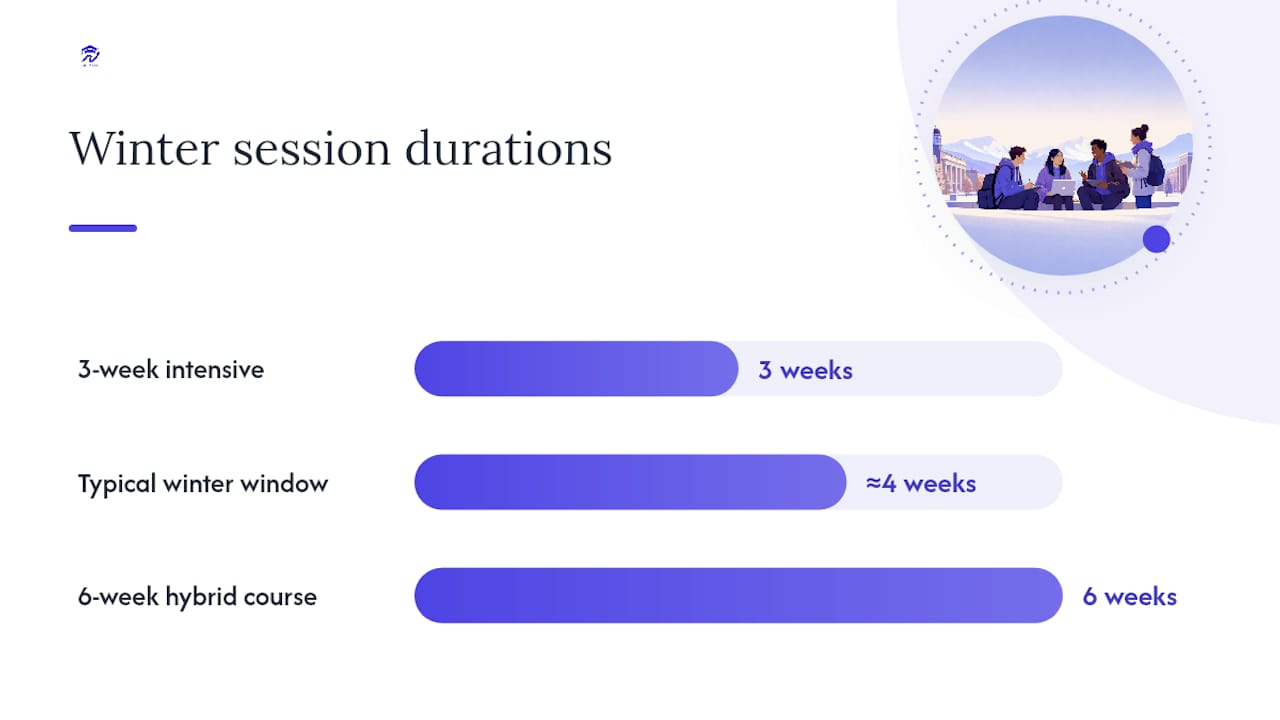
Winter session is a compressed academic term that runs between fall and spring, usually 3, 4, or 6 weeks long depending on the campus. Some schools brand it “Winter Session,” others call it “Winterlude” or “Intersession,” but the structure is the same: compressed terms that run between three and six weeks, same course content, faster pace.
Formats vary widely by department and school:
- Fully online, asynchronous courses that let you work from home during break
- Hybrid courses with a handful of synchronous class meetings
- In person intensives, common for lab sciences and studio courses
- Short study-abroad or travel courses tied to a single topic
Eligibility depends on your enrollment status. Students already enrolled for fall are typically cleared to register, but visiting and non-degree students sometimes face restrictions, especially at schools that reserve winter seats for their own students first. Check your registrar’s eligibility page before you assume a seat is guaranteed.
When Does Winter Session Start, and How Do I Find the Exact Calendar?
Most winter terms open sometime in mid to late December and wrap up by mid January, but the exact window shifts from campus to campus and even department to department. A 3 week intensive at one school might overlap with a 6 week hybrid course at another, so there is no universal calendar you can rely on.
One detail trips up a lot of students: winter courses frequently post to the spring transcript, not a standalone winter record. That matters for GPA calculations, financial aid enrollment counts, and how the course shows up when you request transcripts for grad school or transfer applications.
Three places to check before you build any plan around winter session:
- Your campus academic calendar, published by the registrar
- The dedicated winter session page (search “[your school] winter session registrar”)
- The live course listing or Schedule of Classes, which shows actual seats and section dates
Bookmark these now. Dates get finalized and sometimes shift by a few days year to year.
Registration, Billing, and Credit Limits You Need to Confirm Early
Winter session runs on its own administrative track, separate from spring enrollment in almost every way. Miss a deadline here and you cannot just tack the course onto your spring registration later.
- Register early, and register separately. Advance registration commonly opens in November, well before spring registration windows open. Treat it as its own event on your calendar, not an afterthought once spring planning starts.
- Expect winter tuition to bill with spring. Many schools combine the charge with your spring bill rather than issuing a standalone invoice. Confirm the exact due date with your bursar, and if you are counting on financial aid, verify your disbursement date lines up with that bill.
- Watch your credit cap. Many campuses limit winter enrollment to 3 or 4 credits, roughly one course, because the pace is too intense to sustain across two. If you want to exceed that cap, you will likely need written overload approval from an advisor or dean.
- Have a backup course ready. Low enrolled winter sections get canceled if they don’t hit a minimum headcount, sometimes announced with very little notice. Departments set their own thresholds, and some lecture courses need 20 to 30 students just to run. Pick a second option before you commit emotionally to one class.
How to Pick a Winter Course That Actually Counts
Not every winter course deserves your break. The strongest picks clear a real obstacle: a prerequisite that’s been blocking your next semester’s schedule, a required general education course, or a bottleneck class that only runs once a year. Skip the “just for fun” elective unless your schedule has genuine room for it.
Before you register, confirm the course actually applies where you think it does:
- Pull the exact course description and catalog number, not just the title
- Email your advisor or department to confirm equivalency, particularly for visiting or transfer courses
- Save that email. Registrar staff consistently recommend documenting advisor approvals in writing since winter registration and billing often run through separate systems from your regular term
- If the course transfers from another institution, check what a legalized or apostilled transcript requires; Speedy Apostille Services breaks down that process for credits earned outside your home institution
Pro Tip: Screenshot your advisor’s email approval and the course catalog description the same day you register. If a course gets flagged as non-equivalent months later, you want proof of what you were told, not just a memory of a conversation.
Surviving the Compressed Course: Time Management and LMS Prep
Compressed does not mean easier. It means the same course content, minus the breathing room. Plan for 30 to 40 hours a week on a single 3 credit course, which is close to a part-time job’s worth of hours for one class.
Before the term starts:
- Download the syllabus the moment it’s posted and read it fully, not just skimmed
- Order or download course materials early. Shipping delays don’t care that your course starts in three weeks
- Complete any assigned pre-work so you’re not starting behind on day one
- Log into Canvas or Blackboard ahead of time and learn where the modules, discussion boards, and gradebook actually live
Academic advisors are blunt about this: in a three week term, catching up once you fall behind is nearly impossible. There is no slow week to absorb a missed assignment.
Once the course starts, run a tight weekly regimen. Set your own micro-deadlines two days ahead of the real ones, block dedicated study time on your calendar like it’s a class you can’t skip, and attend every synchronous session live. Email your professor or hit office hours in week one, not week three, if anything feels unclear. If you’re managing this alongside other winter commitments, the same overload management tactics that work for a heavy fall or spring term apply here too, just compressed into a shorter window.
Pro Tip: Know your drop deadline before you know your professor’s name. Compressed terms often have a withdraw window measured in days, not weeks, so mark it the moment you register.
Housing, Financial Aid, Visas, and Tech Support: The Details People Forget
The academic side gets most of the attention, but the logistics around winter session cause just as many headaches. A few things worth checking now, before break starts:
- Housing: Confirm whether your residence hall stays open during winter session or requires a separate continuous-stay or early-move application.
- Financial aid: Winter charges often bill with spring, so confirm your disbursement date and payment plan options with the bursar rather than assuming aid arrives automatically in time.
- International students: Winter credits frequently do not count toward F-1 or J-1 full-time enrollment requirements, so check with your international student services office before treating winter session as part of your visa status.
- Tech support: Verify ITS help desk hours, library database access, and whether Canvas or Blackboard support runs during the break window, since a lot of campus support scales down when most students are gone.
Testing a Winter Course Before You Commit: A Univyze Workflow
Adding a winter course changes more than one term. It shifts prerequisites, spring workload, and sometimes your entire graduation timeline, which is exactly the kind of ripple effect a what-if planning tool is built to show.
A practical way to test the decision before registering:
- Map your current degree requirements and any pending prerequisites into your planning dashboard first
- Add the winter course as a what-if term and check whether it clears an unmet prerequisite or creates a scheduling conflict
- Compare how the added credits change your spring course load or shift your expected graduation term
- Document any advisor approval you receive, since Univyze helps you plan and visualize, but it doesn’t replace your official degree audit or advisor’s sign-off
When Winter Session Is Actually Worth It
Take winter session when it clears a real bottleneck, a blocked prerequisite, an overloaded spring, not for a random elective. Skip it if you can’t commit 30 to 40 weekly hours or if work and caregiving already fill your break. Run the decision past a planning tool and your advisor before you register.
— Ryan
Plan Your Winter Course Without the Guesswork
Univyze is built for exactly the kind of decision winter session forces on you: adding a compressed course without quietly wrecking your spring schedule or pushing graduation back a term. Instead of juggling a catalog PDF, a prerequisite chart, and a mental spreadsheet, you map your degree requirements once and test the winter course as a what-if term to see what it actually changes.
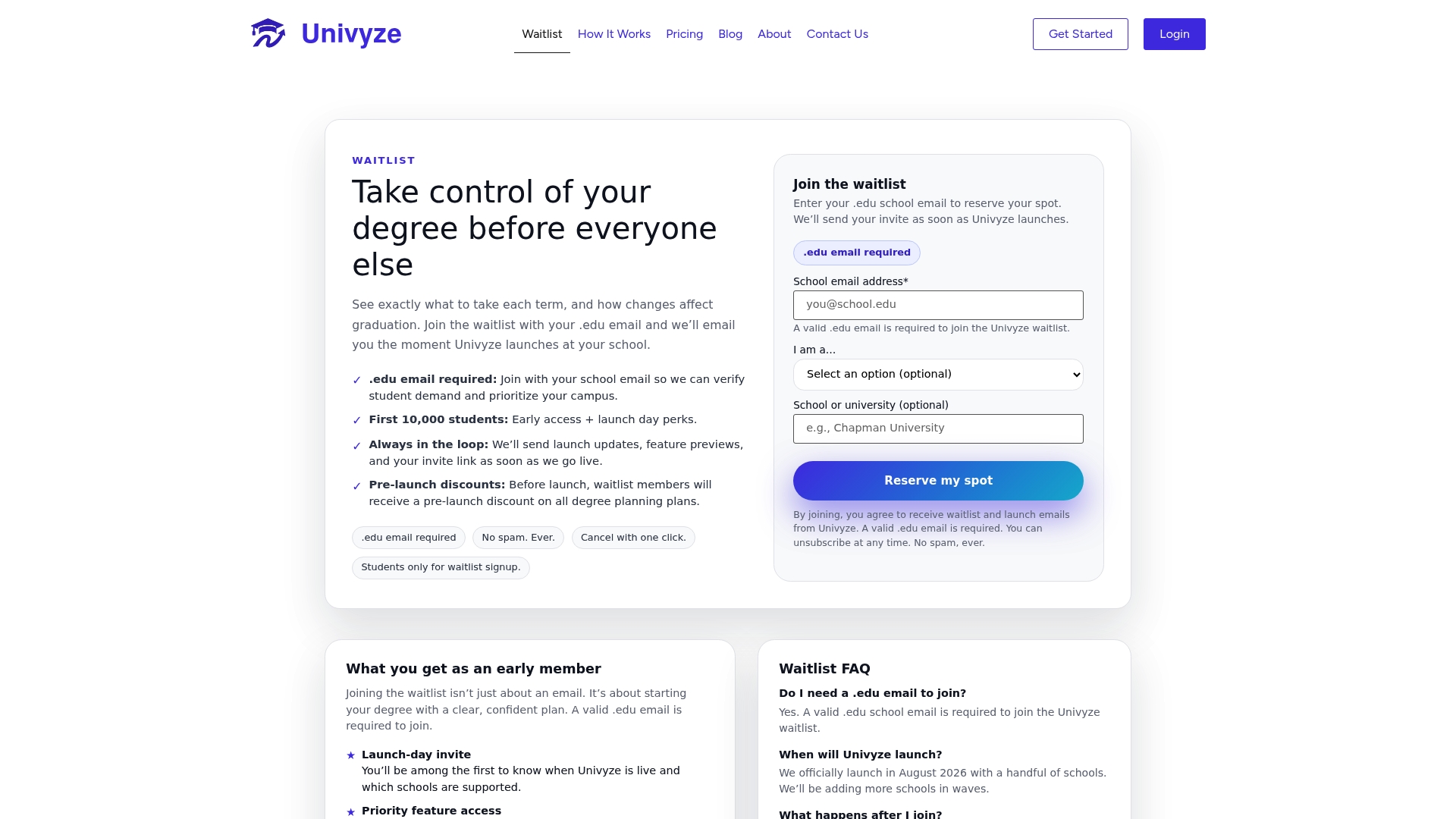
The dashboard shows automatic term-by-term planning, so AP credit, dual enrollment credit, and transfer credits all show up in the same view instead of three different systems. You can also model summer sessions the same way if winter doesn’t fit your schedule this year. None of this replaces your official degree audit, university catalog, registrar, or advisor. Those remain the final word on whether a course counts. But if you want a clearer picture before you spend $30 to 40 hours a week on a compressed course, join the Univyze waitlist and see what your plan looks like with winter session added in.
Registrar Pages Worth Bookmarking Now
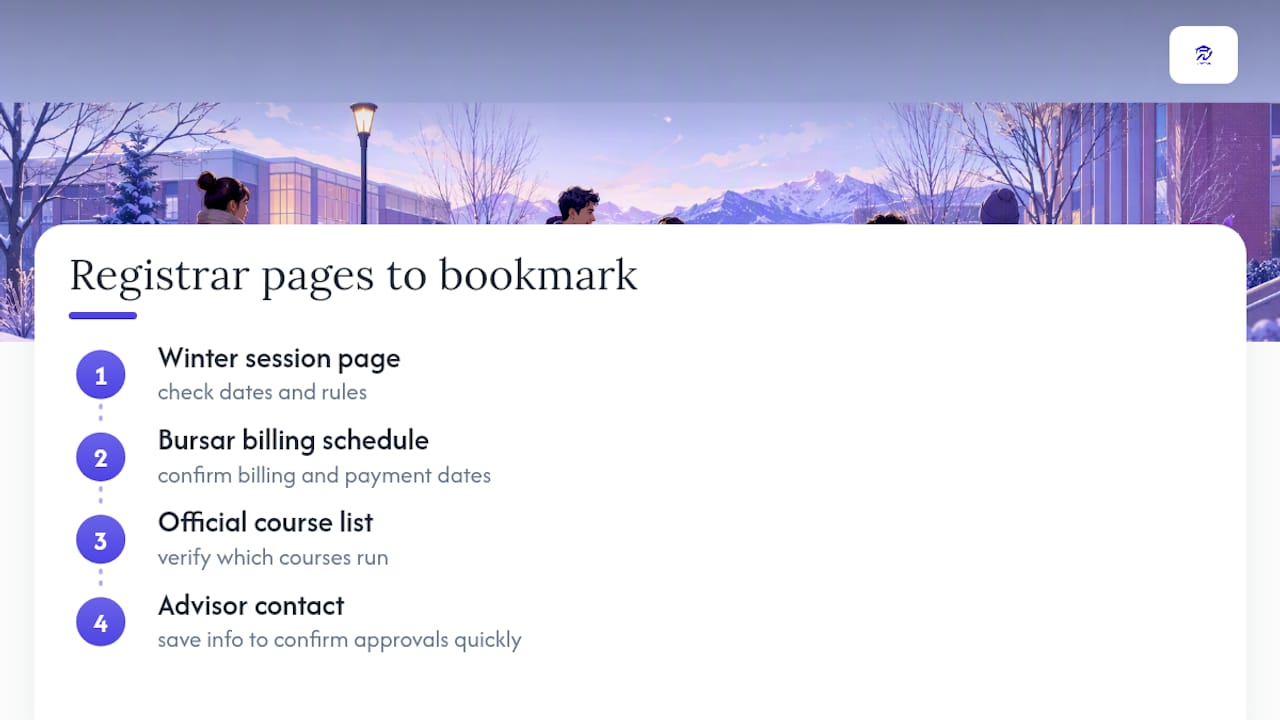
Check your campus registrar’s winter session page, bursar billing schedule, and official course list directly, since dates and rules change year to year. Save your advisor’s contact info alongside them so you can confirm approvals quickly once registration opens.
Sources
- How to Succeed in a 3-Week, Fully Online Winter Session Course – Winter Session – University of Maine
- Winter Session | Office of the Registrar – University of Arizona
- Winter Session – University of Northern Iowa
- Winterlude Online – Online Classes at Syracuse University
FAQ
Is There a Winter Exchange Program for 2026?
Some universities run short winter study-abroad or exchange courses, but availability varies heavily by campus and department, so check your school’s winter session or study-abroad office directly for 2026 offerings.
Are Winter Session Classes Hard?
They cover the same material as a full semester course in a fraction of the time, which means the pace is intense even when the content isn’t harder. Plan for 30 to 40 hours a week on a single 3 credit course to keep up.
What Are the Semester Dates in the USA?
Fall semesters typically run late August through December, and spring runs January through May, but exact dates vary by school. Winter session fills the gap between the two, usually starting in mid to late December.
What Is a “Brown Winter Session”?
This likely refers to a specific university’s winter term branding rather than a universal program. Check that school’s registrar page directly, since naming conventions like “Winterlude” or “Intersession” vary widely and don’t follow a standard format across institutions.