

Bring three things to your next advising appointment: a reviewed degree audit, a drafted course schedule with backups, and a short list of prioritized questions. Do that, and you turn a routine 30-minute slot into a real strategy session on your graduation timeline instead of a scheduling favor.
TL;DR:
- Students should arrive with a reviewed degree audit, a draft schedule of 5 to 7 main courses plus 2 to 3 alternates, and a list of specific questions to maximize appointment value.
- Preparing a detailed draft plan, including course matches and backup options, helps advisors focus on strategic decisions rather than data entry.
- Asking targeted questions about graduation timing, difficult courses, impact of minor changes, and written confirmations improves long-term planning and clarity.
- Bringing transcripts, test scores, and checking for registration holds beforehand reduces delays and keeps the meeting focused on progress.
- Using tools like Univyze provides a visual, term-by-term degree map and scenario testing to better prepare for advising and course registration.
Table of Contents
- What Should Advising Appointment Prep Actually Include?
- How Do You Draft a Tentative Schedule Before Advising?
- What Questions Should You Ask Your Academic Advisor?
- What Should You Bring the Day of Your Advising Appointment?
- What Should You Do Right After an Advising Appointment?
- How Univyze Supports Each Step of Advising Prep
- A Short Note on Shared Responsibility
- Plan Smarter Before Your Next Advising Meeting
- Sources
- FAQ
What Should Advising Appointment Prep Actually Include?
Most students walk into advising with nothing but a vague sense of “I need classes for next semester.” That’s the appointment that gets eaten up by paperwork instead of planning. Lehigh University’s advising office lists five steps that separate a productive meeting from a wasted one: schedule early, review your degree audit, draft a course schedule, check for holds, and write down your questions in advance.
Here’s the checklist broken into what to do, and when.
Before you book:
- Schedule during the first few weeks of the term, not the week registration opens.
- Off-peak meetings give your advisor room to talk about internships, minors, and long-term timing instead of rushing to clear a queue.
Before you walk in:
- Pull your degree audit (DegreeWorks, DARS, or your school’s equivalent) and confirm you’re viewing the correct catalog year.
- Check for missing AP, IB, or transfer credit that should have posted but hasn’t.
- Log into your student portal and check for registration holds. Financial holds usually route to the bursar’s office; immunization holds go to health services; advising holds get cleared by your advisor directly.
- Gather transcripts, test score reports, and any transfer credit evaluations you haven’t already uploaded.
- Write down your school’s registration window, add/drop deadline, and graduation application deadline. If you don’t know them, your registrar’s website does.
Advisors report that students who arrive with these five items covered spend appointment time on decisions, not data entry.
Pro Tip: Screenshot your degree audit before the appointment and again after. If something looks different, you have a paper trail to ask about.
How Do You Draft a Tentative Schedule Before Advising?
Your degree audit isn’t a report card. It’s a worksheet you’re supposed to mess with. Open it, and start matching actual course sections to the requirement lines that are still empty. That single shift, treating the audit as editable rather than read-only, is what Lehigh’s advising guidance means by preparing a draft rather than expecting the advisor to build one from scratch.

Aim for 5 to 7 realistic course options, plus at least 2 to 3 alternates in case something fills or conflicts. Appalachian State’s advising office recommends mapping each option directly to the degree requirement it satisfies, and noting prerequisites and delivery mode (in-person, online, hybrid) for each.
While you’re building the list, flag any course with a reputation for tanking GPAs, a statistics sequence, organic chemistry, whatever your major’s version is. These “stumble courses” deserve a specific conversation about timing and workload.
- Bring your degree audit, annotated with course matches.
- Bring 5 to 7 primary options and 2 to 3 alternates.
- Bring a shopping-cart screenshot or draft schedule as proof you’ve already done the legwork.
Tools built for term-by-term degree planning can speed up this mapping step, but the goal stays the same either way: arrive with a plan, not a blank slate.
What Questions Should You Ask Your Academic Advisor?
The difference between a useless meeting and a useful one is usually the questions. “Can I take this class?” gets you a yes or no. Better questions get you a strategy.
- Am I still on track for my expected graduation term, and what would push it back?
- Which upcoming course is most likely to be a stumble course for me, and when should I take it?
- If I add or drop this minor, what happens to my timeline?
- What’s the actual policy on withdrawals, repeats, and grade replacement at this school?
- Is there a petition process if a required course isn’t offered when I need it?
- What internship, research, or study abroad opportunities fit my major, and who do I contact next?
- Can you confirm in writing (email, portal note) what we just agreed on?
That last question matters more than it sounds. Verbal advice is easy to misremember three weeks later. A written confirmation, even a two-line email, gives you something to point back to if a requirement gets disputed down the road. Curious whether you’re actually on pace? This graduation-timeline breakdown covers the specific markers to check.
What Should You Bring the Day of Your Advising Appointment?
Pack light, but pack the right things. You’ll want a photo ID, your student portal login already tested, a printed or screen-captured degree audit, your course cart draft, and any transcripts or test scores not already on file.
If your appointment is virtual, test your camera and microphone beforehand and confirm your internet connection can hold a video call for the full session. Some general remote-learning etiquette guidance applies just as well to advising calls as it does to online classes: log in a few minutes early, mute when you’re not talking, and keep your webcam framed on your face, not the ceiling.
- Confirm holds are cleared or know exactly which office to contact if they’re not.
- Reschedule rather than sit through a session where a hold blocks half the conversation.
- Remember appointments commonly run about 30 minutes, so lead with your highest-priority questions first.
What Should You Do Right After an Advising Appointment?
The meeting isn’t done when you leave the room. What happens in the next 48 to 72 hours determines whether the plan you just built actually sticks.
- Register for the classes you agreed on as soon as your registration window opens. Don’t wait.
- Follow up on any referrals or petitions. If your advisor pointed you to financial aid, the registrar, or a department chair, note the contact name and the deadline they gave you.
- Save your meeting notes. If your advisor sent a follow-up email confirming decisions, keep it somewhere you’ll find it again.
- Set your next check-in before you forget. University of Tennessee’s advising guidance frames this window as standard practice, not an extra step.
Pro Tip: If a transfer credit evaluation or requirement still looks unclear after the meeting, email your advisor within a week. Waiting until the next registration cycle to raise a question almost always costs you options.
How Univyze Supports Each Step of Advising Prep
Univyze doesn’t replace the meeting. It replaces the scramble beforehand. The platform builds a visual, term-by-term degree map, so instead of squinting at a text-heavy audit the night before your appointment, you’re looking at a plan already organized by semester.
- What-if scenarios let you test a minor swap or a major change before you ask your advisor about it.
- AP, dual-enrollment, and transfer credit handling flags where posted credit might be missing, the same gap advising offices tell students to check manually.
- Schedule conflict alerts catch overlapping sections before you build a cart around a class you can’t actually take.
Because advising works best as a shared responsibility between student and advisor, walking in with a Univyze-built plan gives your advisor something concrete to react to instead of something to build from zero. Univyze is a planning tool, rather than an official degree audit. Always confirm requirement completion with your registrar’s degree audit and your assigned advisor before you register.
A Short Note on Shared Responsibility
Advisors are strategic partners, not scorekeepers. The students who graduate closest to on time are usually the ones who show up early and often, not the ones who wait for a crisis. If you’re a parent reading this, help your student prep the paperwork, but let them ask the questions and own the follow-up. That ownership is the part that actually sticks.
— Ryan
Plan Smarter Before Your Next Advising Meeting
There are tools that help students prepare for advising by organizing degree requirements and course offerings, building term-by-term plans, and enabling testing of what-if scenarios (such as adding a minor, summer sessions, or transfer credits) before meetings.
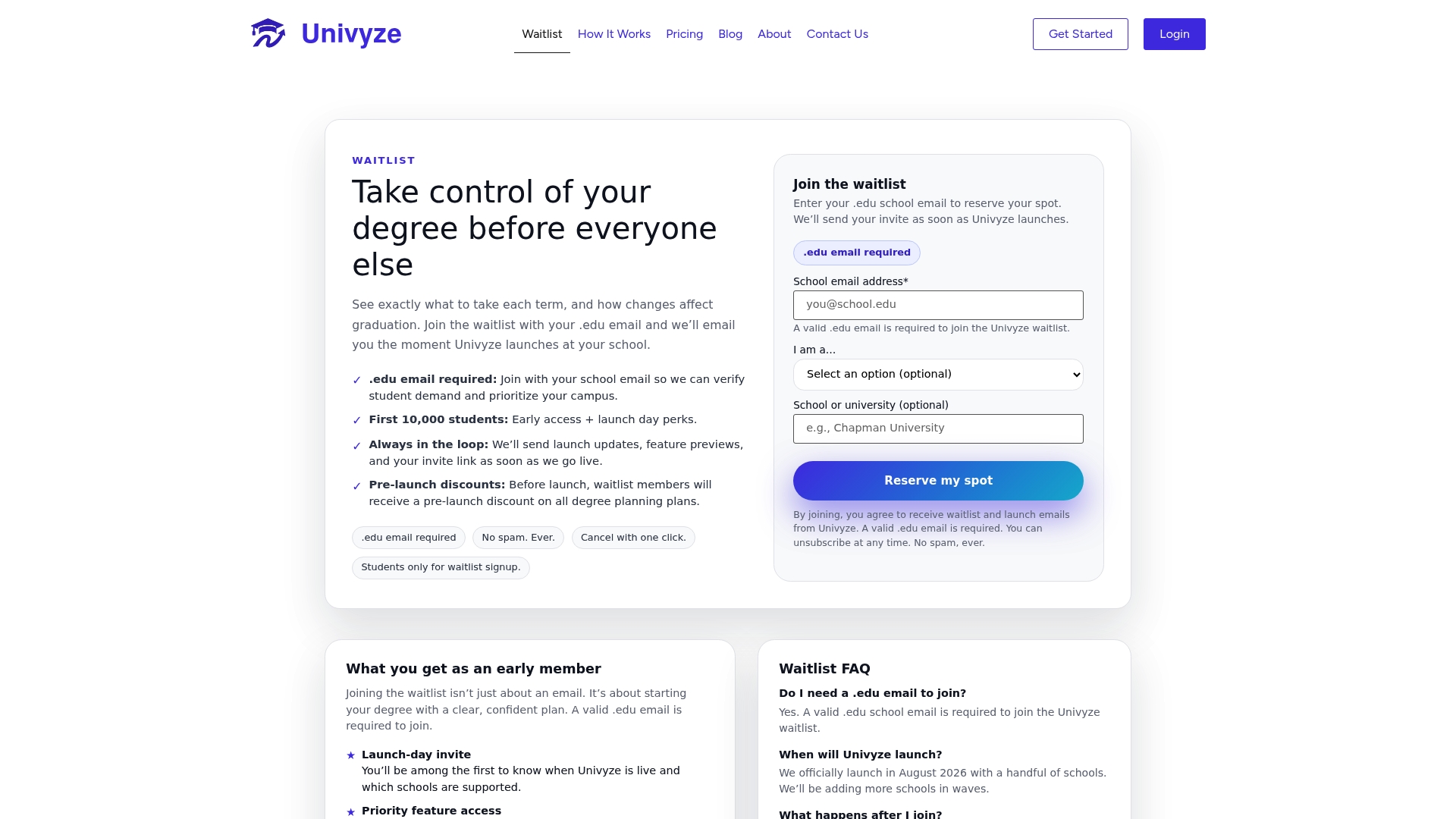
Certain platforms offer parents visibility into their student’s academic plans and assist with managing AP credit, dual enrollment, transfer evaluations, and summer session planning, providing an organized dashboard to support advising preparation. It won’t replace your advisor, and it can’t guarantee course availability, transfer credit acceptance, or a specific graduation date. What it does is give you a clearer, editable starting point so the meeting focuses on decisions instead of data entry. Ready to try it? Join the Univyze waitlist and start building your plan before your next appointment. As always, confirm final requirements with your official degree audit and your registrar.
Sources
- How students should prepare advising meetings | Lehigh University
- How advising works | UC Arts & Sciences
- Preparing for Your Advising Appointment | Appalachian State University
- The advising relationship is at the core of academic advising | NACADA
- Preparing for Your Advising Appointment | UTK Arts & Sciences
FAQ
How do I prepare for an advising appointment?
Review your degree audit, draft a tentative schedule with alternates, check for registration holds, gather transcripts and test scores, and write down prioritized questions before you arrive.
What does an advising appointment actually cover?
It’s a meeting with your assigned advisor to review your degree progress, plan upcoming courses, and discuss requirements, timelines, and opportunities like internships or study abroad.
What are good questions to ask your advisor?
Ask about your realistic graduation timeline, which courses tend to be difficult in your major, how a minor or major change would affect your path, and whether the office can confirm decisions in writing.
What should I bring to an academic advising appointment?
Bring a photo ID, your reviewed degree audit, a drafted course schedule with backups, transcripts or test scores, and a short list of prioritized questions. A tool like Univyze can help you organize this before you go.