

To apply competitively for most BSN programs, plan on completing Anatomy & Physiology I & II with labs, Microbiology with lab, Chemistry with lab, Statistics, English composition, and a psychology course, usually across four to six semesters before you apply. TEAS scores and prerequisite GPA decide who gets an interview. Start today: pull your target program’s catalog and, if you haven’t already, register for Anatomy & Physiology I next term.
TL;DR:
- Most nursing programs require core science courses like Anatomy & Physiology, Microbiology, and Chemistry, with labs and minimum grades of C, but competitive applicants target higher grades.
- Sequencing Anatomy & Physiology I before A&P II and Microbiology is essential, with most programs enforcing a same-institution policy for A&P courses.
- Applicants should build their prerequisite plan around their actual program’s specific sequencing, credit, and recency requirements rather than generic lists found online.
- GPA and recency rules can disqualify well-performing students if courses are outdated or retaken; initial attempts often count unless explicitly waived.
- Using a visual planning tool helps prevent schedule conflicts, recency issues, and credit miscalculations, reducing application delays and helping manage complex prerequisites.
Table of Contents
- What Courses Go Into a Nursing Prerequisites Plan?
- What’s the Best Order to Take Nursing Prerequisites?
- How Do GPA, Recency, and the TEAS Exam Affect Admission?
- Does Transfer Credit, AP, or CLEP Count Toward Prerequisites?
- Sample Term-by-Term Plans for Nursing Prerequisites
- Common Pitfalls That Delay a Nursing Prerequisites Plan
- How Does Financial Aid Work While You’re Taking Prerequisites?
- How a Visual Planner Changes the Prerequisite Sequencing Problem
- Build Your Nursing Prerequisites Plan With Univyze
- Sources
- FAQ
What Courses Go Into a Nursing Prerequisites Plan?
Every nursing prerequisites plan starts with the same core group of science courses, even though the exact labels differ by school. Get this list wrong and you either delay your application by a semester or waste tuition on a course that doesn’t transfer into the requirement it was supposed to fill.
Core science prerequisites
Nursing programs typically require Anatomy & Physiology I & II with labs, Microbiology with lab, and Chemistry with lab, and most set a minimum grade of C in each. Competitive applicants aim higher, since these grades often decide who gets an interview slot.
- Anatomy & Physiology I & II (with lab): the anchor course sequence for nearly every program; some schools combine both semesters into one accelerated course, others split them across a full academic year.
- Microbiology (with lab): usually taken after or alongside A&P II, since it builds on cell biology concepts.
- Chemistry (with lab): general or introductory chemistry, sometimes with an organic or biochemistry component depending on the program.
- Statistics: almost universally required, often satisfied by a general “Intro to Statistics” course rather than a nursing-specific one.
- General Psychology or Lifespan Development: covers human development across the lifespan, a concept nursing curricula build on heavily.
- English composition and Speech/Communication: required nearly everywhere, since clinical documentation and patient communication both depend on writing and verbal clarity.
- Nutrition or Sociology: required at some schools, elective or embedded into other courses at others.
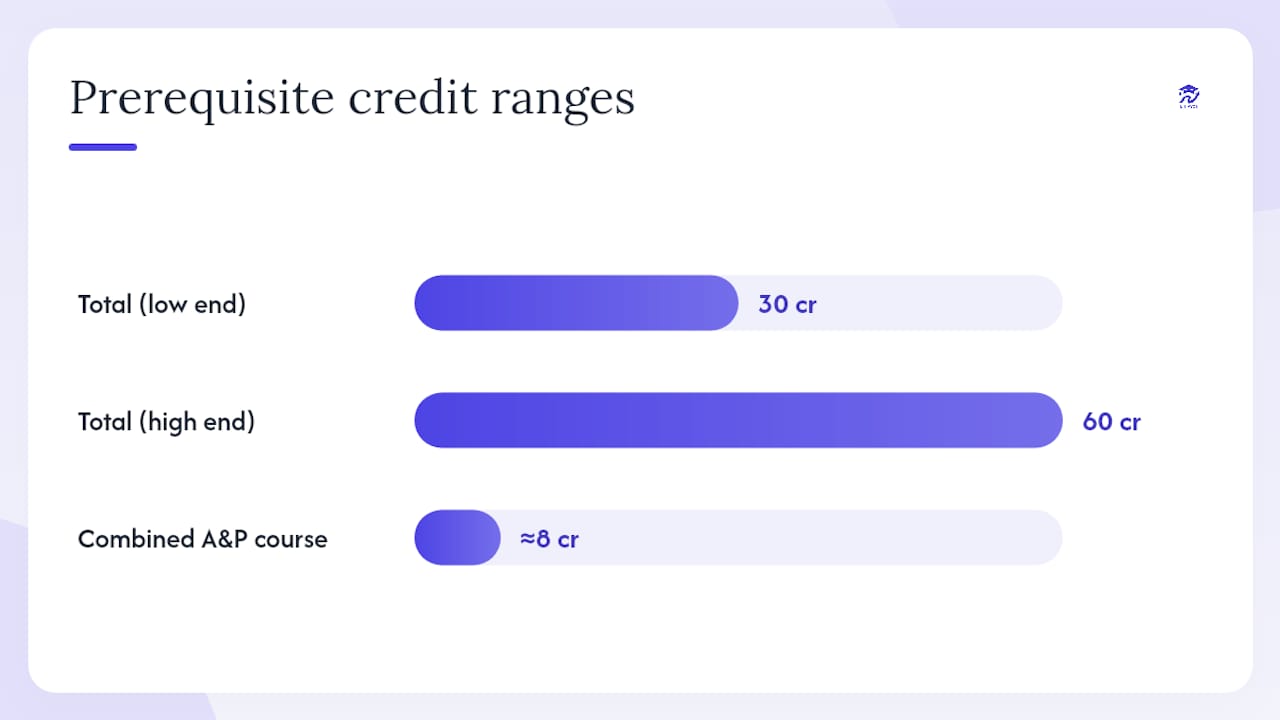
Requirements often total between thirty and sixty prerequisite credit hours, and that range is exactly why two students at different schools can have wildly different course loads for what looks like “the same” nursing degree. A community college feeding into a state university might require a combined A&P course worth approximately eight credits, while a research university nearby splits A&P I and A&P II into two separate courses with distinct labs, prerequisites, and repeat rules.
Grade expectations vary the same way. Some programs post a flat “C or better” rule across every prerequisite. Others set a higher bar, requiring a B or B minus specifically in the science sequence while accepting C’s in the non-science courses. That distinction matters when you’re deciding whether to retake a course you passed with a C minus. Prerequisite rules vary enough across institutions that checking your target program’s catalog and degree audit early prevents you from banking credits that don’t actually satisfy the requirement you think they do.
Why the variation exists
Nursing programs design prerequisites around their own curriculum sequencing, accreditation standards, and clinical partnerships, not around a shared national template. A program with a heavy simulation lab component might lean harder on statistics and research methods early. A program tied to a hospital system with specific clinical rotation agreements might require nutrition because their patient population skews toward chronic disease management. None of this is arbitrary, but none of it is standardized either, which is exactly why copying a friend’s prerequisite list from a different school is a common way students discover, a year too late, that they’re missing a course.
Before registering for anything, build a checklist against your specific program’s published requirements rather than a generic “nursing prerequisites” list you found online. If you’re still comparing schools, Univyze’s guide to choosing classes that actually count toward graduation walks through how to verify a course satisfies the requirement it’s supposed to before you register.
What’s the Best Order to Take Nursing Prerequisites?
Sequence Anatomy & Physiology I first, followed by A&P II the very next term, then Microbiology once the anatomy sequence is done. Statistics, English, and psychology can run in parallel almost anytime, which is the flexibility that makes an otherwise rigid plan workable.

Why A&P leads the sequence
A&P I is the foundation course nearly every other science prerequisite assumes you’ve already taken. Skipping it or delaying it pushes back everything downstream: A&P II, Microbiology, and in some programs, even the psychology or nutrition course that references physiological concepts.
Most campuses also enforce a same-institution sequence policy for A&P I and A&P II, meaning you generally need to take both parts at the same school rather than splitting them across a community college and a university. That policy exists because labs, exam banks, and grading rubrics are built to carry over from part one to part two. Check this before you assume you can take A&P I somewhere cheap over the summer and finish A&P II somewhere else in the fall.
A recommended sequence
- Term 1: Anatomy & Physiology I (with lab), English composition.
- Term 2: Anatomy & Physiology II (with lab), Statistics.
- Term 3: Microbiology (with lab), General Psychology or Lifespan Development.
- Term 4: Chemistry (with lab), Speech/Communication, plus any remaining non-science requirement (nutrition or sociology).
That order isn’t the only workable one, but it front-loads the courses most likely to have prerequisite chains and recency clocks attached, while leaving the flexible non-science courses to fill gaps in whatever term has room.
Pro Tip: Never stack two lab sciences in the same term unless you’ve confirmed your schedule has zero overlap in lab meeting times. Lab sections fill fast, and a scheduling conflict between two required labs is one of the most common reasons students lose an entire semester.
Managing credit load without blowing your timeline
A 15 to 16 credit term with two lab sciences is a heavier load than it looks on paper, since each lab typically adds 2 to 4 hours of contact time beyond its listed credit value. Advisors at community college nursing programs generally recommend sequencing science courses deliberately rather than front-loading everything into one brutal term, because visualizing the actual dependencies between courses, not just their credit counts, is what keeps a plan realistic.
If your schedule allows only one lab science per term, that’s a legitimate constraint, not a failure. It just means your timeline stretches by a term or two, and you plan around that instead of pretending you’ll manage two labs and a part-time job without anything slipping.
Aligning your end dates with application deadlines
Nursing programs generally fall into two deadline patterns: a single annual deadline (often for fall admission) or rolling priority deadlines tied to when your file is complete. Many programs require final prerequisite grades and official transcripts by a specific cutoff, sometimes as early as January 31 for fall admission, sometimes later depending on the CSU or UC system’s priority window.
Work backward from that date. If your target program requires all prerequisites completed, not just in progress, by the application deadline, your last science course needs to end at least one term before you submit. If the program allows one or two courses “in progress” at the time of application, you get a bit more runway, but you’re still racing your own transcript against a clock the admissions office controls, not you.
How Do GPA, Recency, and the TEAS Exam Affect Admission?
Programs rank applicants using three gatekeeping numbers: prerequisite GPA, how recently you took your science courses, and your TEAS score. Miss any one of the three and a strong overall GPA won’t necessarily save your application.
Prerequisite GPA versus cumulative GPA
Most nursing programs calculate a separate prerequisite or science GPA pulled only from your core science and math courses, distinct from your overall college GPA. A 3.0 minimum is common just to be considered eligible, but that’s a floor, not a target. Applicants who actually get accepted at competitive programs often carry prerequisite GPAs between 3.6 and 4.0.
That gap between the eligibility minimum and the realistic competitive benchmark is the single most underestimated part of prerequisite planning. Treat the prerequisite phase with the same intensity you’d bring to nursing school itself, since programs use these exact grades to rank you against every other applicant, not just to check a box.
Recency rules can undo a good grade
Science prerequisites commonly carry a recency window, often five to seven years, after which the course no longer counts even if you earned an A. If you took Chemistry eight years ago while considering a different major, that grade may be dead weight on your application regardless of how well you did.
When in doubt, retake the course rather than gambling on an exception. Recency policies rarely bend for individual students, and finding out you need to retake Microbiology one term before your application deadline is a much worse position than planning for it now.
First-attempt policies and repeats
Here’s a rule that surprises a lot of students: many programs count your first attempt at a prerequisite for GPA and eligibility purposes, even if a later repeat earned a higher grade. That means a rough first semester in Anatomy & Physiology, taken while you were still adjusting to college, can follow you into your application in ways a simple “I retook it and got a B” doesn’t fully erase.
- Confirm whether your target program uses first-attempt, highest-attempt, or averaged grades before you decide to retake anything.
- If a repeat is allowed to replace the original grade, get that policy in writing from the registrar or admissions office, not from a general advising conversation.
- Avoid taking a science prerequisite for a letter grade you’re not prepared for; a strategic withdrawal is often better than a poor first attempt that counts permanently.
TEAS score expectations
The Test of Essential Academic Skills is a near-universal admissions requirement, and competitive programs may set minimum composite scores well above the bare passing threshold, along with limits on how many times you can retake it. Some programs cap attempts at two or three within a rolling period, which makes your first attempt more consequential than test-prep culture often suggests.
Treat TEAS prep the way you’d treat a fifth prerequisite course: budget real study time for it, not a weekend cram session. Students preparing for high-stakes admission or licensure exams generally do better with a structured review timeline. If you want a sense of how nurses approach exam-day readiness for a comparably high-stakes test, the CCRN and NCLEX exam-day checklist from Zero Deficit CCRN Prep offers a useful model for structuring your own TEAS prep timeline, even though it’s built for a later-stage nursing exam.
Does Transfer Credit, AP, or CLEP Count Toward Prerequisites?
Transfer credit, AP scores, and CLEP exams can satisfy specific prerequisite courses, but the credit and the GPA impact are two separate questions, and mixing them up costs students more than almost any other planning mistake.
AP and CLEP credit frequently counts toward the general credit requirement for a course, but it’s often excluded entirely from the prerequisite GPA calculation that admissions committees actually use to rank you. That’s a meaningful distinction: you might walk in with Chemistry “satisfied” by an AP score, yet your prerequisite GPA is calculated only from the college courses you took afterward, meaning that AP credit did nothing to boost the number that decides your competitiveness.
Here’s the verification sequence worth running before you assume anything transfers cleanly:
- Check your institution’s transfer equivalency tool first, then cross-reference it against your target nursing program’s own equivalency table, since the two don’t always agree.
- Contact the registrar for an official equivalency determination if the online tool is ambiguous or doesn’t list your specific course.
- Request an early evaluation from the nursing program directly if you’re transferring from an out-of-state or unfamiliar institution; some programs will review syllabi or course descriptions on request before you formally apply.
- Keep your course syllabi, especially for science labs, since programs sometimes need to confirm lab hours and content match their own standards.
- Flag non-regionally accredited coursework early, since some programs won’t accept prerequisites from institutions outside standard regional accreditation, regardless of the grade earned.
Special cases deserve extra caution. Dual-enrollment science courses taken in high school sometimes satisfy a prerequisite on paper but get flagged during a formal degree audit because the lab component didn’t meet a specific hour requirement. The same goes for online lab sciences: a portion of programs will accept an online lab if it’s explicitly approved and demonstrably meets the same learning outcomes as an in-person lab, but that approval needs to happen before you enroll, not after you’ve already finished the course and are hoping it counts. If you’re weighing transfer options generally, Univyze’s breakdown of what transfer credit evaluation actually decides is a useful primer on how these equivalency decisions get made behind the scenes.
Sample Term-by-Term Plans for Nursing Prerequisites
Universities publish sample plans precisely because prerequisite sequencing rarely happens by accident; the schools that publish clean, on-time completion rates are usually the ones that hand students a specific term-by-term map instead of just a list of course names. Here are three versions built for different circumstances.
| Plan type | Term 1 | Term 2 | Term 3 | Term 4 | Notes |
|---|---|---|---|---|---|
| 4-year traditional | A&P I, English comp | A&P II, Statistics | Microbiology, Psychology | Chemistry, Speech/Comm | General education spread across remaining terms |
| Accelerated pre-entry block | A&P I (fall) | A&P II (spring) | Microbiology + Chemistry (summer, compressed) | Stats + Psych (fall, final term) | Uses summer term to compress an otherwise 4-term science load into 3 |
| Part-time / compressed | A&P I only | English comp only | A&P II only | Statistics only | Stretches prerequisites over four to six semesters; requires close recency tracking |
A few things to notice in that comparison. The accelerated plan leans on a summer term to double up on lab sciences, which only works if your target school offers both labs in the summer session and you’re confident you can handle the compressed pace. The part-time plan is the safest for students juggling work or family obligations, but it comes with a hidden cost: stretching prerequisites across six to eight terms means your earliest science course is much closer to aging out of the recency window by the time you apply.
- Pick the plan type that matches your actual bandwidth, not the one that finishes fastest on paper.
- Map each course’s end date against your target program’s recency window, especially in the part-time version.
- Build in one buffer term if your plan relies on registering into a specific lab section that might fill before you get a slot.
If you’re piecing together a plan like this manually across spreadsheets and catalog PDFs, that’s exactly the kind of term-by-term mapping a visual degree planning tool is built to simplify, since it can show lab conflicts and requirement gaps before you’re locked into a registration.
Common Pitfalls That Delay a Nursing Prerequisites Plan
A handful of mistakes account for most of the delayed applications advisors see every cycle, and nearly all of them are avoidable with a five-minute check before registration opens.
- Misreading the recency window: assuming a science course you took six years ago still counts when your target program’s cutoff is five.
- Piling every lab science into one term: overloading a single semester with two labs, then burning out or under-performing in both.
- Taking a science prerequisite credit/no-credit: most programs require a letter grade for science courses specifically, even if pass/fail is allowed elsewhere on your transcript.
- Submitting transcripts late: missing the exact deadline for final grades, even by a day, can push your entire application to the next admission cycle.
Pro Tip: Run a five-minute pre-registration check every term: confirm your intended courses still satisfy your target program’s current catalog year, verify lab seats are actually open (not just the lecture), and check that your planned course load doesn’t push any science prerequisite past its recency cutoff by your application date.
If you spot a schedule conflict or a full lab section during registration, don’t just drop the course and hope for the best next term. Check the waitlist first, then look at whether a summer or winter intersession offers the same lab. If neither works, that’s the moment to escalate to an academic advisor, and bring your unofficial transcript, your target program’s prerequisite list, and a printed version of your current plan so the conversation starts from specifics instead of guesswork.
How Does Financial Aid Work While You’re Taking Prerequisites?
Financial aid eligibility during your prerequisite phase depends heavily on your enrollment status and whether you’re still classified as a degree-seeking student in your current program. Most federal aid requires at least half-time enrollment to remain eligible for loans, and dropping below that threshold to squeeze in a single science prerequisite can jeopardize aid you’re counting on for the following term.
Summer sessions complicate this further. Many financial aid packages don’t automatically include summer coverage, which matters if your prerequisite plan leans on a summer term to compress your science sequence. Check with your financial aid office before you build a summer-heavy plan around the assumption that aid will simply carry over.
If you’re taking prerequisites as a non-degree or post-baccalaureate student outside a formal program, your aid options shrink considerably, since many federal and state grants require enrollment in a degree-granting program. Some students in this position rely on unsubsidized loans, payment plans, or employer tuition assistance instead. Talk to your financial aid office early, ideally before you register, so a funding gap doesn’t force you to drop a course mid-sequence and lose momentum on your timeline.
How a Visual Planner Changes the Prerequisite Sequencing Problem
Most of the mistakes in this article aren’t knowledge gaps. Students generally know they need A&P, Microbiology, and Chemistry. What trips people up is the sequencing logic underneath it: which course has to come first, which lab sections conflict, and whether a repeat from freshman year is quietly dragging down a GPA calculation nobody explained clearly.
That’s the actual planning problem, and it’s one a static PDF checklist can’t solve. This can be approached with a dynamic dashboard that layers degree requirements on top of real, current course offerings, so you see your prerequisite sequence as an actual term-by-term map rather than a list of course titles with no relationship to each other. When a lab section conflicts with another required course, or a repeat changes your standing, the plan shows it instead of leaving you to discover it during registration week.
The bigger value shows up in the “what if” scenarios nursing applicants deal with constantly. What if you retake Chemistry for a better grade? What if your AP credit doesn’t count toward prerequisite GPA the way you assumed? What-if planning lets you model those changes against your actual timeline before they become expensive surprises, and can factor in AP credit, dual enrollment, and transfer credits so you’re not manually reconciling three different credit sources on your own. For parents helping fund this process, a dashboard can give visibility into progress without requiring frequent phone calls every registration cycle, which tends to lower the stress on both sides of that conversation.
None of this replaces your official degree audit, your university catalog, or your academic advisor. Every prerequisite rule in this article, recency windows, GPA calculations, repeat policies, varies by institution and can change between catalog years. Treat a planning tool as the map that helps you see the terrain clearly, and treat your advisor and registrar as the ones who confirm you’re reading that map correctly.
— Ryan
Build Your Nursing Prerequisites Plan With Univyze
Univyze gives you one dashboard instead of a stack of catalog PDFs and spreadsheet guesses. It maps your prerequisites against real course offerings term by term, flags lab and schedule conflicts before you register, and factors in AP credit, dual enrollment, transfer credits, and summer sessions so you’re not reconciling three credit sources by hand.
The what-if scenario feature lets you test a retake, a course substitution, or a schedule change and see exactly how it shifts your projected timeline, without any guarantee of graduation or admission, since that always depends on your program’s own review. It’s a planning aid, not a replacement for your official degree audit, catalog, registrar, or advisor, but it can help you spot a bottleneck months before it becomes a delayed application. If you want a clearer view of your own term-by-term degree plan before your next registration window opens, join the Univyze waitlist and get early access when it launches.
Sources
- BSN admissions — San Jose State University
- BSN prerequisites — UNC School of Nursing
- Nursing BSN degree guide — University of Wisconsin–Madison
- Pre-licensure program prerequisites and deadlines — Cal State East Bay Nursing
FAQ
What Prerequisites Are Required for Nursing School?
Most BSN programs require Anatomy & Physiology I & II with labs, Microbiology with lab, Chemistry with lab, Statistics, English composition, and a psychology course, typically totaling 30 to 60 credit hours depending on the program.
What Is the Hardest Nursing Prerequisite?
Anatomy & Physiology is widely considered the toughest, since it covers a dense volume of systems and terminology in a single term and typically has the highest first-attempt withdrawal or repeat rate among prerequisites.
What Is the Best Order to Take Nursing Prerequisites?
Take Anatomy & Physiology I first, followed immediately by A&P II, then Microbiology, while spreading Statistics, English, and psychology across the same terms since they carry no prerequisite dependencies.
What Classes Do I Need for My Nursing Prerequisites?
You’ll generally need A&P I and II, Microbiology, Chemistry, Statistics, English composition, a psychology or lifespan development course, and sometimes nutrition or sociology, depending on your specific program’s catalog.
How Long Does a Nursing Prerequisites Plan Usually Take?
Most students complete a full nursing prerequisites plan in four to six semesters, though a compressed schedule using summer terms can shorten that, and a part-time schedule can extend it to six or eight terms.