

Short answer: parents can access a college student’s education records only if the student signs a FERPA release or the parent proves the student is claimed as an IRS dependent. There is no third path. Once your child enrolls in college or turns 18, whichever comes first, the legal right to see grades, financial aid details, and disciplinary records shifts entirely to the student.
That means your first move isn’t a call to the registrar. It’s a conversation with your student, followed by one of two concrete actions:
- Ask your student to sign the campus FERPA release (often through a student portal) or complete the Department of Education’s model consent form.
- If your student won’t or can’t sign, gather proof of dependency, typically a copy of your most recent tax return, and submit it to the registrar under the IRS Section 152 exception.
Either route gets you legal access. Neither one is automatic, and neither one restores the access you had when your child was in high school. The rest of this guide walks through exactly how to request a FERPA release for parents, what forms ask for, and how several real campuses handle the process.
Key Takeaways
Parents gain lawful access to a college student’s education records only through a signed student consent or proof of IRS dependency, and neither path grants login credentials or authority to act for the student.
| Point | Details |
|---|---|
| Two legal paths only | Access requires either student-signed consent or IRS Section 152 dependency proof, nothing else qualifies. |
| Rights transfer at 18 or enrollment | FERPA makes the student the “eligible student” once they enter postsecondary education, shifting rights away from parents automatically. |
| Consent is scoped and revocable | Students choose record categories and expiration, and can cancel access at any time without explanation. |
| Medical records need separate consent | Academic and financial access under FERPA does not extend to counseling or health records, which require distinct forms. |
| Univyze adds visibility, not legal access | Univyze’s family dashboard shows degree progress and course plans without campus credentials, but does not replace the registrar or advisor. |
Table of Contents
- What Is a FERPA Release for Parents, Legally Speaking?
- Student Consent vs. IRS Dependency: Choosing Your Path
- What Fields Appear on a FERPA Consent Form
- A Step-by-Step Checklist for Requesting Access
- What a FERPA Release Doesn’t Cover
- Documentation and Verification: What to Bring
- Staying Informed Without Campus Login Credentials
- Sources
- FAQ
What Is a FERPA Release for Parents, Legally Speaking?
The Family Educational Rights and Privacy Act protects a student’s education records the moment they become an “eligible student,” a legal term the Department of Education uses for anyone who has turned 18 or is attending a postsecondary institution, regardless of age. A high school junior doesn’t count. A first-semester college freshman, even one who just turned 18 the week before orientation, does.
Before that transfer, parents held FERPA rights on the student’s behalf. After it, those rights belong solely to the student, and the parent becomes, legally, just another third party. The Department of Education spells this out clearly in its guidance on who qualifies as an eligible student, and it’s the single most misunderstood part of FERPA among parents of incoming freshmen.
Here’s the part that trips people up: FERPA defines “parent” broadly enough to include a natural parent, a guardian, or anyone acting as a parent in the absence of one, and it treats custodial and noncustodial parents equally unless a court order says otherwise, according to Kennesaw State University’s FERPA guidance. But being a legal parent doesn’t grant access. Only the student’s consent, or the dependency exception, does.
Colleges carry their own obligations under this law, spelled out in the federal regulations at 34 CFR Part 99:
- Send an annual notification to students explaining their FERPA rights, usually buried in an email or student handbook most students never read.
- Provide the eligible student (not the parent) the opportunity to inspect and review their own education records within a reasonable time, not to exceed 45 days of the request, per the Department of Education’s parent guide.
- Keep a disclosure log for every record request, tracking who asked for what and when, under 34 CFR §99.32. Parents who have valid access can typically request this log to see exactly who has viewed their student’s file.
That 45-day window applies to the student requesting their own records, not to a parent seeking access. If you’re waiting on a school to process a signed release or dependency claim, the timeline is governed by the institution’s own administrative process, which varies by campus and is worth asking about directly when you submit paperwork.
Student Consent vs. IRS Dependency: Choosing Your Path
You have exactly two lawful ways to get into your college student’s records, and they work very differently in practice. One depends entirely on your student’s willingness to cooperate. The other depends on your tax filing status and a stack of paperwork the registrar has to verify.
Route one: student-signed consent. This is the cleaner path, and it’s the one most universities push parents toward first. Your student logs into their portal, or fills out a paper form, and names you as an authorized party. They choose which categories of records you can see (academic, financial, disciplinary), how long the authorization lasts, and they can revoke it at any time, no explanation required. Consent typically stays active until the student cancels it or graduates, though some schools default to a one-year or one-term expiration unless the student picks “indefinite.”
Route two: the IRS dependency exception. Section 152 of the tax code lets schools disclose records to a parent without student consent if the parent claims the student as a dependent on their federal tax return. The catch is that FERPA doesn’t require schools to grant this exception. It gives them permission to, and each institution decides how much proof it wants and how it wants that proof delivered. Some registrars accept a redacted 1040. Others want a signed declaration plus a government-issued ID. A few, frankly, make this route more difficult than getting the student to just sign a release.
Here’s how to decide which path fits your situation:
- Start with your student. If the relationship is good and the student is willing, consent is faster, cleaner, and fully within their control, which tends to reduce friction later.
- Use the dependency route when consent isn’t realistic. This matters most for parents managing tuition payments, financial aid appeals, or a student who is unreachable or uncooperative.
- Check your specific school’s documentation requirements before you submit anything. Some registrars require original tax documents notarized or certified; others accept a scanned copy uploaded to a secure portal.
- Expect delays either way. Consent forms can sit in a queue during peak enrollment periods (add/drop week, financial aid disbursement). Dependency claims often take longer because a staff member has to manually verify tax documents against enrollment records.
- Don’t assume one exception covers everything. A dependency claim proven for financial aid purposes doesn’t automatically extend to disciplinary or health records, which frequently fall under separate rules entirely.
Pro Tip: If your student is on the fence about signing a release, frame it as scope-limited and revocable rather than all-or-nothing. Most portals let them share just financial and registration records while keeping grades and disciplinary history private. That’s often the compromise that gets a reluctant 19-year-old to actually click “authorize.”
What Fields Appear on a FERPA Consent Form
Every FERPA release, whether it’s the Department of Education’s template or a school’s custom online form, asks for roughly the same information. Knowing this in advance saves you a second trip to the registrar’s website when your student inevitably fills out the form wrong the first time.
A standard release typically includes:
- Student identifiers: full legal name, student ID number, and date of birth, not a nickname or preferred name that might not match institutional records.
- Authorized person(s): the parent’s or guardian’s full legal name, exactly as it appears on their ID, since many schools cross-check this during verification calls.
- Record categories: checkboxes for academic records, financial and billing records, disciplinary records, and sometimes housing or advising notes. Blanket “all records” options exist at some schools but not all.
- Purpose of disclosure: a brief statement of why access is being granted, occasionally optional but often required.
- Expiration date: some forms default to indefinite until revoked; others require the student to pick a term or academic year.
- Student signature and date: the form is invalid without it, portal-based or paper.
The Department of Education’s model consent form was built as a template institutions can adapt, not a document parents submit directly to the federal government. Most campuses reformat it into their own portal workflow, but the underlying fields rarely change much.
The form itself isn’t the hard part. The hard part is getting your student to be specific about which record categories they’re actually comfortable sharing, and to pick an expiration date instead of leaving it blank and hoping the default works out.
Common mistakes that stall a request:
- Using a nickname or middle name instead of the exact legal name on file.
- Leaving the expiration field blank when the portal requires a selection.
- Checking “academic records” but assuming that also covers financial aid or billing, which most schools treat as a separate category.
- Forgetting that a signed paper form and a portal-based digital consent are not always interchangeable. Ask which format your specific school actually processes.
A Step-by-Step Checklist for Requesting Access
This is the part parents actually want: a sequence they can follow without guessing. The exact screens differ by school, but the shape of the process is remarkably consistent across the country.
- Talk to your student first. Explain why you want access (tuition payments, tracking academic standing, coordinating financial aid) and ask them to initiate the release through their portal or by signing the Department of Education’s model form.
- If pursuing the dependency exception instead, gather your documents now. A copy of your most recent tax return showing the student as a dependent, plus a government-issued photo ID, covers what most registrars ask for, per VCU’s parent consent form requirements.
- If your student completes a portal release, learn the specific authorization phrase or password they set. Many schools, including CU Boulder’s Buff Portal, require the student to create a unique phrase that staff will ask for before discussing any record over the phone or in person.
- Contact the registrar or records office directly, with ID in hand. Expect an identity check, and expect the conversation to stay limited to whatever record categories your student actually authorized, not a blanket “tell me everything.”
- Confirm the release before it’s urgently needed. Waiting until a billing dispute or academic probation letter arrives to set this up adds days you don’t have.
Several universities publish their exact workflow publicly, which makes them useful models even if your student attends a different school entirely.
| Campus | Portal / System | Notable feature |
|---|---|---|
| University of Colorado Boulder | Buff Portal | Student sets an authorization phrase staff verify before any disclosure |
| University of Colorado Colorado Springs | myUCCS Portal | Consent options separate academic, financial, and full-record access |
| Jacksonville State University | Gamecock Parent & Family Connection | Requires student approval; parent views only pre-selected categories |
| Virginia Commonwealth University | Parent FERPA Consent form | Paper form checklist requires tax return copy plus signed declaration |
The common thread across all four: the student initiates it, the school verifies identity before disclosing anything, and the categories of access are limited to whatever was explicitly checked off. No campus grants blanket parental access just because a release exists somewhere in a file.
What a FERPA Release Doesn’t Cover
A signed release feels like it should open every door. It doesn’t, and the gaps matter more than most parents expect.
FERPA governs academic and financial records: grades, transcripts, enrollment status, financial aid, and billing. It does not automatically cover medical or counseling records, which fall under separate health privacy rules and typically require their own distinct consent form filed with the campus health center, according to UCCS’s FERPA consent guidance. A parent with a fully signed academic release can still be told nothing about a student’s visit to counseling services.
A FERPA release also grants no login access, no password, and no authority to act on the student’s behalf. You cannot use it to drop a class, change a meal plan, or contact a professor pretending to be your student. It’s a right to be told information, not a right to intervene.
Schools can disclose records without any consent at all under specific statutory exceptions:
- The dependency exception already covered above.
- Subpoenas or court orders, which override student consent entirely.
- Health or safety emergencies, where a school judges disclosure necessary to protect the student or others.
- The alcohol or drug exception, which lets schools notify parents of a violation involving a student under 21, regardless of consent status.
- Clery Act disclosures related to campus safety reporting, which operate under separate federal rules.
Pro Tip: If you’re dealing with a safety concern rather than a routine records request, skip the standard FERPA release process entirely and call the registrar or campus counsel directly. Emergency disclosure decisions are made case by case, and a signed consent form isn’t the mechanism that applies.
Documentation and Verification: What to Bring
Before you dial the registrar, assemble your paperwork. Most delays come from parents showing up to a conversation without the one document that would have settled it in five minutes.
Commonly required items:
- A copy of your most recent tax return showing the student listed as a dependent, if you’re pursuing that exception rather than consent.
- A government-issued photo ID matching the name on the consent form or dependency declaration.
- The signed consent form itself, or confirmation that your student completed the portal-based release.
Verification practices vary, but expect a staff member to ask for an authorization phrase your student may have set up, a security question, or your ID number before discussing anything. If you don’t have the phrase because your student forgot to tell you, the office will almost certainly decline to proceed until that’s resolved. That’s not bureaucratic stubbornness. It’s the exact protection FERPA is designed to provide.
Schools must also maintain a disclosure log documenting every record request and release under 34 CFR §99.32. If you ever want to see exactly who has accessed your student’s file and when, that log is something you or your student can request from the records office.
Staying Informed Without Campus Login Credentials
None of this solves the problem most parents actually care about day to day: knowing whether your student is on track to graduate, not just whether you can read their transcript after a crisis. FERPA releases answer legal access questions. They don’t give you a clear picture of degree progress, course sequencing, or what happens if your student changes majors halfway through sophomore year.
That’s a different problem, and it doesn’t require campus credentials to solve. Univyze’s shared family dashboard shows degree progress, planned courses, and academic alerts, without your student handing over a portal password or you needing a signed FERPA release just to see the shape of the plan.
A few things worth being direct about:
- Univyze is a planning tool, not a system of record. It doesn’t replace the registrar, the official degree audit, or your student’s advisor.
- Nothing in a Univyze dashboard substitutes for verifying requirements against the university catalog or an academic advisor’s sign-off.
- It works alongside a FERPA release, not instead of one, if your goal is legal access to official records.
Pro Tip: If your student is nervous about sharing every grade but comfortable showing you the overall plan, a shared dashboard often threads that needle better than a broad consent form does. For parents weighing when to even bring this up, understanding how academic terms and calendars work helps frame the conversation around real deadlines instead of vague anxiety.
A Parent’s Short Checklist for Timing and Communication
The best moments to raise a FERPA release aren’t random. Ask around registration, move-in, or right before financial aid disbursement, when the practical need is obvious and your student isn’t caught off guard mid-semester crisis.
Keep the ask simple: “I’m not trying to check up on you, I just want to be able to help with tuition and deadlines without having to go through you every time.” That framing, focused on logistics rather than surveillance, tends to land better than a demand for full access.
If your student refuses and you have a genuine safety or academic-standing concern, that’s when to escalate directly to the registrar’s office rather than pushing harder at home. And if a school itself is mishandling a legitimate request, mishandled requests can be reported to the Student Privacy Policy Office, which enforces FERPA compliance nationally.
— Ryan
How Univyze Complements the FERPA Process
A signed release gets you legal access to records. It doesn’t give you a clear, ongoing view of whether your student’s course plan actually adds up to graduation on schedule. That gap is where most family confusion happens, not in the legal paperwork, but in the months between semesters when nobody’s quite sure what’s been completed and what’s still missing.
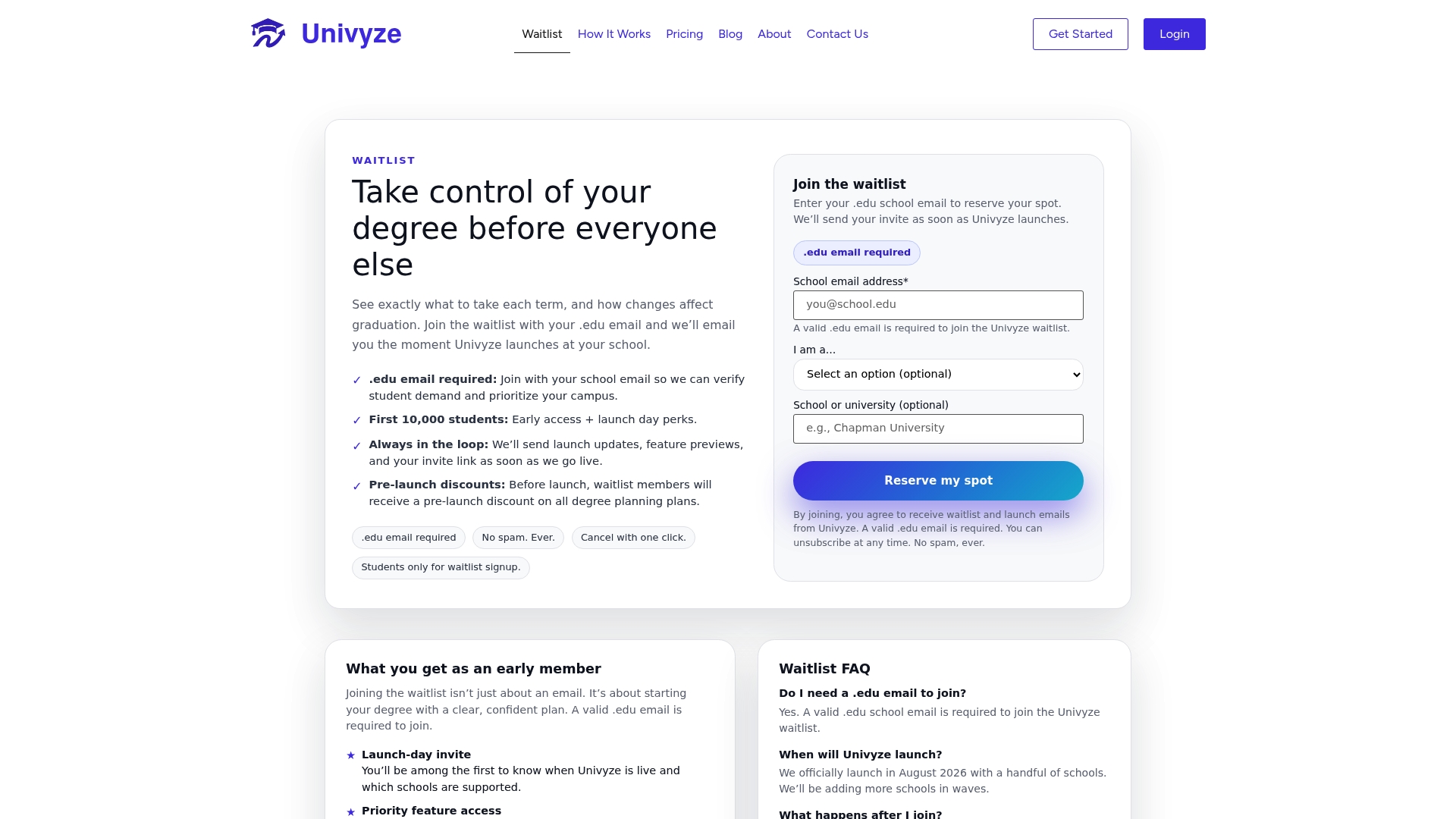
Univyze gives families a shared roadmap: term-by-term planning, AP and dual-enrollment credit tracking, transfer credit visibility, and “what if” scenario planning for a possible major change, all viewable without your student ever sharing a campus password. It’s built to make the plan visible, not to replace the people who officially certify it. Univyze does not guarantee graduation timelines, course availability, or transfer credit acceptance, and every plan should still be checked against your student’s official degree audit, university catalog, and academic advisor.
If continuous visibility into the plan, not just legal access to the file, is what you’re actually after, join the Univyze waitlist or visit the parent landing page to see how the dashboard works for families like yours.
Sources
For the original templates and campus-specific procedures, go straight to the source rather than a third-party summary.
- Model Form for Disclosure to Parents of Dependent Students and Consent Form for Disclosure to Parents
- FERPA consent to release | University of Colorado Boulder Registrar
- FERPA consent to release | UCCS Registrar
- Parent FERPA Consent to Release | VCU
Every South African universities & colleges run their own version of this process. Confirm the exact steps, forms, and documentation your student’s specific institution requires before assuming any example here applies directly.
This article is general information, not a substitute for advice from a qualified lawyer. Consult a qualified legal professional about your own circumstances before acting on anything here.
FAQ
Does FERPA Only Apply to Parents?
No. FERPA protects any eligible student’s education records from disclosure to any third party, including parents, employers, and outside organizations, unless an exception or consent applies.
What Is a Parental Release Form?
It’s a document, often based on the Department of Education’s model form, that the student signs to authorize a school to share specific education records with a named parent or guardian.
What Can Be Shared Without a FERPA Release?
Schools can disclose limited information called “directory information” (name, enrollment status, dates of attendance) without consent unless the student opts out, and they can share records without consent under exceptions like subpoenas, health and safety emergencies, or the IRS dependency rule.
Do I Release FERPA?
Only the eligible student can grant a FERPA release; a parent cannot sign it on the student’s behalf unless the parent is claiming the student as an IRS dependent and following that separate documented exception.