

A loan grace period is the window of time after you leave school when you are not yet required to make payments on your student loans. For most federal loans, that window lasts a few months. The single most useful thing you can do right now: pull out your promissory note or log into your loan servicer’s portal and confirm your exact end date. One more thing to keep in mind from the start — a grace period delays your payments, but it does not erase your debt, and interest may keep building the whole time.
- What it is: A defined period after graduation (or withdrawal) when no payment is required
- How long: Federal Direct Loans have a grace period lasting several months; Federal Perkins Loans have a longer grace period.
- Interest: May still accrue on unsubsidized and private loans during this window
- First action: Check your promissory note or contact your loan servicer to confirm your exact end date
Key Takeaways
A loan grace period delays required payments but does not stop interest from accruing on unsubsidized and private loans, so confirming your exact end date and paying interest during the window are the two highest-impact actions you can take.
| Point | Details |
|---|---|
| Standard grace period length | Federal Direct Loans typically have a multi-month grace period; Federal Perkins Loans have a longer grace period. |
| Interest on unsubsidized loans | Interest accrues during the grace period and capitalizes if unpaid before repayment starts. |
| Private loan terms vary | No standard grace period; check your promissory note or call your lender to confirm. |
| First action to take | Log into StudentAid.gov and your servicer portal to confirm your exact first payment due date. |
| Univyze planning | Univyze’s term-by-term dashboard helps students track graduation timing so repayment start dates are never a surprise. |
Table of Contents
- What does a loan grace period mean, and how is it different from other grace periods?
- How long is a grace period for student loans?
- Which loans usually include a grace period?
- Does interest accrue during the grace period?
- Can you make payments during the grace period?
- When does your grace period start, and how do you find the end date?
- What happens when your grace period ends?
- How to delay or change payments after graduation
- Your 30–90 day checklist before the grace period ends
- Common mistakes students make — and how to avoid them
- The real cost of not planning your repayment window
- Univyze helps you plan smarter before repayment starts
- Sources
- FAQ
What does a loan grace period mean, and how is it different from other grace periods?
The term “grace period” shows up in several financial contexts, and confusing them is one of the most common student mistakes. For student loans, a grace period is a pre-repayment window — a stretch of months before your first payment is ever due. It starts automatically when you graduate, withdraw, or drop below half-time enrollment.
That is fundamentally different from the grace period on a mortgage or a credit card. Those are post-due-date buffers — short windows (often 10–15 days for mortgages, and at least 21 days for credit cards under the Credit CARD Act) that give you a little extra time after a payment was already supposed to arrive. Miss that window and you face a late fee or penalty. The student-loan version is far more generous: your first payment simply hasn’t been scheduled yet.
The trigger events that start a student-loan grace period are specific: graduating, officially withdrawing from school, or dropping below half-time enrollment. Your promissory note — the legal contract you signed when you borrowed — spells out the exact terms for your loans. That document is the authoritative source, not a friend’s experience or a general blog post.
How long is a grace period for student loans?
The standard answer for federal loans is a few months, but there are important exceptions worth knowing before you assume that timeline applies to you.
- Federal Direct Subsidized and Unsubsidized Loans: Six months after you graduate, withdraw, or drop below half-time
- Federal Perkins Loans: a longer grace period reflecting the older program’s design.
- Private student loans: No standardized window; terms vary by lender and are set in your loan contract. The Consumer Financial Protection Bureau recommends checking your promissory note or calling your lender directly to confirm
- Consolidation caveat: If you consolidate your federal loans into a Direct Consolidation Loan while still in your grace period, that grace period ends immediately — your repayment clock starts sooner than you may expect
The six-month window sounds comfortable, but it goes faster than most graduates expect, especially when you factor in job searching, moving, and setting up a new budget.
Which loans usually include a grace period?
Not every loan comes with a built-in grace period, and the differences matter depending on what you borrowed.
- Federal Direct Subsidized Loans: Grace period included — lasting several months after leaving school
- Federal Direct Unsubsidized Loans: Grace period included — lasting several months, but interest accrues the entire time
- Federal Perkins Loans: Grace period included — a longer term (note: the Perkins program stopped making new loans, but existing borrowers still have these terms)
- Parent PLUS Loans: No automatic grace period in the same sense; repayment typically begins shortly after full disbursement, though parents can request deferment while the student is enrolled and for some time after graduation
- Private student loans: Vary widely. Some lenders offer a grace period; others require payments immediately after graduation or even while you are still in school. University financial-aid offices often remind students to verify private loan terms separately from federal ones
As Brown University’s Student Financial Services notes, the grace period exists to give students time to transition from school to repayment — but that transition looks different depending on who holds your loan.
Does interest accrue during the grace period?
This is where the loan grace period definition gets more nuanced, and where the real cost difference between loan types shows up.
| Loan Type | Interest During Grace Period | Who Pays It |
|---|---|---|
| Federal Direct Subsidized | Does not accrue | Government covers it |
| Federal Direct Unsubsidized | Accrues from day one | You (added to balance if unpaid) |
| Federal Perkins | Does not accrue during grace | Government covers it |
| Private Loans | Typically accrues | You (terms set by lender) |
For unsubsidized federal loans, interest starts building the moment the loan is disbursed — not when repayment begins. So during your six-month grace period, that interest is quietly accumulating. If you do not pay it before repayment starts, it capitalizes: it gets added to your principal balance, and you then pay interest on a larger number for the life of the loan.
Federal Student Aid confirms that making payments during the grace period is allowed and reduces total interest paid. For private loans, Experian notes that interest behavior varies and borrowers should check their contract terms.
Pro Tip: If you can only afford one thing during your grace period, pay the interest on your unsubsidized loans. Even small monthly payments prevent capitalization and lower your total repayment cost.
Can you make payments during the grace period?
Yes — and for most borrowers with unsubsidized or private loans, doing so is worth it. There is no penalty for paying early, and every dollar you put toward interest now is a dollar that does not get folded into your principal.
Here is how to think about it depending on your situation:
- If you have subsidized loans only: The government is covering interest during your grace period, so there is less urgency to pay now. Use the time to build an emergency fund instead.
- If you have unsubsidized loans: Pay at least the interest each month. A few hundred dollars during the grace period can save more than that over a 10-year repayment term once capitalization is factored in.
- If you have private loans: Check your contract. Some private lenders apply early payments to fees first, then interest, then principal — so confirm the order before setting up autopay.
- If cash is tight: Even a small, irregular payment is better than nothing. Contact your servicer to confirm how they apply partial payments.
Pro Tip: Set up a small automatic transfer to your loan servicer the month after graduation. Even $25–$50 toward interest keeps capitalization from quietly inflating your balance while you are focused on the job search.
When does your grace period start, and how do you find the end date?
The grace period starts on a specific date tied to a specific event. Knowing that date precisely is the difference between making your first payment on time and missing it by accident.
- Identify your trigger event. Graduation is the most common, but withdrawal or dropping below half-time enrollment also starts the clock. If you re-enroll at half-time or above during your grace period, the clock pauses — and a new grace period begins after you leave school again.
- Check your promissory note. This is the legal document you signed when you borrowed. It states your grace period length and the conditions that trigger it. Log into Studentaid to find your federal loan details.
- Log into your servicer’s portal. Your loan servicer — the company that manages billing and payments — shows your account status. If it says “in grace,” that means you are in the pre-repayment window and your first payment date is visible there.
- Call your servicer if anything is unclear. Ask specifically: “What is my grace period end date?” and “When is my first payment due?” Write down the name of the representative and the date you called.
- Put the date on your calendar with two reminders. Set one alert 30 days before your first payment and another 7 days before. Missing a first payment because you forgot the date is entirely avoidable.
Military service is another factor: if you enter active duty during your grace period, you may be eligible to pause or reset the timeline. Contact your servicer to document your status.
What happens when your grace period ends?
The day after your grace period ends, your first payment is due. That is not a warning — it is the actual deadline. Here is what the timeline looks like if things go wrong:
- Day 1 after grace ends: First payment due. If unpaid, the account is delinquent.
- 30 days past due: Most servicers report delinquency to credit bureaus at this point, which can lower your credit score.
- 90 days past due: Delinquency is reported to all three major credit bureaus. The impact on your credit report becomes more significant.
- 270 days past due: Federal loans enter default. At that point, the entire balance may become due immediately, and the government can garnish wages or tax refunds.
If you cannot make your first payment, contact your servicer before the due date — not after. Ask about income-driven repayment (IDR) plans, deferment, or forbearance. Documenting that contact matters if there is ever a dispute about your account status.
How to delay or change payments after graduation
A grace period is not your only option if you need more time. Several programs exist, each with different trade-offs.
- Deferment: Pauses payments for a qualifying reason (economic hardship, unemployment, returning to school). Interest does not accrue on subsidized loans during deferment, but it does on unsubsidized loans.
- Forbearance: Also pauses payments, but interest accrues on all loan types. Use this for short-term hardship when you do not qualify for deferment. Interest capitalization at the end of forbearance can meaningfully increase your balance.
- Income-Driven Repayment (IDR): Plans like SAVE, PAYE, or IBR cap your monthly payment as a percentage of your discretionary income. If affordability is the long-term concern, IDR is usually a better choice than repeated forbearance.
- Consolidation: Combining multiple federal loans into one Direct Consolidation Loan simplifies billing but ends any remaining grace period immediately. It can also affect your eligibility for certain forgiveness programs, so research the trade-offs before consolidating.
Investopedia notes that deferment and forbearance are distinct from a grace period — they require approval or a qualifying event, and interest capitalization at the end can increase your total balance. Plan carefully before choosing either.
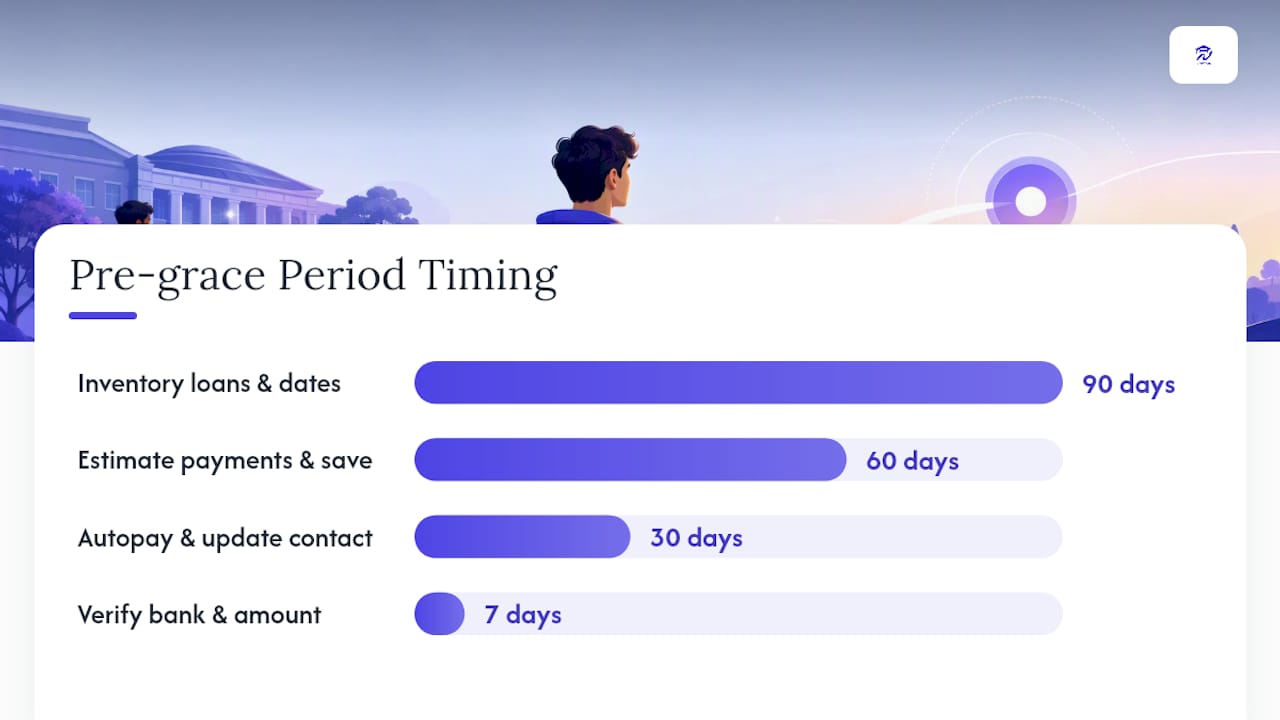
Your 30–90 day checklist before the grace period ends
Turn everything above into tasks. Here is a prioritized sequence:
- 90 days out: Log into StudentAid.gov and list every federal loan, its servicer, and its balance. Note which are subsidized and which are unsubsidized.
- 90 days out: Confirm your grace period end date with each servicer. If you have private loans, call those lenders separately.
- 60 days out: Use your servicer’s repayment estimator to calculate your monthly payment under the Standard 10-Year Plan and at least one IDR plan. Compare both to your expected income.
- 60 days out: Open a dedicated savings buffer — even one month’s payment set aside reduces the stress of a rocky first month.
- 30 days out: Enroll in autopay. Most federal servicers offer a 0.25% interest rate reduction for automatic payments.
- 30 days out: Confirm your mailing address and email are current with every servicer. Billing notices go to the address on file.
- 7 days out: Verify your bank account is linked and the first payment amount matches what you calculated. Check that the payment date is correct.
Pro Tip: Set two phone calendar reminders right now: one for 30 days before your first payment and one for 3 days before. Label them “LOAN PAYMENT DUE” so there is no ambiguity when the notification fires.
Staying on top of graduation timing directly affects when your grace period starts. Students who plan college classes carefully and graduate on schedule avoid the surprise of an earlier-than-expected repayment clock.
Common mistakes students make — and how to avoid them
Most grace-period problems come from a handful of repeated errors.
- Assuming all grace periods are six months. Perkins loans are nine months; private loans may be shorter or nonexistent. Always verify with your specific lender.
- Treating the grace period like forgiveness. Interest on unsubsidized and private loans keeps accruing. Ignoring it costs real money.
- Not knowing which servicer holds each loan. Federal loans can be split across multiple servicers. Log into StudentAid.gov to see the full picture.
- Consolidating without checking the grace period impact. Consolidating during your grace period ends it immediately. Do this intentionally, not by accident.
- Waiting until the last week to set up autopay. Bank processing times mean a payment initiated on the due date may post late. Set up autopay at least two weeks early.
University financial-aid offices — including UCLA’s loan education resources — consistently remind students to read their promissory notes and confirm servicer contact information before graduation. The CFPB offers free tools for comparing repayment options if you are unsure which plan fits your income.
Misunderstanding timelines is also one of the common mistakes that delay graduation — and a delayed graduation means a later grace period start, which can push your entire financial plan off schedule.
The real cost of not planning your repayment window
Most of the advice about grace periods focuses on the mechanics — how long, what triggers it, when to pay. What gets less attention is the connection between your academic timeline and your repayment timeline.

If you take an extra semester because your course sequence was unclear, your grace period starts later, your first payment arrives later, and your total loan cost is higher because interest has been accruing longer. The students who come out of school in the best financial position are almost always the ones who planned their degree path the same way they planned their budget: deliberately, with a clear picture of what comes next.
Checking your promissory note is not a one-time task. It is the beginning of a habit — reading the actual terms of your financial agreements rather than assuming they match what you heard from a roommate. That habit, applied to course planning, repayment planning, and everything in between, is what separates students who feel in control from those who feel blindsided.
Univyze helps you plan smarter before repayment starts
Knowing when your grace period ends is only useful if you also know when you are graduating. That is where Univyze comes in. Univyze’s term-by-term degree planning dashboard shows you exactly how your current course sequence maps to your graduation date, so you can see — before it happens — whether you are on track for a six-month grace period or heading toward an extra semester that shifts everything.
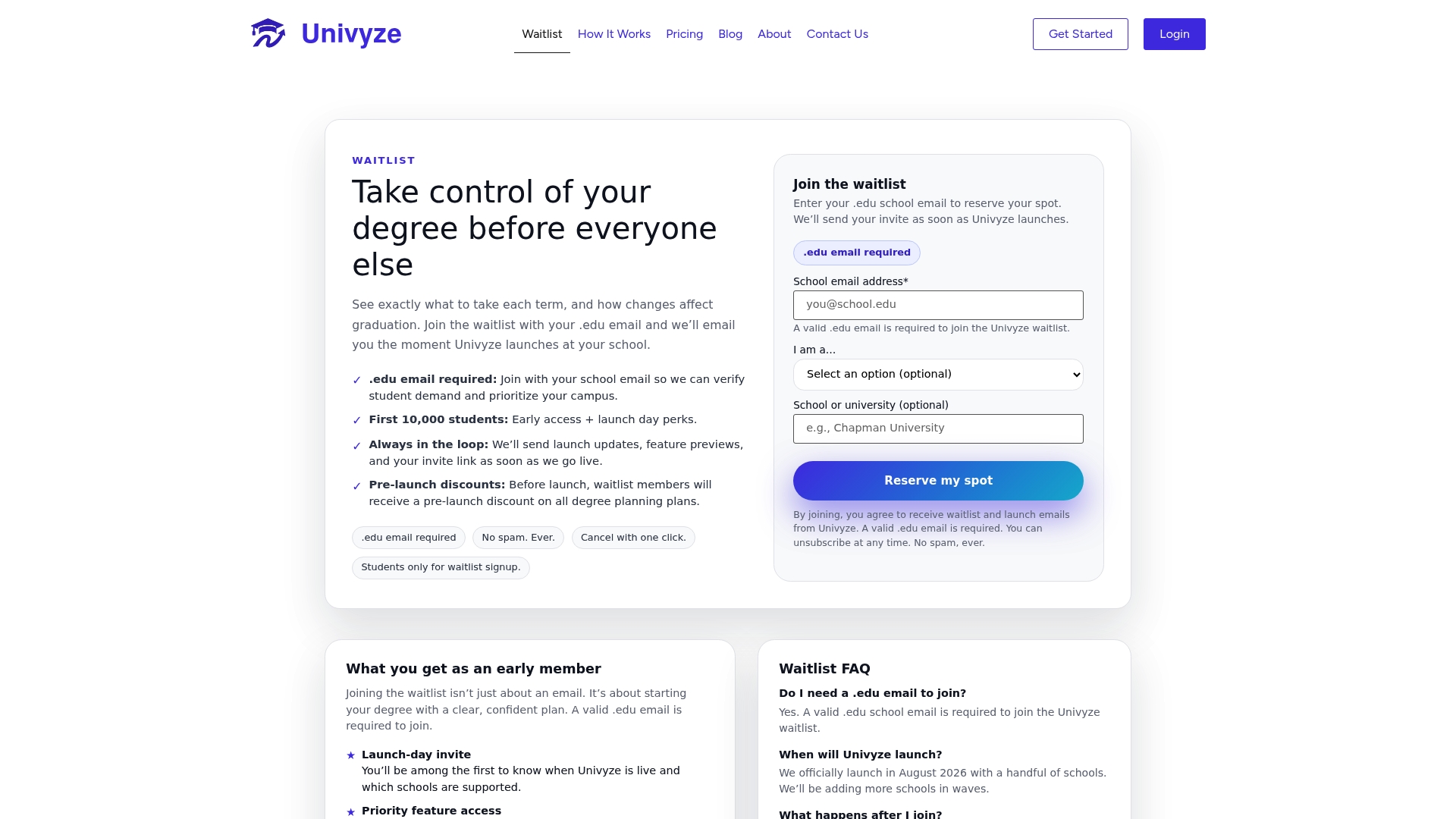
Univyze is not a loan servicer and does not replace your registrar, academic advisor, or official degree audit. What it does is give you a clear visual of your academic path, with what-if planning for major changes, summer sessions, and transfer credits, so your graduation timeline stays predictable. Fewer surprises in your degree plan means fewer surprises in your repayment plan. Join the Univyze waitlist and start planning with clarity.
Sources
These are the primary resources to consult for exact terms, account-level dates, and repayment options:
- Studentaid
- Consumerfinance
- grace period | Wex | US Law | LII / Legal Information Institute
- In grace – Edfinancial Services – Federal Student Aid
- What Is a Grace Period? – Experian
This article is general information, not a substitute for advice from a qualified financial advisor. Consult a qualified financial professional about your own circumstances before acting on anything here.
FAQ
Can you make payments during the grace period?
Yes. Making payments during your grace period is allowed and reduces your total interest paid. Paying at least the interest on unsubsidized loans prevents capitalization when repayment begins.
How long is a grace period for a student loan?
Most federal Direct Loans carry a six-month grace period after you graduate, withdraw, or drop below half-time enrollment. Federal Perkins Loans have a nine-month grace period; private loan terms vary by lender.
How do you find out when your grace period ends?
Log into StudentAid.gov to see your federal loan details and servicer information, then check your servicer’s portal for your account status and first payment due date. Your promissory note also states the grace period length.
What happens if you pay during the grace period?
Your payment reduces your outstanding balance or covers accrued interest, lowering the amount that capitalizes when repayment officially begins. There is no penalty for paying early on federal or most private student loans.