

Completion coaching is structured, goal-focused academic support designed to help students clear the specific barriers standing between them and a finished degree or certificate. It’s not general advising, and it’s not tutoring. It’s a short-term, high-focus relationship built around one outcome: getting you to graduation.
The students who gain the most from it aren’t struggling across the board. They’re close. Completion coaching tends to work best for a narrow set of situations, and most programs are built with exactly these students in mind.
- Students within one to two terms of finishing a degree or certificate
- Students sitting on one or more “Incomplete” grades that need resolving
- Stop-out students trying to figure out re-enrollment
- Students facing a small but specific barrier: a financial hold, a scheduling conflict, a missing form
If you recognize yourself in that list, the rest of this explainer is worth ten minutes of your time. According to Research for Action’s evaluation of completion coaching, eligibility for many programs is defined almost exactly this way: students close to the finish line, or students trying to get back on track after falling off it.
Key Takeaways
Completion coaching works best as short-term, high-contact support for students near the finish line, and its impact depends heavily on how consistently the student engages with it.
| Point | Details |
|---|---|
| Definition | Completion coaching is structured academic support focused on removing specific barriers to finishing a degree or certificate. |
| Best fit | Near-completers, students with Incomplete grades, and returning stop-outs benefit most from coaching. |
| Engagement drives results | Students with at least three coach contacts show stronger outcomes than those with minimal contact. |
| Not a replacement | Coaching complements advising, tutoring, and mentoring rather than replacing any of them. |
| Plan ahead of sessions | Univyze helps students map remaining requirements and test what-if scenarios before meeting a coach, though it is not an official degree audit. |
Table of Contents
- What Is Completion Coaching, Exactly?
- Who Completion Coaching Is Actually For
- How Completion Coaching Works, Step by Step
- What Happens in a Typical Coaching Session
- Does Completion Coaching Actually Work?
- Where to Find Completion Coaching on Campus
- Completion Coaching vs. Advising, Tutoring, and Mentoring
- Signs It’s Time to Reach Out to a Completion Coach
- How to Prepare for Your First Coaching Session
- How Degree-Planning Tools Fit Alongside a Coach
- Why This Matters More Than It Looks Like It Does
- Plan Your Path Alongside Your Coach, Not Instead of One
- Sources
- FAQ
What Is Completion Coaching, Exactly?
Completion coaching is a form of structured academic advising built around persistence and finishing, not around broad academic planning. General advising covers your whole college career: choosing a major, mapping four years, understanding gen-ed requirements. Completion coaching zooms in on the final stretch, or on whatever single obstacle is currently blocking you from moving forward.
Most programs share a similar skeleton, even when the details differ by campus.
- Intake assessment: a coach reviews your transcript, remaining requirements, and any red flags (holds, incompletes, gaps in enrollment).
- Individualized success plan: a short written plan with specific, dated action steps rather than vague encouragement.
- Regular check-ins: scheduled meetings or messages, ranging from a few sessions to consistent contact across a full year.
- Resource navigation: direct help connecting you to financial aid, registration, tutoring, or mental health services when those are what’s actually blocking progress.
- Milestone tracking: a running record of what’s done, what’s pending, and what’s next.
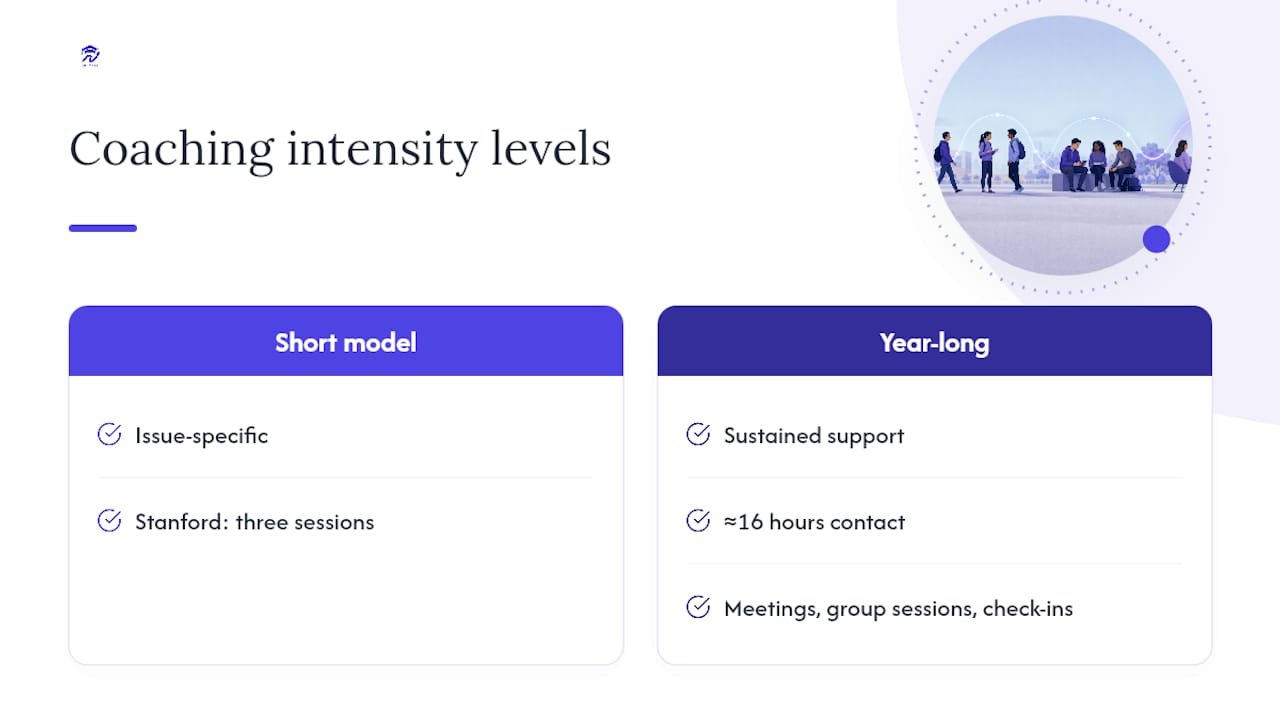
The actual format varies a lot by institution. Stanford’s model, run through its Center for Teaching and Learning, is deliberately narrow: a three-session package aimed specifically at resolving Incomplete grades. That’s it. Three focused meetings, one clear goal, done.
Other programs look nothing like that. Some statewide coaching initiatives run for a full academic year, with coaches maintaining contact every few weeks and tracking dozens of milestones per student. The Michigan College Access Network’s College Completion Corps estimates around 16 hours of coach contact per student per year, split across one-on-one meetings, group sessions, and text or email check-ins.
Neither approach is more “correct.” A three-session model fits a student with one specific problem to solve. A year-long model fits a student who needs sustained accountability across multiple terms. Community college programs, including those at institutions like Crafton Hills College, often lean toward the longer, case-management style, since their student population tends to juggle work, family, and enrollment gaps that a single meeting can’t fix.
Who Completion Coaching Is Actually For
Completion coaching isn’t a universal service for anyone who feels behind. It’s aimed at a fairly specific set of student profiles, and knowing which one you fit into helps you figure out whether it’s worth pursuing.
- Near-completers: students with one or two terms left, often stuck on a single course, a capstone project, or a final requirement.
- Students with Incomplete grades: a grade of “I” on the transcript that needs to convert to a real grade before graduation can happen.
- Returning stop-outs: students who paused enrollment for a semester or longer and need help navigating re-enrollment, updated requirements, and financial aid resets.
- Low-income and first-generation students: many programs proactively reach out to these groups rather than waiting for a request, since research from Research for Action shows barriers here are often institutional (paperwork, unfamiliar systems) rather than academic.
- Students on academic probation who are close to finishing: coaching here focuses narrowly on the finish line rather than a broad academic overhaul.
Picture a senior with a single Incomplete from a lab course two summers ago, still sitting on their transcript. Or a student who left mid-junior year for a family emergency and now needs to figure out which credits still count. Completion coaching exists for exactly those moments, not for a freshman still choosing between majors.
How Completion Coaching Works, Step by Step
The process is more linear than most academic support services, which is part of why it works. Here’s roughly what to expect from first contact to your last meeting.
- Intake and assessment. Your coach reviews your transcript or degree audit, identifies exactly what’s left, and flags anything unusual (holds, incompletes, credit gaps).
- Co-creating a success plan. Rather than handing you a generic checklist, the coach works with you to build a plan specific to your situation, with real dates attached.
- Setting short-term goals. Big goals (“graduate”) get broken into small, weekly or monthly actions (“submit the Incomplete grade petition by Friday”).
- Resource referrals. If the real obstacle is financial aid, a registration hold, or a mental health issue, the coach connects you to the office or service that actually handles it.
- Regular check-ins. Depending on the program, this might be three total sessions or contact every three weeks for a full year.
- Graduation application support. In the final stretch, coaches often walk students through the actual mechanics of applying to graduate, which trips up more students than you’d expect.
The timeline differs sharply by program type. Some, like Stanford’s, wrap up in three sessions total. Others run on a longer cadence: Research for Action’s implementation review documents statewide models where coaches reach out to students roughly every three weeks throughout the year, and caseloads can run 350 to 400 students per coach. That’s a lot of students per coach, which is exactly why showing up prepared matters.
Pro Tip: Bring your degree audit or transcript, a written list of exactly what’s left to complete, and any recent financial aid or billing notices to your first session. Coaches juggling large caseloads move fastest with students who arrive organized, and it often means the difference between a productive 20-minute meeting and a wasted one.
What Happens in a Typical Coaching Session
Sessions are practical, not reflective. You won’t spend much time talking about motivation or long-term career goals. You’ll spend it solving specific, immediate problems.
- Registration troubleshooting, including holds, prerequisite issues, or seat availability
- FAFSA and financial aid navigation, especially when aid has lapsed after a stop-out
- Resolving Incomplete grades, including paperwork and instructor communication
- Planning the final term, credit by credit
- Transfer credit questions, particularly for returning students
- Referrals to tutoring, disability services, or mental health support when those are the actual blocker
Consider two quick, realistic scenarios. A student with a two-year-old Incomplete in organic chemistry works with a coach who tracks down the original instructor, confirms the makeup requirement, and sets a six-week deadline. The grade converts, and the student graduates that spring. In a different case, a student who stopped out after a family crisis works with a coach to sort out which credits are still valid, resets a lapsed FAFSA, and re-enrolls the following term.
In both cases, the coach functions less like a traditional advisor and more like three things at once: a navigator who knows which office solves which problem, an accountability partner who checks whether the deadline got hit, and a connector who makes a warm referral instead of just handing over a phone number.

Does Completion Coaching Actually Work?
The research is more encouraging than skeptical, though it comes with real caveats worth understanding before you set expectations.
One research synthesis found that coached students were 85% more likely to complete an associate’s degree within four years, and 12% more likely to complete a bachelor’s degree within five years, compared to students without coaching. A separate longitudinal look at the Success Boston Coaching program found similarly large gains in associate’s degree completion at multi-year follow-ups, particularly when coaching was comprehensive and sustained rather than a single one-off meeting.
Those numbers only tell part of the story, though. The strength of the effect depends heavily on how much contact a student actually has with a coach.
- Implementation research shows that students with at least three coach contacts saw meaningfully stronger outcomes than students with one or two.
- The ERIC final report on coaching for completion notes that pandemic-era shifts pushed many programs from in-person meetings to texting and email, which changed engagement patterns and, in some cases, weakened outcomes.
- Selection effects matter too. Students who opt into coaching, or who respond consistently to proactive outreach, may already be more motivated than students who don’t, which can inflate the apparent effect of the coaching itself.
None of that erases the core finding: engagement drives results. A coaching relationship you actually show up for tends to outperform one you ignore, and the research backs that up more consistently than it backs any specific number.
Where to Find Completion Coaching on Campus
Completion coaching rarely has its own standalone department. It usually lives inside a broader student success or advising unit, which means you have to know what to search for.
- Center for Teaching and Learning or a similarly named academic support office
- Advising center or student success office, often the default home for coaching programs
- TRIO programs or veterans’ services, which frequently run their own completion-focused coaching
- Community college completion programs, often listed under names like “completion coaches” or “student success coaches”
When you search your school’s website, try terms like “completion coaching,” “graduation coach,” or “student success coach” rather than “advisor,” since the search results differ more than you’d expect. If you’re emailing to request an appointment, a subject line like “Requesting a Completion Coaching Appointment” works, followed by two sentences: state that you’re within one or two terms of finishing (or dealing with an Incomplete or re-enrollment issue), and ask about their next available intake slot.
Have your student ID, a copy of your degree audit, and a one-sentence description of your specific barrier ready before you reach out. Coaches move faster with students who arrive with a clear, specific ask rather than a general “I feel behind.”
Completion Coaching vs. Advising, Tutoring, and Mentoring
These four terms get used almost interchangeably by students, but they describe genuinely different services.
- Academic advising covers your entire academic path: major requirements, course sequencing, long-term planning. It’s broad and ongoing.
- Completion coaching is narrow and short-term, focused specifically on removing whatever is currently blocking graduation.
- Tutoring addresses subject-matter struggle: you don’t understand organic chemistry, so a tutor helps you learn it.
- Mentoring is relationship-based and often career or identity-focused, less tied to a specific academic deadline.
A student failing calculus needs a tutor, not a completion coach. A student with a perfect GPA who paused enrollment for eighteen months and doesn’t know what’s left needs a completion coach, not a tutor. A student unsure which of two majors fits their career goals needs an advisor.
In practice, these services overlap constantly, and good coaches don’t try to replace the others. A completion coach who spots a student struggling with material will refer them to tutoring rather than trying to reteach the subject themselves, and coaches at institutions like David T.C. Academic Tutoring are exactly the kind of specialized resource a coach might point a student toward for subject-specific help.
Signs It’s Time to Reach Out to a Completion Coach
A few concrete situations are strong signals that a completion coach could genuinely move the needle for you right now.
- You have fewer than two terms of coursework left
- You’re carrying an Incomplete grade that’s been sitting unresolved
- You paused enrollment for a semester or longer and haven’t re-enrolled
- A financial hold, however small, is blocking your registration
- Repeated scheduling conflicts keep pushing your graduation date back
If two or more of these apply, requesting an appointment usually takes less effort than the problem you’re trying to solve. Most programs accept a short email or an online intake form, and turnaround for a first meeting is often faster than students expect.
How to Prepare for Your First Coaching Session
Coaches working large caseloads move quickly through the students who arrive prepared. A little prep work before your first meeting changes what you get out of it.
Before you go in, gather your most recent transcript or degree audit, a written list of exactly what’s left to complete, any financial aid or billing notices you’ve received recently, and a short paragraph describing your specific goal. That last part matters more than it sounds. “I want to graduate in May” is vague. “I have one Incomplete in BIO 240 and need to know the makeup deadline” is something a coach can act on immediately.
Once you’re in the room, a few questions are worth asking directly:
- How often will we meet, and through what channel (in person, email, text)?
- What kinds of problems can you help with directly, and what will you refer out?
- How do you track my progress between sessions?
- Is what I share with you confidential from other offices?
After the meeting, write down the agreed plan yourself, even if the coach provides one. A short follow-up email confirming what you both agreed to keeps everyone accountable, especially in programs where a single coach is tracking hundreds of students at once.
How Degree-Planning Tools Fit Alongside a Coach
A completion coach solves the immediate barrier in front of you. A degree-planning tool helps you see everything else that’s coming next, which is exactly where the two work well together rather than in competition.
- Visual degree mapping shows every remaining requirement in one place, so you walk into a coaching session already knowing what’s left.
- Term-by-term scheduling lets you test different sequences before committing, which is useful when a coach flags a scheduling conflict.
- What-if scenarios show how a switched major, added minor, or dropped course shifts your timeline.
- Transfer credit visibility helps returning stop-out students see which past credits are likely to still apply.
- Shared dashboards give parents or advisors visibility into progress without requiring a separate meeting every time.
Here’s a realistic example: a coach reviews your transcript and flags that two required courses only run in alternating fall semesters, which threatens your planned graduation date. Instead of guessing, you open Univyze and run a few what-if scenarios to find a sequence that avoids the conflict, then bring the specific plan back to your coach to confirm it against your degree requirements. Univyze helps you visualize what’s left and test alternatives, but it isn’t an official degree audit. Always confirm final requirements with your registrar or academic advisor before locking in a plan.
Why This Matters More Than It Looks Like It Does
The gap between “almost done” and “actually done” is where a lot of college dreams quietly die, not from academic failure but from paperwork, missed deadlines, and nobody flagging a problem until it’s too late. What strikes me most in the research is how small the actual barriers usually are: one Incomplete, one hold, one missed re-enrollment window. Completion coaching works because it treats those small barriers as urgent instead of letting them sit.
Families supporting a student through this stretch should push for access to coaching resources without assuming the coach’s plan is the final word. Every recommendation still needs a check against your official degree audit and your advisor. Coaching and planning tools both help you move faster. Neither replaces the source of truth sitting in your registrar’s office.
Plan Your Path Alongside Your Coach, Not Instead of One
A completion coach solves the barrier directly in front of you. What most students still lack is a clear, visual sense of everything else still standing between them and graduation, which is exactly the gap Univyze was built to close. Instead of piecing together requirements from a static catalog PDF or guessing how a schedule change ripples into next year, you get a dynamic dashboard that maps your remaining requirements against real course offerings.
Univyze handles the kind of planning work that makes coaching sessions more productive: automatic term-by-term sequencing, what-if scenarios for major or minor changes, and clear handling of AP credit, dual enrollment, and transfer credits from a previous school. Parents and advisors can see the same plan, which cuts down on the back-and-forth that slows progress. Univyze is a planning tool, not an official degree audit, and it can’t guarantee graduation, course availability, or transfer-credit acceptance. Always verify final requirements with your university catalog, registrar, and advisor.
If you’re heading into a completion coaching appointment soon, walking in with a clear visual plan already in hand tends to make that meeting far more useful. Join the Univyze waitlist to get early access and start mapping your remaining requirements before your next session.
Sources
A handful of sources back most of the claims in this explainer, and each one is worth a closer read if you want the full picture rather than the summary.
- Examining the impact, implementation, and cost-effectiveness of completion coaching (Research for Action)
- Coaching for Completion Final Report – ERIC
- Completion Coaching | Center for Teaching and Learning (Stanford University)
- Coaching for Completion (research synthesis / evaluation summary) — ERIC entry
FAQ
What does completion coaching mean in plain terms?
Completion coaching means structured, short-term academic support aimed at helping a student clear specific barriers to finishing a degree or certificate, rather than general long-term academic planning.
What are the four types of coaching typically found on campus?
Colleges generally distinguish between academic advising, completion coaching, tutoring, and mentoring, each addressing a different need: broad planning, finish-line barriers, subject mastery, and relationship-based guidance.
What are the different levels of coaching intensity?
Programs range from short, issue-specific models like Stanford’s three-session package to sustained, year-long coaching involving roughly 16 hours of contact spread across meetings, group sessions, and check-ins.
What does successful completion mean for a coached student?
Successful completion generally means finishing all remaining degree or certificate requirements and formally applying to graduate, with the coach’s role ending once the specific barrier is resolved.
Can a degree-planning tool replace a completion coach?
No. A tool like Univyze helps you visualize remaining requirements and plan term by term, but it works alongside a coach and your official advisor rather than replacing either one.