

Pass/fail usually gives you credit without affecting your GPA, but tight credit caps and long lists of ineligible courses make it riskier than most students assume. Before you elect it, confirm three things: your school’s total pass/fail credit cap, whether the course counts as a free elective, and the exact deadline, because most registrars lock your grading basis the moment it passes.
TL;DR:
- Pass/fail elective limits vary widely, from 9 to 23 credits in total, and most schools restrict students to one such course per term.
- Required major or prerequisite courses and final courses in a sequence are generally ineligible for pass/fail election, but electives are usually allowed unless explicitly restricted.
- A Pass grade typically adds no GPA honor points, but a Fail often affects GPA similarly to an F, meaning the protection only applies if you pass.
- The election deadline usually coincides with withdrawal deadlines, making timely action critical; late requests are rarely accepted unless due to emergencies.
- Transfer credits and automatic pass/fail postings often sit outside your personal cap, but they can still impact graduation, scholarships, and review processes.
Table of Contents
- Understanding Pass Fail Requirements: Eligibility and Credit Caps
- Which Courses Are Eligible for Pass Fail (and Which Aren’t)
- How Pass Fail Grades Affect Your GPA, Credits, and Eligibility
- The Step-by-Step Process for Electing Pass Fail
- Pass Fail’s Effect on Repeats, Retakes, and Transfer Credit
- A Quick Checklist Before You Elect Pass Fail
- Why Most Pass Fail Mistakes Happen Before Anyone Checks the Fine Print
- Model Your Pass Fail Decision Before You Submit It
- Where to Verify Your Campus’s Pass Fail Policy
- Sources
- FAQ
Understanding Pass Fail Requirements: Eligibility and Credit Caps
Most colleges only let degree-seeking undergraduates in good academic standing elect pass/fail, and even then, only within strict limits. The typical structure caps you at one student-elected pass/fail course per term, with a separate lifetime ceiling on total credits.
Those ceilings vary more than students expect. Georgia Tech caps student-elected pass/fail at 9 credit hours toward a degree, while UNC allows students to accumulate up to 23 total pass/fail credits, with its own internal sub-limits on how many count toward specific requirement categories. A gap that wide exists because each campus balances two competing goals: giving students room to explore outside their comfort zone, and preventing pass/fail from quietly eroding the rigor of a transcript.
A few eligibility patterns show up across nearly every catalog:
- You typically need to be classified as a degree-seeking undergraduate, not a non-matriculated or visiting student.
- Many schools require you to be in good academic standing, meaning no active probation.
- First-term or first-year students sometimes face extra restrictions until they’ve completed a minimum number of credit hours.
- Part-time and full-time students may have different per-term limits.
Your own cap almost never appears on a generic FAQ page. Check your university catalog’s grading policy section or your registrar’s website directly, since these are the two sources that carry actual authority over your record. If you’re unsure how close you are to hitting your limit, a degree requirement checklist can help you track what you’ve already spent.
Which Courses Are Eligible for Pass Fail (and Which Aren’t)
The single biggest mistake students make with pass/fail requirements is assuming any course qualifies. It doesn’t. Registrars build these policies around one core idea: pass/fail should apply to exploration, not to the courses that prove you’ve mastered your field.
Courses commonly excluded from student-elected pass/fail include:
- Required courses for your declared major or minor
- Gateway or prerequisite sequences that later courses depend on
- The final course in a sequence, such as the capstone semester of a language requirement
- Many general education requirements, depending on the campus
Free electives and exploratory classes outside your major are usually fair game, unless a specific department restricts them. Some courses are pass/fail by design rather than by choice. Certain internships, practicum placements, and study-abroad postings are graded pass/fail automatically, and UW–Madison’s policy notes these automatic postings often fall outside the limits that apply to student-elected pass/fail. That distinction matters because it means an automatic P/F course usually won’t count against your personal cap.
If a course sits in a gray zone, some departments allow a petition process to request an exception, though approval is never guaranteed.
Pro Tip: Run your target course through your degree audit before electing pass/fail. If the audit shows it filling a required box rather than an elective slot, a pass often won’t satisfy that requirement at all, even though you technically passed the class.
How Pass Fail Grades Affect Your GPA, Credits, and Eligibility
Here’s the mechanic most students misunderstand: your instructor almost never grades you pass or fail directly. They submit a normal letter grade, and the registrar converts it according to institutional thresholds. At many schools, anything from A to C converts to a Pass, while anything below that converts to a Fail, though the exact cutoff varies by campus.
A Pass earns you credit toward your degree but adds zero honor points, meaning it typically has no effect on your GPA either way. A Fail is a different story. At many institutions, a Fail is calculated into your GPA the same way a standard F would be, which erases the entire safety net the pass/fail option is supposed to provide.
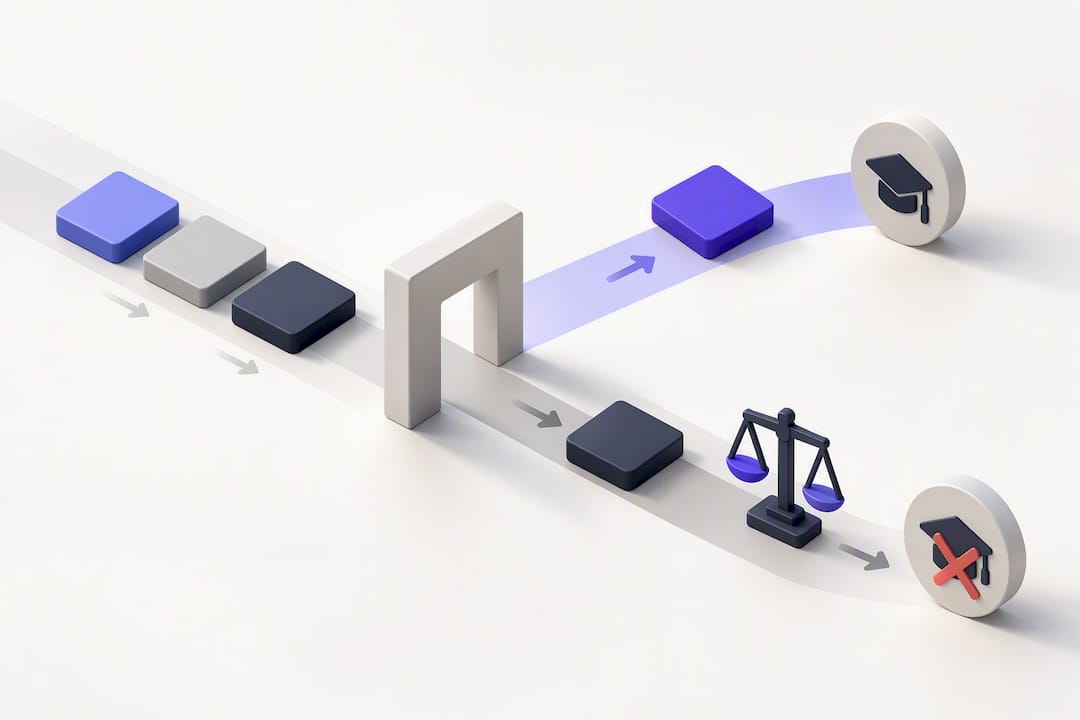
The gap students miss: Pass/fail protects your GPA only if you pass. If you fail, you lose the grade protection and still take the GPA hit, so the option isn’t really a shield against a bad outcome. It’s a shield against a mediocre one.
The consequences extend past your transcript, too:
- Some institutions exclude pass/fail credits from Dean’s List credit-hour minimums, so a pass/fail course might not count toward that particular honor even though it counts toward graduation. William & Mary’s registrar outlines this kind of exclusion explicitly.
- Scholarship and athletic eligibility rules sometimes apply separate GPA or credit-hour calculations that treat pass/fail credits differently than letter grades.
- Graduate and professional programs can view a transcript full of P grades in core subject areas with skepticism, since it gives them no data on how well you actually performed.
Even attempted credits matter beyond the letter grade. Georgia Tech’s policy flags that financial aid and progress-to-degree calculations sometimes track attempted credits separately from earned credits, so a pass/fail election can still show up in places you weren’t expecting.
The Step-by-Step Process for Electing Pass Fail
Every campus phrases this differently, but the sequence is nearly identical everywhere.
- Check your catalog’s grading policy to confirm the course is eligible and you haven’t exceeded your term or lifetime cap.
- Run your degree audit to verify the course fills an elective slot, not a required one.
- Submit the request through your registrar’s online portal or paper form, well before the deadline.
- Wait for confirmation. Processing usually takes a few business days, and UNC’s registrar notes that once the deadline passes, the request is typically final with no exceptions.
- Watch for denial notices. Common reasons include exceeding your credit cap, the course being flagged as ineligible, or conflicts with a graduation application already on file.
The deadline itself deserves its own warning. Most schools tie the pass/fail election window to the same date as the last day to withdraw from a course, which usually falls somewhere in the middle of the term, not near finals. Miss it, and your grading basis locks. A handful of campuses allow late petitions through a dean’s office for documented emergencies, but these are the exception, not something to plan around.
Pro Tip: Set a calendar reminder for your pass/fail deadline the same week you set your withdrawal deadline. Schools frequently list these dates on the same academic calendar page, and missing one usually means missing both.
Pass Fail’s Effect on Repeats, Retakes, and Transfer Credit
Repeat course policy adds another layer most students never check until it’s too late. If you plan to retake a course for grade replacement, pass/fail status can change whether that repeat actually helps your GPA.
The University of Maryland’s registrar notes that repeat and grade-replacement rules differ significantly by institution: some campuses limit you to one or two repeat attempts, some recalculate GPA automatically once the repeat posts, and others require you to submit a formal request before the recalculation happens at all. A course taken pass/fail sometimes doesn’t qualify for the same grade-replacement mechanism as a letter-graded attempt, which means retaking a P/S course may not erase anything on your record the way you’d expect.
Transfer and study-abroad credit bring their own wrinkle. Some programs, particularly engineering study-abroad tracks, post coursework as pass/fail automatically regardless of what you’d prefer. Because these automatic postings often sit outside your personal pass/fail cap, they can still affect how a receiving department evaluates the credit once it transfers back.
- Confirm repeat limits with your registrar before assuming a retake will replace a grade.
- Ask whether a pass/fail repeat counts differently than a letter-graded repeat.
- Verify how your home institution will record an automatically posted study-abroad pass/fail grade.
Coordinating with both your registrar and your advisor before you repeat anything isn’t optional here. The rules are too inconsistent across campuses to guess.
A Quick Checklist Before You Elect Pass Fail
Run through this before you submit anything:
- Pull your degree audit and confirm the course is a genuine free elective, not something disguised as one.
- Check your remaining pass/fail balance. If you’re near your cap, ask whether this course is worth spending your last slot on.
- Think ahead to graduate school, scholarships, or athletic eligibility. A P grade in a subject central to your intended field can raise questions later, even if it solves a problem now.
- Model the outcome before you commit. Test what happens if you pass and what happens if you don’t, ideally in a planning tool or with your advisor, so the decision isn’t a guess.
- Meet your advisor, then submit the registrar form well before the deadline, not on the last day.
Pro Tip: If you’re on the fence, ask your advisor to show you both versions of your plan side by side, one where the course stays letter-graded and one where it’s pass/fail. Seeing the actual requirement impact usually settles the decision faster than any general rule can.
Why Most Pass Fail Mistakes Happen Before Anyone Checks the Fine Print
Students rarely misuse pass/fail out of carelessness. They misuse it because the decision gets made in a hallway conversation, not against an actual degree audit. I’ve seen the pattern often enough to trust it: a student elects pass/fail on what they assume is an elective, only to find out a semester later the department never accepted a P for that particular requirement slot. Early, visual planning catches that before it becomes a lost semester. Talk to your advisor, but bring your own audit to the conversation instead of relying on memory.
— Ryan
Model Your Pass Fail Decision Before You Submit It
There are degree planning tools designed to link degree requirements to actual course history, so students can see whether a course will still count as a free elective before changing its grading basis, not after.
The platform’s dynamic degree mapping and term-by-term planning let you build a what-if scenario: pass this course, and here’s your updated plan; fail it, and here’s how your GPA and remaining requirements shift. Univyze also tracks AP credit, dual enrollment, transfer credits, and summer sessions in the same dashboard, so a pass/fail decision doesn’t get evaluated in isolation from everything else on your transcript. Parents get shared visibility into the plan too, which makes the conversation about a risky elective easier to have as a family instead of a surprise at the end of the term.
Univyze isn’t a substitute for your official degree audit, your university catalog, or your advisor, and it doesn’t guarantee graduation timelines, course availability, or transfer-credit acceptance. It’s a planning layer that helps you walk into that advising meeting with a clearer picture. Plans start with a free Starter tier, and paid options run from $359.40 per year at the Core tier up to $1,199.40 per year for Pro. If you want to test your own pass/fail scenario before your next registration window, join the Univyze waitlist and get early access to the planner.
Where to Verify Your Campus’s Pass Fail Policy
Every rule in this article reflects real registrar and catalog language, but your school’s specific caps and deadlines are the only ones that govern your transcript.
- Georgia Tech’s grading and GPA policy for credit-cap examples
- University of Michigan LSA’s pass/fail grading page for GPA conversion rules
- UNC’s Office of the University Registrar for deadline and eligibility language
- UW–Madison’s Policy Library for automatic posting and eligibility exceptions
- University of Maryland’s course repeat policy for repeat and grade-replacement rules
Your own university catalog and registrar office remain the final word on anything specific to your enrollment.
Sources
- Pass/fail system rules | Georgia Tech Catalog
- Pass/Fail Grading | College of LSA – University of Michigan
- Pass/Fail Option | Office of the University Registrar – UNC
- Use of the pass/fail grading option for undergraduates | UW–Madison Policy Library
- Course repeats | Office of the University Registrar – University of Maryland
FAQ
Is a 60 or 70 the passing grade in college?
There’s no single universal threshold. Individual courses set their own passing grade, often a D or higher for standard letter grading, but pass/fail conversion thresholds are set separately by each registrar and commonly require a C or better to convert to a Pass. Check your specific course syllabus and your campus’s grading policy rather than assuming a fixed number.
Will one F ruin my GPA?
A single F lowers your GPA, but the size of the impact depends on your credit load and existing GPA, not a fixed penalty. One failed three-credit course rarely destroys a strong overall average, but it can matter significantly for students already near a probation threshold or a scholarship minimum.
Does a pass/fail grade look bad on a transcript?
A single Pass rarely raises concerns, but a transcript with many P grades in courses central to your major can prompt questions from graduate or professional admissions committees, since it gives them no performance data. Using pass/fail sparingly and mostly for electives outside your field keeps this risk low.
How is pass/fail calculated?
Your instructor submits a normal letter grade, and the registrar converts it to Pass or Fail based on a set threshold, commonly A through C converting to Pass at many schools. A Pass earns credit with no honor points, while a Fail is typically calculated into your GPA the same way a standard F would be.
How many courses can I take pass/fail?
Most schools cap you at one student-elected pass/fail course per term, with a separate total credit ceiling for your entire undergraduate career. That ceiling ranges widely, from 9 credit hours at some institutions to 23 at others, so check your own catalog for the exact number.