

Four years is the goal most students set, but it’s not the outcome most students get. Nationally, 44% of first-time bachelor’s degree recipients finish within 48 months, while roughly 61% finish within six years. Time to degree, in plain terms, is the elapsed time from first enrollment to graduation, not just the credits on a transcript. If you’re on pace for four years, you’re ahead of most of your peers. If you’re closer to five or six, you’re still on the more common path.
TL;DR:
- The median time to complete a bachelor’s degree is 52 months, which exceeds the traditional four-year target by about one semester.
- Part-time enrollment, remedial coursework, and major changes are key factors that extend a student’s timeline beyond their initial plan.
- Early verification of transfer credits, strategic use of summer terms, and careful planning can significantly reduce overall degree completion time.
- Students working 20 or more hours weekly or supporting families tend to enroll part-time more often, leading to longer graduation timelines.
- Institutional transparency and advising can help identify and address bottlenecks early, minimizing delays caused by scheduling conflicts or credit mismanagement.
Table of Contents
- The National Numbers Behind Time to Degree
- Why Students Take Longer Than Planned
- Turning Credit Requirements Into a Real Timeline
- What Happens When You Need More Time Than Policy Allows
- Six Moves That Actually Shorten Time to Degree
- How a Degree-Planning Dashboard Catches Problems Early
- Socioeconomic Factors Shape Timelines More Than Ambition Does
- The Real Cost of an Extra Year (or Three)
- Time to Degree Has Been Slowly Improving
- Advising Isn’t Optional, It’s a Timeline Variable
- A Checklist for Advisors and Parents Watching the Clock
- Join the Univyze Waitlist and Plan Your Term-by-Term Path
- Primary Sources and Dashboards Worth Bookmarking
- Sources
- FAQ
The National Numbers Behind Time to Degree
The four-year benchmark and the six-year benchmark tell two different stories, and mixing them up is where most confusion starts. The National Center for Education Statistics tracked 2015-16 first-time bachelor’s degree recipients and found a substantial share completed within 48 months. The median time to completion across that same group was 52 months, about a full semester past the four-year mark. That’s the elapsed-time measure: calendar months from first enrollment to diploma, regardless of how many terms a student actually sat in a classroom.
The National Student Clearinghouse uses a longer window and reports that about 61% of students complete a bachelor’s degree within six years. Neither number is wrong. They’re measuring different things over different timeframes, and colleges themselves report both depending on which federal disclosure they’re filling out.
Age changes the picture more than most people expect. Students who start college at 23 or younger and finish a bachelor’s degree post a median completion time of 45 months, close to the traditional four years. Students who start at 30 or older post a median of 162 months, over 13 years. That gap usually reflects part-time enrollment, stop-outs for work or family, and re-entry after years away from school rather than any difference in ability.
A few things worth remembering when you read time-to-degree statistics:
- “Time to degree” almost always means elapsed calendar time, not semesters actively enrolled.
- The 4-year and 6-year figures come from different tracking windows and different cohorts.
- Median completion time (52 months) is a more honest planning number than the “4 years” headline most students hear.
- Age at entry correlates strongly with completion speed, mostly through enrollment intensity, not aptitude.
Quick stat: The median bachelor’s degree recipient in the NCES cohort took 52 months, not 48, to finish. That one-semester gap is often the difference between one extra summer session and one extra full year of tuition.
Why Students Take Longer Than Planned
Almost nobody sets out to take five or six years. It happens through a handful of predictable, well-documented causes, and most students hit more than one of them at once.
Part-time enrollment is the single biggest lever. A student taking 15 credits a semester is on pace for four years. Drop to 9 credits a semester, a common load for students juggling a job or family obligations, and the same degree can stretch past six years unless summer terms or accelerated formats make up the difference.
Remedial coursework adds semesters before real progress starts. Students placed into non-credit-bearing math or writing sequences sometimes spend an entire year catching up before their degree-applicable clock even starts running.
Major changes reset sequential requirements. Switching from biology to communications in junior year doesn’t just change your electives. It can trigger a whole new sequence of prerequisite courses that only run once a year, pushing graduation back by a full academic cycle.
Credit bloat quietly eats semesters. Students take “just in case” electives, retake courses to raise a GPA, or rack up credits that don’t count toward any requirement. Research on degree completion consistently points to this kind of unmanaged credit accumulation as one of the most preventable causes of delay, because it’s driven by planning gaps, not ability.
Course availability and administrative friction do the rest. A required upper-division course that only runs in fall, a locked seat cap, a prerequisite override that takes three weeks to process. None of these show up in national statistics, but advisors see them every term.
Here’s the shorthand version of what typically drags out a timeline:
- Enrollment intensity below 12 to 15 credits per semester
- Remedial or developmental course sequences
- Mid-degree major or minor changes
- Non-degree-applicable elective accumulation
- Course scheduling conflicts and prerequisite bottlenecks
Pro Tip: Before you drop or add a class, check whether it fills a specific requirement box on your degree checklist. A class that “sounds interesting” but doesn’t count toward anything is often the first domino in a longer timeline.
Turning Credit Requirements Into a Real Timeline
Most bachelor’s degrees require about 120 semester credit hours, though some programs, particularly in engineering or the sciences, require 128 or more. That number is the baseline for every timeline calculation you’ll ever do, so it’s worth anchoring to it before assuming your own pace.
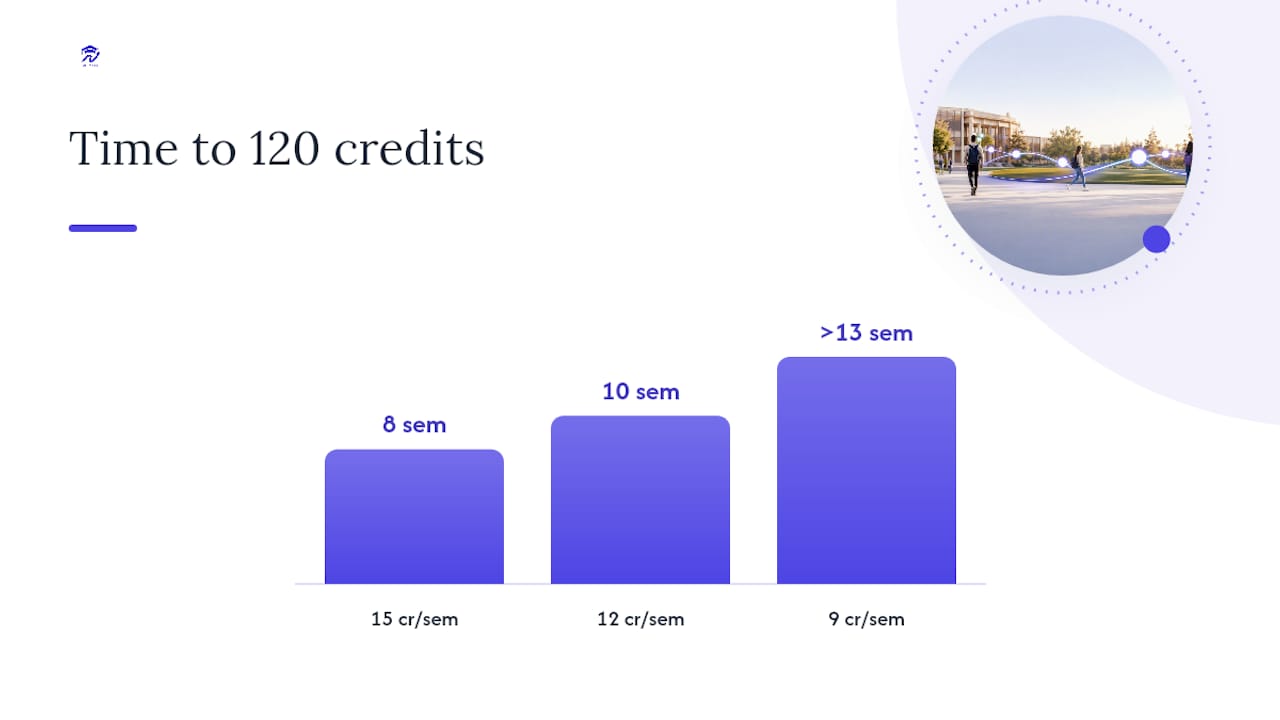
The math is straightforward once you have the credit total. At 15 credits per semester, 120 credits divide into exactly eight semesters, four years. At 12 credits per semester (the minimum for full-time status at most schools), the same degree takes ten semesters, five years. Drop to 9 credits, a common part-time load, and you’re looking at over 13 semesters, more than six and a half years, unless summer terms close the gap.
Summer and accelerated terms change this math in your favor. A single summer session of 6 to 9 credits can knock a full semester off the back end of a degree, and some schools now offer 8-week accelerated formats that let students complete more credits per calendar year without adding to a heavier weekly course load. Our guide on using summer courses to cut a graduation timeline walks through how that works in practice.
Transfer credits, AP scores, and dual enrollment shrink the 120-credit target itself rather than changing your pace. A student who enters college with 24 accepted AP or dual-enrollment credits effectively starts with two semesters already banked, which can turn a five-year plan back into a four-year one without adding a single summer session. The catch is the word “accepted.” Credits only count once your institution has formally evaluated and posted them, which is why verifying transfer and AP credit early is one of the highest-impact actions a student can take. Our breakdown of how AP, dual enrollment, and transfer credits convert toward degree requirements covers the evaluation process in more detail.
What Happens When You Need More Time Than Policy Allows
Every institution sets some version of a time-to-degree policy, and most students never read it until they need it. The details vary by school, but the pattern is fairly consistent across public and private institutions alike.
Colleges typically define an “on-time enrollment window,” often expressed as a maximum number of semesters or a credit-hour ceiling tied to financial aid eligibility, rather than a hard graduation deadline. Federal financial aid rules generally cap eligibility around 150% of a program’s published length, so a 120-credit degree might allow aid coverage through roughly 180 attempted credits before a student has to petition for an extension.
When a student needs to exceed that window, most registrars require a formal petition rather than a simple request. Common documentation includes:
- Medical records or a physician’s statement for health-related delays
- Military orders or deployment documentation for service members
- Evidence of caregiving responsibilities or other extenuating personal circumstances
- A revised degree completion plan showing the remaining coursework and realistic timeline
Petitions typically go through a college dean’s office or financial aid appeals committee, not the registrar alone, and decisions often hinge on whether the student’s remaining plan looks credible and time-bound.
The practical move here is simple: don’t wait until you’re already over the limit to ask questions. Check your official catalog and your school’s degree requirement checklist early, and talk to your advisor or college office the moment you suspect your timeline is drifting past your original plan. Petitions filed with a semester of runway tend to go smoother than ones filed in a panic during a student’s supposed final term.
Six Moves That Actually Shorten Time to Degree
None of these require heroics. They’re mostly about front-loading decisions that students otherwise make too late.
-
Get a degree audit before you register for anything else. Map every required course and its prerequisite chain in your first semester, not your junior year. A sequence bottleneck you catch as a freshman is a scheduling adjustment. The same bottleneck caught as a junior can cost a full extra year.
-
Verify AP, dual-enrollment, and transfer credit before orientation. Don’t assume a credit will transfer just because it appears on a prior transcript. Submit scores and transcripts early enough that your advisor can build your first schedule around confirmed credit, not hoped-for credit.
-
Use summer terms to clear bottleneck courses, not just easy electives. A summer session is most valuable when it knocks out a prerequisite that would otherwise force you to wait an entire academic year for the next offering.
-
Treat every elective as a decision, not a placeholder. Before enrolling, check whether a course counts toward a general education requirement, a major requirement, or nothing at all. Our guide on choosing classes that actually count toward graduation breaks down how to vet a course before it lands on your schedule.
-
Build a contingency plan before you need one. Know your school’s leave-of-absence policy and what a part-time fallback semester would do to your remaining timeline. Students who know these rules in advance make calmer decisions when life interrupts a semester.
-
Run “what-if” scenarios before changing your major. A major change late in a degree is one of the costliest timeline hits there is, because it can restart prerequisite sequences that only run once a year. Modeling the credit impact of a potential switch before you commit to it, rather than after, is often the difference between losing one semester and losing three.
Pro Tip: If you’re considering a major change, ask your advisor to run the new major’s requirements against your completed credits before you file the paperwork. A five-minute comparison can save a full extra year if the new major has a very different core sequence.
Students juggling internships, research, or travel-based learning alongside coursework face an extra layer of scheduling complexity. Programs like the ones covered in this guide to maximizing college student tours and experiential learning can add real value to a degree, but they need to be planned around required course sequences rather than squeezed in around them.
How a Degree-Planning Dashboard Catches Problems Early
Most of the causes of a longer timeline, a missed prerequisite, an elective that doesn’t count, a major change with unknown credit consequences, are visible months in advance if someone is actually looking. That’s the gap Univyze is built to close.
Univyze gives students a term-by-term plan builder that lays out every required course against actual course offerings, so a scheduling conflict or a course that only runs in alternate years shows up before registration, not after. The degree requirement checklist tracks which boxes are filled and which aren’t, which matters because proactive credit management is one of the strongest predictors of on-time completion. The what-if scenario tool lets a student model the credit cost of a potential major change before filing anything official, turning a guess into a side-by-side comparison. Transfer and AP credit tracking keeps banked credit visible instead of buried in a separate portal, and parental visibility features let a parent see real progress without needing a student to relay every update by hand.
None of this replaces your official degree audit. Univyze is a planning aid, not a registrar system, and course availability, transfer-credit acceptance, and graduation eligibility are always determined by your institution. Every plan built in the dashboard should still be checked against your university catalog, your official degree audit, and your advisor before you finalize a schedule.
Socioeconomic Factors Shape Timelines More Than Ambition Does
Two students with identical GPAs can graduate years apart, and the difference is rarely motivation. Students who work 20 or more hours a week, support family members financially, or commute long distances to campus are far more likely to enroll part-time, which is the single strongest predictor of a longer timeline. Part-time enrollment isn’t a personal failing; it’s often the only enrollment intensity that fits around a job that pays rent.
First-generation students face a related but distinct hurdle: less exposure to how credit requirements, prerequisite sequences, and petition processes actually work, which means small planning mistakes go uncaught longer. Students who transfer from community colleges sometimes lose credits in the transition if course equivalencies aren’t confirmed before enrollment, adding semesters that have nothing to do with academic performance.
None of these patterns are fixed. They’re structural, which means they respond to structural fixes: earlier advising contact, clearer credit-transfer processes, and planning tools that surface a problem in month one of freshman year rather than month one of senior year. The age data cited earlier, where younger entrants finish in a median of 45 months versus 162 months for older entrants, is largely a proxy for exactly these enrollment-intensity and life-obligation differences, not a difference in capability.
The Real Cost of an Extra Year (or Three)
Every additional semester carries a bill beyond tuition. Housing, meal plans, transportation, and lost income from delayed full-time employment all stack on top of the credit-hour cost, and for students using loans, extra semesters mean more principal borrowed at a point when compounding interest has less time to be offset by post-graduation earnings.
The career-delay cost is less visible but often larger over a lifetime. Entering the workforce a year or two later pushes back the entire arc of raises, promotions, and retirement contributions that follow a first job. It’s not just lost tuition money; it’s lost earning years that don’t get made up later just because the degree eventually arrives.
There’s a loan-specific wrinkle worth flagging directly: federal aid eligibility is generally capped around 150% of a program’s published length. A student who blows well past that ceiling risks losing aid eligibility for their final stretch of coursework, which is precisely the moment they can least afford an unplanned tuition bill. This is exactly why the petition and documentation process covered earlier exists, and why filing early beats filing after the ceiling is already hit.
None of this means five or six years is a disaster. Plenty of students finish strong on that timeline. It does mean the true cost of drift is usually bigger than the sticker price of one more semester’s tuition suggests.
Time to Degree Has Been Slowly Improving
The picture has shifted, gradually, over the past decade. Wider adoption of dual enrollment and AP credit in high schools means more students arrive on campus with credit already banked, shrinking the gap between “120 credits required” and “120 credits still needed.” Accelerated formats, including compressed 8-week terms, have expanded well beyond online-only programs and now let adult learners in particular complete more credits per calendar year without carrying a heavier weekly course load.
Institutions have also gotten more transparent. Public dashboards that break down completion time by major and entry status, like the University of Wisconsin’s time-to-degree tool, give students and advisors a peer-comparison benchmark that simply didn’t exist in most catalogs a decade ago. That transparency puts pressure on programs with unusually long completion times to fix bottleneck course sequences, since the data is now public rather than buried in an institutional research report.
Advising Isn’t Optional, It’s a Timeline Variable
Academic advisors don’t just approve schedules. Good advising catches a missing prerequisite in September instead of March, flags a major change’s hidden credit cost before paperwork gets filed, and knows which upper-division courses only run once a year. Students who meet with an advisor regularly, not just at mandatory checkpoints, consistently avoid the scheduling surprises that add semesters.
The problem is capacity. Many advisors carry caseloads in the hundreds, which means a lot of the catching happens reactively rather than proactively. A student who shows up to an advising appointment with their own plan already mapped, and specific questions about a prerequisite chain or a transfer credit, gets far more value out of that fifteen-minute meeting than one who shows up asking “what do I need to take.”
That’s also where support services beyond the advisor’s office matter: tutoring centers that keep a student from failing a gateway course, financial aid offices that catch an eligibility issue before it becomes a petition, and peer mentoring programs that flag major-change red flags informally before they become official. Our overview of how support services shape graduation timelines goes deeper into how these pieces fit together.
A Checklist for Advisors and Parents Watching the Clock
If you’re an advisor or a parent trying to keep a student on track, the process boils down to five checkpoints, run early and revisited every term:
- Run a degree audit against the current catalog year, not a general major description, since requirements can shift between a student’s freshman and senior years.
- Confirm which transfer, AP, or dual-enrollment credits have actually posted, not just been submitted, since submission and acceptance are different steps.
- Lock in required, sequential courses first, then fill remaining slots with electives that count toward something specific.
- Schedule summer terms deliberately around whichever prerequisite is the tightest bottleneck, not just whatever’s convenient.
- Document every petition, waiver, or substitution approval in writing, and keep copies outside the student portal in case of a system error or staff turnover.
Here’s a real-shape scenario advisors see constantly: a senior discovers in October that they’re nine credits short of graduation because two required courses only run in spring and one already has a full waitlist. The fix usually isn’t panic, it’s triage: confirm whether a substitution course exists, check if an online or intersession section is available anywhere in the system, and file a prerequisite override request immediately rather than waiting for the add/drop period to open. Waiting even two weeks on that kind of gap often means losing an entire additional semester.
Keep a paper trail. Every approval, waiver, and course substitution should live somewhere a student (or their parent) can find it later, because staff turnover and system migrations lose records more often than anyone likes to admit.
Join the Univyze Waitlist and Plan Your Term-by-Term Path
Everything covered here, credit math, prerequisite sequencing, transfer-credit verification, comes down to one thing: seeing your whole degree mapped out before problems show up on a registration screen. Univyze is built specifically for that, with a dashboard that lays your degree requirements over real course offerings so bottlenecks show up in advance instead of during finals week.
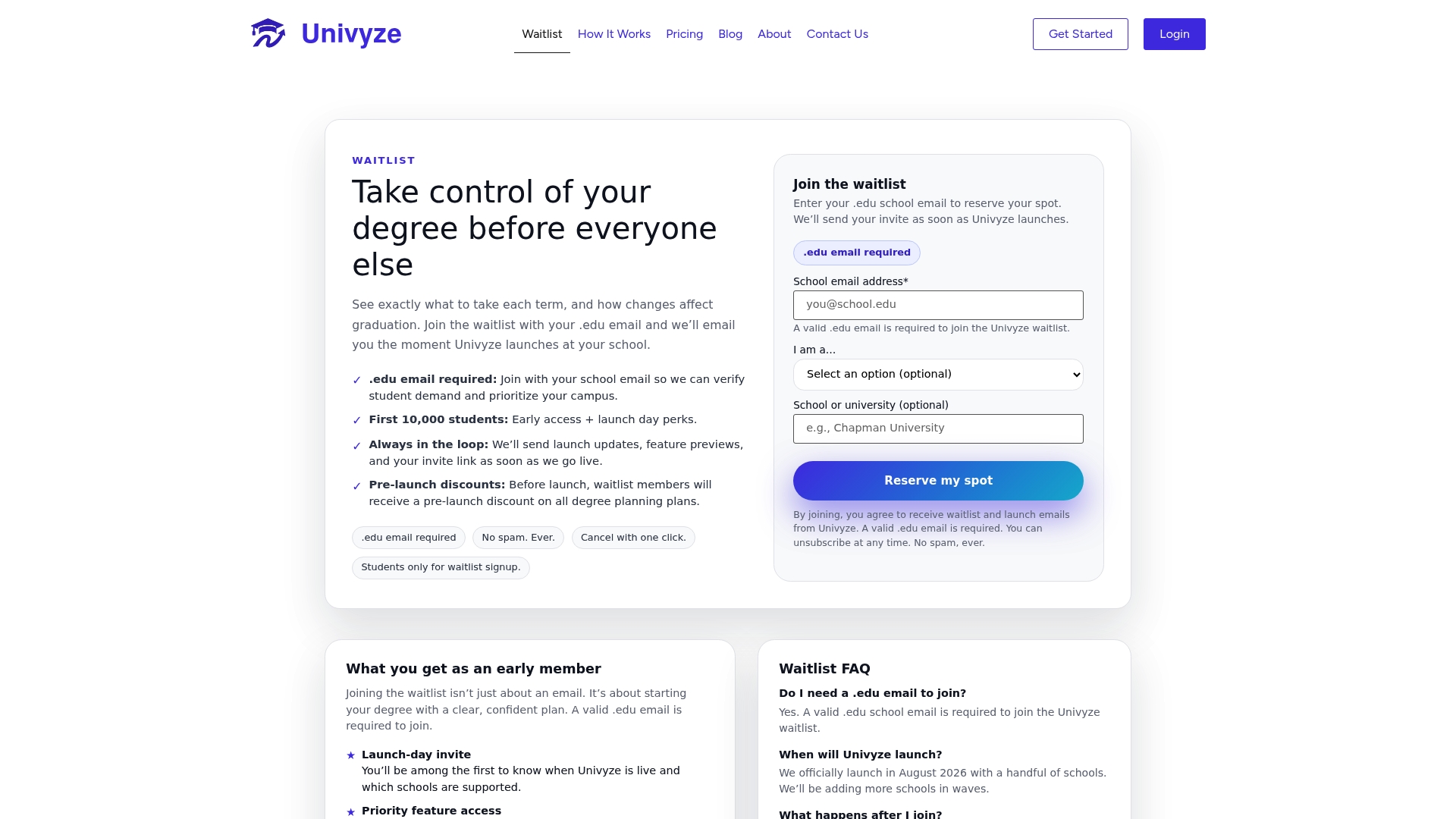
Joining the Univyze waitlist gets you early access to the term-by-term plan builder, sample planning templates, and a preview of the dashboard before general release, including the what-if scenario tool for testing a major change before committing to one. If you’re a parent, the parent visibility features let you follow real progress without playing detective every family dinner.
One honest caveat: Univyze is a planning tool, not your school’s official degree audit system. Course availability, transfer-credit acceptance, and final graduation eligibility are always determined by your registrar and your university catalog, so treat every plan you build as a draft to confirm with your advisor, not a guarantee. If you want a head start on the planning side while you wait for access, our guide on building a multi-year degree plan walks through the same logic the dashboard automates. Join the waitlist, and start mapping your terms before your next registration window opens.
Primary Sources and Dashboards Worth Bookmarking
The statistics in this guide come from a small set of sources worth checking directly, especially if you want numbers specific to your own major or institution.
- NCES Fast Facts: Time to Degree, the federal source for the 44% four-year completion rate and 52-month median.
- National Student Clearinghouse Time to Degree report, the source for the roughly 61% six-year completion figure.
- University of Wisconsin’s institutional time-to-degree dashboard, a model for the kind of major-level, entry-status breakdown many schools now publish.
Your own school’s registrar page and official catalog will almost always have a version of this data specific to your program, and that’s the number that should carry the most weight in your personal planning.
Sources
- Fast Facts: Time to degree (569)
- Undergraduate requirements (example catalog)
- Research on degree completion drivers (PMC article)
FAQ
Is a bachelor’s degree 2 years or 4 years?
A bachelor’s degree is typically a four-year program built around 120 semester credit hours; an associate degree is a separate credential typically earned in about two years.
Is 27 too late to finish college?
No. Age has no bearing on your ability to complete a degree, though older entrants take longer on average mainly due to part-time enrollment and outside obligations, not ability, and many adult learners finish efficiently using accelerated or summer terms.
How much time does it take to get a degree?
The median first-time bachelor’s degree recipient takes 52 months, about four and a half years, though full-time students taking 15 credits a semester can finish in four years, and part-time students often take five to seven.
What is an 8-year degree called?
There’s no formal name for an eight-year bachelor’s degree; it’s still a standard bachelor’s degree, just completed over an extended timeline, usually due to part-time enrollment, transfer credit gaps, or repeated stop-outs rather than a different type of program.
How can I check my own time-to-degree estimate?
Start with your school’s official degree audit and catalog, then use a planning tool like Univyze’s degree requirement checklist to map remaining credits against your actual course sequence and confirm the estimate with your advisor.