

If your child is avoiding homework, slipping in multiple subjects, or expressing dread about school, those are signs your child may need academic advising — not just a tutor. The right first call is usually the school counselor or university advising office, not a tutoring center, because advising addresses the broader pattern — course sequencing, organization, motivation — while tutoring fixes a specific content gap. If you’re not sure which one fits, advising is the safer starting point.
Act within 48–72 hours if you see multiple signs at once:
- Contact the school counselor (K–12) or the university advising office (college) to request an appointment or drop-in slot.
- Pull your child’s most recent grades, attendance record, and any teacher notes before that call.
- For college students, log into the student information system (SIS) to check credit progress and flag any incomplete or failing courses.
A planning tool like Univyze can give you a visual snapshot of where your college student stands on their degree path before that first advising meeting, so you walk in with context rather than questions.
Pro Tip: Behavioral warning signs — avoidance, anxiety, sudden disinterest — often appear weeks before grades drop. Act on the behavior, not the report card.
Key Takeaways
Behavioral warning signs appear before grades drop — acting on avoidance, anxiety, or lost motivation gives families the most time to address root causes before they compound.
| Point | Details |
|---|---|
| Behavioral signs come first | Avoidance, anxiety, and lost interest often precede grade drops; act on behavior, not just report cards. |
| Advising vs. tutoring | Tutoring fixes content gaps; advising addresses patterns like sequencing, organization, and motivation. |
| Timing matters | Book advising before registration, not after a crisis; advisors are busiest in the two weeks before registration opens. |
| FERPA at college | Students must sign a release for parents to access records; arrange this before the advising appointment. |
| Univyze as a planning complement | Univyze maps term-by-term degree progress to help families and advisors start from a shared, concrete picture. |
Table of Contents
- 1. Your child is avoiding schoolwork or shutting down around it
- 2. Grades are dropping across multiple subjects
- 3. Your child understands the material in class but fails tests
- 4. Assignments are chronically late or missing
- 5. Teacher or professor has reached out with concerns
- 6. Your child has missed significant class time
- 7. Your child has lost interest or confidence in school
- 8. Your college student is unsure which classes count toward graduation
- 9. Your student is thinking about changing their major
- 10. Tutoring helped briefly but the gains didn’t stick
- 11. Your student is at risk of not graduating on time
- What academic advisors actually help with
- When to book advising: timing and priority moments
- How parents should prepare and support the advising process
- How to find your child’s advisor and schedule the appointment
- How high school advising differs from college advising
- How digital degree-planning tools complement advising
- What I’d tell any parent who’s worried right now
- Univyze helps families see the full degree picture
- Sources
- FAQ
1. Your child is avoiding schoolwork or shutting down around it
Homework avoidance is one of the earliest and most reliable warning signs of academic struggles. When a student who used to sit down and work now stalls, makes excuses, or has meltdowns at the mention of a subject, that shift in behavior usually signals something deeper than laziness. Behavioral and emotional signals commonly appear before grade drops, giving families a window to act before the report card confirms the problem.
Watch for: refusing to open the backpack, “forgetting” assignments repeatedly, or claiming everything is fine while grades quietly slide.
2. Grades are dropping across multiple subjects
A single bad test in one class is normal. Grades falling in two or three subjects at the same time points to something systemic — a scheduling overload, an organizational breakdown, or a motivation problem that no single subject tutor will fix. This is the clearest academic indicator for advising rather than tutoring.
At the college level, watch for a GPA drop of a full point or more in a single semester, or a pattern of Ws (withdrawals) and Ds appearing on the transcript.
3. Your child understands the material in class but fails tests
This specific pattern — “gets it” during lessons, then blanks on exams — often signals test anxiety, poor study habits, or a mismatch between how material is taught and how it’s assessed. An academic advisor can refer your child to the right campus resource: a learning specialist, a study-skills workshop, or a counselor who handles performance anxiety.
Pro Tip: Ask your child to walk you through a recent homework problem out loud. If they can explain it but still failed the test, the issue is almost certainly test-taking strategy or anxiety, not content knowledge.
4. Assignments are chronically late or missing
One missed assignment is a blip. A pattern of missing work across multiple classes is an organizational or motivational signal. At the high school level, missing assignments can quietly tank a GPA even when a student understands the material. At the college level, a string of zeros can trigger academic probation faster than most students expect.
An advisor can help map out a realistic schedule, identify whether the course load is too heavy, and connect the student to time-management resources.
5. Teacher or professor has reached out with concerns
A teacher-initiated contact — a note home, a progress report flag, a parent-teacher conference request — is the school telling you directly that something needs attention. This is not a sign to wait and see. Teachers see dozens of students daily; when one flags your child specifically, treat it as a referral.
At the college level, a professor’s email suggesting a student visit office hours or the advising center carries the same weight.
6. Your child has missed significant class time
Chronic absences or frequent tardiness disrupt the continuity of learning in ways that are hard to recover from independently. Beyond the academic gap, attendance problems often signal an underlying issue — anxiety, a health concern, a social problem, or a schedule that isn’t working. An advisor can help identify whether the absences are triggering any academic-standing policies and connect the student to the right support.
At the elementary and middle school level, this is a signal to involve both the school counselor and the teacher together.
7. Your child has lost interest or confidence in school
A student who used to enjoy a subject and now describes it as pointless, too hard, or “not for me” has often hit a confidence wall. High-achieving students sometimes hide struggles behind perfectionism or withdrawal, so good grades don’t always mean everything is fine. Watch for a drop in enthusiasm, reluctance to discuss school, or a sudden shift in friend groups tied to academic identity.
This is especially common in the transition from middle to high school, and again from high school to college.
8. Your college student is unsure which classes count toward graduation
Confusion about degree requirements is one of the most common — and costly — advising triggers at the college level. Advising is appropriate when a student has exhausted the catalog and course descriptions but still needs help with course selection, graduation requirements, or major changes. Taking the wrong elective, missing a prerequisite, or misreading a requirement can add a full semester to a degree timeline.

If your student can’t clearly tell you which classes they need next and why, that’s the sign to book an advising appointment.
9. Your student is thinking about changing their major
A major change without advising is one of the fastest ways to lose credits and extend a degree timeline. An advisor can run a what-if analysis, map which completed credits transfer to the new major, and identify the fastest path forward. Major-based advising connects students to curriculum-specific guidance and helps avoid the sequencing errors that come from switching without a plan.
This applies equally to students considering a double major, a minor addition, or a transfer to a different school.
10. Tutoring helped briefly but the gains didn’t stick
Temporary improvement from tutoring that fades within a few weeks is a diagnostic signal in itself. When gains don’t persist, the underlying issue is usually organization, motivation, or course sequencing — not content knowledge. Advising addresses those broader patterns and can determine whether more tutoring is even the right next step, or whether a different intervention is needed entirely.
This is one of the most overlooked indicators for academic support, because parents often assume more tutoring will eventually work.
11. Your student is at risk of not graduating on time
Missing credits, failed required courses, or a transcript that doesn’t align with the expected graduation date are urgent signals. Students who meet with advisors proactively — before registration, not after a crisis — are better positioned to catch requirement changes and fix sequencing problems before they compound. If your college student’s credit count doesn’t match their class standing, or if they’ve never had a formal degree audit conversation with an advisor, book that appointment now.
What academic advisors actually help with
Advisors are not tutors, and they’re not therapists. Their lane is academic planning: course selection, degree progress, sequencing, and referrals. Understanding that scope helps you know what to ask for and when to involve someone else.
What an advisor can do in a first meeting:
- Review the student’s current transcript and credit count
- Identify missing requirements or sequencing gaps
- Recommend which courses to take next term
- Flag prerequisite conflicts or overloaded schedules
- Refer the student to tutoring, disability services, counseling, or financial aid
- Clarify what a major change would cost in time and credits
- Update registration holds or authorize course overrides (at many institutions)
When advising is the right call vs. when something else fits better:
| Situation | Right resource |
|---|---|
| Failing one subject, content gaps | Tutoring |
| Grades dropping across subjects | Academic advising |
| Anxiety or emotional distress | Counseling / mental health services |
| Suspected learning disability | Psychoeducational evaluation |
| Missing credits, wrong courses | Academic advising |
| Major change or transfer | Academic advising |
| Study skills, time management | Advising + learning center |
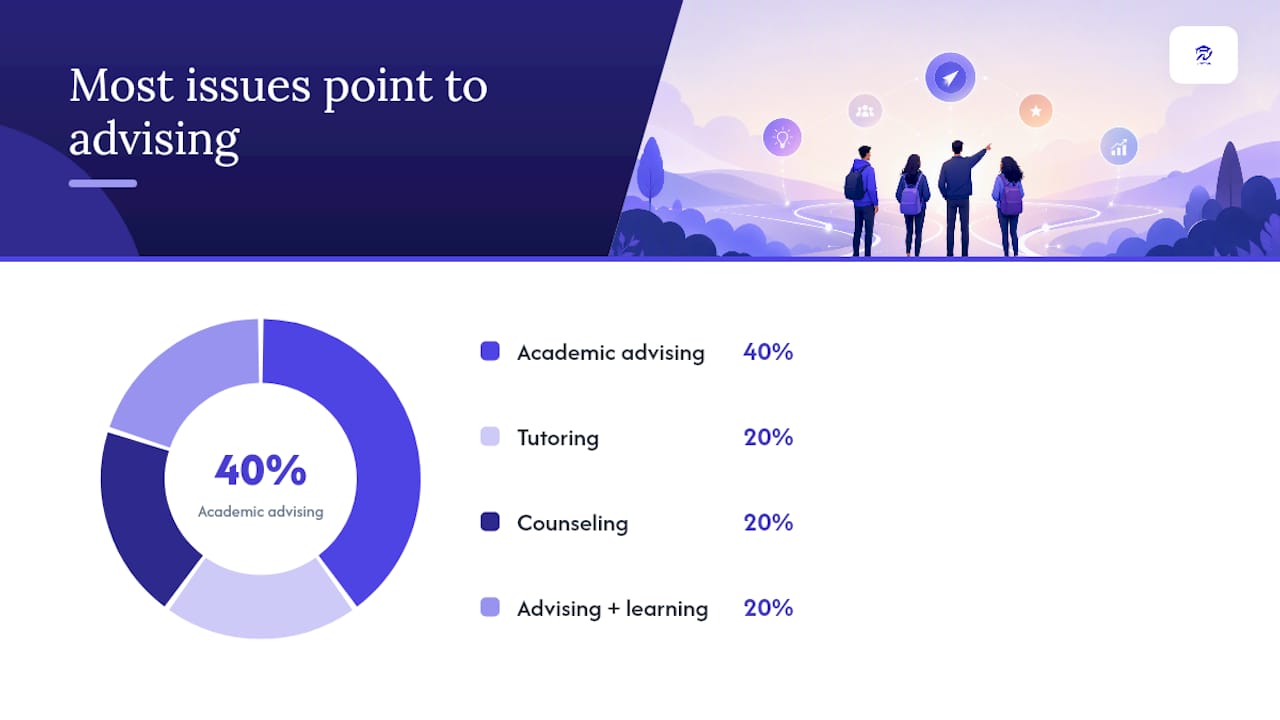
Advisors also connect students to campus resources beyond tutoring — extracurriculars, internships, study abroad, and professional networks — making the relationship more valuable than a single appointment suggests.
When to book advising: timing and priority moments
Timing matters. An advising appointment booked the week before finals, or the day before registration closes, is rushed and less useful than one scheduled with lead time.
Book immediately if:
- A teacher or professor has flagged your child’s performance in writing.
- Grades have dropped across two or more subjects in the same term.
- Your college student has failed or withdrawn from a required course.
- Your student mentions they don’t know what classes to take next.
- Graduation is within two years and no formal degree audit has happened.
Schedule proactively (routine triggers):
- Before each registration period — at least three to four weeks out.
- After a long plateau (no improvement despite effort over a full semester).
- When a major change, minor addition, or transfer is being considered.
- At the start of each academic year, even if things seem fine.
Every degree-seeking undergraduate is assigned an advisor at matriculation; early outreach before registration improves the quality of planning and avoids the rushed conversations that happen during peak periods. Advisors are busiest in the two weeks before registration opens — reach out before that window.
Pro Tip: Use drop-in advising for quick, urgent questions (“Is this course a prerequisite for X?”). Reserve scheduled appointments for bigger conversations — major changes, graduation audits, or multi-semester planning.
How parents should prepare and support the advising process
Your role is to support, not steer. The most effective parent in an advising context is one who shows up prepared, asks good questions, and then lets the student own the conversation.
What to bring to the meeting:
- Recent report cards or grade printouts (last two semesters minimum)
- Any teacher notes, progress reports, or flagged assignments
- The student’s current schedule and any planned changes
- For college students: a screenshot of the degree audit or credit summary from the SIS portal
- A short list of the student’s own concerns (written by the student, not the parent)
Sample questions to ask the advisor:
- Which requirements has my child completed, and which are still outstanding?
- Is the current course sequence putting graduation at risk?
- What would a major change cost in time and credits?
- What campus resources do you recommend for this specific situation?
- When should we schedule the next check-in?
A note on FERPA for college students: Once a student turns 18 or enrolls in a postsecondary institution, FERPA (the Family Educational Rights and Privacy Act) transfers educational record rights to the student. Advisors at U.S. colleges generally cannot share grades or academic details with parents without the student’s written consent. The practical fix: have your student sign a FERPA release form through the registrar’s office before the meeting, or attend together so the student can share directly.
A diagnostic conversation with the teacher first gives you classroom context that makes the advising appointment more productive — you’ll know whether the issue is content, behavior, or organization before you walk in.
Pro Tip: Frame the advising appointment to your child as “figuring out the best plan,” not “fixing a problem.” Students who feel supported rather than managed are more likely to follow through on the advisor’s recommendations.
How to find your child’s advisor and schedule the appointment
Step-by-step for K–12:
- Email or call the homeroom or subject teacher first — ask for their read on the situation.
- Contact the school’s guidance counselor office directly; most schools list counselors by grade or last name on the school website.
- Request a three-way meeting: parent, counselor, and teacher together when possible.
- Ask the counselor whether a formal referral to a specialist (reading specialist, school psychologist) is warranted.
Step-by-step for college:
- Log into the student’s SIS portal (common systems: Banner, PeopleSoft, Workday) and look for an “My Advisor” or “Advising” tab — most U.S. universities list the assigned advisor there.
- Visit the department or college advising page directly (e.g., College of Engineering Advising, College of Arts and Sciences Advising).
- Use the scheduling tool linked from that page — many schools use EAB Navigate, Starfish, or a similar platform for booking.
- If no appointment is available within a week, use drop-in advising for an initial triage conversation.
- Bring documentation (see the parent prep section above) to the first meeting.
Drop-in vs. scheduled appointments:
- Drop-in: best for quick, specific questions; no documentation needed; first-come, first-served.
- Scheduled: required for complex conversations (graduation audit, major change, academic probation); allows the advisor to pull records in advance.
After the first meeting, ask the advisor to send a follow-up email summarizing what was discussed and the next steps. That written record is your accountability tool.
How high school advising differs from college advising
The core goal is the same — keep the student on track — but the structure, accountability, and privacy rules are different enough that parents need to adjust their approach at each stage.
| Feature | High school | College |
|---|---|---|
| Who manages credits | School counselor tracks graduation requirements | Student is responsible; advisor guides |
| Advising model | Centralized (one counselor per grade band) | Often decentralized by major/department |
| Parent access | Parents have full access to records | FERPA limits access without student consent |
| Meeting frequency | Typically annual or as-needed | Recommended at least once per semester |
| Referral process | Counselor coordinates with teachers directly | Advisor refers to separate campus offices |
| Graduation planning | Counselor monitors 4-year plan | Student must proactively audit progress |
The biggest practical shift: in high school, the counselor often comes to the student (flags, check-ins, group sessions). In college, the student must initiate. That shift catches a lot of families off guard, especially in the first year.
Decentralized advising models place students with advisors who know their major’s curriculum; meeting the major-specific advisor as early as possible prevents the sequencing errors that are hardest to fix later.
For parents helping a student choose or reconsider a college major, the college advising appointment is the right place to start that conversation formally.
How digital degree-planning tools complement advising
An advisor gives your student expert guidance. A planning tool gives both of you a clear picture of where things stand before and after that conversation. Those two things work well together.
Univyze is a degree-planning platform, not an official degree audit or a replacement for an advisor. What it does is give students and parents a visual, term-by-term map of the degree path, so the advising conversation starts from a shared, concrete picture rather than a vague sense that “something seems off.”
Features that directly support the advising process:
- Term-by-term planning that shows which courses are needed each semester
- What-if scenario analysis for major changes or minor additions
- AP credit, dual enrollment, and transfer credit integration
- Schedule conflict checks before registration
- Progress tracking parents can view alongside their student
A practical scenario: A sophomore is at risk of a delayed graduation because she took two electives that don’t count toward her major requirements. Her advisor identifies the gap. With a student success dashboard, she and her parents can immediately see which remaining required courses fit into the next two semesters, which ones are offered in summer, and whether an overloaded semester is avoidable. The advisor’s recommendation becomes a plan, not just advice.
Proactive advising before registration or major changes prevents many degree delays. Advisors are often busiest around registration — reach out early to secure thoughtful, not rushed, planning.
Pro Tip: Before your student’s next advising appointment, use Univyze to pull a snapshot of completed and remaining requirements. Walking in with that visual gives the advisor a faster starting point and makes the meeting more productive.
Always verify official degree requirements with your university’s catalog, registrar, and assigned advisor. Univyze reflects planning scenarios — the official record lives with your institution.
What I’d tell any parent who’s worried right now
Recognizing that your child needs help is not a failure — it’s the job. The parents who act on the early signals (the avoidance, the vague complaints, the one bad test that turns into three) give their kids the most time to course-correct. Waiting for a crisis to confirm what you already suspected just shrinks the window.
The practical steps this week: contact the teacher or counselor, pull the grades and attendance record, and book the appointment. Then step back and let the student own the conversation with the advisor. Your job after that is follow-up — check in at four to six weeks to see whether the plan is being implemented, not just agreed to.
Progress in academics rarely looks like a straight line up. What you’re watching for is whether the direction changes after intervention.
Univyze helps families see the full degree picture
When an advisor recommends a new course sequence or flags a graduation risk, the next question is always: “So what does the plan actually look like?” That’s where Univyze fits in.
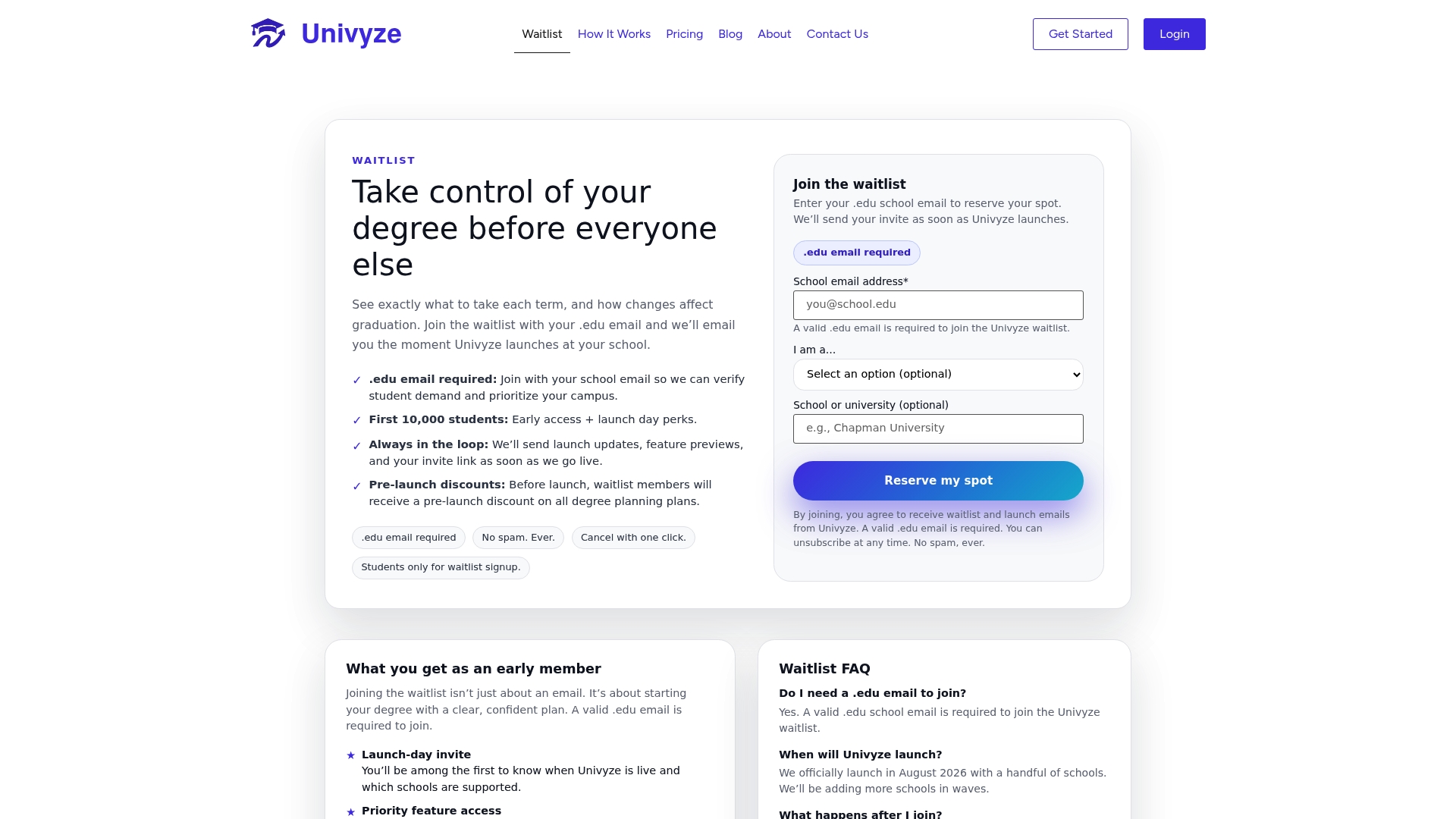
Univyze gives college students and their parents a term-by-term degree plan that maps real course offerings against degree requirements, so nothing falls through the cracks between advising appointments. You can model what-if scenarios for major changes, see how AP or transfer credits apply, check for schedule conflicts before registration, and track progress toward graduation in one place. It’s a planning complement to your advisor, not a substitute for one.
Ready to see where your student stands? Join the Univyze waitlist and get early access to the planning dashboard built for students who want to graduate on time.
Sources
These are the official and vetted resources worth bookmarking before your first advising appointment.
- Advising at Tech — Georgia Tech
- Academic advising — San Diego State University
- Academic advising FAQs — UW-Green Bay
- Academic advising vs. tutoring — Novel Education Group
Academic advisors are most effective when students treat the relationship as a collaborative partnership — not a one-time fix, but an ongoing check-in that keeps the degree path clear and the timeline realistic.
FAQ
How do you know if your child needs a tutor vs. an advisor?
If the struggle is limited to one subject and the student understands the material in class, a tutor is the right first step. If grades are dropping across multiple subjects, assignments are chronically missing, or the student seems lost about their overall academic path, advising addresses those broader patterns more effectively than tutoring alone.
How often should a student meet with their academic advisor?
At minimum, once per semester — and always before registration. Proactive advising before registration or major milestones prevents degree delays and catches requirement changes before they become problems; students navigating a major change or academic probation should meet more frequently, roughly every four to six weeks.
What should a parent bring to an academic advising appointment?
Bring recent grades, attendance records, any teacher notes or progress reports, and for college students, a screenshot of the current degree audit from the SIS portal. Having that documentation ready lets the advisor spend the meeting on solutions rather than gathering basic information.
How can I tell if my child is ready for college-level advising independence?
Look for whether your student can articulate which courses they need, why, and what comes next. If they can’t answer those questions clearly, they likely need more structured advising support — and a planning tool like Univyze can help them build that clarity before they walk into the advisor’s office.