

Before you commit to a school, six questions will tell you more than any campus brochure: What is my actual net price after aid? What is the four-year graduation rate for my intended major? Who teaches the required courses? Is housing guaranteed? What support services exist for mental health and disability accommodations? And what do graduates in my field actually earn? Get written answers to those before you deposit a single dollar.
Here is a portable checklist you can text to a parent or pull up on a campus visit:
- Net cost: “Can you run my profile through the Net Price Calculator and give me a written estimate?”
- Graduation timeline: “What percentage of students in this major graduate in four years, and what are the most common reasons for delays?”
- Who teaches: “Are required 100- and 200-level courses taught by professors or graduate teaching assistants?”
- Housing guarantee: “Is on-campus housing guaranteed for first-year students, and for how many years?”
- Support services: “How do I access mental health counseling, and is there a session limit or wait time?”
- Career outcomes: “Can you share program-specific placement rates and average starting salaries in writing?”
Who to ask: Net cost goes to the financial aid office. Graduation timelines belong to the department chair or registrar. Housing questions go to the residential life office. Career outcomes go to career services, not admissions. The FTC advises getting financial and program promises in writing and using College Scorecard to verify debt and outcome data independently.
Table of Contents
- How to prioritize your questions and who on campus actually answers them
- 1. What to ask about academics and major fit
- 2. What to ask about admissions, costs, and financial aid
- 3. What to confirm about housing and dining
- 4. What to ask about campus life and student culture
- 5. What to verify about safety, health, and campus support
- 6. What to ask about career services and post-graduation outcomes
- 7. How to get the most out of a campus visit
- 8. What to ask current students and alumni
- 9. How to compare schools using a decision matrix
- 10. How to verify course sequencing and graduation risk
- Key Takeaways
- The question most students forget to ask
- Univyze turns your answers into a term-by-term graduation plan
- Useful sources for verifying claims before you enroll
- FAQ
How to prioritize your questions and who on campus actually answers them
Not every question deserves equal weight, and the wrong person will give you a vague or optimistic answer. Map your priorities first: cost, major certainty, campus life, or commute. Then route each question to the office that holds the binding answer.
| Category | Best source | Why |
|---|---|---|
| Net price and aid deadlines | Financial aid office | Admissions reps quote sticker price; financial aid gives the real number |
| Course sequencing and transfer credits | Registrar | Binding policies live here, not in a brochure |
| Major curriculum and research | Department advisor or chair | They know which courses bottleneck and when sections fill |
| Housing options and meal plans | Residential life office | Policies change year to year |
| Career outcomes and internships | Career services director | They track placement data admissions cannot verify |
| Daily life, food, social scene | Current students | No office can replicate this |
Admissions offices advise preparing targeted questions for each campus office rather than directing everything to admissions reps, who are trained to sell the school, not audit it.
Pro Tip: Schedule separate appointments with the department and the registrar on the same visit day. Admissions reps can answer logistics like deadlines and acceptance rates, but they rarely know whether Organic Chemistry II is offered every semester or only in the fall.
Sample scripts you can use:
- On a tour: “I’m interested in [major]. Could you connect me with someone in that department today, or give me a direct email for the department advisor?”
- On a phone call: “I’d like a written net-price estimate based on my family’s income. Who in financial aid handles that?”
- At an info session: “What’s the most common reason students in this program take longer than four years to graduate?”
1. What to ask about academics and major fit
The department visit is where the real picture emerges. Admissions materials describe programs in their best light; faculty and current students describe them accurately.
Who teaches your courses? At large research universities, introductory courses in high-demand majors are often taught by graduate teaching assistants, not tenure-track professors. Ask specifically whether the 100- and 200-level required courses in your intended major are taught by faculty. The student-to-faculty ratio published on a school’s website is a university-wide average; your actual experience in a 300-seat lecture hall is different.
Ask the department advisor for a sample four-year plan and then ask how many students in the major actually follow it. If the answer is “most students take five years,” that is a cost signal, not just a scheduling inconvenience. U.S. News recommends asking departmental staff directly about retention and graduation rates because program-specific data rarely appears on a school’s main website.
Pro Tip: Ask: “How often is [required course] offered, and does the department hold seats for declared majors?” A course offered once a year with no seat protection is a graduation bottleneck waiting to happen.
Other questions worth asking the department:
- Does the program have an honors track, and what are the admission requirements?
- Are undergraduate research positions available, and how competitive are they?
- What study-abroad programs are affiliated with this major, and do credits transfer cleanly?
- How does the department support students who arrive undecided or want to switch concentrations?
For help thinking through how to choose the right college major before you even get to the department visit, that groundwork pays off in sharper questions.
2. What to ask about admissions, costs, and financial aid
The published tuition figure is almost never what you will pay. Your real question is the net price: tuition plus fees plus room and board minus all grants and scholarships. That number can differ from the sticker price by tens of thousands of dollars.
Start with the Net Price Calculator. Every accredited school is required to post one. Run it with your actual family income and assets, then ask the financial aid office to confirm the estimate in writing. The FTC recommends using the Net Price Calculator alongside College Scorecard, which publishes program-level graduate earnings and median debt figures so you can judge whether the investment makes sense for your intended field.
Scholarship renewal rules are where students get blindsided. Merit awards commonly require a minimum semester GPA and a full-time credit load to renew. Losing eligibility mid-degree can add semesters and thousands in unplanned costs. Get the renewal criteria in writing before you accept any award.
Questions to ask financial aid directly:
- What is the total cost of attendance, including mandatory fees, average textbook costs, and transportation?
- Are institutional scholarships guaranteed for all four years, or are they renewable based on conditions?
- What is the deadline to appeal a financial aid award, and what documentation is required?
- Are there supplemental scholarships I can apply for after admission?
For a broader look at student financial aid options in 2026, understanding aid types before your visit helps you ask sharper questions at the financial aid office.
Pro Tip: Ask the financial aid office: “What happens to my institutional scholarship if I drop below full-time status for a medical or personal reason?” The answer reveals how flexible the school actually is.
3. What to confirm about housing and dining
Housing questions have a way of surfacing costs and constraints that never appear in the viewbook. Ask them early, because policies vary significantly between schools.
Is on-campus housing guaranteed for first-year students? Some schools guarantee it; others run a lottery. If a guarantee exists, ask how many years it covers and whether students are required to live on campus for a set period. That requirement affects your budget directly.
Confirm the roommate selection process: is it self-selected through a portal, randomly assigned, or based on a compatibility survey? Ask whether single rooms are available and at what cost premium. Some residence halls have themed living-learning communities tied to specific majors or interests, which can be a genuine advantage for students who want built-in community.
Pro Tip: Ask to see a sample housing contract and ask specifically about the process for requesting a roommate change. A school with a clear, low-friction appeals process signals that residential life takes student wellbeing seriously.
Meal plan questions worth asking:
- What meal plan tiers are available, and what is the cost difference between them?
- Are dietary accommodations available for vegetarian, vegan, or allergy-specific needs?
- Can meal plan dollars roll over between semesters, or do unused credits expire?
- What are the realistic off-campus dining options if you live in a residence hall without a car?
4. What to ask about campus life and student culture
A campus visit tells you a lot, but the most useful information comes from students who have no reason to sell you on the school. The Princeton Review recommends speaking with as many current students as possible, because their candid answers reveal the daily reality that admissions materials smooth over.
Ask a student: “What do you actually do on a Friday night?” and “Where do students hang out between classes?” Those two questions tell you more about campus culture than any organized tour. Follow up with: “What’s the one thing you wish you’d known before enrolling?”
Quick checklist for evaluating cultural fit:
- Is there visible diversity across racial, ethnic, and socioeconomic groups on campus?
- Do students from different backgrounds interact, or does the campus feel socially siloed?
- How active is Greek life, and does it dominate the social scene or coexist with other communities?
- Are there active student organizations for your specific interests, and how easy is it to start a new one?
- What offices or resource centers exist for LGBTQ+ students, first-generation students, veterans, and student parents?
University of Illinois Urbana-Champaign’s admissions blog organizes campus-visit questions by category and notes that student-body questions are especially revealing, particularly those about daily life and peer support.
5. What to verify about safety, health, and campus support
These questions feel awkward to ask, but they matter more than most students realize until they need the services.
Every college is required to publish an Annual Security Report under the Clery Act. Ask where it is posted and review it before your visit. It includes crime statistics by category and location, emergency notification procedures, and policies on sexual violence. Ask whether campus security officers are sworn law enforcement or a private security team, since that distinction affects their authority to respond to incidents.
Counseling and mental health services vary dramatically between schools. Some campuses offer unlimited sessions with licensed counselors; others cap appointments at six to eight per year. Ask the health center directly: “What is the average wait time for a first counseling appointment?” If the answer is several weeks, that is a real gap in support. UW-La Crosse’s guidance points students toward asking about counseling availability and health services as part of standard campus-visit preparation.
Pro Tip: Ask: “If I have a mental health crisis at 2 AM, what is the after-hours contact process?” A school with a clear, staffed answer takes student wellbeing seriously. A vague answer is information too.
Also confirm:
- How does the school handle ADA accommodation requests, and what documentation is required?
- Where is the Title IX coordinator’s office, and how are complaints processed?
- Are there basic safety features like emergency blue-light stations and a campus shuttle service?
Campus resources play a measurable role in graduation success, and knowing what exists before you enroll helps you use those resources from day one.
6. What to ask about career services and post-graduation outcomes
Career services is one of the most underused offices on any campus, and the quality of it varies enormously. Ask pointed questions before you enroll, not after you graduate.
Pro Tip: Ask career services: “Can you connect me with a recent graduate from my intended major for a 15-minute conversation?” A school that facilitates that connection easily has a functioning alumni network. One that hesitates probably does not.
Questions to ask career services directly:
- Do employers actively recruit on campus, and which companies recruit specifically from my intended major?
- What is the internship placement rate for students in my program, and can you share that in writing?
- Is there a required internship or co-op component in my major, and is it credit-bearing?
- What does career advising look like: one-on-one appointments, group workshops, or both?
- Are there service-learning or experiential-learning options embedded in the curriculum?
Admissions reps can answer logistical questions about deadlines and campus policies, but program-specific salary data and employer partnerships require a direct conversation with career services. If they cannot produce written placement data for your major, treat that as a gap.
7. How to get the most out of a campus visit
A campus visit is a job interview in reverse: you are evaluating the school. Treat it that way.
Schedule meetings with at least five people: an admissions rep, a department advisor in your intended major, a housing staff member, a career services representative, and at least two current students. Admissions will often arrange these if you ask when booking your visit. If they cannot, that is worth noting.
Bring a printed list of your top-priority questions, your most recent transcript (useful if you want to discuss transfer credits or AP credit on the spot), and your phone for quick voice notes. Do not rely on memory. After each conversation, record the name of the person you spoke with and what they told you, especially any promises about financial aid, housing, or course availability.
Pro Tip: If you cannot visit in person, request a virtual one-on-one with a current student in your intended major, not just a group info session. Most schools will arrange this if you ask directly.
Sample scripts for sensitive questions:
- On scholarship renewal: “I want to confirm: if I maintain a [X] GPA and carry 12 credits per semester, is my merit award guaranteed for all four years? Can I get that in writing?”
- On course availability: “Is [required course] offered every semester, or only once a year? What happens if I cannot get a seat?”
- On transfer credits: “I have [X] AP credits and [Y] dual-enrollment credits. Can someone in the registrar’s office give me a preliminary written evaluation before I enroll?”
8. What to ask current students and alumni
Current students and alumni will tell you things no admissions rep will. The key is asking questions that invite honest answers rather than rehearsed ones.
Ask current students:
- What is your least favorite thing about this school?
- How hard is it to get into the classes you need each semester?
- Do professors actually hold office hours, and do students use them?
- What does the food situation look like after the dining hall closes?
- If you could change one thing about living here, what would it be?
Ask alumni:
- Did your major prepare you for your first job, or did you feel like you had to learn everything on the job?
- How useful has the alumni network been for job searching or career pivots?
- Were there any hidden costs or surprises in your final year that you did not anticipate?
Watch for patterns. If three different students mention that a specific required course is nearly impossible to get into, or that advising appointments take weeks to schedule, those are not isolated complaints. The Princeton Review notes that speaking with multiple students gives a fuller picture than any single conversation, precisely because consistent themes reveal systemic issues.
9. How to compare schools using a decision matrix
Once you have answers from two or more schools, gut feeling alone is a poor tiebreaker. A simple scoring matrix forces you to weigh what actually matters to you.
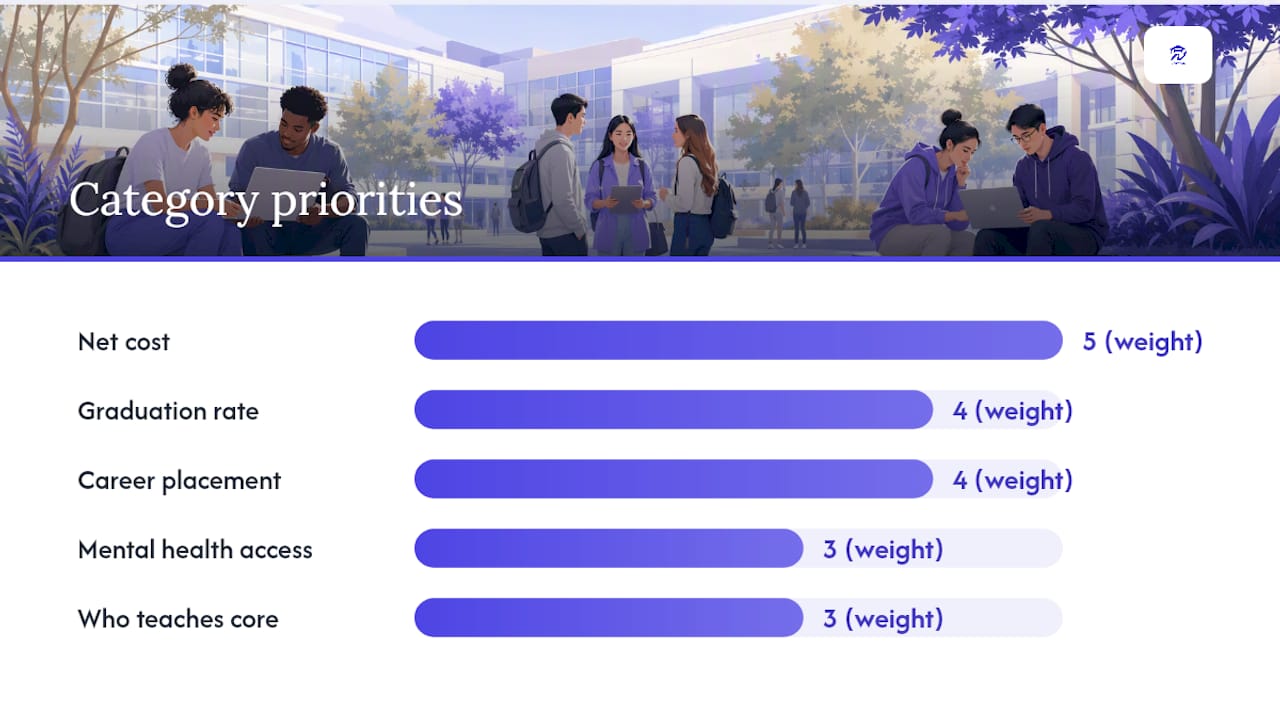
Sample decision matrix:
| Category | Weight (1–5) | School A | School B | School A score | School B score |
|---|---|---|---|---|---|
| Net cost (4-year estimate) | 5 | — | — | 2 | 5 |
| 4-year graduation rate (major) | 4 | — | — | 3 | 4 |
| Who teaches core courses | 3 | Mostly TAs | Mostly faculty | 2 | 4 |
| Housing guarantee | 3 | Yes, 1 year | Yes, 2 years | 3 | 4 |
| Career placement (written data) | 4 | Not provided | Provided | 1 | 4 |
| Mental health access | 3 | 3-week wait | Same-week | 2 | 5 |
Assign a weight of 1–5 to each category based on your priorities. Score each school 1–5 on that category. Multiply weight by score and sum the totals. The math will not make the decision for you, but it will surface trade-offs you might rationalize away otherwise.
Pro Tip: When two schools are within 10% of each other on total score, prioritize fit over small cost differences only if the higher-cost school has a demonstrably stronger career placement record for your specific major. Otherwise, the lower-cost school wins on pure financial risk.
A printable version of this matrix, alongside a college schedule-building checklist, gives you a concrete next step after your visits.
10. How to verify course sequencing and graduation risk
This is the step most students skip, and it is the one that costs them an extra semester.
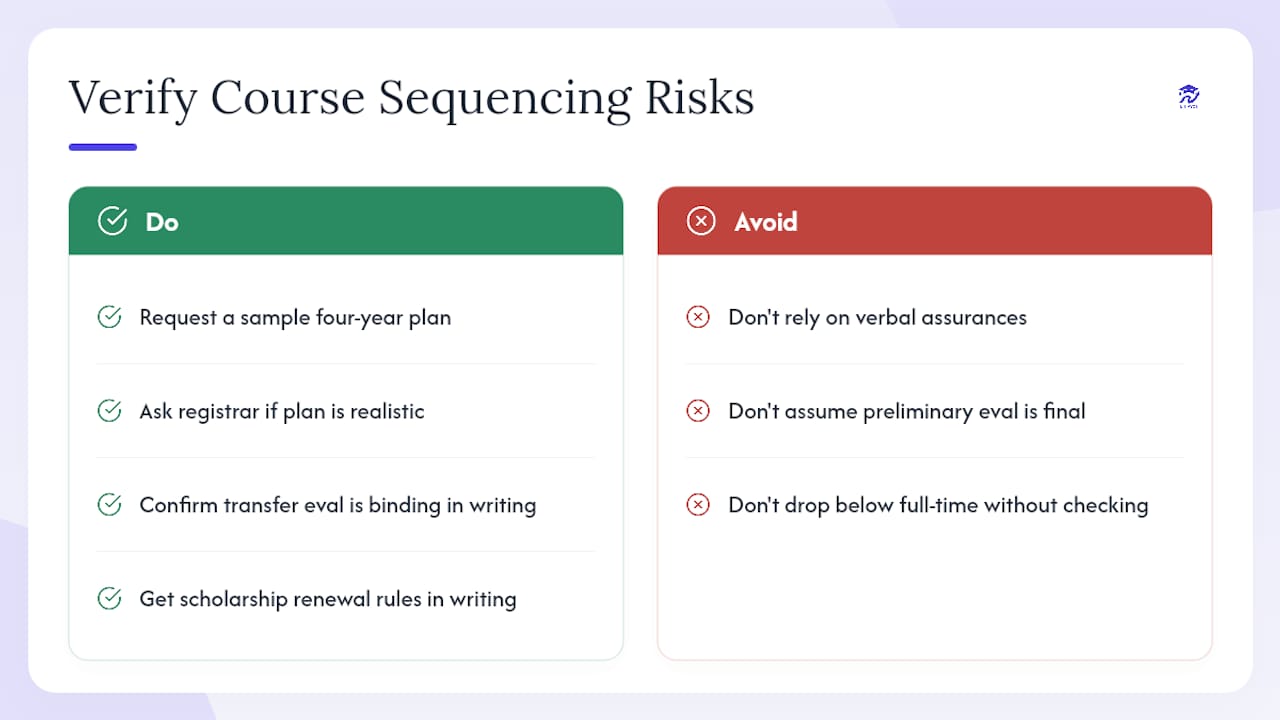
Request a sample four-year plan from the department for your intended major. Then ask the registrar two questions: “Is this plan realistic given current course availability?” and “What is the department’s written policy on transfer-credit acceptance?” Those two questions reveal whether the plan on paper matches the plan in practice.
Many schools require a completed application and official transcripts before issuing a binding transfer-credit evaluation. A preliminary evaluation is useful for planning, but confirm in writing whether it is binding or conditional. Verbal assurances from an admissions rep carry no weight once you are enrolled.
Scholarship renewal is the other hidden risk. Merit awards commonly require a minimum GPA and a full credit load each semester. If you drop a course due to illness or switch majors, you may lose eligibility without warning. Ask the financial aid office for the renewal criteria in writing and ask specifically: “What happens to my award if I need to drop below full-time status for one semester?”
Pro Tip: Keep a folder, digital or physical, with every written confirmation you receive: net-price estimates, transfer-credit evaluations, scholarship renewal criteria, and housing contracts. If a dispute arises after enrollment, written documentation is the only thing that matters.
Once you have those answers, Univyze can help you translate them into a term-by-term plan. Its degree planning tools let you map AP credits, dual-enrollment credits, and transfer credits against your degree requirements and run “what if” scenarios for major changes or schedule conflicts. Univyze supports your planning process; it does not replace your official degree audit, registrar, or academic advisor.
Key Takeaways
Asking the right questions before enrolling protects you from extra semesters, surprise costs, and programs that look stronger on paper than they perform in practice.
| Point | Details |
|---|---|
| Get net price in writing | Use the Net Price Calculator and ask financial aid for a written estimate based on your actual income profile. |
| Verify scholarship renewal rules | Merit awards often require a minimum GPA and full-time credit load; losing eligibility can add semesters and cost. |
| Ask departments, not just admissions | Course sequencing, graduation timelines, and research opportunities require answers from faculty and the registrar. |
| Use a decision matrix | Score schools on weighted categories to surface trade-offs you might otherwise rationalize away. |
| Univyze for term-by-term planning | Univyze helps you map answers into a graduation-ready schedule with AP credits, transfer credits, and what-if scenarios. |
The question most students forget to ask
Most students spend their campus visits asking about the things they can already see: the dorms, the dining hall, the rec center. The questions that actually protect your investment are the ones that feel slightly awkward to ask out loud.
Nobody walks into an info session and says, “What happens to my scholarship if I fail a class?” or “How often does the required course for my major actually have open seats?” Those questions feel presumptuous, or pessimistic, or like you are planning to fail. But they are the exact questions that determine whether you graduate in four years or five.
The schools that answer those questions directly, with specifics and in writing, are telling you something important about how they operate. The ones that deflect with “we have great support services” or “students rarely have those problems” are also telling you something.
There is a version of college planning that treats the enrollment decision as the finish line. It is not. Enrollment is the starting gun. The students who come out ahead are the ones who treat the pre-enrollment conversation as a negotiation, not a formality: they ask for written confirmation of financial aid terms, they request sample four-year plans, they talk to three current students instead of one, and they run the numbers on net cost before they fall in love with a campus.
The matrix in this article is not a guarantee of anything. But it forces you to weigh what you actually care about instead of what looks good in a brochure. That discipline, applied before you sign anything, is worth more than any campus tour.
Univyze turns your answers into a term-by-term graduation plan
You have done the hard work: asked the right questions, collected written answers, and compared schools on what actually matters. The next step is translating those answers into a schedule that holds together across four years.
Univyze is built for exactly that moment. Its automatic term-by-term planning maps your AP credits, dual-enrollment credits, and transfer credits directly against your degree requirements, so you can see at a glance which semesters are overloaded and which courses are prerequisites for the ones you need junior year. The “what if” feature lets you model a major change or a dropped course without losing track of your graduation timeline. Parents and advisors can view the same dashboard, which means fewer surprises for everyone.
A student checking whether Organic Chemistry II is available next spring, and whether missing it pushes back their graduation by a full year, can run that scenario in Univyze in minutes rather than waiting for an advisor appointment. Univyze supports your planning; your official degree audit, registrar, and academic advisor remain the authoritative sources for binding requirements.
Join the Univyze waitlist and start building a plan that actually accounts for how your degree works in practice.
Useful sources for verifying claims before you enroll
These are the authoritative places to check numbers and policies. No admissions rep’s word substitutes for a primary source.
- Choosing a College: Questions To Ask | Consumer Advice
- 50 Questions to Ask on a College Visit — Admissions Blog – University of Illinois Urbana-Champaign
- 60 Questions To Ask on Your College Tour | The Princeton Review
- 32 Questions to Ask on a College Visit | U.S. News
- 30 questions to ask your college admissions rep
- Top Online College Admissions Questions: What Prospective and Returning CSU Students Need to Know | The Link
FAQ
What are the most important questions to ask before enrolling?
The six non-negotiable questions cover net price, four-year graduation rate for your specific major, who teaches required courses, housing guarantees, mental health service access, and career placement data. Get written answers to all six before you commit.
What questions should I ask on a college visit?
Ask the department about course sequencing and who teaches core classes, ask financial aid for a written net-price estimate, ask housing about guarantee policies, and ask at least two current students what they wish they had known before enrolling. University of Illinois Urbana-Champaign’s admissions blog organizes 50 practical visit questions by category.
What should I ask college admissions representatives?
Admissions reps are the right source for deadlines, acceptance rates, housing logistics, and how to schedule department visits. For binding answers on financial aid, course availability, and transfer credits, route those questions to the financial aid office, registrar, and department directly, as Central Michigan University’s admissions guidance recommends.
What is a good question to ask current college students?
“What is your least favorite thing about this school?” and “How hard is it to get into the courses you need each semester?” produce the most honest answers. Consistent complaints across multiple students about advising, course bottlenecks, or hidden fees signal real systemic issues, not isolated bad luck.
How can I compare colleges objectively after collecting answers?
Build a weighted decision matrix: assign each category (net cost, graduation rate, career placement, housing, support services) a weight of 1–5 based on your priorities, score each school on that category, and multiply. The totals surface trade-offs that gut feeling alone tends to hide.