

The strongest MyMajors.com alternatives do two things well: they help you figure out which major fits you, and they help you track whether you’re actually on pace to finish it. Most college major finder tools stop at the first job. The best ones go further.
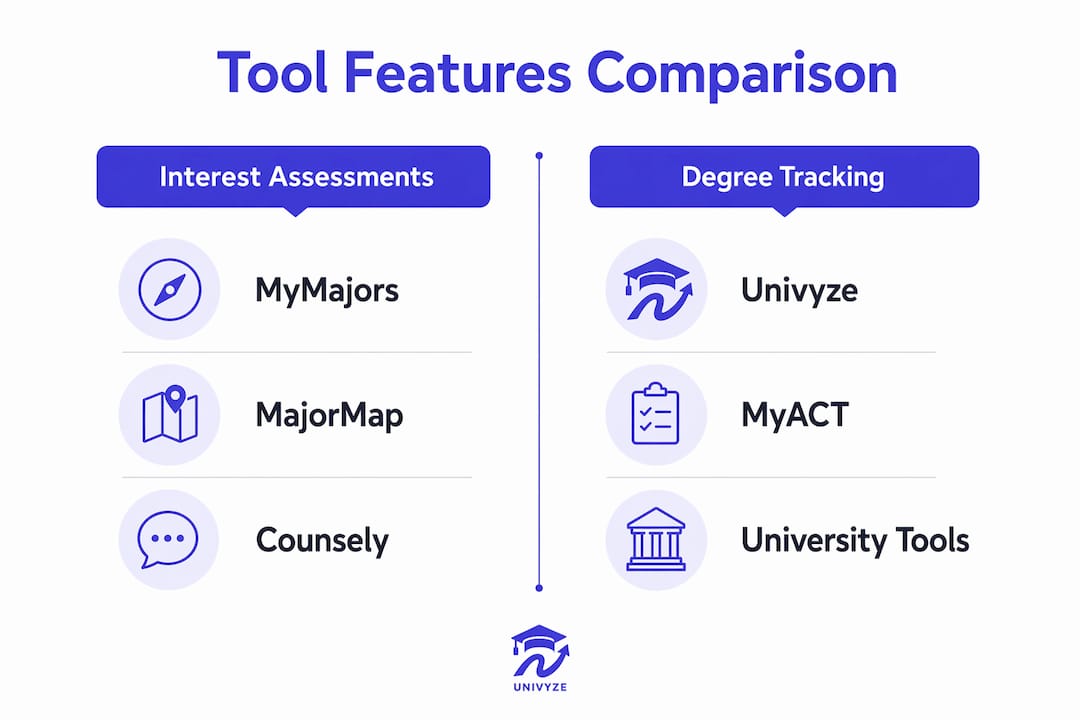
Here’s a quick look at the top options:
- MajorMap — Free, 36-question Holland Code assessment with degree and career matches; no paywall
- Counsely — 60-question interest profiler tied to U.S. Department of Labor data; free account required to save results and access curriculum planning
- MyACT (ACT’s College Majors Map) — Matches ACT inventory results to more than 1,500 majors; requires a MyACT account
- Univyze — Goes beyond interest assessment to provide a dynamic dashboard that maps degree requirements against real course offerings, term by term
If you’re a student or parent trying to avoid extra semesters and surprise tuition bills, the combination of a solid interest assessment plus a degree progress tracker is what actually moves the needle.
Why picking the right major early saves real money
Over 80% of college students change their major at least once, often leading to lost credits, prerequisite restarts, and semesters added to your timeline.
Choosing a compatible major early reduces that risk. Students who find a well-matched major tend to stay on track with their course sequences rather than scrambling to rebuild them after a switch. Interest assessments give you direction, but they don’t tell you whether your credits are stacking up correctly toward a degree.
The real planning gap: Standard interest assessments don’t track degree progress or institutional requirements. Students often mistake an interest profiler for a degree audit. They’re not the same thing.
The financial stakes are real. Every extra semester adds tuition, housing, and living costs. Proactive planning, combining major exploration with credit tracking, is the most practical way to protect your timeline and your budget.
What the leading academic planning tools actually offer
MajorMap
MajorMap uses 36 questions built on the Holland Code (RIASEC) framework, the same model behind the Strong Interest Inventory and the U.S. Department of Labor’s ONET database. It’s completely free, with no trial period or credit card required. Results include your Holland Code, degree matches, career matches with salary data from ONET/BLS, and a college fit guide. Other platforms charge $20–$60 for comparable assessments.
Counsely
Counsely’s interest profiler runs 60 questions based on the O*NET Interest Profiler developed by the U.S. Department of Labor. Most students finish in under five minutes. A free account is required to save results, and that account also unlocks the Curriculum Planner, which connects your interest profile to course recommendations. Counsely also notes that profile results help students write more authentic “Why This Major” essays and identify relevant extracurriculars for college applications.
MyACT College Majors Map
ACT’s built-in major exploration tool organizes more than 1,500 majors into 13 groups and color-codes them based on your ACT inventory results. It’s a strong option if you’ve already taken the ACT, since your test data feeds directly into the recommendations. You’ll need a MyACT account to access the inventories.
Univyze
Univyze takes a different approach. Rather than stopping at major discovery, it integrates degree requirements with actual course offerings in a term-by-term dashboard. It supports AP credit, dual enrollment, transfer credits, summer sessions, and what-if planning for potential major changes. Parents can also see their student’s progress, which helps reduce the guesswork on both sides.

Pro Tip: Use a major exploration tool like MajorMap or Counsely first to narrow your options, then layer in a degree tracking tool to confirm those majors are actually achievable within your target timeline at your specific school.
How to choose a major and plan your degree without wasting credits
Treat any interest assessment as a starting point, not a final answer. MajorMap, Counsely, and similar tools surface patterns in your interests and connect them to broad career categories. That’s genuinely useful. But a national interest match doesn’t replace your school’s official degree requirements, and major requirements vary significantly by institution.
Here’s a practical sequence that works:
- Complete an interest assessment (MajorMap or Counsely) to identify two or three candidate majors
- Pull the official degree requirements from your university catalog for each candidate major
- Map out a rough course sequence for each, noting which credits would transfer across options
- Use a degree tracking tool to visualize which path fits your current credits and timeline
- Verify everything with your academic advisor and official degree audit before registering
Building a flexible course sequence matters especially in the first two years. Many lower-division courses count toward multiple majors, so choosing them carefully keeps your options open without wasting units. When you’re ready to build a multi-year plan, having your credits mapped against actual requirements makes the process far less stressful.
Pro Tip: Your interest profile results can directly strengthen your college application. Counsely specifically notes that profile results help students write more authentic “Why This Major” essays and identify extracurriculars that align with their interests.
What is MyMajors.com and how does it work?
MyMajors.com is a 15-minute online assessment backed by the National Science Foundation. It factors in academic achievement, aptitude, and personal interests to recommend a ranked list of best-fit majors. According to MyMajors, students who engage with the right major graduate at up to 22% higher rates than the national average. The platform serves both individual students and institutions, offering college-specific versions that match students to programs at a particular school. It’s free for students and also has tools for high school counselors and college administrators.
Other tools worth knowing for major and career planning
Beyond the platforms already covered, a few other resources round out the picture. Arizona State University’s me3® quiz uses a Euclidean distance matching algorithm to compare your RIASEC score against more than 500 careers from U.S. Department of Labor data, then maps results to ASU degree programs. It’s a strong example of how a university-specific tool can go deeper than a generic assessment. For a broader comparison of career assessment tools, NueCareer’s 2026 roundup covers several platforms with different methodologies and price points.
Best practices in degree tracking and planning
Degree tracking works best when it’s dynamic, not static. A printed checklist or a one-time advising appointment gives you a snapshot; a live dashboard gives you a running picture. The most effective approach connects your actual completed credits to your remaining requirements and flags conflicts before they become problems.
Key habits that protect your timeline:
- Review your degree progress at the start of every term, not just at registration
- Account for AP credits, dual enrollment units, and transfer credits from the beginning
- Run a what-if scenario before switching majors to see exactly which credits carry over
- Confirm your plan with your registrar and advisor before finalizing your schedule
Why traditional interest assessments have real limits
Interest assessments are built to surface preferences, not to audit progress. A quiz that tells you “you’d be a good fit for biology” cannot tell you whether BIO 101 at your school is a prerequisite for BIO 220, or whether you need to take it before junior year to stay on track. That gap is where students lose semesters.
Authentic degree progress tracking uses dynamic tools and formative portfolios that align with real-world academic tasks and institutional requirements, rather than static quizzes. The distinction matters because a student who relies only on an interest assessment for planning may feel confident about their major while quietly falling behind on the actual requirements.
Why authentic degree progress tracking changes outcomes
Tracking degree progress in real time gives students and parents a shared, accurate picture of where things stand. When a student can see exactly which requirements are complete, which are in progress, and which are still outstanding, they make better registration decisions. They’re less likely to take a course that doesn’t count, and more likely to catch a missing prerequisite before it derails a semester.
This kind of visibility also helps parents have more productive conversations with their students. Instead of asking “are you on track?” and getting a vague answer, they can look at the same dashboard and ask specific questions. You can learn more about tracking graduation progress and what that looks like in practice.
How the top tools compare on features and accuracy
| Tool | Assessment Length | Framework | Degree Tracking | Cost |
|---|---|---|---|---|
| MyMajors.com | 15 minutes | Proprietary + NSF-backed | No | Free |
| MajorMap | 36 questions | Holland Code (RIASEC) | No | Free |
| Counsely | 60 questions | O*NET / U.S. Dept. of Labor | Curriculum planner only | Free (account required) |
| MyACT | Varies | ACT inventories | No | Free (ACT account required) |
| Univyze | N/A | Degree requirements + course data | Yes, term-by-term | See univyze.com |
The pattern is consistent: interest-based tools are free and widely available, but none of them track whether your actual credits are moving you toward graduation. That’s the gap Univyze fills.
What students and parents say about these tools
Students who use interest assessments consistently report that the results feel accurate enough to be useful as a starting point, but not specific enough to replace real advising. MajorMap’s free access and immediate results get positive mentions from students who want a quick, no-commitment read on their options. Counsely’s longer assessment tends to feel more thorough, and the curriculum planner feature is a meaningful step beyond what most free tools offer.
The most common frustration across all interest-based tools is the same: students complete an assessment, get a list of majors, and then have no clear path from “I might like biology” to “here’s exactly what I need to take and when.” That’s the planning layer these tools don’t provide on their own.
How well do these tools work across different schools?
Interest assessments like MajorMap and Counsely produce results based on national career and major data, which means they work regardless of which school you attend. The tradeoff is that they can’t account for your specific institution’s course offerings, prerequisite chains, or graduation requirements. A major that looks straightforward nationally might have a bottleneck course at your school that fills up fast.
University-specific tools like ASU’s me3® solve this by tying results directly to programs at that institution. For students at other schools, the practical workaround is to use a national assessment for direction and then verify the details against your school’s official catalog and degree audit system. Univyze addresses this by integrating real course offerings with degree requirements at the institutional level, so the planning reflects what’s actually available at your school.
Univyze gives you a clearer path from major choice to graduation
Most major exploration tools hand you a list and wish you luck. Univyze picks up where they leave off.
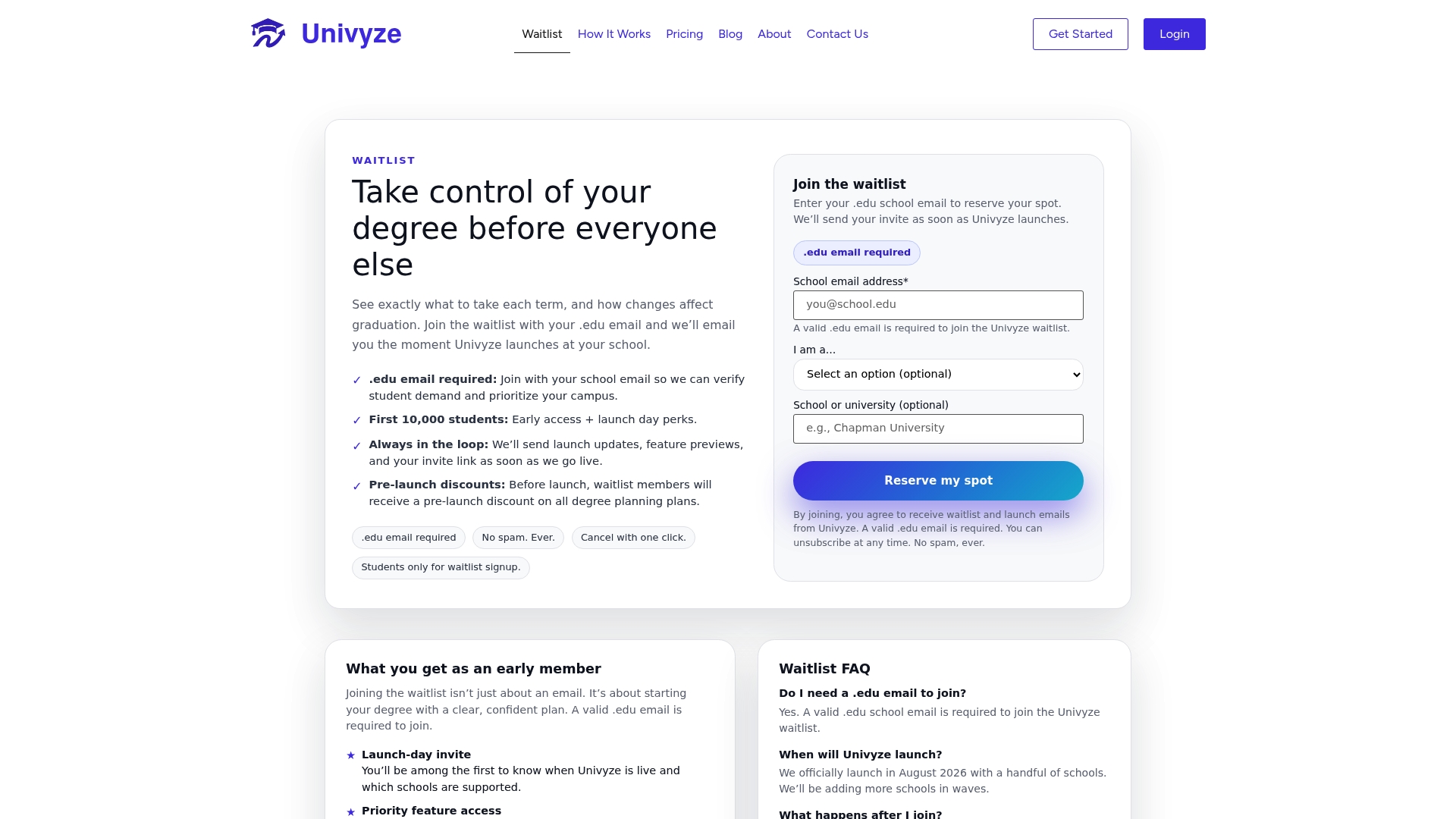
The difference is the dashboard. Univyze maps your degree requirements against real course offerings at your school and builds out a term-by-term plan you can actually follow. It accounts for AP credits, dual enrollment, transfer credits, and summer sessions from the start, so your plan reflects your real situation rather than a generic template. The what-if planning feature lets you model a major change before committing, so you can see exactly which credits carry over and which don’t.
Parents get visibility into their student’s progress without needing to decode a degree audit. Students get a clearer picture of what’s left and when to take it. Neither group has to rely on a once-a-semester advising appointment to know if things are on track.
Univyze is a planning tool, not an official degree audit or a replacement for your academic advisor. Always verify your plan with your registrar, university catalog, and advisor before finalizing your schedule. When you’re ready to see how term-by-term degree planning works in practice, join the Univyze waitlist and get early access.
Key Takeaways
Combining a validated interest assessment with a degree tracking tool is the most reliable way to choose a compatible major and stay on pace to graduate without extra semesters.
| Point | Details |
|---|---|
| Major changes are common | Over 80% of students change their major at least once, often adding semesters and costs. |
| Interest tools have limits | Standard assessments don’t track degree progress or institutional requirements. |
| MajorMap and Counsely are free | MajorMap uses 36 Holland Code questions; Counsely uses 60 O*NET-based questions with a free account for saving results. |
| Graduation rates can improve | Students matched to best-fit majors graduate at up to 22% higher rates than the national average. |
| Univyze adds the tracking layer | Univyze integrates degree requirements with real course offerings for term-by-term planning, including AP credits and transfer credits. |
FAQ
What is the best free alternative to MyMajors.com?
MajorMap is the strongest free option, offering a 36-question Holland Code assessment with degree matches, career matches, and salary data at no cost. Counsely is also free but requires a free account to save results.
Do any of these tools track actual degree progress?
Standard interest assessments like MyMajors.com, MajorMap, and Counsely don’t track degree progress or institutional requirements. Univyze is built specifically for that purpose, mapping your credits against real degree requirements term by term.
How accurate are online major assessments?
Tools based on validated frameworks like the Holland Code (RIASEC) or the O*NET Interest Profiler provide a reliable starting point, but no assessment can account for your specific school’s course offerings or prerequisite structure. Always verify results with your official degree audit and advisor.
Can interest assessment results help with college applications?
Yes. Counsely notes that interest profile results help students write more authentic “Why This Major” essays and identify extracurricular activities that align with their interests, which strengthens college applications.
Is Univyze a replacement for an academic advisor?
No. Univyze is a planning tool that helps students visualize their degree path and plan course sequences. Students should always verify their plan with their registrar, university catalog, and academic advisor before registering for classes.