

Tuition per credit hour is the dollar amount a college charges for each academic credit you earn. Your total tuition bill is simply that rate multiplied by the number of credits you enroll in. A student taking 15 credits pays base tuition equal to the per-credit rate multiplied by the number of credits for the semester. That math is the foundation of nearly every college tuition bill in the United States.
Here is what this means in practice:
- One credit hour = one unit of academic credit, typically earned by completing a course that meets for one hour of classroom instruction per week over a 15-week semester.
- Most courses carry 3 credit hours, so a standard semester course costs 3 × your per-credit rate.
- Full-time enrollment is generally 12–18 credits per semester; part-time is fewer than 12.
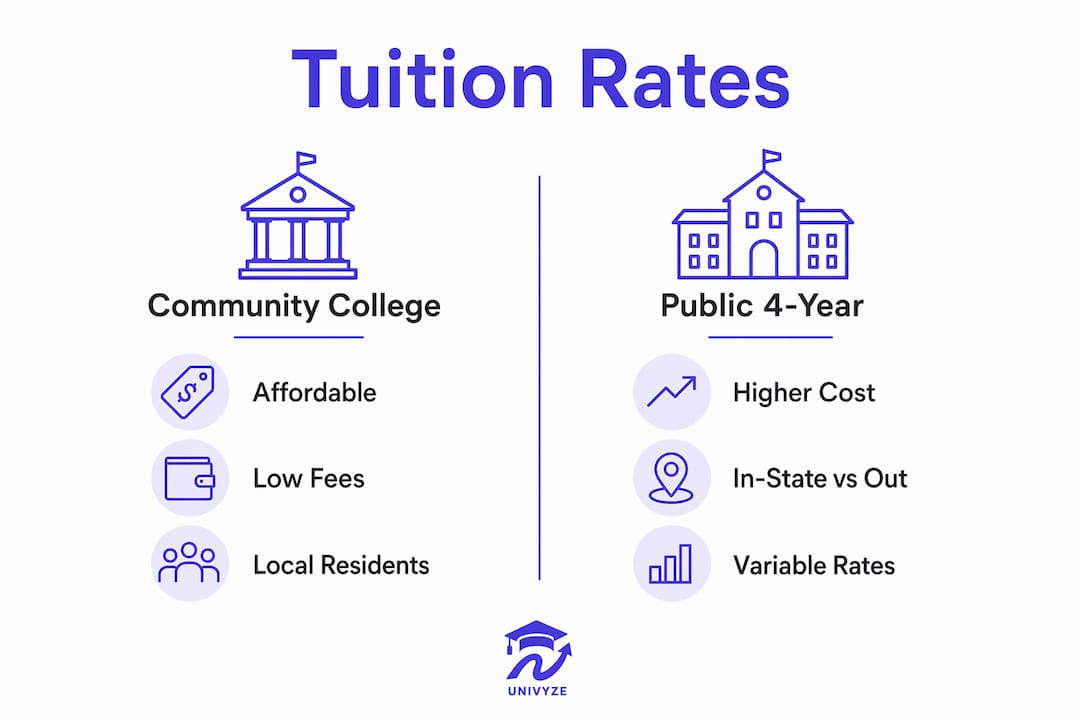
- Residency status matters. In-state students at public universities pay far less per credit than out-of-state students.
- Institution type matters just as much. Community colleges, public four-year universities, and private colleges each operate in a different price range entirely.
Understanding tuition rates by credit hour before you register gives you real control over your semester bill.
How much does tuition per credit hour actually cost?
The average public four-year university charges approximately $411 per in-state credit hour, putting a typical 3-credit course at about $1,234. Out-of-state students at the same schools pay dramatically more, often $900–$1,400 per credit hour. Private nonprofit universities operate on a different scale altogether, frequently charging $1,500–$2,000 or more per credit regardless of where you live.
Community colleges are the most affordable option by a wide margin. Maricopa County residents at Maricopa Community Colleges pay $97 per credit hour for lower-division courses, while out-of-county residents pay $546 per credit hour for the same class. Florida State University charges in-state undergraduates $215.55 per credit hour and out-of-state students $855.07. Northern Kentucky University sets its 2026–27 Kentucky/Ohio/Indiana resident undergraduate rate at $472 per credit hour, with non-residents paying $638.

| Institution type | Residency | Typical rate per credit hour |
|---|---|---|
| Public 2-year (community college) | In-district | $138 |
| Public university | In-state | $350–$550 |
| Public university | Out-of-state | $900–$1,400 |
| Private nonprofit university | N/A (no residency distinction) | ~$1,500–$2,000+ |
These ranges are starting points. Graduate programs, professional schools, and specific colleges within a university often carry their own rates on top of the base figures above.
What a credit hour means and how billing structures work
A credit hour represents one hour of classroom instruction per week across a standard 15-week semester, plus roughly two hours of outside study time for each of those hours. A 3-credit course therefore expects about nine hours of your week. Most bachelor’s degrees require 120 credit hours total, which is why understanding the per-credit cost compounds so quickly into a four-year budget.
Billing structures split into two main models:
- Per-credit billing: Part-time students (fewer than 12 credits) pay the per-credit rate for every credit they take. No flat rate applies.
- Flat-rate billing: Many universities charge a single semester rate once you hit full-time status, typically 12–18 or 12–19 credits. Penn State, for example, charges per credit up to 11 credits, then switches to a flat rate from 12–19 credits.
- Overload billing: Credits above the flat-rate ceiling (often 18 or 19) revert to the per-credit rate. At Penn State, anything above 19 credits is billed at the standard per-credit rate on top of the flat-rate charge.
- Summer sessions: Most universities do not apply flat-rate billing in summer. You pay per credit regardless of how many you take.
- Graduate vs. undergraduate rates: Graduate courses carry higher per-credit rates at virtually every institution. Taking a graduate-level course as an undergrad may trigger the higher rate.
- Labs and seminars: Some courses carry fewer credit hours than their contact hours suggest. Always confirm credit weight in the university catalog before assuming a course’s cost.
Mandatory fees and their impact on your real cost per credit
Base tuition is not what you actually pay. Mandatory fees charged per credit hour, including technology fees, student activity fees, health service fees, and facilities fees, can add more than $100 per credit hour depending on the institution. A school advertising $350 per credit hour in base tuition may cost $450 or more once fees are included.
Common per-credit fees to budget for:
- Technology fee: Covers campus IT infrastructure, software licenses, and online learning platforms.
- Student activity fee: Funds clubs, events, and campus organizations.
- Health services fee: Supports campus health centers and counseling services.
- Facilities or building fee: Contributes to campus construction and maintenance.
- Course-specific fees: Labs, studio arts, and clinical programs often carry additional per-course charges beyond the standard per-credit fee.
Financial advisors consistently recommend calculating total cost per credit by adding all mandatory fees to the base tuition rate before comparing schools. Looking only at advertised tuition can underestimate your actual semester bill by hundreds of dollars.
Pro Tip: Pull the full tuition and fees schedule from your school’s bursar or student accounts office, not just the headline tuition rate on the admissions page. The difference between those two numbers is often where budget surprises hide.
How smarter academic planning helps you manage tuition costs
Understanding your per-credit rate changes how you approach registration. If your school uses flat-rate billing between 12 and 18 credits, adding a fourth or fifth course within that band costs you nothing extra in tuition. That is one of the most underused levers in college cost management.
Practical strategies that actually move the needle:
- Stay within the flat-rate band. Taking 15 credits instead of 12 at a flat-rate school lowers your effective cost per credit without raising your bill.
- Avoid unnecessary overloads. Credits above the flat-rate ceiling revert to per-credit billing, so a 20-credit semester can spike your bill unexpectedly.
- Use AP, dual enrollment, and transfer credits wisely. Credits you bring in from high school or another institution reduce the total credits you need to pay for at your current school.
- Plan courses that count toward graduation. A class that does not fulfill a requirement is a credit you may need to retake, paying for it twice.
- Check course-level pricing. Some universities charge different rates by course prefix or college. An engineering course may cost more per credit than a general education course at the same school.
- Compare total cost per credit, not just base tuition. Include mandatory fees when evaluating schools or programs side by side.
Univyze is built for exactly this kind of planning. Its term-by-term dashboard maps your degree requirements against real course offerings, so you can see which courses count, when to take them, and how your credit load affects your bill each semester. It also accounts for AP credits, dual enrollment, transfer credits, and what-if scenarios when you are considering a major change. Univyze is a planning tool, not a replacement for your academic advisor or official degree audit. Always verify your requirements with your registrar and university catalog.

Ready to plan smarter? Join the Univyze waitlist and start mapping your path to graduation before your next registration window opens.
Key Takeaways
Tuition per credit hour is the single most useful metric for comparing college costs, projecting semester bills, and making registration decisions that protect your budget.
| Point | Details |
|---|---|
| Base rate varies widely | Public in-state four-year rates typically range from $350 to $550 per credit hour; public community colleges average around $138 per credit. |
| Residency changes everything | Out-of-state students at public universities often pay $900–$1,400 per credit hour versus in-state rates. |
| Flat-rate billing rewards full-time students | Taking 15 credits instead of 12 under a flat-rate model lowers your effective cost per credit with no added charge. |
| Fees raise the real cost | Mandatory per-credit fees can add more than $100 per credit hour on top of base tuition. |
| Plan courses that count | Credits that do not fulfill degree requirements cost the same as ones that do, making course planning a direct cost-control tool. |
FAQ
What does tuition per credit hour mean?
Tuition per credit hour is the amount a college charges for each academic credit you enroll in. Multiply that rate by your total credits to get your base tuition for the semester.
How much is 1 credit hour at a typical US college?
Rates vary by school and residency. Public four-year in-state students average around $411 per credit hour, while community college in-district rates can be as low as $97.
Is 3 credits the same as 3 credit hours?
Yes. A 3-credit course and a 3-credit-hour course are the same thing. Most standard college courses carry 3 credit hours, costing three times your school’s per-credit rate.
How many hours of work does 1 credit hour represent?
One credit hour typically equals one hour of classroom instruction per week over a 15-week semester, plus roughly two hours of outside study, for a total of about three hours of academic work per week.