

AP credit, dual enrollment, and transfer credits are three distinct ways to bring college-level work into your degree plan before or during your time at a four-year school. Understanding how AP credit, dual enrollment, and transfer credits affect your college plan is the difference between graduating on time and paying for an extra semester you did not expect. Each credit type follows different rules, carries different risks, and lands differently depending on where you enroll. Getting this right early saves real money and real time.
How do AP credits affect your college course planning and graduation timeline?
AP exam scores are not automatically applied for credit. Each college sets its own policy on qualifying scores and whether a passing score earns credit hours, placement into a higher course, or both. The College Board’s ACE recommendation is to award credit for a score of 3 or higher, but many selective universities require a 4 or 5, and some offer placement only with no credit hours attached.
The distinction between credit and placement matters more than most students realize. Credit reduces your total required hours, which can shorten your degree timeline and lower tuition costs. Placement lets you skip a course without reducing your credit requirement, meaning you still need to fill that slot with something else. A student who earns a 5 on AP Calculus BC at UCLA may satisfy two math requirements entirely. The same score at a more selective private school might only place them into a higher course.
Score thresholds also vary by subject. A score of 5 can clear a major requirement while a score of 3 may clear only a general education requirement or nothing at all. This means two students with the same AP score can have completely different outcomes depending on their school and major.
Timing is a practical factor that students frequently overlook. In 2026, AP exams cost $99 each, and free score sending is available until june 20 for may exams. Missing that deadline means paying for additional score reports, which can delay credit posting and affect your registration window.
- Check your target school’s AP credit policy by subject before you take the exam.
- Confirm whether the school awards credit hours, placement, or both for your score.
- Send official scores before the free deadline to avoid delays.
- Match your AP credits to your intended major requirements, not just general education.
- Keep a written record of each score and the corresponding credit policy at your school.
Pro Tip: Search “[Your College] AP credit policy” and look for the official registrar or admissions page. Many schools publish a full chart by subject and score. Save it as a PDF so you have it when you register for classes.
What are the benefits and risks of dual enrollment credits in college planning?
Dual enrollment is actual college coursework taken while you are still in high school. Unlike AP exams, dual enrollment grades appear on an official college transcript and become part of your college GPA. That is the key difference most students miss.

The dual enrollment benefits are real. Credits earned through an accredited community college or university program can transfer directly into your degree plan, potentially shaving a full semester off your timeline. Cost is also lower in most cases. Many districts cover tuition entirely, making dual enrollment one of the most affordable ways to earn college credit.
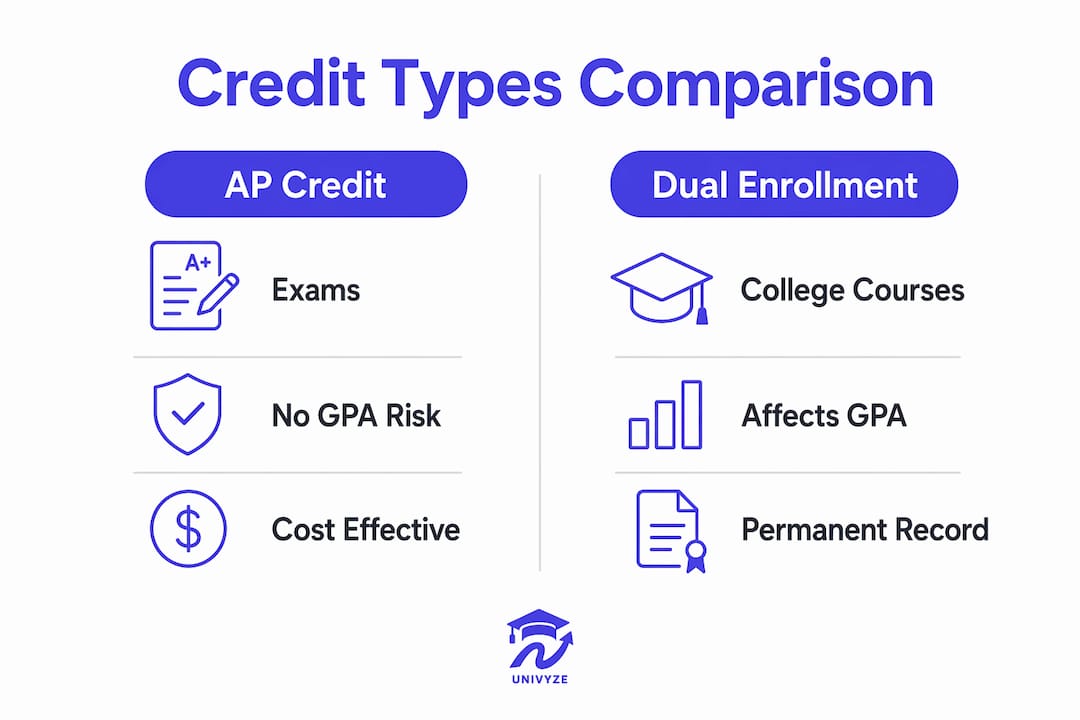
The risks, however, are permanent. A C or D in a dual enrollment course does not disappear after high school graduation. It follows you into your college GPA calculation, which affects academic standing, scholarships, and graduate school applications. AP exam scores carry no GPA weight at all. That asymmetry makes dual enrollment a higher-stakes choice.
Credit acceptance is not guaranteed. Dual enrollment credit transfer depends on accreditation, course content alignment, and the receiving college’s transfer policy. A course taken at a community college may transfer as a free elective rather than satisfying a specific major requirement. That credit still counts toward your total hours, but it does not move you closer to your degree.
Here is how to approach dual enrollment with the right mindset:
- Confirm the receiving college’s articulation agreement with the institution offering the dual enrollment course.
- Choose courses that align directly with your intended major or general education requirements.
- Treat every dual enrollment class like a college class. The grade is permanent.
- Request official transcripts from the dual enrollment institution and submit them to your college registrar before orientation.
- Follow up to confirm the credits are posted correctly on your degree audit.
Pro Tip: Ask your high school counselor for a list of dual enrollment courses that have formal articulation agreements with your target colleges. Articulated courses have the highest acceptance rate and are most likely to count toward specific degree requirements.
How do transfer credit policies influence your college degree plan?
Transfer credit policies are the rules a college uses to decide whether credits earned elsewhere count toward your degree. The evaluation process typically takes 7–10 business days, but incomplete transcripts or department backlogs can push that timeline further. A delayed evaluation means you may not know your credit standing before registration opens.
The reasons credits get denied are specific and predictable. About 15% of dual enrollment and transfer credits are denied due to major mismatch or course repetition. A biology course taken at a community college may not satisfy the upper-division biology requirement at a four-year university. A writing course may duplicate a requirement you already fulfilled. Neither denial has anything to do with your grade. It comes down to fit.
The financial stakes are significant. Accepting 45 transfer credits versus 30 can reduce your time to degree by roughly one semester. One semester of tuition, housing, and living costs adds up quickly. That difference is why course planning saves real tuition dollars when you map credits carefully before you enroll.
Federal financial aid adds another layer of complexity. Transfer credits affect SAP calculations, including your pace toward completion and your maximum timeframe for aid eligibility. If a college counts your transfer credits toward your attempted hours but not your completed hours, your SAP pace drops. That can put your Pell Grant eligibility at risk. Verify how your new institution treats transfer credits before you assume your aid is safe.
| Transfer credit scenario | Likely outcome |
|---|---|
| Credits match major requirements | Applied directly to degree, reduces required semesters |
| Credits match general education only | Count toward total hours, do not advance major progress |
| Credits duplicate completed coursework | Denied; no credit awarded |
| Credits from unaccredited institution | Typically denied entirely |
| Credits submitted after registration | May delay posting; affects schedule accuracy |
AP credit vs. dual enrollment vs. transfer credits: which fits your goals?
Each credit type serves a different purpose, and the best choice depends on your goals, your target school, and your risk tolerance.
AP credits carry no GPA risk and cost $99 per exam in 2026. They work best for students applying to public universities with clear AP credit charts. Selective private schools like MIT or Georgetown often award placement only, not credit hours, so the timeline benefit disappears. AP credits also have no transcript footprint, which protects your GPA entirely.
Dual enrollment credits are graded and permanent. They work best when you have a clear articulation agreement and are confident in the subject. Public university systems like the California State University or University of California systems often have strong articulation agreements with California community colleges, making dual enrollment a reliable path. Private and out-of-state schools evaluate these credits case by case.
Transfer credits from a community college or another four-year institution carry the most variability. They can reduce your degree timeline significantly when accepted, but the evaluation process takes time and the outcome is not guaranteed. Students who build a multi-year degree plan before transferring are far better positioned to avoid credit loss.
- AP credit: low risk, no GPA impact, best for public universities with published credit charts.
- Dual enrollment: moderate risk, permanent GPA impact, best when articulation agreements exist.
- Transfer credits: highest variability, strongest timeline benefit when accepted in full.
The students who benefit most from all three credit types are those who align every course with their intended major before they register. Earning credits that only satisfy elective requirements delays your degree just as much as earning no credits at all.
What practical strategies help you maximize AP, dual enrollment, and transfer credits?
Credit planning works best when it starts early and stays organized. AP credit planning involves three steps: checking college policies, sending official score reports on time, and integrating the credit into your course plan before registration. Skipping any one of those steps creates problems that are hard to fix after the fact.
For dual enrollment, verifying credit posting at the receiving institution is non-negotiable. Official transcripts must come directly from the institution that issued them. An unofficial copy or a self-reported grade will not satisfy most registrar requirements. Submit official transcripts as early as possible, then follow up to confirm the credits appear on your degree audit.
For transfer credits, proactively requesting course-by-course reviews can cut down on delays. Do not wait for the registrar to reach out. Contact the department directly if a course is under review for major credit. Maintaining a detailed credit record for each AP score, dual enrollment grade, and transfer evaluation keeps you ahead of surprises at registration.
- Verify AP credit policies at your target school before exam day, not after.
- Submit dual enrollment transcripts officially and confirm posting before your first registration.
- Request course-by-course transfer evaluations early and follow up with academic departments.
- Map every incoming credit to a specific degree requirement, not just a credit hour total.
- Use scenario planning tools to model what your degree timeline looks like with and without each credit accepted.
Pro Tip: Create a simple spreadsheet with four columns: credit type, course name, score or grade, and college policy outcome. Update it every time you get new information. This single document will save you from registration surprises every semester.
Key takeaways
AP credit, dual enrollment, and transfer credits each reduce your degree timeline only when they align with your specific college’s policies and your intended major requirements.
| Point | Details |
|---|---|
| AP credit vs. placement | Credit reduces required hours; placement only skips a course without cutting your total credit load. |
| Dual enrollment GPA risk | Dual enrollment grades are permanent and affect your college GPA, unlike AP exam scores. |
| Transfer credit denial rate | About 15% of transfer credits are denied due to major mismatch or course repetition, not credit origin. |
| Financial aid impact | Transfer credits affect SAP pace and maximum timeframe, which can put Pell Grant eligibility at risk. |
| Early action wins | Submitting official transcripts early and confirming credit posting prevents registration delays every semester. |
The part nobody tells you until it’s too late
I have watched students arrive at college with 30 credits on paper and end up no further ahead than their peers who arrived with zero. The credits existed. They just did not count toward anything that mattered for the degree.
The mistake is treating credit accumulation as the goal. The real goal is credit applicability. A dual enrollment English course that satisfies your college’s composition requirement is worth far more than three AP elective credits that fill hours but do not advance your major. The difference shows up in your junior year when you realize you still have every upper-division requirement ahead of you.
The other thing I have seen trip students up is the GPA surprise from dual enrollment. A B in a dual enrollment course taken at 16 years old follows you into graduate school applications. That is not a reason to avoid dual enrollment. It is a reason to treat it exactly like the college course it is. Plan your course load carefully, get help early if you need it, and do not take a dual enrollment course just because it is available.
The students who get this right are the ones who pick classes with a clear plan and verify every credit against their actual degree requirements. They do not assume. They confirm. That habit, built early, is worth more than any single AP score.
— Ryan
How Univyze helps you plan with AP, dual enrollment, and transfer credits
Figuring out which credits count and how they fit into your degree is exactly the kind of problem Univyze was built to solve. Univyze gives you a dynamic dashboard that maps your AP credits, dual enrollment history, and transfer credits directly against your degree requirements, term by term.

You can run what-if scenarios to see how your timeline changes if a transfer credit gets denied or if you add a summer course. Parents can see your progress clearly without needing to decode a degree audit. Univyze does not replace your academic advisor, but it gives you the full picture before you walk into that meeting. Start building your credit-aware degree plan with Univyze and join the waitlist at univyze.com/waitlist.
FAQ
Do all colleges accept AP scores for credit?
No. Each college sets its own AP credit policy, including minimum score thresholds and whether a qualifying score earns credit hours, placement, or both. Always check the registrar’s AP credit chart for your specific school.
Does dual enrollment affect my college GPA?
Yes. Dual enrollment grades appear on your official college transcript and are included in your college GPA calculation, unlike AP exam scores, which carry no GPA weight.
How long does transfer credit evaluation take?
Transfer credit evaluation typically takes 7–10 business days, but delays are common when transcripts are incomplete or department reviews are required. Submit official transcripts as early as possible to protect your registration timeline.
Can transfer credits affect my financial aid?
Yes. Transfer credits affect SAP calculations, including your pace toward completion and your maximum timeframe for federal aid. Confirm how your new institution counts transfer credits before assuming your Pell Grant eligibility is unchanged.
What is the most common reason transfer credits get denied?
About 15% of transfer credits are denied due to major mismatch or course repetition. The credit’s origin, whether AP, dual enrollment, or community college, is rarely the reason for denial.
Recommended
- How Many Credits Should You Take Per Semester? A Complete College Planning Guide – univyze.com
- How to Choose Classes That Actually Count Toward Graduation (And Avoid Wasting Time and Money) – univyze.com
- How Course Planning Saves Tuition: A Student’s Guide
- College Schedule Building Basics Checklist for First-Term Students