

Campus resources are defined as the full set of institutional services, programs, and facilities that colleges provide to help students complete their degrees. The role of campus resources in graduation is direct: students who actively use academic advising, tutoring centers, peer mentorship, TRIO Student Support Services, and basic needs centers graduate at measurably higher rates than those who do not. Graduation rates are not fixed and improve with institutional commitment to advising, financial assistance, and clear pathways. For students and parents trying to understand what actually moves the needle on degree completion, the answer is consistent and well-documented. Campus support is not a bonus. It is a core driver of finishing on time.
What types of campus resources are most impactful for graduation success?
Campus resources fall into five categories, and each one addresses a specific barrier that causes students to fall behind or drop out entirely.
Academic advising and degree planning sit at the top of the list. An adviser maps your exact degree requirements against the courses you have already completed, flags missing credits, and helps you sequence future semesters correctly. Students who meet with advisers regularly avoid the most common and costly mistake in college: taking courses that do not count toward their degree. Univyze builds on this concept by giving students a dynamic dashboard that connects degree requirements to real course offerings, so the planning process is visible and updated in real time.

Tutoring and academic support centers provide subject-specific help that office hours alone cannot cover. Most universities run writing centers, math labs, and subject tutoring through departments like the College of Arts and Sciences or through a dedicated learning commons. Using these resources weekly, not just before exams, produces the strongest results.
Financial aid counseling and emergency grants keep students enrolled when money runs short. Many colleges now offer emergency funds of a few hundred dollars to cover unexpected costs like a car repair or a medical bill. That small amount can be the difference between staying enrolled and withdrawing for a semester.
Wraparound services address food, housing, and childcare. 3 out of 5 American undergraduates face food or housing insecurity. That figure explains why basic needs centers have expanded rapidly across campuses. When students are hungry or unstable at home, academic performance drops regardless of how strong the tutoring center is.
Peer mentorship programs connect newer students with upperclassmen who have already navigated the same degree requirements, registration systems, and campus culture. These relationships build confidence and resource awareness simultaneously.
Pro Tip: Visit your campus resource center during the first two weeks of each semester, not when you are already struggling. Early contact with advisers and tutors sets a baseline that makes every subsequent conversation more productive.
How do campus resources improve graduation rates?
The evidence connecting campus support to graduation outcomes is specific and consistent across program types.
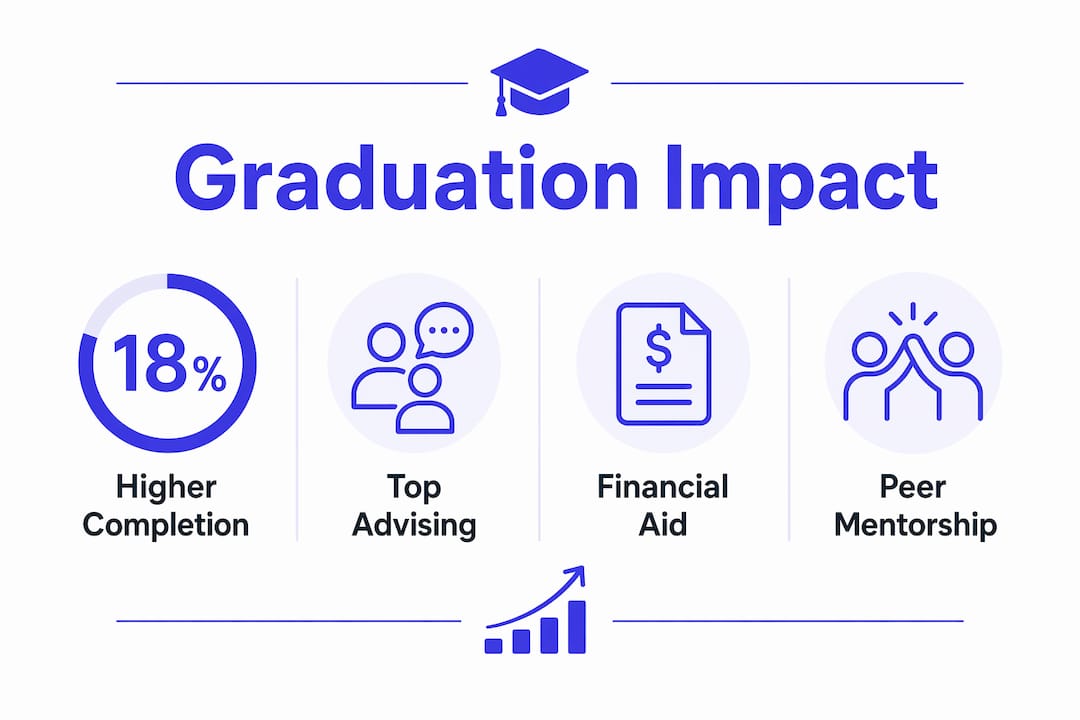
TRIO Student Support Services participants are 18% more likely to earn bachelor’s degrees than non-participants. That gap reflects what structured, consistent support does over four years compared to students navigating the system alone. TRIO programs provide tutoring, advising, financial aid assistance, and cultural programming, and the combination produces results that no single service achieves on its own.
Peer mentorship shows similarly strong outcomes. 70% of first-year participants in peer mentorship programs report a better understanding and use of campus resources linked to academic success. That number matters because resource awareness is the first barrier. Students who do not know a service exists cannot use it.
“Graduation rates improve when institutions treat advising, financial aid, and clear degree pathways as interconnected systems rather than separate departments.” — Inside Higher Ed, 2026
| Resource type | Documented impact |
|---|---|
| TRIO Student Support Services | 18% higher bachelor’s degree completion rate |
| Peer mentorship programs | 70% of first-year participants report better resource use |
| Basic needs centers | Reduced food and housing insecurity for 3 in 5 undergraduates |
| Graduation help desks | Centralized academic, financial, and procedural support |
| Emergency financial aid | Keeps students enrolled through unexpected hardships |
Institutional investments in advising and financial aid correlate directly with better four-year and six-year graduation rates. Schools that use predictive analytics to flag at-risk students and intervene early see the strongest gains. The data is clear: the more connected a student is to campus support, the more likely they are to finish.
What challenges do specific student groups face, and how do resources help?
Not every student faces the same barriers, and the most effective campus support models recognize that difference.
First-generation students arrive without the family knowledge base that continuing-generation students take for granted. They are less likely to know how to read a degree audit, negotiate a financial aid appeal, or identify which adviser handles their specific major. First-generation students benefit from consistent, dedicated academic advising rather than sporadic drop-in support. Early adviser relationships that map requirements effectively produce measurably better graduation preparedness. A single meeting at the start of freshman year is not enough. Ongoing relationships are what close the gap.
Students facing food and housing insecurity need wraparound services before academic support can work. Early adopters of comprehensive wraparound services stay enrolled better through hardships. These services include childcare, mental health counseling, and emergency aid. Funding constraints limit how many schools can offer the full package, but the schools that do see stronger retention numbers.
The table below contrasts traditional and modern support models:
| Approach | Traditional model | Modern integrated model |
|---|---|---|
| Advising | Drop-in, reactive | Scheduled, data-informed, proactive |
| Financial support | Standard aid packages | Emergency grants plus aid counseling |
| Basic needs | Not addressed | Food pantries, housing help, childcare |
| Student tracking | Manual, end-of-semester | Predictive analytics, early alerts |
| Resource access | Siloed by department | Centralized graduation help desks |
Graduation help desks centralize academic, financial, and procedural support into a single point of contact. That model removes the burden of knowing which office handles which problem. A student who is behind on credits, short on funds, and confused about graduation requirements can walk into one place and get answers.
Pro Tip: If your campus has a graduation help desk or one-stop student services center, make it your first stop at the start of junior year. That is when degree completion timelines become urgent, and early clarity prevents expensive mistakes.
How can students and parents use campus resources to graduate on time?
Knowing resources exist is not the same as using them. Students who wait until crisis to seek help are less likely to graduate on time. Treating resource use as part of the regular academic routine is what separates students who finish on schedule from those who do not.
Here is a practical framework for students and parents:
-
Schedule an advising appointment in the first month of each academic year. Do not wait for a problem to appear. Use the meeting to review your degree audit, confirm your course sequence, and identify any requirements you might have missed. Catching a missing prerequisite in September is far less costly than catching it in April.
-
Use tutoring centers on a weekly schedule, not just before exams. Regular visits build the kind of subject fluency that shows up on midterms and finals. Most tutoring centers are free and underused. That is a resource you have already paid for through tuition.
-
File your graduation application well ahead of the deadline. Applying for graduation requires proactive filing months in advance. Missing the deadline can delay degree conferral by an entire semester, and late fees apply at many institutions. Monitor your student email for deadline notices every semester starting junior year.
-
Visit the career center at least once per semester. Career advising is not just for seniors. Students who build internship experience and professional networks earlier graduate with clearer post-degree plans, which itself motivates on-time completion.
-
Parents: ask about resource availability, not just grades. A student who is struggling academically is often also struggling with food, housing, or mental health. Asking “Are you using the tutoring center?” or “Have you met with your adviser this semester?” opens conversations that grades alone do not. Univyze gives parents direct visibility into their student’s academic progress, which makes these conversations specific rather than general. Learn more about parent visibility tools that connect families to their student’s degree timeline.
-
Avoid the common mistakes that delay graduation, such as taking courses out of sequence or missing prerequisite requirements. These errors are almost always preventable with consistent advising.
Key takeaways
Campus resources directly increase graduation rates when students engage with them consistently and early rather than waiting for a crisis to force the conversation.
| Point | Details |
|---|---|
| Start early with advising | Meet your academic adviser in the first month of each year to review your degree audit. |
| TRIO and peer mentorship work | TRIO participants are 18% more likely to earn a bachelor’s degree than non-participants. |
| Wraparound services matter | 3 in 5 undergraduates face food or housing insecurity, making basic needs centers critical for retention. |
| File graduation applications on time | Missing deadlines can delay degree conferral by a full semester and trigger late fees. |
| Routine use beats crisis use | Students who build resource use into their weekly schedule graduate on time at higher rates. |
Campus resources have changed. Students need to change with them.
When I look at how campus support has evolved over the past decade, the shift is significant. Resources that used to be niche programs for a small subset of students have become central institutional systems. Graduation help desks, predictive analytics, wraparound services, and integrated advising models are not experimental anymore. They are the standard at schools serious about completion rates.
What has not changed is student behavior. Most students still wait too long. They treat advising as a formality, tutoring as a last resort, and financial aid counseling as something other people need. That gap between what institutions now offer and what students actually use is where degrees get lost.
The students I see graduate on time share one habit: they treat campus resources as part of their academic routine, not as emergency services. They schedule tutoring the same way they schedule class. They meet with advisers before problems appear. They know their graduation application deadline before junior year ends.
For first-generation students and students facing economic pressure, the stakes are even higher. Dedicated advising and wraparound services exist specifically because the data shows they work. Using them is not a sign of struggle. It is a sign of planning. Parents play a real role here too. Asking the right questions and staying informed about your student’s academic path is not hovering. It is the kind of support that actually helps.
— Ryan
Univyze helps you plan smarter and graduate on time
Unclear degree planning is one of the most common reasons students spend extra semesters in school, paying tuition they did not budget for. Univyze connects degree requirements directly to real course offerings, so you can see your full academic path in one place.
Whether you are a student trying to sequence your remaining credits correctly or a parent wanting visibility into your student’s progress, Univyze gives you the tools to plan with confidence. See how Univyze works and find out how smarter planning can help you finish on time, or even early. You can also explore choosing classes that count toward your degree so every semester moves you forward.
FAQ
What is the role of campus resources in graduation?
Campus resources, including academic advising, tutoring, peer mentorship, and financial aid counseling, directly increase the likelihood that students complete their degrees on time. Students who use these services consistently graduate at higher rates than those who do not.
Which campus resources have the biggest impact on graduation rates?
TRIO Student Support Services participants are 18% more likely to earn bachelor’s degrees than non-participants, making it one of the most documented high-impact programs. Peer mentorship and integrated advising also show strong, measurable results.
How do campus resources help first-generation students graduate?
First-generation students benefit most from consistent, dedicated academic advising rather than drop-in support. Early adviser relationships that map degree requirements reduce the navigation gaps that cause first-generation students to fall behind.
When should students start using campus resources?
Students should engage with academic advisers, tutoring centers, and peer mentorship programs in the first month of their first year. Early engagement builds habits and prevents the kind of credit and deadline errors that delay graduation.
How can parents support their student’s use of campus resources?
Parents can ask specific questions about advising appointments, tutoring use, and graduation application deadlines rather than focusing only on grades. Univyze offers a parent visibility dashboard that connects families to their student’s academic progress in real time.