

Yes, your study-abroad courses will almost certainly earn credit, but whether they satisfy resident credit, transfer credit, or nothing more than a general elective depends entirely on paperwork you file before you leave. The one move that protects you: get written, course-by-course pre-approval naming the exact home requirement each class will satisfy, confirm placeholder enrollment if you need full-time status for aid, and save every syllabus and graded assignment from day one.
TL;DR:
- Most institutions consider study-abroad courses sponsored by your school as resident credit that affects your GPA, while outside programs usually transfer as GPA-neutral credits.
- Confirm your abroad program’s credit type and obtain written, course-specific approval before departure to ensure proper transfer and requirement fulfillment.
- Foreign credit systems rarely match US semester credits exactly; carefully convert ECTS, quarter credits, and contact hours using your school’s guidelines to avoid miscounts.
- Keep detailed records of syllabi, graded work, and approval forms during your stay abroad to prevent issues with transferring credits or disputing evaluations.
- Final credit posting and requirement matching happen after you return, so early planning and correct documentation are key to avoiding delays or losing aid eligibility.
Table of Contents
- Study Abroad Credits: Resident vs. Transfer and Placeholder Courses
- How Many Credits Count as Full-Time for Study Abroad Programs
- Converting ECTS, Quarter Credits, and Contact Hours to Semester Credits
- Getting Pre-Approval Before You Leave
- Staying on Top of Records While You’re Abroad
- What Happens to Your Credits After You Come Home
- Do Study Abroad Credits Count Toward Your Major or GPA?
- Will FAFSA Pay for Study Abroad?
- How to Handle Study Abroad Credits If Courses Are Not Pre-Approved
- Dealing With Discrepancies or Disputes Over Credit Transfer After Study Abroad
- Tips for Optimizing Credit Transfer to Maximize Degree Progress
- Resources and Offices to Consult for Resolving Study Abroad Credit Issues
- The Overlooked Risk in Study Abroad Planning
- Plan Your Study Abroad Term Without the Credit Guesswork
- Where to Verify Your School’s Actual Credit Policy
- Sources
- FAQ
Study Abroad Credits: Resident vs. Transfer and Placeholder Courses
Not all study-abroad credit behaves the same way once it lands on your transcript. Programs run directly by your home institution typically post as resident credit, meaning the grade counts toward your GPA just like a class taken on campus. Courses taken through an outside provider or a partner university abroad usually come back as transfer credit, which often shows up as a “T” grade or “pass” notation that doesn’t touch your home GPA at all. The University of Wisconsin-Milwaukee’s Center for International Education confirms this split is the single biggest factor in how your abroad semester affects your academic record.
While you’re overseas, your registrar likely uses a placeholder course to keep you enrolled full-time for financial-aid purposes. That placeholder isn’t your final grade. It’s a stand-in that gets replaced once the real evaluation comes through.
- Resident credit: Usually institution-sponsored programs; grade affects GPA.
- Transfer credit: Usually third-party or exchange programs; often GPA-neutral.
- Placeholder credit: Temporary enrollment marker to preserve full-time status and aid eligibility until official evaluation is complete.
Knowing which bucket your program falls into before you register for host classes changes how carefully you need to document everything.
How Many Credits Count as Full-Time for Study Abroad Programs
There’s no single national minimum for study-abroad enrollment. Most schools expect semester participants to carry somewhere around 12 to 18 home-university credits while abroad, with the exact ceiling on transferable credits set by each institution’s own policy, according to UNC Study Abroad’s coursework planning guide. Summer programs run lighter, often starting eligibility at 3 to 6 credits.
- Semester programs: plan for roughly 12–18 credits, but confirm your school’s exact floor and ceiling.
- Summer programs: financial-aid eligibility often starts around 3–6 credits.
- Full-time status matters for aid, visas in some countries, and insurance, not just degree progress.
Before you finalize a host-course schedule, check your required credit load per term against what your study-abroad office expects. A mismatch here is one of the most common reasons students lose aid mid-program.
Converting ECTS, Quarter Credits, and Contact Hours to Semester Credits
Foreign credit systems don’t map onto U.S. semester credits in a clean one-to-one ratio, and assuming they do is where a lot of students get burned. Boston College’s own conversion table treats 2 ECTS as equal to 1 BC credit and 6 ECTS as equal to 3 BC credits, which sounds simple until you realize the ratio can shift depending on your total course load for the term, per Boston College’s program credit guidelines.
Quick reference for common conversions:
- ECTS to semester credits: often 2 ECTS ≈ 1 U.S. credit, but confirm your school’s exact table.
- Quarter credits to semester credits: a standard formula multiplies quarter credits by two-thirds.
- Contact hours: some schools require a minimum number of instructional hours per credit, regardless of the host country’s own credit label.
Statistic Callout: Boston College’s conversion table shows that 6 ECTS can typically equal 3 BC credits, but the same host course might convert differently for a student carrying a heavier load. Conversion is load-dependent, not fixed.
Test a handful of your actual candidate courses through your registrar’s quarter-versus-semester conversion tool before you lock in your abroad schedule. A generic online calculator won’t catch your school’s specific rounding rules.
Getting Pre-Approval Before You Leave
Written, course-by-course approval is the single document that protects your degree timeline abroad. Columbia’s study-abroad office requires exactly this kind of formal sign-off, not an informal email exchange, before overseas coursework can count toward a major or concentration, according to Columbia’s study-abroad steps page.
- Request a written equivalency for each course, naming the exact home course or requirement it will satisfy.
- Submit your school’s Education Abroad Approval Form or equivalency request, confirming whether the credit will post as resident or transfer.
- Confirm the minimum passing grade your school requires for transfer credit, since thresholds vary. Maryland Global notes some institutions require a C- or better before a transfer course posts at all, per its course selection and approval guidance.
- Collect syllabi, reading lists, and contact-hour breakdowns for every course you’re requesting approval for, before you board a plane.
Pro Tip: Ask your department to write the intended home-course number directly on your approval form, not just a vague “counts toward major” note. Specific documentation resolves disputes months later when nobody remembers the verbal conversation.
Staying on Top of Records While You’re Abroad
Download syllabi, graded assignments, and any host-university grade reports the moment they’re posted. Host learning-management systems get wiped or archived after the term ends, and you don’t want to be emailing a foreign registrar’s office from your dorm room in October asking for a syllabus you could have saved in June.
- Save PDFs of every syllabus and assignment rubric to cloud storage, not just your laptop.
- If you add or drop a course after arriving, contact your home advisor immediately and update your approval form to match.
- Keep registration receipts and enrollment confirmations. Financial-aid audits sometimes ask for them months later.
Formatting these documents cleanly also matters when a department reviews them; a well-organized syllabus packet, similar to guidance on preparing academic documents for institutional review, makes the evaluator’s job faster and your case stronger.
What Happens to Your Credits After You Come Home
The post-return process runs through several distinct stages, and knowing the order helps you know when to worry versus when to just wait.
- Request an official transcript be sent directly to your study-abroad or registrar’s office, following your school’s exact submission instructions.
- The registrar prepares a preliminary evaluation, matching host courses to rough home equivalents.
- Your academic department reviews syllabi and coursework to assign an actual home course number, a step the University of Washington’s credit conversion page describes as central to the whole process.
- The registrar posts the final credit to your transcript, often three to eight weeks after your transcript arrives, though this varies by school and term volume.
If posting drags well past that window, escalate to your advisor or registrar directly rather than assuming it will sort itself out. Registrar queues get backed up right after each academic term ends.
Do Study Abroad Credits Count Toward Your Major or GPA?
Posting to your transcript and satisfying a specific degree requirement are two different things, and mixing them up is where students lose the most time. Transfer credit that arrives without prior departmental approval often defaults to general elective credit, even if the course content overlapped heavily with your major.
- Resident credit typically posts with a letter grade and affects your GPA the same way an on-campus class would.
- Transfer credit usually posts as pass or credit-only, leaving your home GPA untouched, per UWM’s credit policy.
- Without departmental sign-off, an overseas course tends to count as an elective rather than fulfilling a major, minor, or Gen Ed slot.
Seniors and anyone within a year of graduation should treat department approval as non-negotiable before departure. A course that seems obviously equivalent to a professor abroad might read very differently to a department chair reviewing a syllabus six months later. If you’re testing whether a course might satisfy a general education requirement, get that confirmed in writing, not assumed.
Will FAFSA Pay for Study Abroad?
FAFSA itself doesn’t pay for anything directly. It’s the application that determines your federal aid eligibility, and whether that aid covers a specific study-abroad program depends on your home school’s financial-aid office and its own cost-of-attendance calculations, according to Federal Student Aid’s guidance on how aid is calculated.
- Your eligibility depends on maintaining the enrollment status your school requires, often tied to that placeholder course mentioned earlier.
- Ask the financial-aid office directly whether your specific program is pre-approved for aid disbursement, since not every third-party program automatically qualifies.
- Have this conversation before you commit to a program, not after you’ve already paid a deposit.
Aid offices process these requests on their own timeline, and a program that seems standard to you might require extra paperwork on their end.
How to Handle Study Abroad Credits If Courses Are Not Pre-Approved
Sometimes you land abroad and realize the course you registered for isn’t the one you got pre-approved for, or you never got formal approval in the first place. This happens more often than students expect, especially when host universities finalize their course catalogs late or swap instructors right before the term starts.
Your first move is to contact your home advisor or study-abroad office the moment you notice the mismatch, not after the term ends. Explain exactly what changed and ask whether an amended approval form can be submitted retroactively. Many departments will still evaluate an unapproved course after the fact, but they’re evaluating it cold, without the benefit of your original justification for why it should count toward a specific requirement.
Keep the syllabus, assignments, and any host-institution course description regardless of whether you have approval. Without that paper trail, a department reviewing an unapproved course after your return has almost nothing to work with beyond a course title, and course titles translate poorly across institutions and countries.
If a department declines to grant the equivalency you hoped for, ask directly what it would take to reconsider. Sometimes an additional writing sample or a direct conversation with the host professor closes the gap. Other times, the course simply posts as a general elective, which isn’t a disaster but does mean it won’t move you closer to finishing a specific major or Gen Ed requirement. Build that possibility into your plan before you assume every course abroad will land exactly where you hoped.
Dealing With Discrepancies or Disputes Over Credit Transfer After Study Abroad
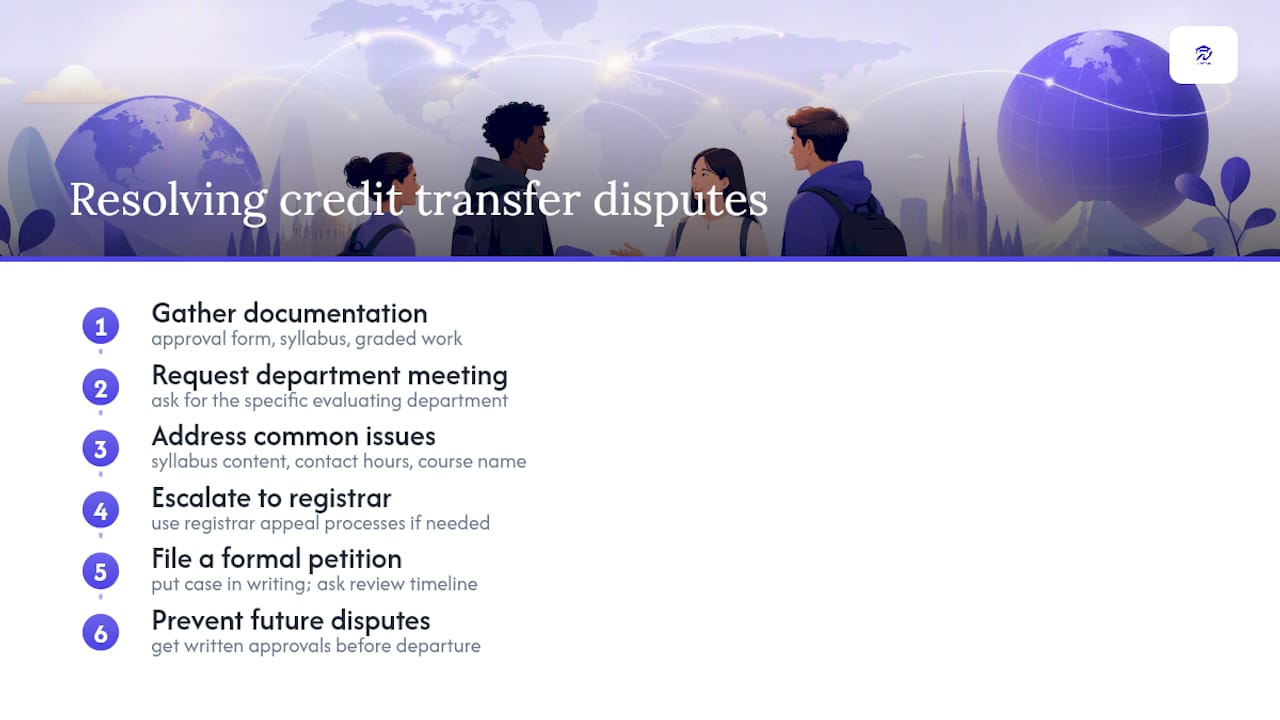
Discrepancies happen even when you did everything right. Maybe the department assigned your course a lower-level number than expected, or a course you thought would satisfy a major requirement posted as a general elective instead. The first step is always documentation. Pull your original approval form, your syllabus, and your graded work, then request a specific meeting with the department that made the evaluation rather than a generic advising appointment.
Most disputes come down to one of three things: the syllabus didn’t clearly show equivalent content, the contact hours didn’t match, or the approval form named a different course than the one you actually took. Each of those is fixable if you can show your paperwork lines up with what you’re asking for.
If the department doesn’t budge, escalate to your registrar’s office, since registrars often have appeal processes separate from departmental review. Some schools also allow a formal petition, which puts your case in writing and creates a record that outlasts any single conversation. Ask specifically what the appeal timeline looks like. A petition filed in October that won’t be reviewed until March isn’t useful if you’re trying to register for spring classes that depend on the outcome.
The uncomfortable truth is that disputes take longer to resolve than students expect, often stretching into the following term. That’s exactly why front-loading your approvals before departure matters so much: it’s far easier to get a “yes” in writing in June than to argue for one in November after the course is already finished and the professor who taught it is unreachable.
Tips for Optimizing Credit Transfer to Maximize Degree Progress
Treat your study-abroad term like any other semester of degree planning, not a separate adventure that happens to also generate credits. Map out exactly which requirements you still need before you even start browsing host-university course catalogs. That way you’re choosing courses based on what moves your degree forward, not just what sounds interesting in a glossy program brochure.
Prioritize courses with the clearest equivalency path. A host course with a detailed syllabus that closely mirrors a specific home course is far easier to get approved than a broadly titled seminar with a vague description. When you have a choice between two courses that both interest you, pick the one with better documentation.
Don’t overload on unapproved courses “just in case.” Every course you take without a pre-approved equivalency is a gamble on how it’ll post, and stacking several of those gambles into one semester multiplies your risk of ending up with a term full of unplanned electives. If your program allows some flexibility, keep at least the majority of your schedule tied to pre-approved equivalencies and treat one or two open slots as your risk tolerance, not your default approach.
Finally, revisit your degree plan the moment you’re back, not at your next scheduled advising appointment. Waiting weeks to check how your credits actually posted means you might register for a future term based on outdated assumptions about what you still need.
Resources and Offices to Consult for Resolving Study Abroad Credit Issues
Your study-abroad or international education office is your first stop for program-specific questions, since they handle the approval forms and typically manage the relationship with host institutions directly. Your academic department, specifically whichever advisor or chair handles transfer-equivalency decisions, is who actually evaluates whether a course satisfies a major or Gen Ed requirement.
The registrar’s office controls the mechanics of how credit posts to your transcript and is usually the right place to ask about timing delays or to check what your official transfer-credit policy states in writing. If a decision doesn’t go your way, ask the registrar specifically about the school’s appeal or petition process, since this often lives outside normal advising channels.
Your financial-aid office is a separate resource entirely, worth contacting before departure to confirm your specific program qualifies for aid disbursement. Many schools also have a dedicated transfer-credit or transfer credit evaluation coordinator who handles disputes across departments, which can save you from bouncing between offices that each think the other one owns your problem.

Keep a written record of every conversation, including names, dates, and what was promised. Verbal reassurances from a study-abroad coordinator in August mean very little to a department chair reviewing your file in January if there’s no paper trail behind them.
The Overlooked Risk in Study Abroad Planning
Most advice about study-abroad credit focuses on process. File the form, get the approval, wait for the transcript. That’s necessary, but it misses the bigger risk: students often don’t know how a specific abroad course fits into their overall degree plan until months after they’re back, by which point a scheduling conflict or missing prerequisite has already cost them a term.
A degree planning tool can link degree requirements to course offerings and let you run what-if scenarios before you commit to a host-course schedule. That means you can test whether a candidate abroad course would satisfy a specific requirement or just default to elective credit, and see how either outcome shifts your remaining terms. It won’t replace your official approval process. It’s a planning aid, not your registrar, and every equivalency decision still has to go through your school’s actual review. But catching a missing prerequisite or a course that would only post as an elective before you register abroad is far easier than untangling it after the fact.
— Ryan
Plan Your Study Abroad Term Without the Credit Guesswork
Most students don’t find out a course won’t count toward their major until it’s too late to fix cheaply. Instead of hunting through catalogs and approval forms with no clear picture of how a semester abroad fits your remaining requirements, a dynamic planning dashboard can map your degree plan against course offerings term by term, so you can run what-if scenarios before you commit to a host schedule.
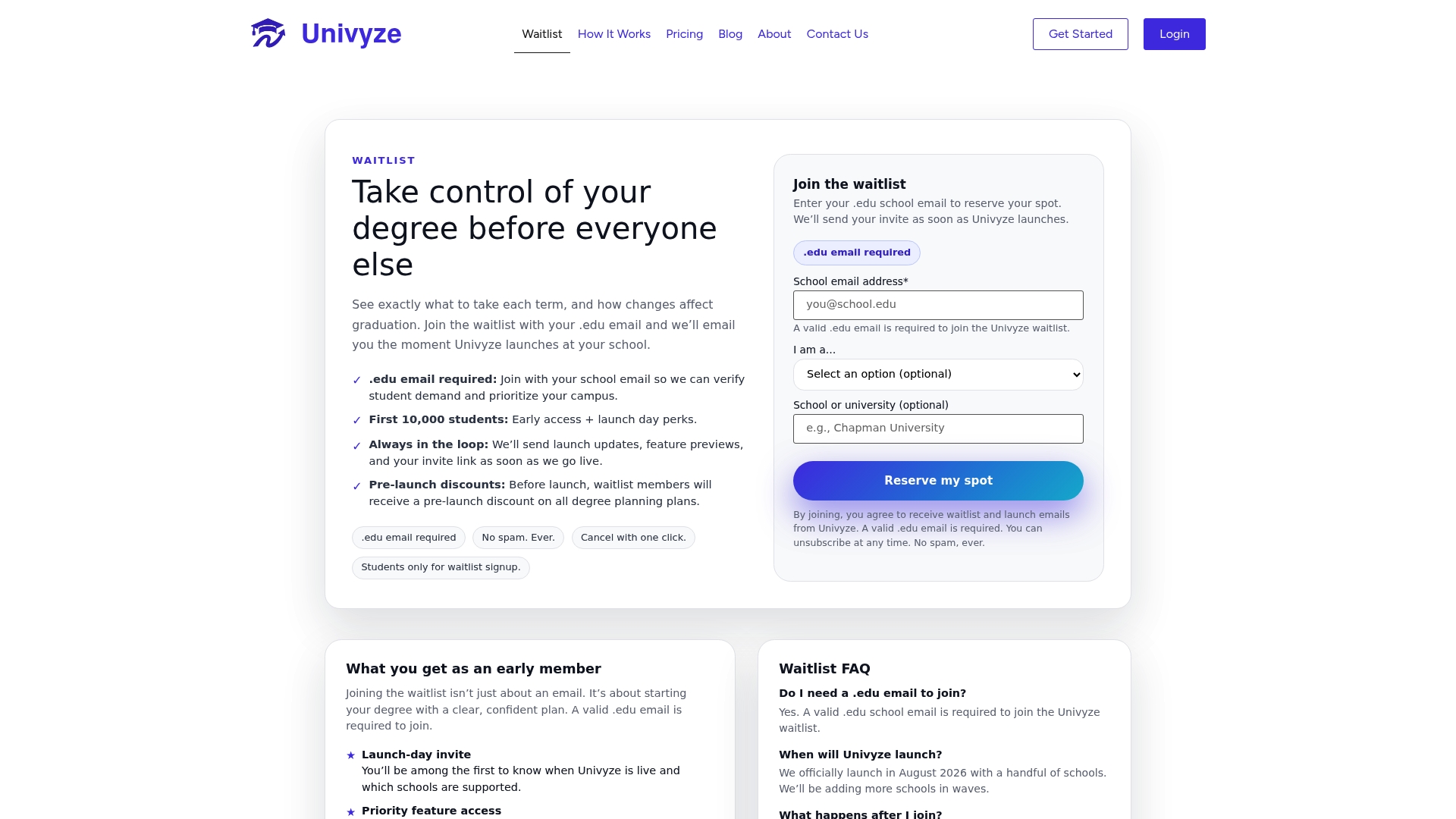
A degree planning platform can support term-by-term planning, AP credit, dual enrollment, transfer credits, and summer-session scheduling, all in one visual map instead of scattered spreadsheets and advisor emails. Parents may get shared visibility into progress, which matters when a study-abroad decision affects tuition planning at home. This is a planning tool, not an official degree audit, so always confirm final equivalencies with your registrar, department, and advisor. Explore the Core, Plus, and Pro plans or join the Univyze waitlist to see how what-if planning could apply to your own abroad semester.
Where to Verify Your School’s Actual Credit Policy
Every school sets its own rules, so check your UWM Center for International Education equivalent office page, your registrar’s transfer-credit policy, and Federal Student Aid’s guidance before finalizing any abroad plans.
Sources
- Academics & credit – UWM Center for International Education
- Planning for your coursework before you go abroad – UNC Study Abroad
- Program credit and course guidelines – Boston College (PDF)
- When you return — Credit conversion process – University of Washington
FAQ
Do You Get Credits for Studying Abroad?
Yes, approved study-abroad coursework generally earns credit, though whether it posts as resident credit or transfer credit depends on your program type. Institution-sponsored programs typically post as resident credit affecting GPA, while third-party programs often transfer as pass or credit-only, per UWM’s credit guidance.
Does 3 Credit Hours Mean 3 Credits?
At most U.S. schools, 3 credit hours does equal 3 semester credits, but foreign systems don’t always match one-to-one. Boston College’s conversion table treats 6 ECTS as equal to 3 BC credits, showing how the ratio can shift depending on your course load, according to Boston College’s guidelines.
How Many Credits Do You Need to Go Abroad?
There’s no universal minimum, but many schools expect semester participants to carry roughly 12 to 18 home-university credits, with summer programs often starting eligibility around 3 to 6 credits, per UNC Study Abroad’s planning guide. Confirm your school’s exact requirement before registering for host courses.
Will FAFSA Pay for Study Abroad?
FAFSA determines your federal aid eligibility, but it doesn’t automatically fund study abroad. Your home school’s financial-aid office decides whether your specific program qualifies based on your enrollment status and its cost-of-attendance rules, according to Federal Student Aid.
Can Univyze Guarantee My Study Abroad Credits Will Transfer?
No, Univyze is a planning tool that helps you visualize how a potential course fits your degree plan through what-if scenarios, not an official transfer-credit authority. Final equivalency decisions always come from your registrar, department, and academic advisor.