

An articulation agreement is a formal deal between two schools that spells out exactly how credits earned at one will count at the other. For transfer students, this document is the difference between walking into a new school with a semester’s head start or discovering, halfway through junior year, that a dozen credits vanished into thin air. The U.S. Department of Education confirms this is the core function of these agreements: protecting the credits you already earned.
Before you assume your community college classes will sail through, check two places first:
- Transferology, a national database that previews how coursework maps across 400 or more participating colleges
- Your target school’s own transfer or registrar page, where the actual, binding equivalency tables live
Key Takeaways
Articulation agreements only protect your credits when you verify them against the current catalog year and confirm the result with an official transcript evaluation.
| Point | Details |
|---|---|
| Know your agreement type | Course-to-course, program-to-program, block transfer, and TAG agreements each carry different rules. |
| Preview, then confirm | Use Transferology or a school’s equivalency guide as a starting point, not a final answer. |
| Check the catalog year | An expired or outdated run date is the most common cause of lost credit. |
| Get it in writing | Advisor confirmation and saved syllabi protect you if a course gets reclassified later. |
| Submit transcripts early | Official credit doesn’t post until the registrar completes a formal review. |
Where to Verify the Details
Start with Federal Student Aid’s overview of articulation agreements for the baseline definition, then check 20 U.S.C. §1093a for the federal framework, Transferology for a national course preview, and your target school’s own registrar page for the binding rules.
Table of Contents
- What Is an Articulation Agreement, and What Types Exist?
- How Does the Credit Evaluation Process Actually Work?
- Where to Find and Read a Transfer Equivalency Guide
- What Mistakes Cause Students to Lose Transfer Credits?
- How Univyze Helps You Plan Around Transfer Rules
- What Transfer Students Get Wrong About Articulation Agreements
- Sources
- FAQ
What Is an Articulation Agreement, and What Types Exist?
Not every articulation agreement works the same way, and knowing which type applies to you changes how you plan your semesters.
- Course-to-course agreements match a single class at your current school to its equivalent at the receiving school. This is the most common type and usually covers general education requirements.
- Program-to-program agreements align an entire associate degree track (nursing, business, engineering) with a specific bachelor’s program, so a whole sequence transfers as a block rather than course by course.
- Block transfer agreements move an entire completed set of general education or core coursework at once, often tied to earning an associate degree first.
- Guaranteed admission agreements, sometimes called Transfer Admission Guarantees or TAGs, promise a seat at the receiving institution if you hit specific GPA and course benchmarks. The University of California’s TAG program is a well-known example.
- Bilateral agreements exist between two specific schools, while multilateral agreements cover an entire state system, often built around common course numbering so credits behave consistently across dozens of campuses.
A community college student aiming for a four-year nursing program, for instance, might rely on a program-to-program agreement for major courses and a separate block agreement for general education. Two different documents, two different rules.
How Does the Credit Evaluation Process Actually Work?
Here’s the part most students miss: the equivalency chart you find online is a preview, not a promise. It shows what has historically transferred, but it is not the same as an official decision on your transcript.
The real evaluation happens in stages, and each one matters:
- A published transfer guide, like the University of Utah’s transfer credit equivalency guide, gives you an unofficial snapshot of likely equivalencies.
- The registrar’s office typically handles the formal transcript review once you’re officially admitted and have submitted transcripts.
- Academic departments often step in separately to decide whether a course counts toward your major, versus just filling an elective slot.
Even institutions with generous agreements set limits. Walden University notes that some arrangements cap transferable credit at around 75% of a degree’s total requirements, though the exact ceiling varies widely by school and program.
Watch for these three rules on every agreement you read: minimum grade requirements (a C might transfer where a C-minus won’t), maximum transferable credit limits, and the catalog year or “run date” that tells you which version of the agreement is currently active.
Where to Find and Read a Transfer Equivalency Guide
Finding the right document is only half the job. Reading it correctly, and then acting on it, is what actually protects your credits.
Start your search in four places: the receiving school’s registrar or transfer admissions page, your state’s articulation portal if your state runs one, the specific academic department’s own equivalency table, and Transferology for a broader, cross-institution preview. Community college advising offices often keep a running list of active partner agreements too, and it’s worth asking directly rather than assuming one exists.
When you pull up an actual equivalency row, you’re looking at several columns that all matter: the sending course code and title, the credit hours, the receiving school’s equivalent course (or a generic elective label if there’s no direct match), the category it satisfies (general education, major core, or free elective), and any prerequisite it fulfills. Skip past the catalog year field at your own risk. Univyze’s guide on how to choose classes that actually count toward graduation walks through this in more detail.
Once you’ve identified a course you believe will transfer, follow this sequence:
- Request a pre-evaluation from the receiving school’s transfer office if one is offered. Many schools will informally review your planned courses before you even apply.
- Save your syllabi for every course you hope will transfer, especially anything outside a clearly listed equivalency.
- Get written confirmation from an advisor, not just a verbal nod in a meeting.
- Submit your official transcript as soon as you’re admitted. Nothing becomes official until the registrar or department completes a formal review.
- Follow up in writing if you haven’t seen the credit posted to your account within a few weeks of enrollment.
Pro Tip: Keep a folder, digital or physical, with every syllabus, transcript, and email confirmation tied to your transfer credits. If a department reclassifies a course as an elective instead of a major requirement, that paper trail is what gets it fixed.
If you’re planning a move from a two-year school, Univyze’s step-by-step transfer guide breaks down the timing in more detail.
What Mistakes Cause Students to Lose Transfer Credits?
Most lost credit isn’t the result of some obscure rule. It’s usually one of five predictable mistakes, repeated by thousands of transfer students every year.
- Assuming automatic transfer. An articulation agreement existing doesn’t mean your specific course was ever reviewed against it. Confirm the exact course, not just the general subject area.
- Using an outdated catalog year. Agreements get revised as curriculum changes. Guides and equivalency lists are updated regularly, and checking your catalog year against your intended graduation year prevents what’s sometimes called credit drift.
- Missing the minimum grade cutoff. A C-minus might satisfy the credit requirement but fall short of the grade floor for major-specific transfer.
- Content mismatch. A course with the same title at two schools can cover different material, and a department reviewer may reject it on that basis alone.
- Delaying your official transcript. Waiting until the semester starts to send your transcript means credit might not post until weeks into the term, which can knock you out of a required class.
The financial stakes are real: one missed prerequisite or one semester of misapplied credit can push graduation back an entire term, adding a full round of tuition, housing, and living costs you hadn’t budgeted for. Common Course Numbering systems, which some states use to standardize course codes across institutions, exist specifically to reduce this kind of mismatch.
How Univyze Helps You Plan Around Transfer Rules
Reading equivalency charts is one thing. Building an actual semester-by-semester plan around them is another, and that’s where a planning tool earns its place.
Univyze lets you map a partner school’s articulation pathway directly into a term-by-term schedule, so you can see where transfer credits are likely to land before you ever submit a transcript. A few things it’s built for:
- Dynamic degree mapping that shows how your current coursework lines up against a target program’s requirements
- What-if scenarios to test how a major change or a different transfer pathway shifts your timeline
- Transfer-credit placeholders, so AP, dual-enrollment, and community college credits show up in your plan before they’re officially posted
- Term-by-term automatic planning that flags missing prerequisites early, before they become a registration-day surprise
None of this replaces your school’s official degree audit. Univyze is a planning tool, not a registrar, so always confirm final credit decisions with your official degree audit, academic advisor, and university catalog before you register.
What Transfer Students Get Wrong About Articulation Agreements
Most advice on this topic treats articulation agreements like a guarantee. They’re not. They’re a starting position, and the students who benefit most are the ones who treat the published guide as a hypothesis to test, not a contract to rely on.
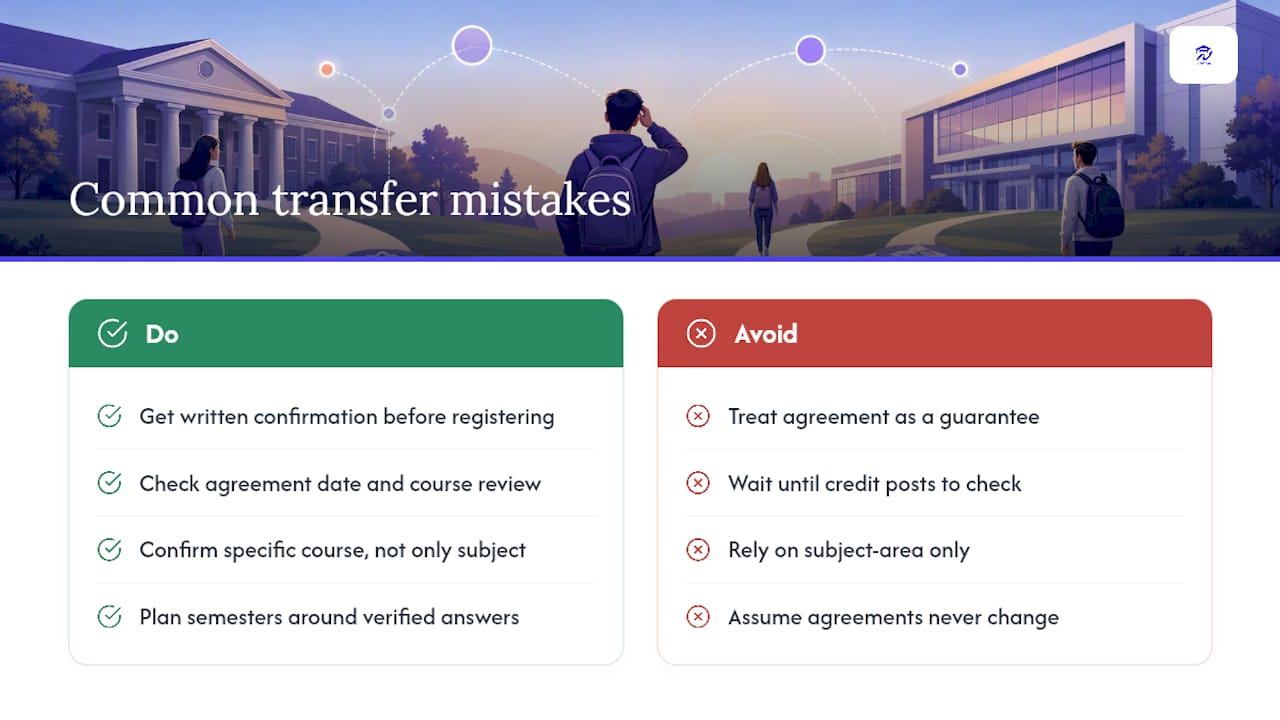
The conventional wisdom says “check if your schools have an agreement.” That’s table stakes. What actually matters is checking the date on that agreement and confirming whether your specific course, not just your subject area, was reviewed under it. A biology course that transferred cleanly for a student two catalog years ago might now be flagged for content mismatch, and nobody sends out a notice when that happens.
If you take one thing from this: request written confirmation from an advisor before you register for your next term, not after. Waiting until credit posts to find out something didn’t transfer is how a two-year plan turns into a three-year plan. Plan the semesters around the verified answer, not the hopeful one.
— Ryan
Sources
- What is an articulation agreement? | Federal Student Aid
- §1093a. Articulation agreements — U.S. Code
- Transfer credit equivalency guide | University of Utah
FAQ
What Are the Different Types of Articulation Agreements?
The main types are course-to-course, program-to-program, block transfer, and guaranteed admission agreements (TAGs), which can be either bilateral between two schools or multilateral across a whole state system.
What Is the 90/10 Rule for Colleges?
Rules about federal funding apply to for-profit institutions and revenue sources, not to credit transfer, so such rules are not a factor in whether your articulation agreement credits will count.
What Are Articulation Agreements?
An articulation agreement is a formal agreement between two schools that spells out how credits earned at one will transfer to the other.
Can You Transfer From a Four-Year College to Another Four-Year School?
Yes, four-year-to-four-year transfers happen regularly, though they typically rely on course-to-course equivalency review rather than the block or program agreements more common between community colleges and universities.
Who Makes the Final Decision on Whether My Credits Transfer?
The receiving school’s registrar completes the official transcript evaluation, but the academic department often makes the separate call on whether a credit counts toward your major or only as an elective.
Ready to see how your transfer credits could fit into an actual semester plan? Join the Univyze waitlist and get early access to a planning dashboard built to map AP credit, dual enrollment, and transfer coursework term by term, so you walk into registration with a plan instead of a guess.