

Credit hour overlap happens in two ways: a scheduling conflict, where two classes meet at the same time, or a curricular overlap, where one course gets applied to more than one degree requirement. If either sounds like your situation, the first move is the same: pull up your degree audit and talk to your advisor or registrar before you finalize enrollment.
Two things anchor how campuses handle this. Federal rules under 34 CFR define what a credit hour actually measures, and your registrar’s overlap policy decides how many shared credits your specific majors, minors, or general education plan will allow.
- Scheduling overlap: two courses meet at the same time; you usually cannot enroll in both without a formal petition.
- Curricular overlap: one course satisfies two requirements at once (say, a major and a minor); departments cap how much of this is allowed.
A single overlooked overlap involving some duplicated credits can push graduation back an entire term. That is real tuition and housing money, not a paperwork footnote.
Key Takeaways
Credit hour overlap comes in two forms, scheduling conflicts and curricular double-counting, and catching either before enrollment is cheaper than fixing it after.
| Point | Details |
|---|---|
| Two kinds of overlap | Scheduling overlap is a meeting-time conflict; curricular overlap is one course counted toward two requirements. |
| Federal baseline defines the credit hour | About one hour of class plus two hours outside work weekly over a 15-week semester, per 34 CFR. |
| Departments cap overlap | Many majors require 12 to 18 unique credits, per policies like Yale’s, separate from any overlapping coursework. |
| Duplicated credit can delay graduation | Losing three to nine credits to duplication can force an extra term, extra tuition, and possible SAP or scholarship complications. |
| Verify before you register | Check your degree audit and transfer equivalency first; a tool like Univyze helps visualize overlap risk, but always confirm with your registrar. |
Table of Contents
- What Is a Credit Hour, and Why Does the Definition Matter?
- Scheduling Overlap vs. Curricular Overlap: What’s the Difference?
- How Do Colleges Set Limits on Overlapping Credits?
- Real Examples of How Duplicate Credit Happens
- How Overlap Affects Graduation Timelines and Tuition Costs
- How to Prevent or Fix Credit Hour Overlap Before It Costs You
- Where Degree-Planning Dashboards Fit in Preventing Overlap
- Get a Clearer View of Your Degree Path With Univyze
- Sources
- FAQ
What Is a Credit Hour, and Why Does the Definition Matter?
A credit hour, in the federal sense that most U.S. colleges use for accreditation and financial aid, equals roughly one hour of classroom instruction plus a minimum of two hours of outside coursework per week, sustained across a 15-week semester (or an equivalent amount of work in a different format). That baseline comes from 34 CFR 600.2, and it is the yardstick accreditors check against when they review a program.
That definition is not just red tape. A credit hour is meant to represent actual learning and workload, not simply time spent in a seat. That is exactly why registrars resist letting one course fill two boxes on your degree audit. If double-counting were unlimited, a student could hit “120 credits” without doing 120 credits’ worth of distinct academic work, and the Department of Education’s guidance makes clear that federal aid eligibility depends on institutions holding that line for reporting purposes, even if they use other measures internally.
The definition also shifts by format. A standard 3 credit lecture course typically means about three hours of class time weekly. A lab or practicum credit often runs longer in-seat hours for the same credit value, because the workload outside class is lighter. Quarter-system schools convert credit hours differently than semester schools, which matters if you are transferring between the two.
Pro Tip: Before any advising meeting, print your school’s official credit-hour policy from the course catalog or registrar page. Bring your unofficial transcript and a list of every AP, dual-enrollment, or transfer credit you are counting. Advisors move faster when they are not hunting for your history first.
Scheduling Overlap vs. Curricular Overlap: What’s the Difference?
These two problems get lumped together under “overlap,” but they are handled by completely different offices and completely different rules.
Scheduling overlap means two courses meet at overlapping times, so you physically cannot attend both. Say Organic Chemistry meets Tuesday and Thursday from 11:00 AM to 12:15 PM, and the required Statistics lab meets Tuesday from 11:30 AM to 1:00 PM. You cannot register for both sections without an exception. Institutions strictly limit these exceptions, and enforcement generally sits with the registrar, the instructor, and sometimes the provost’s office for edge cases.
Curricular overlap, also called credit overlap or shared credits, means the same completed course counts toward two different requirements, like a course that satisfies both a Psychology major requirement and a Sociology minor elective. This is regulated by academic departments and colleges, not the registrar’s scheduling system, and it typically comes with a cap: many programs require a set number of unique, non-overlapping credits per major before overlap is allowed at all.
- Scheduling overlap is enforced by: instructors, department schedulers, the registrar, and in unusual cases the provost.
- Curricular overlap is enforced by: the academic department, the college curriculum committee, and the registrar during your final degree audit.
Knowing which kind you are dealing with tells you exactly who to email first, which saves you from bouncing between offices.
How Do Colleges Set Limits on Overlapping Credits?
Most campuses run on a two-track system: the registrar polices scheduling conflicts hard, while departments set the numeric ceilings on how much credit can double up across programs. Neither track is negotiable by default, but both have formal exception paths.
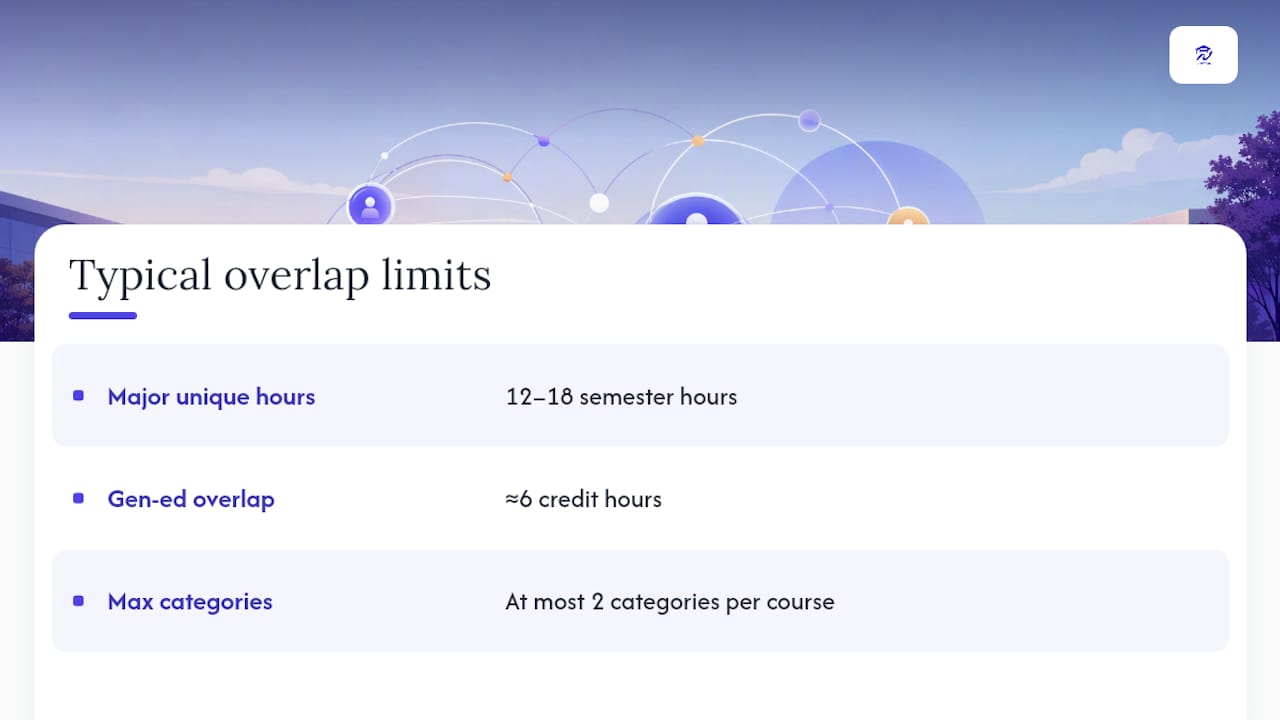
Typical numeric limits look like this. A university might require 12 to 18 unique semester hours per declared major, meaning that many credits cannot be shared with any other program on your transcript. Yale’s academic regulations illustrate this pattern well: simultaneous degrees and combined majors are capped on how many term courses can overlap, with unique-hour minimums built in specifically to prevent one thin course load from satisfying two credentials. Other schools cap general education overlap with a major or minor at around 6 credit hours, and most enforce a hard rule that a single course can count toward at most two categories, never three, according to policy language used at Ohio State’s College of Arts and Sciences.
“Overlap requests are not a courtesy exception. They require proof the student cannot otherwise complete degree requirements on schedule, plus a written plan for handling any missed material.” That is the standard WashU’s Office of the Provost applies to scheduling overlap petitions, and it reflects how most institutions treat these requests: rare, documented, and department approved.
The approval chain usually runs from your department chair or program director, up through a college curriculum committee for curricular overlap, or through the registrar and potentially a dean or provost’s office for scheduling exceptions. If you are petitioning, expect to submit: a written explanation of why the overlap is necessary, evidence you cannot graduate on time without it, and, for scheduling conflicts, a signed agreement with the instructor about how you will cover missed class time. Timelines vary by campus, but starting the conversation the semester before you need the exception gives everyone room to actually process it.
Real Examples of How Duplicate Credit Happens
Duplication rarely looks dramatic. It shows up quietly, usually when a student assumes two credit sources are additive when they are not.
- AP credit plus the equivalent college course: you earn AP credit for Calculus I, then enroll in Calculus I anyway because an advisor didn’t flag it. Your transcript may show both, but the audit typically only counts one.
- Transfer credit equivalency mismatches: a transfer course maps to a general elective instead of the specific requirement you expected, creating an unplanned gap, not a true overlap, but one that’s often confused with it.
- Repeating a non-repeatable course: if a course description says “Repeatable: No” and you retake it, the second attempt often replaces your grade but adds zero new credit hours toward graduation.
- Overlapping exam credit: earning credit through both AP and CLEP for the same subject area often means you only receive credit for one, per most university credit-hour policies.
On a real audit, this looks like a line item marked “duplicate, not counted” or simply a hole where you expected a requirement to be checked off.
Pro Tip: Before enrolling in anything that might overlap with existing credit, run it past your school’s transfer equivalency tool or articulation agreement, and confirm with a transcript evaluator, not just an unofficial online estimate. A five-minute check now beats a semester-late discovery.
How Overlap Affects Graduation Timelines and Tuition Costs
Unresolved overlap does one specific thing: it shrinks the number of unique credits that count toward your degree, which can force an extra semester or a summer course load you did not budget for.
The math adds up fast. If a few credits get disqualified as duplicates during your final degree audit, that is potentially an entire extra course, or an extra term, standing between you and your diploma. Beyond direct tuition, an added semester often means additional housing costs, and it can quietly threaten financial aid tied to full-time enrollment status or scholarship renewal requirements. It can also affect Satisfactory Academic Progress calculations, since SAP reviews typically weigh completed credits against attempted credits, and duplicate attempts count against you on the attempted side even when they don’t help you graduate.

For advisors, the practical checklist is short: review the degree audit for flagged duplicates every term, check whether any affected credits touch a student’s SAP status or scholarship renewal terms, estimate the real tuition impact of an extra term in dollars, and have a fallback ready, whether that’s a summer session, a course substitution, or a formal petition. Catching this in October is a five-minute fix. Catching it in April of senior year is a much more expensive one.
How to Prevent or Fix Credit Hour Overlap Before It Costs You
The single highest-value habit here is checking your degree audit and confirming transfer equivalency before you register, not after. Everything else on this list is damage control by comparison.
- Pull your degree audit and read the actual course descriptions, not just titles, to see whether a course is flagged as satisfying more than one requirement.
- Confirm transfer or exam credit equivalency in writing through your registrar’s transfer equivalency tool, especially for AP, IB, dual enrollment, or CLEP credit.
- Run a what-if scenario for any major, minor, or program change before you commit, so you can see overlap risk while it’s still theoretical.
- Check prerequisite and regression rules, particularly if you are retaking a course, since a non-repeatable flag can zero out the added credit even if your GPA improves.
- Get every exception or substitution approved in writing, from the department or registrar, before you rely on it in your graduation plan.
If you discover overlap has already happened, document exactly which courses and credits are involved, then meet with your department or registrar directly rather than emailing multiple offices at once. Ask specifically whether a course substitution or a formal petition fits your situation. Substitution generally works when a close equivalent exists; a formal petition is the route when no substitute exists and you need an exception to standard policy.
A short email like this moves things faster: “I’m seeing a possible credit overlap between [Course A] and [Course B] on my degree audit. Could you confirm whether both will count toward graduation, or whether I need a substitution or petition?” Specific course names and your student ID get you a faster answer than a vague “can we talk about my schedule” message.
For more on how scheduling conflicts specifically get resolved, see this breakdown of common schedule conflict types, and for AP and transfer credit rules in more depth, this guide on AP credit, dual enrollment, and transfer credits covers the mechanics.
Where Degree-Planning Dashboards Fit in Preventing Overlap
Visual planning dashboards help by surfacing overlap risk before you ever register, not after you’re stuck untangling it with your registrar. Univyze’s dashboard shows how a course maps against multiple requirements at once, term by term, so a double-counted class is visible instead of buried three clicks into a PDF audit.
The features that matter most for overlap specifically: term-by-term planning that lays out your whole path, transfer and AP credit import so outside credit is reflected accurately from day one, what-if scenarios for testing a major or minor change before committing, and flags when a course is doing double duty across requirements. A student weighing a Statistics minor, for instance, can run a what-if plan and immediately see that six of those credits already overlap with their Economics major, information that would otherwise surface only after a formal audit request.
Univyze is a planning tool that helps you see your options clearly. It is not an official degree audit, and it does not replace your advisor, registrar, or university catalog. Always verify final requirements through your school’s official channels.
Pro Tip: Run a what-if scenario the moment you’re even considering a second major or minor. It costs nothing and can save you a semester.
An advisor’s take on what students keep getting wrong
The mistake I see most is assuming all transfer credit “counts” simply because it appears on a transcript. It might count as elective hours and still leave the actual requirement unmet. Same goes for repeatable course flags: students assume retaking a class always adds credit, and departments quietly clarify otherwise. And too many students trust a single unofficial transcript evaluation instead of confirming with the registrar directly.
Good habits fix most of this. Review your degree audit at least once a year, start planning early if you’re considering multiple majors or minors, and get every exception in writing rather than relying on a verbal “that should be fine” from a hallway conversation.
Get a Clearer View of Your Degree Path With Univyze
Spotting overlap after the fact means damage control. Spotting it before you register means it barely costs you anything. That’s the entire point of building your plan visually instead of piecing it together from a static PDF audit and a handful of advising emails.

Univyze’s dashboard lays out your degree requirements against real course offerings, term by term, so a double-counted class or a scheduling collision shows up while you can still do something about it. What-if scenarios let you test a major change or an added minor before you commit, transfer and AP credit import keeps outside credit accurate from the start, and progress tracking gives you (and, if you choose, your parents) a clear read on where you stand. None of this replaces your official degree audit, catalog, or advisor. It’s a planning layer that makes those conversations faster and better informed. See how the full planning dashboard works or check out pricing and join the waitlist to get early access.
Sources
The rules above come from federal credit-hour regulations, sample university catalogs, and registrar policy pages, not universal law, so your campus specifics will vary.
Always check your own institution’s catalog and registrar page before assuming a rule here applies exactly as written.
Start with the federal credit-hour definition, the Department of Education’s program integrity guidance, and your own school’s registrar and catalog pages for scheduling and overlap rules specific to your programs.
- Enrollment in Courses with Overlapping Meeting Times | Office of the Provost | WashU
- Additional credit limitations | University of Iowa
- Program integrity information and guidance (ED)
FAQ
How Many Hours Is 1 Credit Hour?
One credit hour typically represents about one hour of classroom instruction plus a minimum of two hours of outside coursework each week over a 15-week semester, per the federal definition.
Does 3 Credit Hours Mean 3 Credits?
Yes, credit hours and credits are typically the same unit at most U.S. institutions; a 3 credit hour course adds 3 credits toward your degree total, assuming it isn’t flagged as duplicate or overlapping with another requirement.
Does 4 Credits Mean 4 Hours?
Not exactly. Four credits usually means roughly four hours of weekly class time plus around eight hours of outside coursework, though labs and practicums can shift that ratio since they carry more in-seat time for the same credit value.
Is 12 Credit Hours in 1 Semester Considered Full-Time?
Yes, 12 credit hours per semester is the common threshold most colleges use to define full-time enrollment, which matters for financial aid eligibility and scholarship renewal, both of which can be affected if duplicate credits push you below that line.
Can Univyze Tell Me Whether My Credits Actually Overlap?
Univyze’s dashboard can flag when a planned course appears to satisfy more than one requirement in your plan, which helps you catch potential overlap early, but it is a planning tool, not an official audit, so confirm any flagged overlap with your registrar or advisor.